Automotive engines theory & servicing Manual – PDF DOWNLOAD
Original price was: $75.95.$19.95Current price is: $19.95.
Automotive engines theory & servicing Manual – PDF DOWNLOAD
Description
Automotive engines theory & servicing Manual – PDF DOWNLOAD
FILE DETAILS:
Automotive engines theory & servicing Manual – PDF DOWNLOAD
Language : English
Pages : 696
Downloadable : Yes
File Type : PDF
Size: 25.6 MB
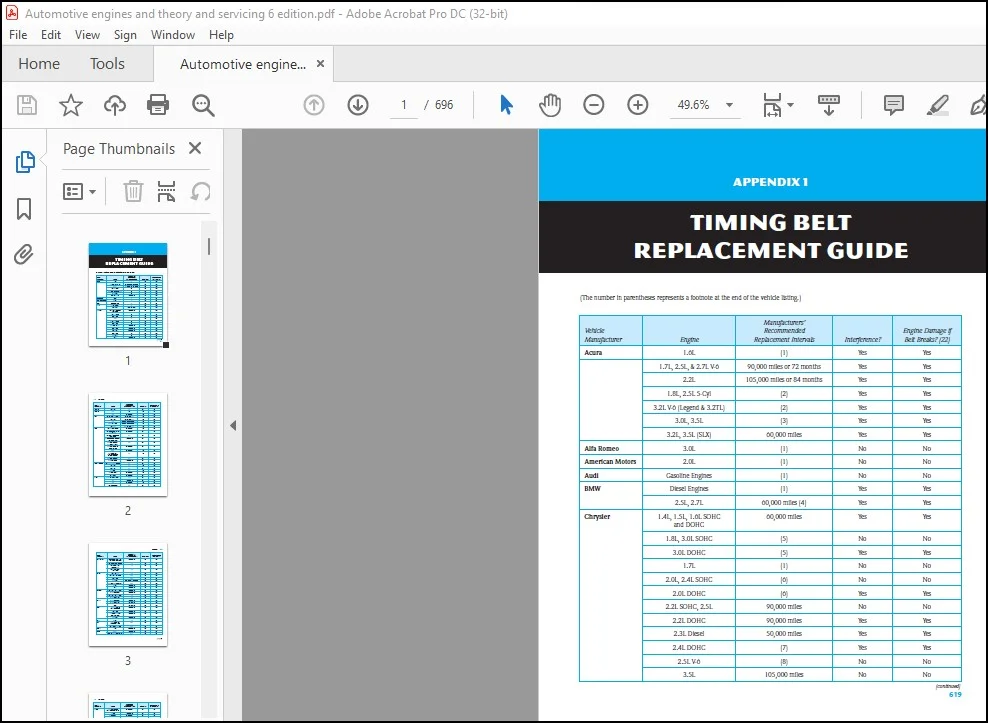
IMAGES PREVIEW OF THE MANUAL:
DESCRIPTION:
Automotive engines theory & servicing Manual – PDF DOWNLOAD
SAFETY TIPS FOR TECHNICIANS
■ When lifting any object, get a secure grip with solid footing.
Keep the load close to your body to minimize the strain. Lift
with your legs and arms, not your back.
■ Do not twist your body when carrying a load. Instead,
pivot your feet to help prevent strain on the spine.
■ Ask for help when moving or lifting heavy objects.
■ Push a heavy object rather than pull it. (This is opposite
to the way you should work with tools—never push a
wrench! If you do and a bolt or nut loosens, your entire
weight is used to propel your hand(s) forward. This usually
results in cuts, bruises, or other painful injury.)
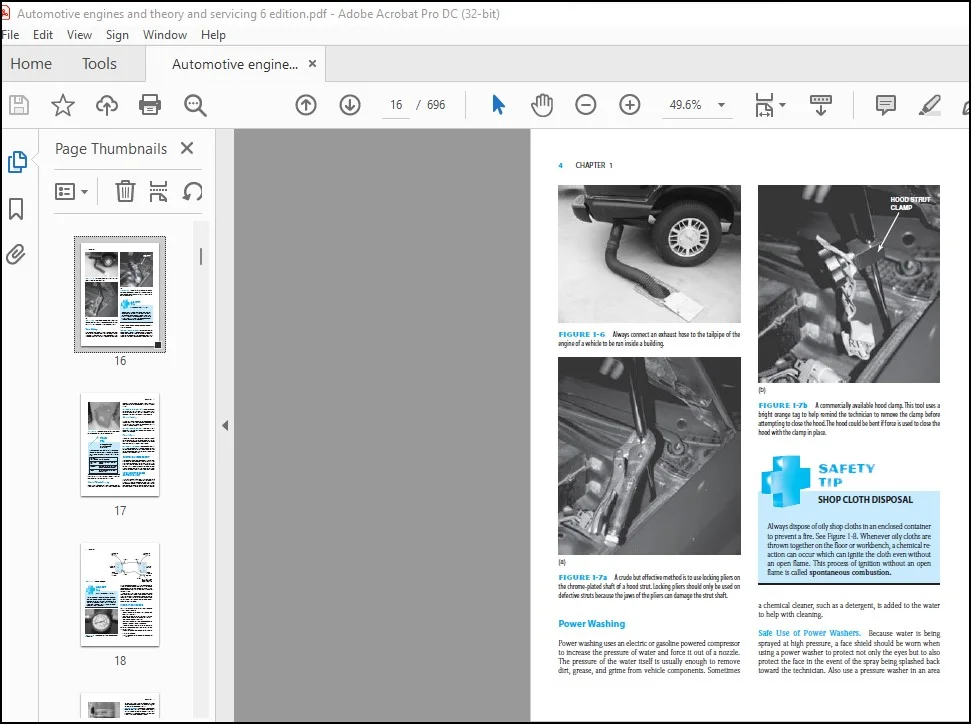
■ Always connect an exhaust hose to the tailpipe of any
running vehicle to help prevent the buildup of carbon
monoxide inside a closed garage space. See Figure 1-6.
■ When standing, keep objects, parts, and tools with which
you are working between chest height and waist height.
If seated, work at tasks that are at elbow height.
TABLE OF CONTENTS:
Automotive engines theory & servicing Manual – PDF DOWNLOAD
A. General Engine Diagnosis (17 questions)
1. Verify the driver’s complaint and/or road test the vehicle; determine necessary action. 339
2. Determine if the no-crank, no-start, or hard starting condition is an ignition system, cranking system, fuel
system, or engine mechanical problem.
340
3. Inspect the engine assembly for fuel, oil, coolant, and other leaks; determine necessary action. 340
4. Listen to engine noises; determine necessary action. 341
5. Diagnose the cause of excessive oil consumption, coolant consumption, unusual engine exhaust color, odor,
and sound; determine necessary action.
340
6. Perform engine vacuum tests; determine necessary action. 347–350
7. Perform cylinder power balance tests; determine necessary action. 343
8. Perform cylinder compression tests; determine necessary action. 342–345
9. Perform cylinder leakage tests; determine necessary action. 345–346
B. Cylinder Head and Valve Train Diagnosis and Repair (18 questions)
1. Remove cylinder heads, disassemble, clean, and prepare for inspection according to manufacturers’
procedures.
358, 381–383
2. Visually inspect cylinder heads for cracks; gasket surface areas for warpage, corrosion, and leakage; and check
passage condition.
366–367
3. Inspect and test valve springs for squareness, pressure, and free height comparison; replace as necessary. 408–410
4. Inspect valve spring retainers, rotators, locks, and valve lock grooves. 426–429
5. Replace valve stem seals. 426–429
6. Inspect valve guides for wear; check valve guide height and stem-to-guide clearance; determine needed repairs. 387–389
7. Inspect valves; resurface or replace according to manufacturers’ procedures. 412–414
8. Inspect and resurface valve seats according to manufacturers’ procedures. 413–417
9. Check valve face-to-seat contact and valve seat concentricity (runout). 413–417
10. Check valve spring installed (assembled) height and valve stem height; service valve and spring assemblies as
necessary.
424–425
Engine Repair (A1)
(continued)
626 Appendix 2
ASE Task List
Textbook
Page No.
11. Inspect pushrods, rocker arms, rocker arm pivots, and shafts for wear, bending, cracks, looseness, and blocked
oil passages; repair or replace as required.
448–451
12. Inspect and replace hydraulic or mechanical lifters/lash adjusters. 467–473
13. Adjust valves on engines with mechanical or hydraulic lifters. 473
14. Inspect and replace camshaft drives (includes checking gear wear and backlash, sprocket and chain wear,
overhead cam drive sprockets, drive belts, belt tension, tensioners, and cam sensor components).
442–446
15. Inspect and measure camshaft journals and lobes. 447
16. Inspect and measure camshaft bore for wear, damage, out-of-round, and alignment; repair or replace according
to manufacturers’ specifications.
442
17. Time camshaft(s) to crankshaft. 583–584
18. Reassemble and install cylinder heads and gaskets; replace and tighten fasteners according to manufacturers’
procedures.
581–583
C. Engine Block Diagnosis and Repair (18 questions)
1. Disassemble engine block and clean and prepare components for inspection. 358–361
2. Visually inspect engine block for cracks, corrosion, passage condition, core and gallery plug holes, and surface
warpage; determine necessary action.
366–367
3. Inspect and repair damaged threads where allowed; install core and gallery plugs. 38–40
4. Inspect and measure cylinder walls; remove cylinder wall ridges; hone and clean cylinder walls; determine
need for further action.
359
5. Visually inspect crankshaft for surface cracks and journal damage; check oil passage condition; measure journal
wear; check crankshaft sensor reluctor ring (where applicable); determine necessary action.
531
6. Inspect and measure main bearing bores and cap alignment and fit. 536–538
7. Install main bearings and crankshaft; check bearing clearances and end play; replace/retorque bolts according
to manufacturers’ procedures.
573–574
8. Inspect camshaft bearings for unusual wear; remove and replace camshaft bearings; install camshaft, timing
chain, and gears; check end play.
569–570
9. Inspect auxiliary (balance, intermediate, idler, counterbalance, or silencer) shaft(s) and support bearings for
damage and wear; determine necessary action.
547
10. Inspect, measure, service, repair, or replace pistons, piston pins, and pin bushings; identify piston and bearing
wear patterns that indicate connecting rod alignment problems; determine necessary action.
490
11. Inspect connecting rods for damage, alignment, bore condition, and pin fit; determine necessary action. 493
12. Inspect, measure, and install or replace piston rings; assemble piston and connecting rod; install piston/rod
assembly; check bearing clearance and sideplay; replace/retorque fasteners according to manufacturers’
procedures.
495
13. Inspect, reinstall, or replace crankshaft vibration damper (harmonic balancer). 530
14. Inspect crankshaft flange and flywheel mating surfaces; inspect and replace crankshaft pilot bearing/bushing
(if applicable); inspect flywheel/flexplate for cracks and wear (includes flywheel ring gear); measure flywheel
runout; determine necessary action.
15. Inspect and replace pans, covers, gaskets, and seals. 588
16. Assemble engine parts using formed-in-place (tube-applied) sealants or gaskets. 586–587
D. Lubrication and Cooling Systems Diagnosis and Repair (9 questions)
1. Perform oil pressure tests; determine necessary action. 342
2. Disassemble, inspect, measure, and repair oil pump (includes gears, rotors, housing, and pick-up assembly),
pressure relief devices, and pump drive; replace oil filter.
220
3. Perform cooling system tests; determine necessary action. 191
4. Inspect, replace, and adjust drive belts, tensioners, and pulleys. 193, 200
5. Inspect and replace engine cooling and heater system hoses. 202
6. Inspect, test, and replace thermostat, bypass, and housing. 184
7. Inspect coolant; drain, flush, and refill cooling system with recommended coolant; bleed air as required. 187
8. Inspect and replace water pump. 194
9. Inspect, test, and replace radiator, heater core, pressure cap, and coolant recovery system. 202
10. Clean, inspect, test, and replace fan (both electrical and mechanical), fan clutch, fan shroud, air dams, and
cooling related temperature sensors.
196–199
11. Inspect, test, and replace auxiliary oil coolers. 226
E. Fuel, Electrical, Ignition, and Exhaust Systems Inspection and Service (8 questions)
1. Inspect, clean, or replace fuel and air induction system components, intake manifold, and gaskets. 586
2. Inspect, service, or replace air filters, filter housings, and intake ductwork. 313–314
3. Inspect turbocharger/supercharger; determine necessary action. 332–333
4. Test battery; charge as necessary. 237
5. Remove and replace starter. 241
6. Inspect and replace positive crankcase ventilation (PCV) system components. 296–297
7. Visually inspect and reinstall primary and secondary ignition system components; time distributor. 271–272
8. Inspect, service, and replace exhaust manifold. 586
Contact us: [email protected]
https://vimeo.com/767568983
PLEASE NOTE:
- This is the SAME manual used by the dealers to troubleshoot any faults in your vehicle. This can be yours in 2 minutes after the payment is made.
- Contact us at [email protected] should you have any queries before your purchase or that you need any other service / repair / parts operators manual.
S.V