aXcent LYRAx2 Ventilator Service Manual Repair Guide Medical Equipment PDF
Original price was: $95.00.$32.95Current price is: $32.95.
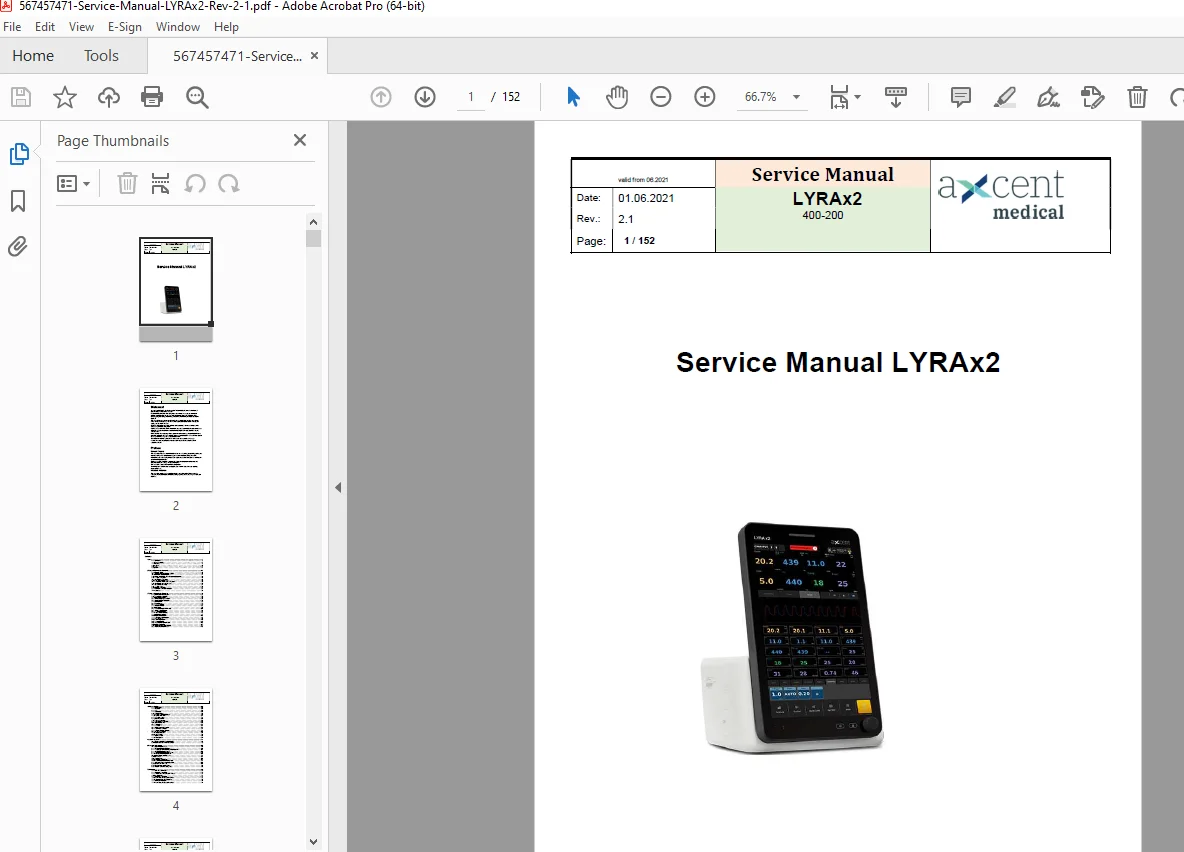
Official 152-page service manual for aXcent Medical LYRAx2 ventilator (Model 400-200). Comprehensive technical documentation covering complete maintenance procedures, troubleshooting, calibration, and repair for biomedical engineers and authorized service technicians. Includes detailed pneumatic circuits, electronic schematics, parts diagrams, preventive maintenance schedules, and performance verification tests. Essential guide for servicing this critical respiratory care equipment.
Description
aXcent LYRAx2 Ventilator Service Manual Repair Guide Medical Equipment PDF DOWNLOAD
DESCRIPTION
Professional Service Documentation for aXcent LYRAx2 Ventilator Systems
This aXcent LYRAx2 ventilator service manual is the official factory technical guide for biomedical engineers and authorized service technicians responsible for maintaining, troubleshooting, and repairing the LYRAx2 mechanical ventilator. With 152 pages of comprehensive technical documentation, this medical ventilator repair guide provides complete assembly, disassembly, testing, and troubleshooting procedures for ensuring optimal ventilator performance in critical care environments.
FILE DETAILS
| Detail | Information |
|---|---|
| Manual Name | Service Manual LYRAx2 Rev. 2.1 |
| Equipment Model | LYRAx2 (Model 400-200) |
| Manufacturer | aXcent Medical GmbH |
| Publication Date | June 2021 |
| Revision | 2.1 (valid from 06.2021) |
| Total Pages | 152 |
| PDF Quality | High-resolution factory original document |
| Language | English |
| File Size | 7.95 MB |
| Format | Searchable PDF |
COMPLETE TABLE OF CONTENTS
1. SAFETY (Pages 8-12)
- Definitions – Warning, Caution, and Note classifications
- Safety Information – Critical guidelines for service technicians
- Warning Procedures – Hazard prevention and personal safety protocols
- Caution Statements – Equipment damage prevention guidelines
- Safety Symbols – International safety symbol reference guide
2. THEORY OF OPERATION FOR PNEUMATIC SYSTEM (Pages 13-24)
- Pneumatic Circuit Overview – Complete system architecture
- Pneumatic Circuit Diagram – Detailed schematic illustrations
- Theory of Operation of Pneumatic Subsystems:
- Supply Subsystem – Gas delivery and regulation
- Nebulizing Subsystem – Medication delivery mechanisms
- Blower Box Subsystem – Turbine and air generation
- Inspiratory Fixture Seat Subsystem – Inhalation valve assembly
- Inspiratory Valve Subsystem – Flow control mechanisms
- Expiration Assembly – Exhalation valve operation
- Patient Tube – Breathing circuit connections
- Pneumatic Connection Diagrams – Complete tube routing schematics
- Tubes List – All pneumatic connections with specifications
3. THEORY OF OPERATION FOR ELECTRONIC SYSTEM (Pages 25-49)
- System Schematic Diagram – Complete electrical overview
- Hardware Block Diagram – Component interconnections
- Power Supply System:
- Power Supply System Block Diagram
- Power Supplies Distribution throughout system
- Board Function Details:
- Power Boards:
- AC-DC Module specifications and operation
- DC-DC Module voltage regulation
- Main Board Components:
- Power Management Module
- Main Control Module (microprocessor systems)
- Parameter Module (sensor interfaces)
- Vacuum Sensor Board
- Protection Module (safety circuits)
- Display Module Boards:
- Power Indicator Module
- TP-key Board (touchpad interface)
- Alarm Light Board
- Encoder Board
- Touchscreen Driver Board
- Power Boards:
- Electrical Connection Diagram – Complete wiring schematics
- Electrical Connection List – All connectors and wire assignments
4. MAINTENANCE MENU (Pages 50-57)
- Hospital Setup Configuration:
- Language selection and customization
- Unit preferences and measurement systems
- Gas Supply configuration options
- Default Settings management
- Transfer User Configuration procedures
- Export Patient Data functionality
- Nurse Call Setting integration
- System Information:
- Version Information tracking
- Configuration Information display
- Factory Maintenance Access:
- Factory Setup parameters
- Settings management
- Maintenance Information logs
- Functional Activation procedures
- Restore Factory Defaults process
- Version Information verification
- Factory Calibration procedures
- Data Monitoring capabilities
- Diagnosis Test routines
- Event Logbook access
5. SOFTWARE UPGRADE (Pages 58-59)
- USB Memory Upgrade Procedures – Step-by-step firmware updates
- Problems and Recommended Actions – Troubleshooting upgrade failures
6. PREVENTIVE MAINTENANCE (Pages 60-68)
- Equipment Maintenance Schedules:
- One-Year Replaceable Parts:
- Expiratory Valve Diaphragm Replacement procedures
- HEPA Filter Replacement instructions
- Air Inlet Dust Filter Replacement
- Fan Dust Filter Replacement
- Periodically Maintained Parts – Complete maintenance schedule
- One-Year Replaceable Parts:
- Routine Test Procedures:
- System Check protocols
- Ventilation Control Tests:
- Volume Control Ventilation Test
- Pressure Control Ventilation Test
- Sensor Zero Point Test
- Flow Sensor Accuracy Test
- Pressure Sensor Accuracy Test
7. CALIBRATION (Pages 69-81)
- Patient Flow Calibration:
- Detailed calibration procedures
- Error Codes and Corrective Actions
- O2% Calibration:
- Oxygen sensor calibration steps
- Error Codes and Corrective Actions
- O2 Proportional Valve Calibration:
- Valve adjustment procedures
- Error Codes and Corrective Actions
- Pressure and Flow Zeroing:
- Zeroing Procedures
- Error Codes and Corrective Actions
- Pressure Calibration:
- Complete pressure sensor calibration
- Error Code and Corrective Actions
8. TROUBLESHOOTING (Pages 82-107)
- Introduction to Troubleshooting – Systematic diagnostic approach
- System Check Failures – Common startup errors and solutions
- Technical Alarms – Complete alarm code reference with resolutions
- Diagnosis Test Procedures:
- Preparations for Testing
- Troubleshooting Methods:
- Sensor Zero Point Error resolution
- Sensor Sampling Line Connection Error
- O2 Proportional Valve Status Error
- PEEP Valve Status Error
- Pressure Release Valve Status Error
- Pneumatic System Failures:
- Commonly Used Devices and Tools
- Pneumatic Failures List with diagnostic procedures
- Gas Supply Subsystem Issues:
- Regulator Output Pressure inaccuracy
- Nebulizer faults and flow abnormalities
- Maximum O2 flow output problems
- Measured O2 flow fluctuations
- Maximum Output Flow troubleshooting
- O2 Concentration Inaccuracy diagnosis
- Inspiratory Valve Assembly Leakage detection
- Expiration Valve Assembly Leakage testing
- Patient Flow Test error resolution
- O2 Sensor measurement error correction
- Hardware and Electrical System Failures – Electronic troubleshooting
9. REPAIR AND DISASSEMBLY (Pages 108-122)
- Prepare for Disassembly:
- Required Tools list
- Preparations and safety precautions
- Service Parts Replacement Procedures:
- Replace the Inspiratory Valve Component
- Replace the Expiratory Valve Component
- Replace the O2 Sensor
- Replace the Air Inlet Dust Filter
- Replace the Fan Dust Filter
- Replace the HEPA Filter
- Replace the Upper Cover Component
- Replace the Display Component
- Replace the Side Cover
- Replace the Lithium Battery
- Replace the Core-Board PCBA
- Replace the Main Board PCBA
- Replace the Front Baffle
- Replace the Three-Way Valve
- Replace the Gas Capacitor Component
- Replace the Power Board
- Replace the Turbine Component
- Replace the Inspiratory Valve Seat Component
- Replace the O2 Inlet Component
- Replace the Right Panel
- Replace the Expiratory Valve Seat Component
- Replace the Speaker
- Replace the AC-DC Power Module
- Replace the Fan
- Replace the Switch
10. PERFORMANCE VERIFICATION (Pages 123-130)
- System Inspection – Post-repair verification checklist
- Power Failure Alarm Test – Battery backup verification
- O2 Pipeline Test – Gas supply system testing
- System Test – Complete functional verification
- Spontaneous Breathing Supporting Test – Patient trigger testing
- Humidifier Performance Test – Humidity system verification
- Alarm Tests (Complete Suite):
- Prepare for Alarm Test
- High Pressure Alarm Test
- High Tidal Volume Test
- Low Tidal Volume Test
- Low Minute Volume Test
- High PEEP Test
- Patient Circuit Occluded Test
- High Oxygen Test
- Low Oxygen Test
- Running on Internal Battery Test
- Battery Low Test
- Apnea Alarm Test
- Function Tests:
- Setting to Standard Working Mode
- Tidal Volume Test
- Trigger Function Test
- Special Functions Test
- Electrical Safety Test:
- Test Method specifications
- Test Form documentation
11. PARTS (Pages 131-140)
- Main Unit Assembly:
- Exploded View diagrams
- Complete Parts List with part numbers
- Display Assembly:
- Exploded View illustrations
- Parts List with ordering information
- Display Front Housing Assembly:
- Exploded View diagrams
- Parts List
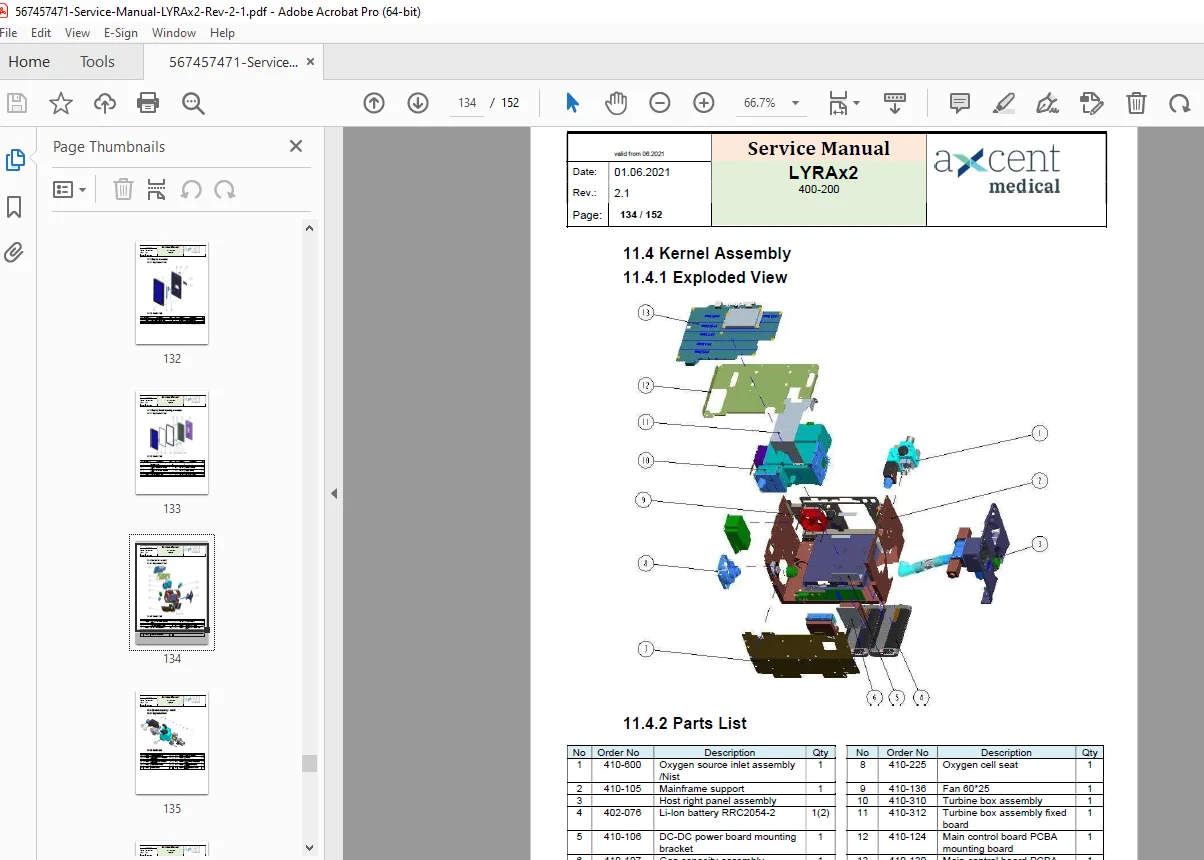
- Kernel Assembly:
- Exploded View
- Parts List
- O2 Inlet Assembly (NIST):
- Exploded View
- Parts List
- O2 Inlet Assembly (DISS):
- Exploded View
- Parts List
- Blower Box Assembly:
- Exploded View
- Parts List
- Inspiratory Valve Seat Component:
- Exploded View
- Parts List
- Inspiratory Valve Assembly:
- Exploded View
- Parts List
- Rinse Box Assembly:
- Exploded View
- Parts List
- Expiratory Valve Seat Assembly:
- Exploded View
- Parts List
- Expiratory Valve Assembly (Adult):
- Exploded View
- Parts List
- Expiratory Valve Assembly (Infant):
- Exploded View
- Parts List
APPENDIX A: PREVENTIVE MAINTENANCE REPORT (Pages 141-145)
- Check before Preventive Maintenance – Pre-service inspection checklist
- Preventive Maintenance procedures – Complete maintenance protocol
- Test after Preventive Maintenance – Post-service verification
APPENDIX B: REPLACEMENT PARTS LIST (Page 146+)
- Complete catalog of replacement parts with part numbers
- Ordering information for consumables and components
WHO NEEDS THIS AXCENT LYRA X2 SERVICE MANUAL?
✓ Biomedical Equipment Technicians (BMETs) – Service and repair ventilators in hospital and critical care settings
✓ Clinical Engineering Departments – Maintain respiratory care equipment and ensure regulatory compliance
✓ Independent Medical Equipment Service Companies – Provide authorized service for aXcent ventilators
✓ Respiratory Therapy Departments – Understand equipment operation for better patient care coordination
✓ Hospital Maintenance Staff – Perform routine preventive maintenance and minor repairs
✓ Medical Equipment Training Centers – Teach ventilator service and repair procedures
✓ ICU and Emergency Department Engineers – Support critical life-support equipment
KEY BENEFITS OF THIS MEDICAL VENTILATOR REPAIR GUIDE
Official Factory Documentation – Authentic aXcent Medical technical manual with manufacturer-approved procedures, not third-party interpretations or reverse-engineered guides.
Complete System Coverage – All LYRAx2 subsystems covered: pneumatic circuits, electronic systems, sensors, valves, power supplies, and control boards.
Reduce Service Costs – Perform more repairs in-house with detailed step-by-step procedures, reducing dependence on expensive third-party service contracts.
Minimize Critical Downtime – Quick diagnostic procedures and comprehensive troubleshooting flowcharts help restore ventilators to service rapidly in life-critical situations.
Safety Compliance – Follow manufacturer-approved safety protocols essential for working with life-support respiratory equipment.
Accurate Parts Identification – Exploded view diagrams with official part numbers ensure ordering correct replacement components every time.
Comprehensive Calibration Procedures – Maintain factory-specified accuracy for flow, pressure, and oxygen sensors critical to patient safety.
Performance Verification – Complete post-repair testing protocols ensure equipment meets manufacturer specifications before returning to clinical use.
LYRA X2 VENTILATOR TECHNOLOGY
The aXcent Medical LYRAx2 represents advanced mechanical ventilation technology for critical care, emergency, and transport applications. This turbine-driven ventilator provides both invasive and non-invasive ventilation modes with precise control of tidal volume, pressure, flow, and oxygen concentration. The system’s sophisticated pneumatic design and electronic control architecture ensure reliable performance in demanding clinical environments where patient lives depend on consistent ventilator operation.
This LYRAx2 technical documentation covers the complete system including turbine/blower assemblies, proportional valve controls, flow and pressure sensors, oxygen monitoring, alarm systems, and battery backup capabilities that make this ventilator essential in modern respiratory care.
TECHNICAL SPECIFICATIONS COVERED
The manual provides complete technical data including:
- Pneumatic system pressures and flow rates
- Electrical specifications and power requirements
- Sensor accuracy ranges and calibration tolerances
- Alarm threshold specifications
- Environmental operating conditions
- Battery performance specifications
- Ventilation mode parameters
- Gas consumption rates
MAINTENANCE AND CALIBRATION FOCUS
This service manual emphasizes preventive maintenance to maximize ventilator uptime and reliability. Detailed maintenance schedules cover:
- Daily, weekly, and monthly inspection routines
- Annual replacement components and procedures
- Calibration intervals and verification methods
- Filter replacement schedules (HEPA, dust, air inlet)
- Valve diaphragm maintenance
- Sensor verification and adjustment
- Software update procedures
COMPREHENSIVE TROUBLESHOOTING APPROACH
The troubleshooting section provides systematic diagnostic procedures for:
- System check failures during power-on diagnostics
- Technical alarm code interpretation (complete reference)
- Pneumatic system leakage detection
- Flow and pressure measurement errors
- Oxygen concentration inaccuracies
- Valve operation failures
- Electronic control system faults
- Power supply issues
- Display and interface problems
Each troubleshooting procedure includes:
- Symptom description
- Probable causes
- Diagnostic test procedures
- Required tools and test equipment
- Step-by-step corrective actions
- Verification procedures
REPAIR PROCEDURES WITH EXPLODED VIEWS
The disassembly and repair section provides detailed procedures for replacing over 25 major components, each with:
- Exploded view diagrams showing component relationships
- Step-by-step removal procedures
- Installation and reassembly instructions
- Torque specifications where applicable
- Post-installation verification steps
- Official part numbers for ordering
INTENDED AUDIENCE
This manual is specifically designed for biomedical engineers, authorized service technicians, and clinical engineering professionals responsible for maintaining life-support respiratory equipment. The documentation assumes technical knowledge of:
- Medical device safety standards
- Pneumatic systems and gas flow principles
- Electronic circuits and control systems
- Sensor technology and calibration
- Ventilator operation and clinical applications
DOCUMENT AUTHENTICITY & COPYRIGHT
This is the original factory service manual produced by aXcent Medical GmbH, not a reproduction, aftermarket guide, or operator’s manual. The PDF maintains original document formatting, technical diagrams, schematics, and exploded views from the manufacturer. All 152 pages are fully searchable with proper bookmarking for quick navigation to specific procedures.
The manual carries aXcent Medical’s intellectual property statement and copyright protection, ensuring technical accuracy and compliance with equipment manufacturer standards. Revision 2.1 represents the most current service information available as of June 2021.
SAFETY AND LIABILITY
The manual includes comprehensive safety warnings and cautions specific to servicing respiratory equipment:
- Personal safety protocols for service technicians
- Patient safety considerations during maintenance
- Electrical safety requirements
- Pneumatic system safety procedures
- Proper use of test equipment
- Post-repair verification requirements
As stated in the manual: “The equipment must be operated and serviced by trained professionals only.”
INSTANT DIGITAL DELIVERY
Upon purchase, you receive immediate download access to this complete LYRAx2 service manual in PDF format. No shipping delays, no waiting for physical delivery. Compatible with all devices – computers, tablets, and smartphones for use in the workshop or at the patient bedside. Print specific sections for your service kit or maintain the entire searchable manual on your mobile device.
⚕️ When ventilator downtime in critical care isn’t an option, having the official factory service manual can mean the difference between rapid repair and extended equipment outages. Equip your biomedical engineering team with the professional-grade technical documentation trusted by aXcent-authorized service centers worldwide. Download instantly and restore life-support equipment to service faster!
Market Analysis:
- Medical ventilator service manuals: $39.99 – $89.99
- Critical care equipment documentation: $44.99 – $99.99
- Life-support system technical guides: $49.99 – $129.99
- Respiratory equipment service manuals: $42.99 – $95.99
Value Justification:
- Life-Critical Equipment – Ventilators are essential life-support systems ($25,000-$45,000 value) requiring expert maintenance
- Professional Healthcare Market – Biomedical engineers and clinical engineering departments require certified manufacturer documentation
- Service Cost Savings – One prevented service call ($300-$800) or avoided equipment replacement pays for manual many times over
- 152 Pages of Technical Content – Comprehensive coverage with detailed schematics, exploded views, and step-by-step procedures
- Factory Original – Authentic aXcent Medical documentation commands premium pricing in medical equipment service market
- Critical Care Application – Ventilator downtime in ICU/emergency settings creates urgent need for rapid repair capabilities
- Specialized Market – Limited availability of aXcent LYRAx2-specific service documentation
- Regulatory Compliance – Helps meet hospital accreditation and regulatory requirements for manufacturer-approved service procedures
Competitive Positioning:
At $44.99, this pricing reflects the critical nature of life-support equipment documentation while remaining accessible to hospital biomedical engineering departments and independent medical equipment service providers. The price point acknowledges the professional healthcare audience and the high-value equipment being serviced.
Alternative Pricing Options:
- Standard Price: $44.99 (recommended)
- Premium Price: $49.99 (if positioning as comprehensive critical care equipment guide)
- Professional/Enterprise Price: $54.99 (for bundling with additional service resources)
- Promotional Price: $39.99 (introductory launch pricing for new product listing)
Market Justification:
- Hospital biomedical departments have equipment service budgets that accommodate professional technical documentation
- Independent service providers can bill documentation costs to service contracts
- Preventing ventilator downtime in critical care justifies premium pricing
- Official manufacturer documentation is required for warranty compliance and accreditation
- Limited competition for model-specific aXcent LYRAx2 service documentation