Class Tractor NECTIS 227 237 247 257 267 Operator’s Manual – PDF DOWNLOAD
Original price was: $78.00.$23.95Current price is: $23.95.
Class Tractor NECTIS 227 237 247 257 267 Operator’s Manual – PDF DOWNLOAD
Description
Class Tractor NECTIS 227 237 247 257 267 Operator’s Manual – PDF DOWNLOAD
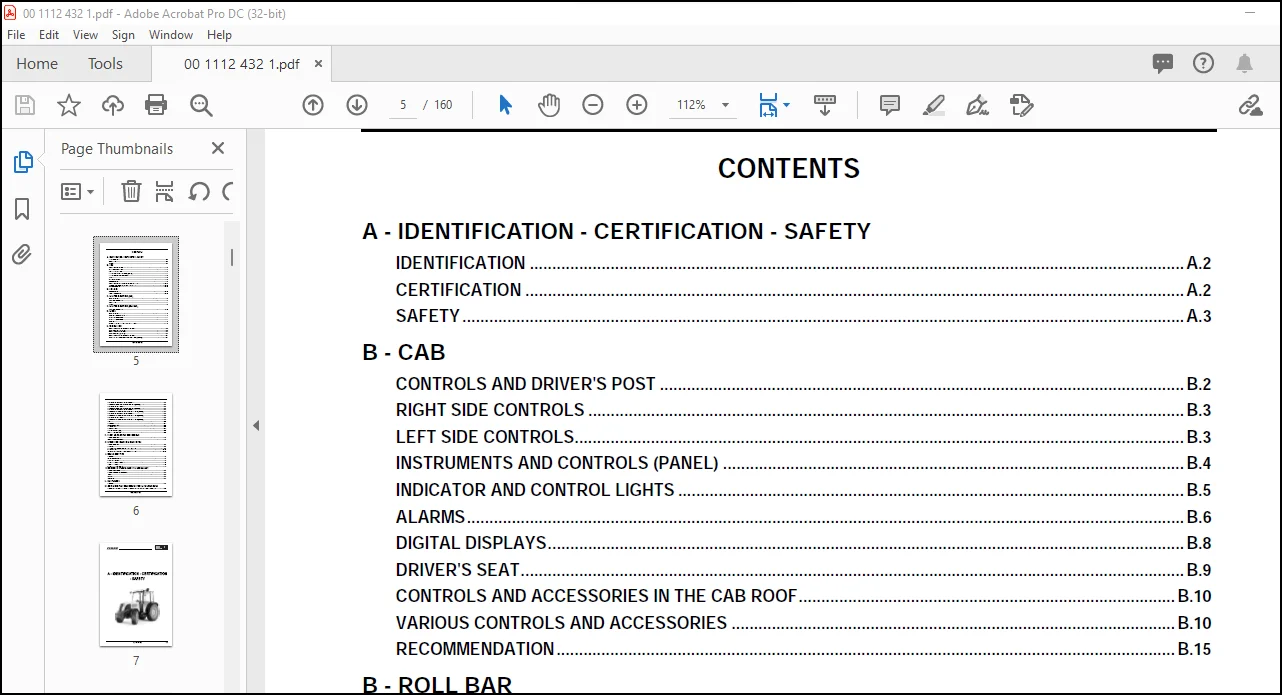
PICTURES PREVIEW OF THE MANUAL:
DESCRIPTION:
Class Tractor NECTIS 227 237 247 257 267 Operator’s Manual – PDF DOWNLOAD
For your safety
Before using the tractor for the first time, read the user’s
manual and observe the general safety instructions!
WARNING TRIANGLE
In this user’s manual, this sign indicates all the
paragraphs concerning safety aspects. Pass on these safety
instructions to all other users.
The instruction and warning plates affixed to the tractor give
important information about possible risks of use. Respect for
these instructions is a guarantee of your safety!
Appropriate use
This tractor has been designed to be used exclusively for
normal agricultural work (appropriate use).
Any use other than that defined above will be considered as
inappropriate and will release the manufacturer from any
liability in the event of damage or injury; the user alone will
bear the risks resulting from such misuse.
Appropriate use also supposes the observance of the
operating, maintenance and repair regulations laid down by
the manufacturer.
The tractor must be used, maintained and repaired only by
persons with a thorough knowledge of the vehicle and aware
of the possible risks.
Specific accident prevention instructions must be observed
as well as general rules concerning technical safety, health
and safety regulations and the highway code.
The manufacturer declines all responsibility for any damage
resulting from any modification made to the tractor without
their approval.
TABLE OF CONTENTS:
Class Tractor NECTIS 227 237 247 257 267 Operator’s Manual – PDF DOWNLOAD
For your safety 1
Warning triangle 1
Appropriate use 1
Chapter symbols 3
Notes 4
A – IDENTIFICATION – CERTIFICATION – SAFETY 5
IDENTIFICATION A2 5
Certification A2 5
SAFETY A3 5
B – CAB 5
Controls and driver’s post B2 5
Right side controls B3 5
Left side controls B3 5
INSTRUMENTS AND CONTROLS (panel) B4 5
Indicator and control lights B5 5
ALARMS B6 5
DIGITAL DISPLAYS B8 5
DRIVER’S SEAT B9 5
Controls and accessories in the cab roof B10 5
Various controls and accessories B10 5
Recommendation B15 5
B – Roll bar 5
DRIVER’S SEAT B17 5
Folding roll bar B18 5
C – Electrical services (cab) 5
CHARACTERISTICS C2 5
Lighting – indicators C3 5
CONTROLS C4 5
Fuses C6 5
C – Electrical services (roll bar) 5
Lighting – indicators C12 5
D – ENGINE 5
CHARACTERISTICS D2 5
Operations before start D3 5
STARTING THE ENGINE D4 5
STOPPING THE ENGINE D4 5
OPERATION D5 5
Bleeding air from the injection system D8 5
E – Transmission 5
NECTIS 227-237 VE, 227-237-247 VL, 227-247 F E2 5
GEAR BOX – 12/12 (30 km/h) E2 5
NECTIS 257-267 VL, 257-267 F E3 5
GEAR BOX – 12/12 (30 km/h) E3 5
NECTIS 227-237 VE, 227-237-247 VL, 227-247 F E4 5
Gearbox with mechanical doubler – 24/24 (30 km/h) E4 5
NECTIS 227-237 VE, 227-237-247 VL, 227-247 F E5 5
Gearbox with mechanical doubler – 24/24 (40 km/h) E5 6
NECTIS 257-267 Vl, 257-267 F E6 6
Gearbox with mechanical doubler – 24/24 (40 km/h) E6 6
NECTIS 227-237 Ve, 227-237-247 VL, 227-247 F E7 6
Gearbox with TWINSHIFT and REVERSHIFT – 24/12 (30 km/h) E7 6
NECTIS 227-237 Ve, 227-237-247 VL, 227-247 F E8 6
Gearbox with TWINSHIFT and REVERSHIFT – 24/12 (40 km/h) E8 6
NECTIS 257-267 Vl, 257-267 F E9 6
Gearbox with TWINSHIFT and REVERSHIFT – 24/12 (40 km/h) E9 6
Clutch E10 6
Gearbox E11 6
Range selection E13 6
Differential E13 6
Brake system E14 6
Power take-off (PTO) E15 6
Towing the tractor E18 6
F – Front axles – driven and undriven 6
Characteristics F2 6
Front axle engagement F5 6
G – Hydraulics – rear linkage and hitch 6
Characteristics G2 6
Rear lift G3 6
Linkage (Electronic Tracto-Control) TCE 6 G6 6
Automatic hitching G12 6
Instructions for adjusting the rear hitch G13 6
J – WHEELS AND TYRES 6
General J2 6
Inflation pressure J2 6
Tyres and tracks J4 6
Adjusting front track J12 6
STEERING STOPS J13 6
Adjusting rear track J14 6
K – Dimensions, weights, capacities and ballast 6
Dimensions cab version K2 6
Dimensions roll bar version K3 6
Weight K4 6
Ballast K6 6
Capacities K7 6
L – Maintenance 6
General L2 6
M – Operations that are mandatory under the guarantee 6
OPERATIONS MANDATORY UNDER THE TERMS OF THE CONTRACTUAL GUARANTEE M2 6
A – IDENTIFICATION – CERTIFICATION – SAFETY 7
IDENTIFICATION 8
Certification 8
SAFETY 9
FOREWORD 9
PRECAUTIONS BEFORE STARTING 9
CONDITION OF THE TRACTOR 10
ADJUSTMENT OR MAINTENANCE – REPAIRS 11
AXLE STANDS 12
HYDRAULIC SYSTEMS 12
ELECTRICAL SYSTEM 13
FUEL 13
Re-fuelling 13
Coolant 13
ROAD USE – USE FOR TRANSPORT 14
OPERATION 15
GENERAL RULE 15
WHEEL TRACK 15
ATTACHING IMPLEMENTS 15
Driving 15
STATIONARY WORK 16
USE OF TOOLS DRIVEN BY THE PTO 16
TOXIC PRODUCTS 17
IMPORTANT 17
Air conditioning 18
RECOMMENDATIONS: 18
IMPORTANT 18
SAFETY CABS 18
ENVIRONMENTAL SAFETY 18
Safety stickers with warning pictograms 19
Notes 20
Notes 0
D – ENGINE 55
CHARACTERISTICS 56
Operations before start 57
STARTING THE ENGINE 58
STOPPING THE ENGINE 58
OPERATION 59
General 59
RUNNING-IN 59
Recommendations: 59
1 – Avoid operating lightly loaded or for long periods at idle Lack of load during the first 100 hours can cause glazing of the cylinder liners This leads to excessive oil consumption and loss of power 59
2 – Avoid overloading the engine: The engine suffers overload when too high a gear ratio is used and engine speed drops to about 1 600 to 1 800 rpm, with maximum throttle applied This causes mechanical and thermal stress which is harmful dur 59
3 – Pay particular attention to fluid levels (oil and coolant) as well as engine temperature 59
Operating temperature 59
OPERATING RPM 59
Idle 59
Maximum off-load rpm 59
Specific consumption 59
Operating at intermediate power 60
Full power operation 60
FUEL 61
General 61
Quality requirement 61
Filling the tank 61
1 – Clean the area around the fuel filler cap 61
2 – Remove the filler cap (1) and put it in a clean dry place 61
3 – After refuelling, replace and tighten the filler cap 61
Handling the fuel 61
Bleeding air from the injection system 62
Notes 64
E – Transmission 65
NECTIS 227-237 VE, 227-237-247 VL, 227-247 F 66
GEAR BOX – 12/12 (30 km/h) 66
NECTIS 257-267 VL, 257-267 F 67
GEAR BOX – 12/12 (30 km/h) 67
NECTIS 227-237 VE, 227-237-247 VL, 227-247 F 68
Gearbox with mechanical doubler – 24/24 (30 km/h) 68
NECTIS 227-237 VE, 227-237-247 VL, 227-247 F 69
Gearbox with mechanical doubler – 24/24 (40 km/h) 69
NECTIS 257-267 Vl, 257-267 F 70
Gearbox with mechanical doubler – 24/24 (40 km/h) 70
NECTIS 227-237 Ve, 227-237-247 VL, 227-247 F 71
Gearbox with TWINSHIFT and REVERSHIFT – 24/12 (30 km/h) 71
The reverse speed is between the ‘tortoise’ and ‘hare’ values of the forward speed 71
NECTIS 227-237 Ve, 227-237-247 VL, 227-247 F 72
Gearbox with TWINSHIFT and REVERSHIFT – 24/12 (40 km/h) 72
The reverse speed is between the ‘tortoise’ and ‘hare’ values of the forward speed 72
NECTIS 257-267 Vl, 257-267 F 73
Gearbox with TWINSHIFT and REVERSHIFT – 24/12 (40 km/h) 73
The reverse speed is between the ‘tortoise’ and ‘hare’ values of the forward speed 73
Tables of forward speeds 74
Clutch 74
Pedal 74
Lever 74
Switch 74
Gearbox 75
Mechanical drive reverser 75
I Forward 75
II Reverse 75
Electro-hydraulic reverser (ISC) 75
I Forward 75
II Neutral 75
III Reverse 75
IV De-clutched 75
Gear selection 76
Mechanical range doubler 76
Electro-hydraulic range doubler 76
Range selection 77
I Reduced speed 77
II Slow speed [fi] 77
III Normal speed 77
N Neutral 77
Differential 77
Brake system 78
Brake pedal (1) 78
Trailer brake 78
Hydraulic braking 78
Handbrake (3) 78
To apply the hand brake: 78
To release: 78
Power take-off (PTO) 79
Power take-off with mechanical engagement 79
De-clutching 79
Hydraulically-engaged power take-off 79
Selection of the standard or proportional PTO range 80
Selection of PTO speeds 80
Hitching-up and towing PTO attachments 81
Important 81
Stationary working 82
Towing the tractor 82
F – Front axles – driven and undriven 83
Characteristics 84
Front/Rear inter-axle ratio 85
Front axle engagement 87
Version with electro-hydraulic control 87
Operating mode 87
Choice of operating mode 87
Override mode 87
Automatic mode 87
Brake system 87
Version with mechanical operation (lever) 87
Notes 88
G – Hydraulics – rear linkage and hitch 89
Characteristics 90
Hydraulic pump 90
Single pump system 90
Double pump system 90
Triple pump system 90
Fluid capacities 90
See chapter “K” 90
Hydraulic lift 90
Lift with draft and position control 90
Rear hitch 90
Models VL and F 90
Model VE 90
Rear lift 91
Position control 91
Operation 91
Force control 91
Operation 91
Adjustment 91
Implement handling at end of row 91
Position control 91
Force control 91
Implement control using force control 91
Mixed control 92
Operation 92
Adjustment 92
Implement handling at end of row 92
Floating linkage 92
Implement handling at end of row 92
Adjustment valve (A) 93
Adjustment valve (B) 93
Sensitivity 93
1 – Bottom hole: Maximum sensitivity 93
2 – Centre hole: Medium sensitivity 93
3 – Upper hole: Minimum sensitivity 93
SPECIAL CASES 93
Linkage (Electronic Tracto-Control) TCE 6 94
Control panel 94
1 – Stop position indicator light 94
2 – Linkage movement indicator light (up) 94
3 – Linkage movement indicator light (down) 94
4 – Control mode setting adjuster (force / position) 94
5 – Upper limit adjustment selector 94
6 – Setting adjustor (“mixed” or “force” position) 94
7 – Lowering speed adjustor 94
8 – Transport lock button 94
9 – 3-position memory button 94
10 – “Quick entry” button 94
Using the linkage 95
Position control 95
OPERATION 95
Force control 95
Upper limit adjustment 96
OPERATION 96
Rate of descent adjustment 96
“Rapid entry” function 97
Function of external control buttons 97
3-position memory button 98
High position 98
Stop position 98
Working position 98
Transport lock mode function 98
Motion indicator warning light 98
Linkage emergency and safety warning light 99
Regular flashing 99
Slow/rapid flashing 99
Automatic hitching100
Automatic hooks100
Coupling the implement100
Uncoupling the implement100
Maintenance100
Instructions for adjusting the rear hitch101
Influence of hitch geometry on lifting capacity101
A – Top link (upper link attachment point with respect to the centre line of the wheels and the length of the link) In all cases remember that the different rod attachment positions available with the three holes offer different linkage seni101
B – Lower bars (linkage rod attachment points to the lower bars, depending on the version)101
C – Lifting rods (length of lifting rods)101
Maximum mechanical advantage101
Minimum mechanical advantage101
Adjusting the lifting rods102
Adjustment of the upper rod103
Adjustment103
Adjustment of lateral stabilisers103
Mechanical adjustment of lateral stabilisers103
Hydraulic adjustment of the lateral stabilisers103
Hydraulic adjustment of the stabilsers with lateral offset104
1 – With switch (C) in position (A), lever (D) offers the following settings:104
2 – With switch (C) in position (B), lever (D) offers the following settings:104
Vertical hydraulic strut104
Trailer towing105
Track-mounted height-adjustable tow fork105
Height-adjustable tow fork (pin attachnment)105
Oscillating tow bar (E)105
Auxiliary spool valves106
Control levers and pressure connectors106
Combinations of auxiliary spool valves107
Single pump system107
Double pump system107
Triple pump system107
Single pump system107
Double pump system107
Triple pump system107
Adjustment of flow regulator108
Dual acting/single acting conversion108
Free return108
J – WHEELS AND TYRES109
General110
REPLACEMENT OF TYRES, USE OF DIFFERENT TYPES OF TYRE110
Special case of tractors with four wheel drive110
Front/Rear inter-axle ratio110
Inflation pressure110
Operating on soft ground (to improve grip)110
Operating on hard ground (on the road, towing, etc)110
Tyres and tracks112
The front track is the distance at ground level between the centres of the front tyres The rear track is the distance between the centres of the rear tyres at ground level112
Tyre combinations112
Nectis VE112
Nectis VL113
Nectis F113
Tables of front tracks (2 wheel drive) Nectis VE, VL & F114
Tables of front tracks (4 wheel drive)115
Nectis VE & VL (with narrow front axle)115
Nectis 227 VL – 237 VL – 247 VL115
Tables of front tracks (4 wheel drive)116
Nectis 257-267 VL116
Nectis 227-247 F116
Tables of front tracks (4 wheel drive)117
Nectis 247-257-267 F117
Tables of rear tracks118
Nectis VE118
Nectis VL118
Tables of rear tracks119
Nectis F119
Adjusting front track120
Front axle (2 wheel drive)120
Driven front axle120
Method120
STEERING STOPS121
Check121
Adjustment121
Adjusting rear track122
K – Dimensions, weights, capacities and ballast123
Dimensions cab version124
Dimensions roll bar version125
Weight126
Total permissable laden weight127
Ballast128
When they leave the production line, tractors are ballasted to behave normally in most operating situations128
Capacities129
The following table gives lubricant and fluid quantities required in each component129
Only use recommended lubricants and fluids129
When topping up, the oil or fluid category must not be changed129
Regular oil changes are essential129
L – Maintenance131
General132
Advice132
General cleaning132
High-pressure cleaning systems132
ROUTINE MAINTENANCE132
Touching up paintwork132
Welding132
FAILURES OR MALFUNCTIONS132
Decrease in fluid level132
Quantity and type of oil132
Grease quality132
Cab air filter: Cleaning134
Windscreen washer fluid level: Check134
Diesel fuel strainer: Replace135
Wheel drive mechanical clutch clearance: Check135
Engine oil level: Check136
Elimination of water in the fuel: Cleaning136
Coolant level: Check136
Service brake fluid level: Check136
Hydraulic fluid level: Check137
Important: – The fluid level must never fall below the lower mark (III) – If using hydraulic implements that require a large quantity of fluid in their power supply system (hydraulic motors, large capacity cylinders), top the fluid up to the137
Transmission oil cooler: Cleaning137
Air conditioning compressor: Lubricating the compressor138
Radiator grills: Cleaning138
Front axle swing bearings (4 wheel drive): Lubrication139
Rear lift: Lubrication140
Front axle final drive oil level: Check141
Front axle differential unit oil level: Check141
Front driven axle king pins: Lubrication142
Front axle steering actuator: Lubrication142
Clean the grease nipples (C) and grease142
Wheel disc and rim nuts: Check142
Tyre inflation pressure: Check143
Front weight attachment bolts: Check143
Cab air filter: Replacement143
Battery terminals: Cleaning – greasing143
Engine oil: Replace144
Engine oil filter cartridge: Replace144
Diesel fuel filter cartridges144
3 cylinder model144
4 cylinder model144
Alternator and water pump drive belt145
Check145
Replace145
Compressor drive belt: Check146
Third hydraulic pump drive belt: Check146
Front axle king pins: Lubrication147
Front axle swing hinge pin: Lubrication147
Front axle final drive oil: Replace147
Hydraulic/transmission system filter cartridges:148
Replacing the high pressure filter148
Electro-hydraulic reverser filter148
Bleeding air from the circuit148
PTO clutch mechanical control: Check148
Foot brake clearance: Check149
Hydraulic system accumulator (version with reverser under torque): Check149
safety patch solenoid valve (version with reverser under torque): Check149
Front axle differential casing oil: Replace150
Hydraulic/transmission oil: Replace151
Hydraulic strainer: Replace152
Hand brake clearance: Check152
Front axle breather: Replace152
Engine air filter: Replace153
Brake system fluid: Replace154
Diesel fuel strainer: Replace154
Engine maintenance154
Hydraulic system accumulator154
Air conditioning dehumidifier: Replace154
MAINTENANCE RECORD155
Operations to be carried out every 500 h155
Operations to be carried out every 1 000 h156
Operations to be carried out every 2 000 h156
M – Operations that are mandatory under the guarantee157
OPERATIONS MANDATORY UNDER THE TERMS OF THE CONTRACTUAL GUARANTEE158
Pre-delivery inspection – Handing over to the customer158
à) Pre-delivery inspection158
Your CLAAS agent is responsible for preparing your tractor before delivery:158
He must stamp and sign it after checking and confirming the service handbook inspections158
If you wish, he can also install any certified equipment or after-sales options (air-conditioning, front power take-off and linkage, radio, etc)158
b) Handing over to the customer158
Your supplier must provide you with the use and servicing handbook on delivery He must explain this document and carry out a test, with you, in the field in order to familiarise you with your new tractor, and to answer all your questions158
The “Acknowledgement of receipt”, “Pre-delivery inspection” and “Delivery to the customer” sheets (to be found in the service handbook) must be filled in and signed by the technician responsible for the handover, and signed by the user158
On of the copies of the acknowledgement of receipt remains in the service handbook which is given to the user The other copies are intended for CLAAS158
MANDATORY ROUTINE MAINTENANCE158
ENGINE159
HYDRAULIC SYSTEM159
HYDROSTATIC STEERING159
FRONT DRIVE TRAIN – FRONT AXLE159
TRANSMISSION – LINKAGE159
WHEELS AND TYRES159
ELECTRICAL SYSTEM159
Battery:159
Instrument panel:159
Lights:159
Heating, ventilation, cooling:159
Fuses:159
ENGINE160
HYDRAULIC SYSTEM160
HYDROSTATIC STEERING160
FRONT DRIVE TRAIN – FRONT AXLE160
TRANSMISSION – LINKAGE160
WHEELS AND TYRES160
ELECTRICAL SYSTEM160
Battery:160
Instrument panel:160
Lights:160
Heating, ventilation, cooling160
Fuses:160
B_GBpdf 0
B – CAB 21
Controls and driver’s post 22
Installation A: Installation with electro-hydraulic doubler and on-torque reverser (ISC) 22
Installation B: Installation with mechanical doubler and mechanical reverser 22
1 – PTO clutch lever (hydraulic engagement version ) 22
2 – Clutch pedal 22
3 – Dog-clutch engagement lever for standard or proportional PTO 22
4 – Electro-hydraulic reverse selector lever 22
5 – Height-adjustable steering wheel 22
6 – Instrument panel 22
7 – Multifunction control (direction indicators, lighting and horn) 22
8 – Main switch (key operated) 22
9 – Brake pedals 22
10 – Gear lever and hydraulic doubler control 22
11 – Accelerator pedal 22
12 – Driver’s seat 22
13 – Range lever 22
14 – Auxiliary spool valves contol lever 22
15 – Mechanical drive reverser lever 22
16 – Mechanical doubler control lever 22
17 – Gear lever 22
Right side controls 23
Installation A: Installation with electronic linkage Installation B: Installation with mechanical linkage 23
1 – Control lever for 2nd auxiliary spool valve 23
2 – Manual accelerator lever 23
3 – Electronic linkage unit 23
4 – Hydraulic lift rod control lever 23
5 – Control lever for linkage arm sweep spool valve 23
6 – Selector button for linkage arm sweep or central position 23
7 – Position control lever 23
8 – Force control lever 23
Left side controls 23
1 – PTO clutch lever (mechanical engagement version)* 23
2 – 4 wheel drive dog clutch lever (mechanical engagement version)* 23
INSTRUMENTS AND CONTROLS (panel) 24
1 – Unused location 24
2 – Rotating light control button (roll bar) 24
3 – Emergency alarm button 24
4 – Instrument panel 24
5 – Unused location 24
6 – Front axle engage button 24
7 – Differential lock engage button 24
8 – On-board computer button 24
9 – Multifunction control (direction indicators, lighting and horn) 24
10 – Main switch (key operated) 24
Indicator and control lights 25
1 – Fuel low level warning light 25
2 – Main beam indicator 25
3 – Direction indicators 2nd trailor 25
4 – 1st trailer direction indicators repeater 25
5 – Tractor direction indicators repeater 25
6 – Rear power take-off indicator 25
7 – Front power take-off indicator 25
8 – Brake fluid level warning light 25
9 – Hand brake warning light 25
10 – Battery charge warning light 25
11 – Emergency stop light 25
12 – Engine oil pressure warning light 25
13 – “Hydraulic doubler” oil pressure warning light 25
14 – Transmission oil temperature warning light 25
15 – Blocked dry type air filter warning light 25
16 – Preheat indicator (option) 25
17 – Not used 25
18 – Transmission computer defect warning 25
19 – Hydraulic doubler warning (reduced speed) 25
20 – Front axle engagement indicator light 25
21 – Engine coolant temperature warning light 25
22 – Differential lock indicator 25
23 – Fuel collector tank low-level warning light 25
A – Fuel gauge 25
B – Engine tachometer 25
C – Engine coolant temperature gauge 25
D – Theoretical forward speed indicator in km/h or mph 25
E – Display: 25
ALARMS 26
RED “PRIMARY ALARM” LIGHTS 26
Emergency stop light 26
Battery charge warning light* 26
Engine oil pressure warning light* 26
Engine coolant temperature warning light* 26
1 – Clean the radiator and radiator cover grills 26
2 – Check that the water pump belt is not stretched or broken 26
3 – Check the coolant level 26
Hydraulic circuit (doubler) oil pressure warning light* 26
Transmission oil temperature warning light* 26
Hand brake warning light* 26
ORANGE “CAUTION” LIGHTS 27
Preheat indicator (option) 27
Blocked dry type air filter warning light 27
Fuel low level warning light 27
Transmission computer defect light 27
DIGITAL DISPLAYS 28
Digital display d 28
Digital display e 28
Zeroing the trip hour meter 28
Setting the digital clock 28
DRIVER’S SEAT 29
Pneumatic seat (A) 29
1 – Vertical suspension (stiffness adjustment) 29
2 – Longitudinal positions 29
Comfort seat (B) 29
3 – Longitudinal adjustment 29
4 – Suspension adjustment 29
5 – User weight adjustment 29
Safety belts (C) 29
Controls and accessories in the cab roof 30
RIGHT-HAND SIDE 30
1 – Rotating light switch 30
2 – Location for car radio 30
3 – Loudspeaker 30
4 – Front working lights switch 30
5 – Rear working lights switch 30
6 – Overhead light 30
7 – Windscreen wiper switch 30
8 – Rear window wiper switch 30
Radio 30
Equipment provision 30
Various controls and accessories 30
Natural ventilation 30
Rear opening window (A) 30
Opening 30
Closure 30
Opening windscreen (A) 31
Opening 31
Closure 31
Adjustable steering column 31
Outside rear view mirrors 32
Adjustment 32
Adjustment 32
Interior rear view mirror 32
Sun blind 33
Operation 33
Toolbox 33
Heating – ventilation – cooling system 34
1 – Adjusting forced ventilation 34
2 – Turning on the air conditioning 34
3 – Adjusting the air temperature 34
Adjusting forced ventilation 34
Adjusting the air temperature 34
Air conditioning 34
Cable aperture (1) 35
Recommendation 35
Cleaning 35
Notes 36
B – Roll bar 37
DRIVER’S SEAT 38
Waterproof seat 38
1 – Longitudinal adjustment 38
2 – Suspension adjustment 38
3 – User weight adjustment 38
Rear view mirrors 38
Adjustment 38
Toolbox 38
Folding roll bar 39
Notes 40
C_GBpdf 0
C – Electrical services (cab) 41
Characteristics 42
Lights 42
Towing socket 42
Trailer/implement light socket (A) 42
1 – Left direction indicators 42
2 – Available 42
3 – Earth 42
4 – Right direction indicators 42
5 – Right side lights + number plate light 42
6 – Brake light 42
7 – Left side lights 42
Electric cabinet power socket (B) 42
Lighting – indicators 43
At the front 43
1 – Main beam lights 43
2 – Dipped headlights 43
3 – Side indicator repeaters: 43
4 – Working lights 43
At the rear 43
5 – Rotating beacon 43
6 – Side indicator repeaters: 43
7 – Number plate light 43
8 – Working lights 43
9 – Reflectors 43
Controls 44
Direction indicators 44
Horn (III) 44
Headlights 44
To flash headlights 44
Rotating beacon 45
Hazard warning lights 45
Working lights 45
Windscreen wiper 45
Screen washer 45
Overhead light (D) 46
Key operated ignition 46
Position of the ignition 46
Fuses 46
Allocation of fuses 46
Removable fuse 46
1 – The removable fuse (tractor section) is located near the alternator 46
2 – The removable fuse (cab section) is located near the battery compartment 46
3 – The starter relay is located near the alternator 46
Fuse and relays – electronic linkage 46
Fuse box 47
In version with ISC transmission, tractors can be equipped with fuse box (A) or fuse box (B) 47
Version with ISC transmission : Fuse box (A) 47
The fuse box (A) is located under the left panel of the instrument panel 47
The fuse box (B) is located under the left panel of the instrument panel 48
Fuse box (cab) 49
Version with mechanical transmission 49
Relay 49
Fuse box 50
Relay 50
C – Electrical services (roll bar) 51
Lighting – indicators 52
1 – Rotating beacon 52
2 – Working lights 52
3 – Side indicator repeaters: 52
Side indicator repeaters 53
Working light 53
Notes 54
PLEASE NOTE:
- This is the same manual used by DEALER to MAINTAIN your vehicle.
- The manual can be all yours – Once payment is completed you will be redirected to the download page where you can download the manual. All in 2-5 minutes!!
- Need more service/repair/parts manuals, please contact heydownloadss @gmail.com. We might surprise you with a nice offer
s.m