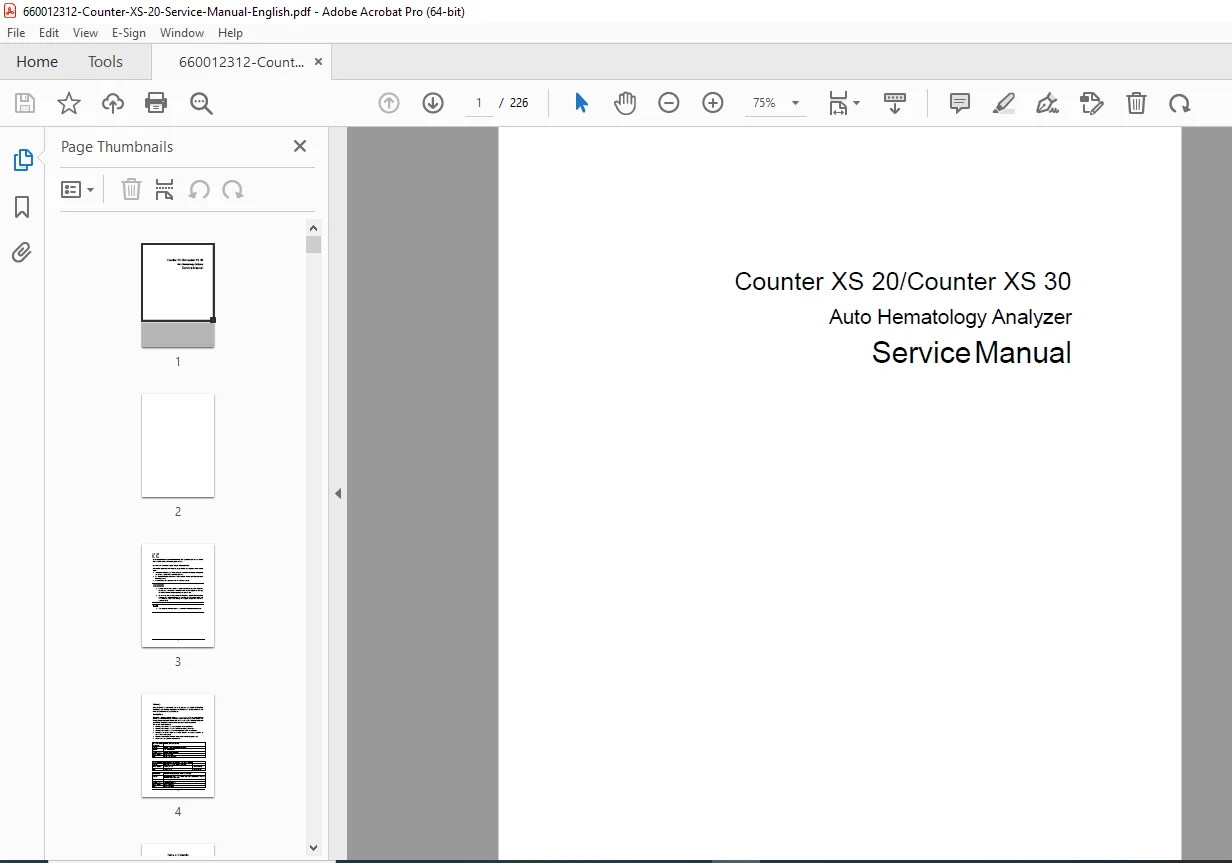
Counter XS-20 XS-30 Auto Hematology Analyzer Service Manual PDF
Original price was: $95.00.$30.95Current price is: $30.95.
Official service manual for the Counter XS-20 and Counter XS-30 Auto Hematology Analyzers. Complete 226-page technical documentation covering CBC testing parameters, impedance measurement principles, WBC/RBC/PLT detection systems, fluidic circuits, hardware diagnostics, mechanical disassembly, calibration procedures, troubleshooting protocols, and preventive maintenance. Essential service manual for biomedical engineers, clinical laboratory technicians, and authorized hematology analyzer service personnel.
Description
Counter XS-20 XS-30 Auto Hematology Analyzer Service Manual PDF – DOWNLOAD
DESCRIPTION
Counter XS-20/XS-30 Auto Hematology Analyzer – Official Factory Service Manual
This is the complete, official factory service manual for the Counter XS-20 and Counter XS-30 Auto Hematology Analyzers. With 226 comprehensive pages of detailed technical information, this manual provides everything needed for professional maintenance, calibration, repair, and troubleshooting of these automated complete blood count (CBC) analyzers used in clinical laboratories worldwide.
FILE DETAILS
- Equipment Covered:
- Counter XS-20 Auto Hematology Analyzer
- Counter XS-30 Auto Hematology Analyzer
- Document Date: September 2017
- Manufacturer: Shenzhen Mindray Bio-Medical Electronics Co., Ltd.
- Licensed to: Wiener Laboratorios S.A.I.C.
- PDF Quality: High-quality optimized professional documentation
- Total Pages: 226 Pages
- File Size: 6.4 MB
- Format: A4 size
- Language: English
ANALYZER SPECIFICATIONS
Physical Specifications:
- Counter XS-20:
- Dimensions: 295mm (W) × 407mm (D) × 398mm (H)
- Weight: 20 kg
- Counter XS-30:
- Dimensions: 295mm (W) × 398mm (D) × 398mm (H)
- Weight: 20 kg
Electrical Specifications:
- Input Voltage: 100-240V AC ±10%
- Input Power: ≤180 VA
- Frequency: 50/60 ±1 Hz
- Fuse: 250V 3.15A D5×20
Environmental Requirements:
- Operating Environment:
- Temperature: 15°C ~ 30°C
- Relative Humidity: 20% ~ 85%
- Atmospheric Pressure: 70 kPa ~ 106 kPa
- Storage Environment:
- Temperature: -10°C ~ 40°C
- Relative Humidity: 10% ~ 90%
- Atmospheric Pressure: 50 kPa ~ 106 kPa
Performance Specifications:
- Throughput:
- Counter XS-20: ≥40 samples/hour
- Counter XS-30: ≥70 samples/hour
- Sample Modes:
- Whole blood mode (WB)
- Prediluted mode (PD)
Testing Parameters (21 Quantified Results):
- WBC (White Blood Cell count)
- Lymph# (Lymphocyte number)
- Mid# (Mid-sized Cell number)
- Gran# (Granulocyte number)
- Lymph% (Lymphocyte percentage)
- Mid% (Mid-sized Cell percentage)
- Gran% (Granulocyte percentage)
- RBC (Red Blood Cell count)
- HGB (Hemoglobin concentration)
- MCV (Mean Corpuscular Volume)
- MCH (Mean Corpuscular Hemoglobin)
- MCHC (Mean Corpuscular Hemoglobin Concentration)
- HCT (Hematocrit)
- RDW-CV (Red Cell Distribution Width – Coefficient of Variation)
- RDW-SD (Red Cell Distribution Width – Standard Deviation)
- PLT (Platelet count)
- MPV (Mean Platelet Volume)
- PDW (Platelet Distribution Width)
- PCT (Plateletcrit)
- P-LCR (Platelet Large Cell Ratio)
- P-LCC (Platelet Large Cell Count)
Histograms:
- WBC (White Blood Cell) histogram
- RBC (Red Blood Cell) histogram
- PLT (Platelet) histogram
COMPREHENSIVE MANUAL COVERAGE
CHAPTER 1: USING THIS MANUAL
- Overview:
- Purpose and scope of service manual
- Relationship to operator’s manual
- Proper use requirements
- Who Should Read This Manual:
- Service professionals with comprehensive knowledge of:
- Circuitry and fluidics
- Reagents and quality control
- Troubleshooting procedures
- Familiarity with system operations
- Mechanical tool proficiency
- Digital voltmeter and oscilloscope skills
- Circuit diagram and fluidic chart analysis
- Service professionals with comprehensive knowledge of:
- Using This Manual:
- Complete 12-chapter structure guide
- 6 appendices reference
- Quick-reference navigation table
- Conventions Used:
- Key naming conventions
- Screen text identification
- Chapter reference formatting
- Illustration disclaimers
- Safety Information:
- Biohazard warnings for samples, controls, calibrators, reagents, waste
- Fire/explosion hazard prevention
- Electric shock hazards
- Mechanical movement warnings
- ESD protection requirements
- Personal protective equipment requirements
- Symbol Definitions:
- Biohazard symbols
- Laser warning symbols
- Power symbols
- CE marking
- WEEE disposal requirements
- Manufacturer identification
CHAPTER 2: PRODUCT SPECIFICATIONS
- Product Name and Models:
- Counter XS-20 specifications
- Counter XS-30 specifications
- Visual appearance documentation
- Physical Specifications:
- Detailed dimensional drawings
- Weight specifications
- Component layout
- Electrical Specifications:
- Power supply requirements
- Fuse specifications and locations
- Input power characteristics
- Environment Requirements:
- Operating temperature and humidity ranges
- Storage environment specifications
- Running environment conditions
- Atmospheric pressure limitations
- Sample Mode Specifications:
- Whole blood testing protocols
- Prediluted sample handling
- Throughput Performance:
- Samples per hour ratings
- Mode-specific throughput rates
- Testing Parameters:
- Complete 21-parameter list
- 3 histogram descriptions
- Parameter abbreviations
- Performance Requirements:
- Background/Blank Count: Acceptable baseline levels
- Carryover: Maximum contamination between samples
- Repeatability: CV% specifications for each parameter
- Linearity: Linear range for each parameter
- Display Range:
- Upper and lower limits for each parameter
- Flag conditions for out-of-range results
- Product Description:
- Main unit components
- Power/status indicators
- Power input connector
- Aspiration key function
- USB port locations and functions
- Product Configuration:
- Standard components list
- Optional accessories
- Reagents, Controls and Calibrators:
- Approved reagent specifications
- Reagent consumption volumes per test
- Control material requirements
- Calibrator specifications
- Information storage capacity
CHAPTER 3: SYSTEM PRINCIPLES
- Introduction:
- Complete system overview
- Measurement technology foundation
- Analyzer Workflow:
- Step-by-step sample processing sequence
- Timing diagrams
- Process flow charts
- Aspiration:
- Sample probe mechanics
- Aspiration volume control
- Whole blood vs. prediluted sample handling
- Air bubble prevention
- Dilution:
- Reagent mixing principles
- Dilution ratios for WBC, RBC, PLT
- Temperature control during dilution
- Mixing chamber design
- WBC Measurement:
- Measurement Principle:
- Impedance/conductivity method
- Cell lysis technique
- Three-part differential principle
- WBC-Related Parameters:
- Total WBC count
- Lymphocyte count and percentage
- Mid-cell count and percentage
- Granulocyte count and percentage
- WBC histogram generation
- Measurement Principle:
- HGB Measurement:
- Colorimetric method (cyanide-free)
- Light absorbance measurement
- Wavelength specifications
- Calibration requirements
- RBC/PLT Measurement:
- Impedance Method:
- Coulter principle application
- Aperture sizing
- Pulse height analysis
- RBC-Related Parameters:
- RBC count
- MCV (Mean Corpuscular Volume)
- MCH (Mean Corpuscular Hemoglobin)
- MCHC (Mean Corpuscular Hemoglobin Concentration)
- HCT (Hematocrit) – calculated
- RDW-CV and RDW-SD
- RBC histogram
- PLT-Related Parameters:
- Platelet count
- MPV (Mean Platelet Volume)
- PDW (Platelet Distribution Width)
- PCT (Plateletcrit)
- P-LCR (Platelet Large Cell Ratio)
- P-LCC (Platelet Large Cell Count)
- PLT histogram
- Impedance Method:
- Wash:
- Internal fluidic cleaning cycles
- Reagent flushing procedures
- Contamination prevention protocols
- Troubleshooting:
- Flags:
- Morphology flags
- Instrument flags
- Flag interpretation guide
- Shielding Protocol:
- Interference detection
- Data validation procedures
- Flags:
CHAPTER 4: SOFTWARE AND INTERFACE
- Login:
- User ID and password for service level access
- Access level permissions
- Security protocols
- System Self-Test:
- Automatic diagnostic procedures when logging in at service level
- Component verification
- System integrity checks
- Review:
- Trend Graphs:
- Parameter trend analysis
- Quality control data review
- Historical data plotting
- Trend Graphs:
- Calibration:
- Calibration Factors:
- Factory calibration constants
- User-adjustable factors
- Calibration with Calibrator:
- Step-by-step calibration procedures
- Calibrator lot entry
- Acceptance criteria
- Calibration Factors:
- Sample Probe Debug:
- Probe positioning verification
- Aspiration volume testing
- Probe cleaning verification
- Temperature Calibration:
- Chamber temperature verification
- Thermistor calibration
- Temperature stability testing
- Gain Calibration:
- WBC gain adjustment
- RBC/PLT gain adjustment
- Threshold setting optimization
- Gain Setup:
- Manual gain adjustment procedures
- Histogram optimization
- Baseline adjustment
- Performance:
- Background Count:
- Blank reagent testing
- Acceptable background levels
- Contamination detection
- Reproducibility:
- Precision testing procedures
- CV% calculation
- Acceptance criteria
- Carryover:
- High-low-low testing protocol
- Carryover calculation
- Acceptable limits
- Background Count:
- Advanced Toolbox:
- Language Setup: User interface language selection
- Additional diagnostic tools
- System configuration options
CHAPTER 5: DATA TRANSMISSION
- External interface settings
- USB communication protocols
- Data export formats
- LIS (Laboratory Information System) connectivity
- Communication troubleshooting
CHAPTER 6: FLUIDIC SYSTEM
- System Composition:
- Reagent tanks and tubing
- Aspiration system
- Dilution chambers
- Measurement chambers
- Waste system
- Reagent Dosage:
- Volume specifications per test
- Flow rate control
- Pressure regulation
- Basic Channels:
- WBC channel fluidics
- RBC/PLT channel fluidics
- HGB channel fluidics
- Wash channel
- Time Sequence:
- Fluidic event timing diagrams
- Valve actuation sequences
- Chamber filling and emptying cycles
- Fluidic Troubleshooting:
- Leakage detection
- Blockage diagnosis
- Pressure verification
- Flow rate testing
CHAPTER 7: HARDWARE SYSTEM
- Hardware Structure:
- Main control board
- Power supply board
- Motor driver board
- Signal processing board
- Display interface
- Board Composition:
- Component identification
- Circuit block diagrams
- Signal flow paths
- Adjusting Procedures:
- Potentiometer adjustments
- Voltage level verification
- Signal amplitude calibration
- Testing Points:
- Critical voltage test points
- Signal measurement locations
- Waveform monitoring points
- Troubleshooting:
- Systematic hardware fault isolation
- Board-level diagnostics
- Component testing procedures
CHAPTER 8: MECHANICAL SYSTEM
- Structure Description:
- External housing components
- Internal mechanical assembly
- Sample probe mechanism
- Motor and drive systems
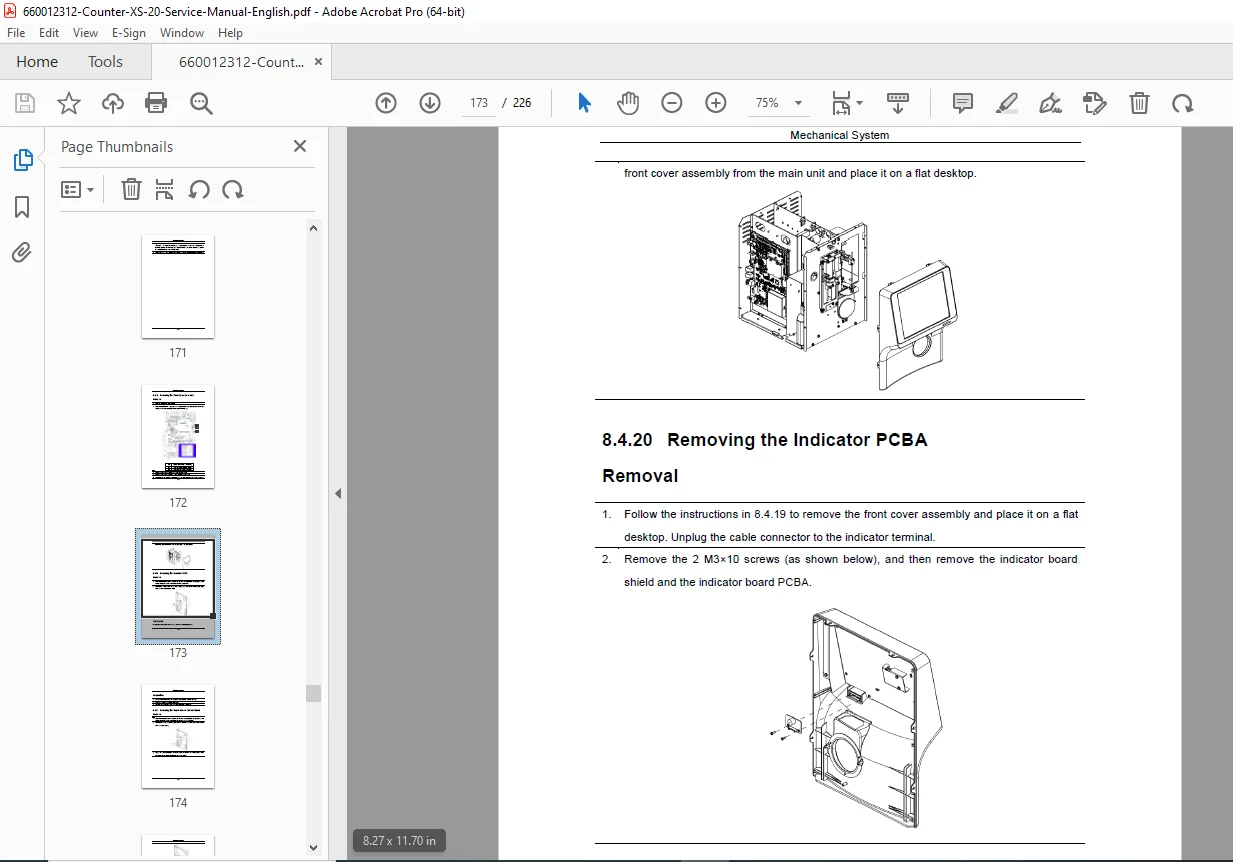
- Disassembly Procedures:
- Step-by-step disassembly instructions
- Tool requirements
- Component removal sequence
- Safety precautions
- Verification:
- Mechanical alignment checks
- Movement range verification
- Sensor positioning
- Reassembly verification
CHAPTER 9: TROUBLESHOOTING
- Error Code Reference:
- Complete error code listing
- Error descriptions
- Probable causes
- Corrective actions
- Systematic Troubleshooting:
- Symptom-based diagnosis trees
- Component isolation procedures
- Test procedures for verification
- Common Problems:
- Sample aspiration failures
- Abnormal results
- Fluidic system issues
- Electrical faults
- Mechanical problems
CHAPTER 10: DEBUGGING
- Post-service debugging procedures
- System verification tests
- Performance confirmation
- Final checkout protocols
CHAPTER 11: DEBUGGING AND VERIFICATION AFTER SERVICING
- Complete Verification Protocol:
- Background count verification
- Reproducibility testing
- Carryover testing
- Calibration verification
- Control testing
- Documentation Requirements:
- Service records
- Test results
- Calibration certificates
CHAPTER 12: SERVICE BOM (BILL OF MATERIALS)
- Complete spare parts catalog
- Part numbers and descriptions
- Recommended spare parts inventory
- Consumable items listing
- Tool requirements
APPENDIX A: FLUIDIC DIAGRAMS
- Complete fluidic system schematics
- Valve identification
- Tubing routing
- Pressure points
- Flow directions
APPENDIX B: LISTS OF TUBE CONNECTORS
- Connector types and specifications
- Connection points
- Tubing sizes
- Material specifications
APPENDIX C: HARDWARE DIAGRAMS
- Complete circuit schematics
- PCB layouts
- Component locations
- Wiring diagrams
APPENDIX D: CABLES AND WIRES
- Cable assembly diagrams
- Wire color codes
- Connector pinouts
- Cable routing
APPENDIX E: MENUS AND FUNCTIONS OF DIFFERENT ACCESS LEVELS
- Operator level menus
- Service level menus
- Engineering level access
- Function descriptions
APPENDIX F: DEBUGGING AND VERIFICATION RECORD
- Service record templates
- Test result forms
- Calibration documentation
- Performance verification checklists
MEASUREMENT TECHNOLOGIES
Impedance Method (Coulter Principle):
- Cells suspended in conductive solution pass through aperture
- Cell volume displaces electrolyte, creating resistance change
- Pulse height proportional to cell volume
- Accurate cell counting and sizing
Colorimetric Method:
- Cyanide-free hemoglobin measurement
- Light absorbance at specific wavelength
- Precise HGB concentration determination
Three-Part Differential:
- WBC population analysis
- Lymphocyte identification
- Mid-cell (Monocytes, Eosinophils, Basophils) separation
- Granulocyte quantification
REGULATORY COMPLIANCE
CE Marking:
- Fully compliant with EU In Vitro Diagnostic Medical Device Directive 98/79/EC
- CE representative: Shanghai International Holding Corp. GmbH (Europe)
Environmental Compliance:
- WEEE (Waste Electrical and Electronic Equipment) compliant
- Proper disposal and recycling requirements
Safety Standards:
- IEC safety compliance for medical laboratory equipment
- Electrical safety requirements
- Biohazard containment standards
WARRANTY INFORMATION
Warranty Exclusions:
- Malfunction caused by improper use
- Damage from unstable or out-of-range power input
- Force majeure events (fire, earthquake)
- Unauthorized repairs or modifications
- Illegible serial numbers
Service Requirements:
- Installation, repairs, modifications must be performed by Wiener lab authorized personnel
- Electrical installation must comply with national/local requirements
- Equipment must be used according to operator’s manual
IDEAL FOR:
- Hospital clinical laboratory biomedical engineers
- Independent biomedical equipment technicians (IBETs)
- Medical laboratory equipment service companies
- Authorized Wiener/Mindray service centers
- Clinical laboratory managers
- Laboratory technical staff with service responsibilities
- Medical device training institutions
- Healthcare facility technical services departments
- Blood bank technical personnel
- Pathology department technical staff
WHY THIS MANUAL IS ESSENTIAL:
The Counter XS-20/XS-30 Auto Hematology Analyzer performs critical complete blood count (CBC) testing in clinical laboratories. This comprehensive 226-page service manual provides:
✓ Patient Safety – Proper calibration and maintenance ensures accurate diagnostic results
✓ Complete Blood Count Accuracy – 21 parameters must be precisely calibrated
✓ Systematic Troubleshooting – Comprehensive error code reference and diagnostic trees
✓ Fluidic System Mastery – Detailed diagrams and maintenance procedures
✓ Hardware Diagnostics – Circuit diagrams and testing point locations
✓ Quality Control – Background, reproducibility, and carryover testing protocols
✓ Calibration Procedures – Temperature, gain, and parameter-specific calibration
✓ Preventive Maintenance – Scheduled service procedures to maximize uptime
IMPORTANT MEDICAL DEVICE NOTICE:
This service manual is intended for use by qualified biomedical engineers and factory-trained laboratory equipment service technicians only. Servicing hematology analyzers requires:
- Understanding of impedance-based cell counting principles
- Knowledge of fluidic systems and reagent chemistry
- Familiarity with quality control and calibration procedures
- Proper test equipment (voltmeter, oscilloscope, precision pipettes)
- Understanding of hematology parameters and reference ranges
- Compliance with laboratory safety and biohazard protocols
WARNING: Improper service or calibration can result in:
- Inaccurate patient test results affecting medical diagnosis
- Sample carryover contamination between patients
- Reagent system failures and waste
- Biohazard exposure to laboratory personnel
- Equipment damage requiring costly repairs
Always follow:
- Biohazard safety protocols when handling patient samples
- ESD protection procedures for electronic components
- Manufacturer calibration and verification procedures
- Laboratory quality control requirements
- Proper disposal of biohazardous waste
Keep your Counter XS-20/XS-30 Hematology Analyzer operating at peak performance! This official factory service manual provides the same comprehensive information used by Wiener/Mindray-trained technicians. With instant PDF download, qualified biomedical engineers can access this 226-page technical resource immediately. Whether performing routine calibration, troubleshooting measurement errors, servicing fluidic systems, or conducting preventive maintenance, this manual is your complete technical reference for professional hematology analyzer service.