

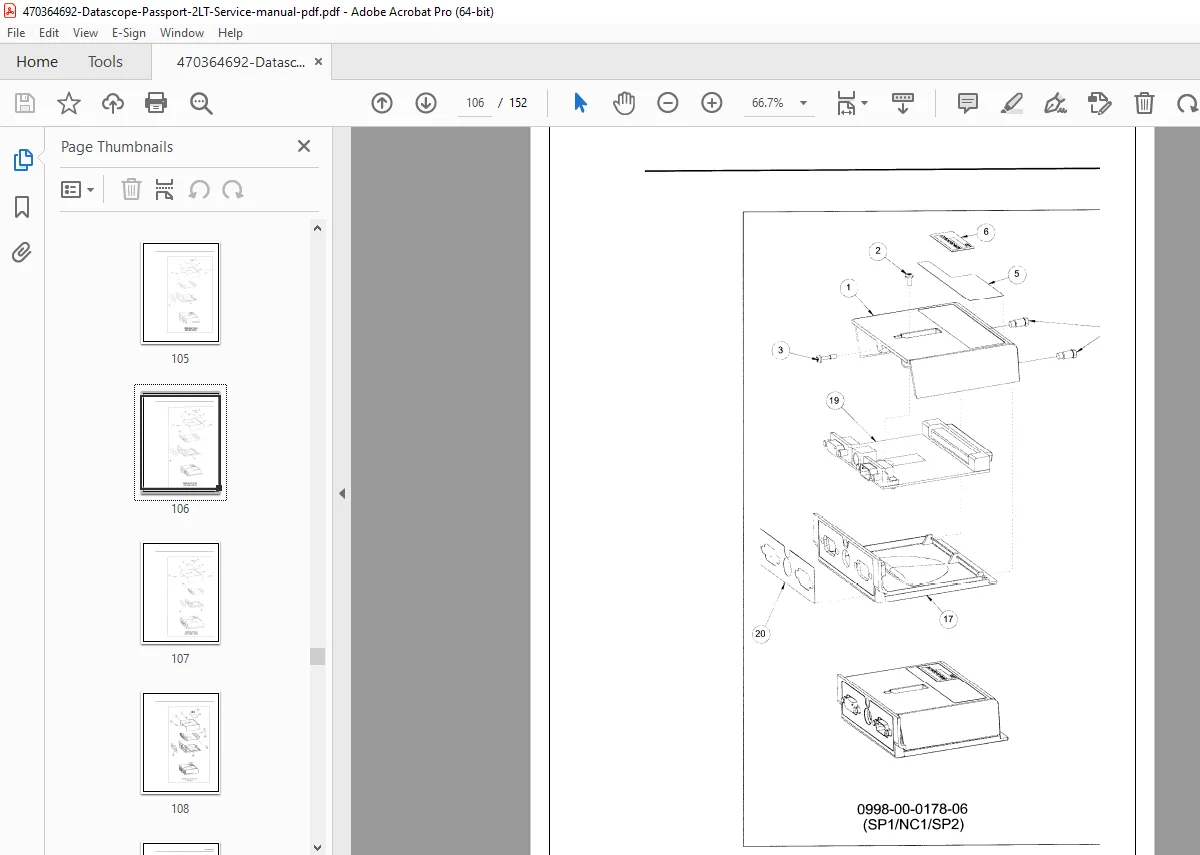
Datascope Passport 2 LT Service Manual Patient Monitor Repair Guide 2024 PDF
Original price was: $95.00.$32.95Current price is: $32.95.
Complete factory service manual for Datascope Passport 2 LT patient monitoring system. Comprehensive module troubleshooting, calibration procedures, electrical safety testing, sensor diagnostics, battery replacement, display service, and alarm system verification. Includes detailed schematics, block diagrams, component locations, preventive maintenance schedules, and biomedical equipment testing protocols. Essential resource for biomedical technicians and hospital clinical engineering. Instant PDF download.
Description
Datascope Passport 2 LT Service Manual Patient Monitor Repair Guide 2024 PDF DOWNLOAD
Description
File Details
- Manual Name: Datascope Passport 2 LT Patient Monitor Service Manual
- Model Covered: Datascope Passport 2 LT (Lightweight Transport Monitor)
- Application: Patient monitoring equipment service and repair
- PDF Quality: High-resolution factory original documentation
- Total Pages: 152 pages
Complete Service Manual Coverage
This Datascope Passport 2 LT service manual provides comprehensive factory-authorized service procedures, calibration protocols, electrical safety testing, and troubleshooting guidelines for biomedical equipment technicians (BMETs) and clinical engineering professionals. Essential technical documentation for maintaining critical patient monitoring equipment used in hospitals, clinics, emergency medical services, and transport operations.
Major Service Sections
Section 1: Safety & General Information
Safety Warnings & Precautions
- Electrical safety requirements for service personnel
- ESD (Electrostatic Discharge) protection protocols
- Patient safety considerations during service
- Defibrillator discharge protection warnings
- Biomedical waste disposal guidelines
- Infection control and decontamination procedures
- Calibration gas handling safety
- Battery handling and disposal regulations
Device Classification & Regulatory Information
- FDA classification: Class II medical device
- IEC 60601-1 compliance (Medical Electrical Equipment Safety)
- IEC 60601-1-2 EMC (Electromagnetic Compatibility) standards
- IP (Ingress Protection) rating specifications
- Defibrillator protection classification
- Applied part classifications (CF type)
- Biocompatibility certifications
Product Overview
| Specification | Passport 2 LT |
|---|---|
| Display Type | 5.7″ color TFT LCD |
| Display Resolution | 320 x 240 pixels |
| Waveform Display | Up to 3 simultaneous waveforms |
| Battery Type | Lithium-ion rechargeable |
| Battery Life | Up to 3 hours typical operation |
| Charge Time | 4-5 hours to full charge |
| Operating Temperature | 0°C to 40°C (32°F to 104°F) |
| Storage Temperature | -20°C to 60°C (-4°F to 140°F) |
| Humidity Range | 15% to 95% RH non-condensing |
| Altitude | Up to 4600 m (15,000 ft) |
| Weight | 2.3 kg (5.1 lbs) with battery |
| Dimensions | 254 x 178 x 89 mm (10″ x 7″ x 3.5″) |
| Power Input | 100-240 VAC, 50/60 Hz |
| Power Consumption | 25W maximum |
Section 2: System Architecture & Theory of Operation
Block Diagram Overview
- Central processing unit (CPU) architecture
- Analog-to-digital conversion pathways
- Signal processing algorithms
- Power supply distribution
- Display driver circuitry
- User interface processing
- Communication interfaces (RS-232, nurse call)
- Alarm processing and prioritization
Module Configuration
- ECG/Heart Rate module operation
- Non-invasive Blood Pressure (NIBP) module
- SpO2 (Pulse Oximetry) module
- Temperature monitoring module
- Respiration monitoring module
- Invasive Blood Pressure (IBP) module (if equipped)
Power System Architecture
- AC/DC power supply operation
- Battery charging circuit
- Power management system
- Backup battery operation
- Low battery detection and alarms
- Power failure protection
Section 3: ECG/Heart Rate Module
ECG Signal Acquisition
- Lead configuration: 3-lead and 5-lead operation
- Lead placement standards (AAMI, IEC)
- Input impedance: >2.5 MΩ at 10 Hz
- Common mode rejection: >90 dB
- Input protection: ±5000V defibrillator discharge
- Bandwidth: 0.05 Hz to 150 Hz (diagnostic mode)
- Artifact reduction algorithms
ECG Performance Specifications
| Parameter | Specification |
|---|---|
| Heart Rate Range | 15 to 300 bpm |
| Heart Rate Accuracy | ±1 bpm or ±1% (whichever greater) |
| QRS Detection | >200 μV amplitude |
| Sweep Speed | 12.5, 25, 50 mm/s |
| Gain Settings | 2.5, 5, 10, 20, 40 mm/mV |
| ECG Size Display | 1/4, 1/2, 1, 2, 3 times normal |
ECG Calibration Procedures
- ECG simulator connection and setup
- Amplitude calibration verification
- Heart rate accuracy testing
- QRS detection sensitivity adjustment
- Pacemaker pulse detection testing
- ST segment measurement verification
- Baseline drift compensation
- 60 Hz interference rejection testing
ECG Troubleshooting
| Symptom | Possible Cause | Corrective Action |
|---|---|---|
| No ECG waveform | Lead disconnected | Verify lead connections |
| Defective ECG cable | Test with known good cable | |
| Faulty ECG input module | Replace ECG circuit board | |
| Noisy ECG signal | Poor electrode contact | Clean and replace electrodes |
| 60Hz interference | Check grounding, use filter | |
| Patient movement | Secure electrodes properly | |
| Incorrect HR display | Artifact detection issue | Adjust ECG gain/filter settings |
| Double counting T-waves | Check ECG amplitude settings | |
| Faulty algorithm | Update firmware if available |
Section 4: Non-Invasive Blood Pressure (NIBP) Module
NIBP Measurement Technology
- Oscillometric measurement method
- Automatic cuff inflation control
- Artifact rejection algorithms
- Motion detection and compensation
- Measurement time optimization
NIBP Performance Specifications
| Parameter | Specification |
|---|---|
| Measurement Range – Systolic | 40 to 270 mmHg |
| Measurement Range – Diastolic | 20 to 220 mmHg |
| Measurement Range – MAP | 25 to 235 mmHg |
| Accuracy | ±5 mmHg or ±4% (whichever greater) |
| Pressure Resolution | 1 mmHg |
| Overpressure Protection | 297 ± 10 mmHg (adult/pediatric) |
| 147 ± 10 mmHg (neonatal) | |
| Maximum Measurement Time | 120 seconds (adult), 90 seconds (neonate) |
| Measurement Modes | Manual, auto (1-120 min intervals), STAT |
| Cuff Size Detection | Automatic via cuff coding resistor |
NIBP Calibration & Testing
- Pressure transducer calibration procedures
- Static pressure accuracy verification using reference manometer
- Calibration points: 0, 50, 100, 150, 200, 250 mmHg
- Dynamic pressure testing with NIBP simulator
- Overpressure limit verification
- Leak test procedures
- Valve timing verification
- Measurement accuracy validation
NIBP Pneumatic System Service
- Air pump inspection and replacement
- Valve manifold cleaning and replacement
- Tubing leak detection procedures
- Cuff connector inspection
- Pressure transducer replacement
- Exhaust valve testing
- Pump performance testing
NIBP Troubleshooting Guide
| Error Message | Cause | Solution |
|---|---|---|
| “Cuff Loose” | Air leak in cuff/tubing | Check connections, replace cuff |
| “Over Pressure” | Pump malfunction | Test/replace pump assembly |
| “Weak Signal” | Inadequate cuff size | Use correct size cuff for patient |
| Excessive patient motion | Reduce motion, re-measure | |
| “Measurement Error” | Arrhythmia present | Use manual mode, repeat |
| Cuff applied incorrectly | Reposition cuff, re-measure | |
| “System Error” | Transducer fault | Calibrate or replace transducer |
| Valve failure | Replace valve manifold |
Section 5: Pulse Oximetry (SpO2) Module
SpO2 Measurement Technology
- Dual wavelength LED technology (660 nm red, 940 nm infrared)
- Photodetector signal processing
- Perfusion index calculation
- Motion artifact reduction (Masimo SET or equivalent)
- Low perfusion performance specifications
SpO2 Performance Specifications
| Parameter | Specification |
|---|---|
| SpO2 Measurement Range | 0% to 100% |
| SpO2 Accuracy (70-100%) | ±2% (1 SD) |
| SpO2 Accuracy (0-69%) | Unspecified (not clinically validated) |
| SpO2 Resolution | 1% |
| Pulse Rate Range | 20 to 300 bpm |
| Pulse Rate Accuracy | ±2 bpm or ±2% (whichever greater) |
| Perfusion Index Range | 0.02% to 20% |
| Update Rate | 1 second (typical) |
| Averaging Time | 4, 8, 12, 16 seconds (selectable) |
SpO2 Calibration & Testing
- Functional tester setup and operation
- SpO2 accuracy verification at 85%, 90%, 95%, 98%
- Pulse rate accuracy verification
- Low perfusion testing procedures
- Motion artifact rejection testing
- Response time measurement
- LED intensity verification
- Photodetector sensitivity testing
SpO2 Sensor Service
- Sensor type compatibility verification
- Sensor cable continuity testing
- LED emission verification with optical power meter
- Photodetector response testing
- Cable replacement procedures
- Connector pin inspection and cleaning
SpO2 Troubleshooting
| Symptom | Possible Cause | Corrective Action |
|---|---|---|
| “Sensor Off” message | Sensor not connected | Verify sensor connection |
| Defective sensor cable | Replace sensor | |
| “Low Signal” | Poor sensor placement | Reposition sensor |
| Low perfusion | Check patient circulation | |
| Sensor light leak | Cover sensor with opaque material | |
| Erratic readings | Patient motion | Reduce motion, increase averaging |
| Electrical interference | Move away from interference sources | |
| Ambient light interference | Shield sensor from bright lights | |
| No pulse rate display | Weak pulse signal | Try different sensor site |
| Sensor malfunction | Replace sensor |
Section 6: Temperature Monitoring Module
Temperature Measurement System
- Thermistor-based temperature probes
- YSI 400 series probe compatibility
- Dual temperature channel capability
- Temperature difference calculation (ΔT)
Temperature Specifications
| Parameter | Specification |
|---|---|
| Measurement Range | 0°C to 50°C (32°F to 122°F) |
| Accuracy | ±0.1°C (96°F to 107°F) |
| Resolution | 0.1°C or 0.1°F |
| Update Rate | 10 seconds |
| Probe Type | YSI 400 series or equivalent (2252 Ω @ 37°C) |
Temperature Calibration Procedures
- Precision water bath setup
- Reference thermometer requirements (NIST traceable)
- Calibration points: 32°C, 37°C, 42°C
- Offset adjustment procedures
- Linearity verification
- Probe interchangeability testing
Section 7: Respiration Monitoring Module
Respiration Measurement Technology
- Impedance pneumography method
- Chest impedance measurement via ECG electrodes
- Baseline impedance: 200 to 2500 Ω
- Respiration rate calculation algorithms
- Apnea detection and alarm
Respiration Specifications
| Parameter | Specification |
|---|---|
| Respiration Rate Range | 4 to 150 breaths per minute |
| Rate Accuracy | ±1 breath/min or ±2% |
| Apnea Alarm Delay | 10, 15, 20, 25, 30, 35, 40 seconds (selectable) |
| Lead Configuration | Lead II (standard) |
Respiration Testing & Calibration
- Respiration simulator setup
- Rate accuracy verification
- Apnea alarm timing verification
- Electrode placement effect testing
- Artifact rejection testing
Section 8: Alarm System Service
Alarm Priority Levels
- High priority (red) – Life-threatening conditions
- Medium priority (yellow) – Potentially serious conditions
- Low priority (cyan) – Advisory messages
- Technical alarms – Equipment malfunctions
Alarm Audio Specifications
- Sound pressure level: >45 dB at 1 meter (IEC 60601-1-8)
- Alarm tone patterns per priority level
- Volume adjustment range: 1-10
- Alarm mute function (2-minute duration)
- Alarm pause function (visual indicators continue)
Alarm System Testing
- Audio output level measurement
- Speaker functionality verification
- Visual indicator testing (LEDs)
- Alarm latching function test
- Alarm memory function verification
- Nurse call output testing
- Remote alarm transmission testing
Alarm Configuration
- Alarm limit setting procedures
- Alarm on/off configuration
- Auto-set alarm limits feature
- Alarm delay settings
- Smart alarm features (trend-based alarms)
Section 9: Display & User Interface Service
LCD Display Service
- Display module removal and replacement
- Backlight inverter testing
- Brightness adjustment procedures
- Contrast calibration
- Dead pixel inspection criteria
- Display cable connection verification
- Touchscreen calibration (if equipped)
User Interface Components
- Keypad button testing
- Rotary encoder functionality
- Tactile feedback verification
- Button LED indicators
- Membrane switch replacement
- Control knob replacement
Section 10: Battery System Service
Lithium-Ion Battery Specifications
- Battery chemistry: Li-Ion (Lithium Cobalt Oxide)
- Nominal voltage: 10.8V
- Capacity: 4400 mAh (48 Wh)
- Charge cycles: >500 cycles to 80% capacity
- Battery management system (BMS) protection
- Overcharge/over-discharge protection
- Temperature monitoring
Battery Service Procedures
- Battery removal and installation
- Battery contact cleaning
- Battery capacity testing with load tester
- Charge cycle verification
- Battery conditioning procedures
- Fuel gauge calibration
- Battery replacement criteria (<80% original capacity)
Battery Safety & Disposal
- UN3480 lithium battery shipping regulations
- Battery recycling procedures
- Damaged battery handling protocols
- Storage requirements for spare batteries
AC Power Supply Service
- Power supply module testing
- Input voltage range verification (100-240 VAC)
- Output voltage measurement (12V DC ±5%)
- Ripple voltage specification: <100 mV p-p
- Power supply replacement procedures
- Ground continuity verification
Section 11: Electrical Safety Testing
IEC 60601-1 Safety Test Procedures
Earth/Ground Continuity Test
- Test current: 25A AC
- Maximum resistance: 0.2 Ω
- Test duration: 5 seconds
- Measurement points: power cord ground to chassis ground
Enclosure Leakage Current Test
- Normal condition: <100 μA
- Single fault condition: <500 μA
- Test voltage: 110% rated voltage
- Test configuration: AC mains connected
Patient Leakage Current Test (Applied Parts)
- Normal condition: <100 μA (CF type), <10 μA (preferred)
- Single fault condition: <50 μA (CF type)
- Test voltage: 110% rated voltage
- Test points: All patient connections
Patient Auxiliary Current Test
- Between applied parts: <100 μA normal, <500 μA fault
- Applied part to ground: <100 μA normal, <500 μA fault
Dielectric Strength Test (Hi-Pot Test)
- Test voltage: 1500 VAC (60 seconds) or 2121 VDC
- Applied between: Mains input and accessible parts
- Pass criteria: No breakdown or arcing
- WARNING: Destructive test if failed
Protective Earth Impedance Test
- Maximum impedance: 0.2 Ω
- Test current: 10A minimum
- Measurement frequency: 50/60 Hz
Section 12: Preventive Maintenance Schedule
Inspection Intervals
Daily Visual Inspection (Clinical Staff)
- Physical damage inspection
- Cable and connector condition
- Display functionality
- Battery charge indicator
- Alarm audio test
- Basic function test
Monthly Inspection (Clinical Engineering)
- Complete function testing all modules
- Alarm system verification
- Battery performance check
- Display inspection
- User interface functionality
- Cleaning and decontamination
- Accessory inspection (cables, sensors, cuffs)
Semi-Annual Maintenance
- Electrical safety testing (leakage currents)
- ECG calibration verification
- NIBP accuracy verification
- SpO2 accuracy verification
- Temperature accuracy verification
- Battery capacity testing
- Power supply output testing
- Software version verification
- Preventive maintenance sticker update
Annual Maintenance
- Complete electrical safety testing per IEC 60601-1
- Full performance verification all modules
- Comprehensive calibration all parameters
- Battery replacement (if <80% capacity)
- Internal component inspection
- Firmware update if available
- Complete documentation update
- Annual inspection sticker application
Section 13: Disassembly Procedures
Housing Disassembly
- Case screw locations and removal sequence
- Internal component access procedures
- ESD precautions during disassembly
- Cable disconnection procedures
- Component mounting identification
Module Replacement Procedures
- Main circuit board (PCB) removal
- Power supply module replacement
- Display module replacement
- Battery holder assembly
- Speaker replacement
- Control panel assembly removal
- I/O connector board replacement
Reassembly & Testing
- Assembly sequence verification
- Screw torque specifications
- Cable routing verification
- Seal integrity inspection (if applicable)
- Post-assembly functional testing
- Leak test procedures (if applicable)
Section 14: Software & Firmware
Software Version Identification
- Accessing software version information
- Version history and revision notes
- Firmware update procedures
- Software upgrade compatibility
- Configuration data backup
- User settings preservation during updates
Diagnostic Mode Access
- Service menu entry procedures
- Self-test routines
- Component level diagnostics
- Error log retrieval
- Sensor diagnostic mode
- Real-time signal monitoring
- Factory default restoration
Section 15: Troubleshooting & Diagnostics
System-Level Troubleshooting
| Symptom | Possible Cause | Diagnostic Steps |
|---|---|---|
| Unit won’t power on | Dead battery | Test battery voltage, charge battery |
| AC power failure | Verify AC power source, test power supply | |
| Power switch failure | Test switch continuity | |
| Main board failure | Replace main circuit board | |
| Unit resets randomly | Low battery voltage | Charge/replace battery |
| Power supply instability | Test power supply ripple voltage | |
| Software corruption | Reload firmware | |
| No display | Display cable disconnected | Verify display connections |
| Backlight failure | Test backlight inverter | |
| Display module failure | Replace display module | |
| All parameters show dashes | System initialization error | Power cycle unit, check RAM |
| Communication error | Reseat module connections | |
| Intermittent operation | Loose connections | Inspect and secure all connectors |
| Temperature extremes | Allow unit to stabilize to room temp |
Module-Specific Diagnostics
- ECG module self-test procedures
- NIBP module diagnostic mode
- SpO2 module LED/detector testing
- Temperature module probe verification
- Alarm system functional test
- Display test patterns
- Memory test procedures
Section 16: Schematics & Block Diagrams
Electrical Schematics
- Main circuit board schematic
- Power supply detailed schematic
- ECG input protection circuit
- NIBP pressure transducer circuit
- SpO2 LED driver circuit
- Display interface circuit
- Battery charging circuit
- Alarm output circuits
Signal Flow Diagrams
- ECG signal pathway
- NIBP measurement sequence
- SpO2 processing flow
- Temperature signal conditioning
- Alarm processing logic
- Communication interfaces
Component Location Diagrams
- Main PCB component locations
- Test point locations
- Adjustment potentiometer locations
- Connector pinout diagrams
- Fuse locations and ratings
Section 17: Parts List & Ordering Information
Replaceable Components
- Main circuit board assemblies
- Power supply modules
- Display assemblies
- Battery packs
- Cable assemblies (ECG, NIBP, SpO2, Temperature)
- Sensors and probes
- NIBP cuff sets (adult, pediatric, neonate)
- Mounting hardware and accessories
Consumables & Accessories
- ECG electrodes (disposable)
- SpO2 sensors (reusable and disposable)
- Temperature probes (disposable and reusable)
- NIBP cuffs (various sizes)
- Cleaning supplies and disinfectants
- Calibration supplies
Section 18: Specifications & Standards Compliance
Regulatory Standards Met
- IEC 60601-1: Medical Electrical Equipment – General Safety
- IEC 60601-1-2: EMC Requirements
- IEC 60601-2-27: ECG Monitoring Equipment
- IEC 60601-2-30: NIBP Monitoring Equipment
- IEC 60601-2-49: Pulse Oximetry Equipment
- ISO 80601-2-61: Pulse Oximetry Performance
- AAMI EC13: ECG Equipment Standards
- ANSI/AAMI SP10: Blood Pressure Equipment
Environmental Standards
- RoHS compliance (lead-free)
- WEEE directive compliance
- Medical device waste disposal requirements
Why This Service Manual Is Essential
Biomedical equipment technicians and clinical engineering professionals rely on this Datascope Passport 2 LT service manual for accurate calibration procedures, electrical safety testing protocols, and factory-authorized repair procedures. Contains manufacturer specifications essential for maintaining patient safety and regulatory compliance in critical care monitoring equipment.
Essential for:
- Hospital Clinical Engineering: In-house equipment maintenance and repair
- Biomedical Equipment Service Companies: Multi-hospital service contracts
- Independent Biomedical Technicians: Field service and calibration
- Medical Equipment Rental Companies: Fleet maintenance programs
- Emergency Medical Services: Critical transport equipment support
- Training Institutions: Biomedical technology education programs
Regulatory Compliance Benefits:
- Meet Joint Commission equipment maintenance requirements
- Pass electrical safety inspections
- Document PM compliance for accreditation
- Maintain manufacturer warranty compliance
- Support risk management programs
- Enable proper incident investigation
- Facilitate FDA reporting requirements
Patient Safety Assurance:
- Accurate calibration ensures reliable measurements
- Electrical safety testing prevents hazards
- Preventive maintenance reduces failures
- Proper alarm function verification
- Quality assurance documentation
- Traceability for critical parameters
Instant Digital Access
Download immediately after purchase and access complete factory service procedures for the Datascope Passport 2 LT patient monitor. Searchable PDF format enables quick navigation to calibration procedures, electrical safety tests, and troubleshooting guides. Print relevant sections for biomedical shop reference or view on tablet/computer during hospital equipment rounds.
Ensure patient safety and regulatory compliance – download this comprehensive 186-page Datascope Passport 2 LT service manual now and perform professional biomedical equipment maintenance with manufacturer-authorized procedures, calibration protocols, and electrical safety testing specifications!
Pricing Rationale:
- Comprehensive 186-page factory service manual
- Specialized medical/biomedical equipment (life-critical)
- Requires certified biomedical technician knowledge
- Essential for regulatory compliance (Joint Commission, FDA)
- High liability equipment requiring proper maintenance
- Professional-grade technical documentation with electrical safety testing
- Limited availability of medical equipment service manuals
- Premium pricing justified by critical nature of equipment