Haulotte Forklift SIGMA 16 – SIGMA 46 SIGMA 16 PRO – SIGMA 46 PRO Service and Repair Manual
$28.95
Haulotte Forklift SIGMA 16 – SIGMA 46 SIGMA 16 PRO – SIGMA 46 PRO Service and Repair Manual – PDF DOWNLOAD
Description
Haulotte Forklift SIGMA 16 – SIGMA 46 SIGMA 16 PRO – SIGMA 46 PRO Service and Repair Manual – PDF DOWNLOAD
FILE DETAILS:
Haulotte Forklift SIGMA 16 – SIGMA 46 SIGMA 16 PRO – SIGMA 46 PRO Service and Repair Manual – PDF DOWNLOAD
Language : English
Pages :302
Downloadable : Yes
File Type : PDF
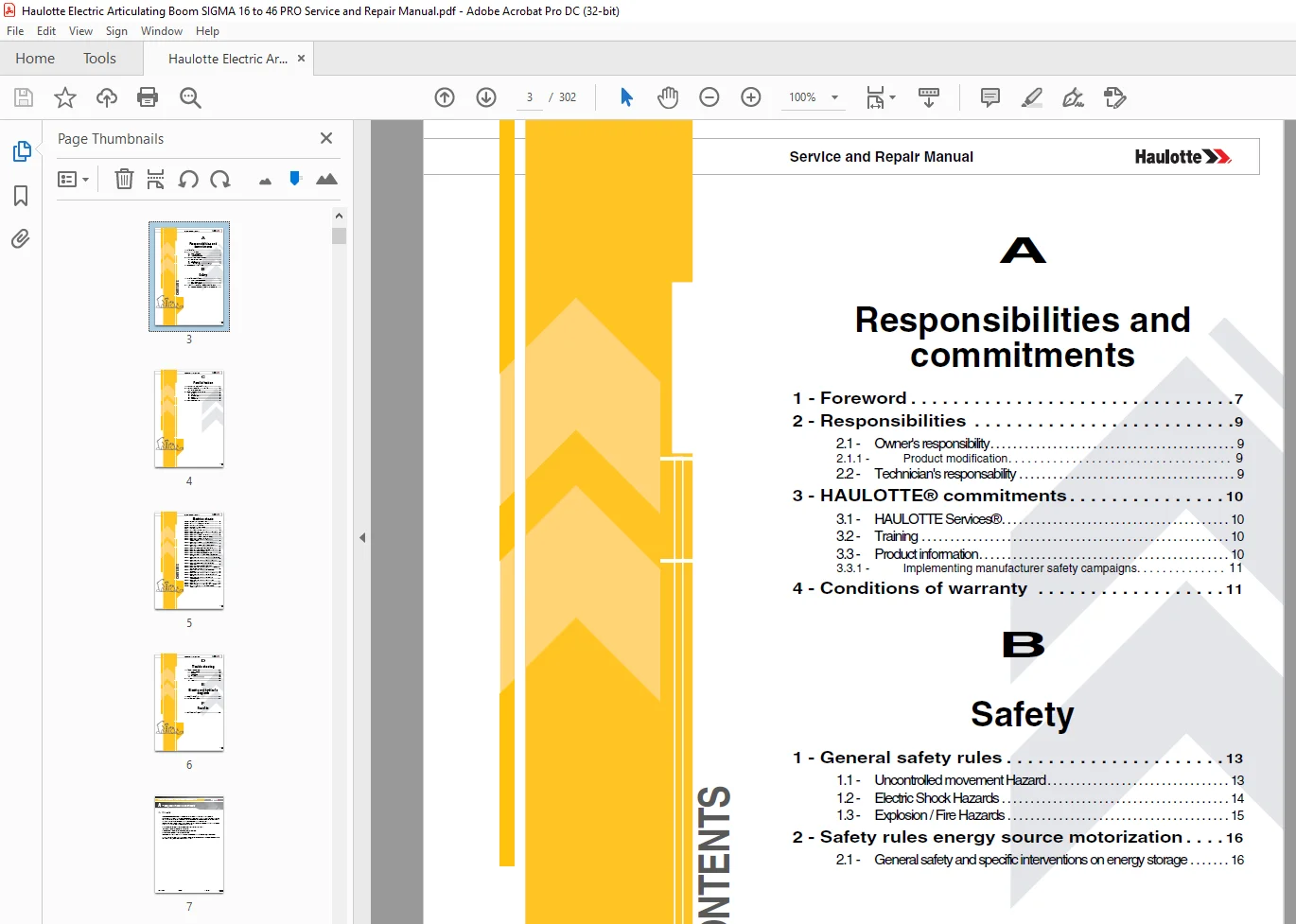
TABLE OF CONTENTS:
Haulotte Forklift SIGMA 16 – SIGMA 46 SIGMA 16 PRO – SIGMA 46 PRO Service and Repair Manual – PDF DOWNLOAD
Service and Repair Manual 1
SIGMA 16 – SIGMA 46 SIGMA 16 PRO – SIGMA 46 PRO 1
A 3
Responsibilities and commitments 3
1 – Foreword 7 3
2 – Responsibilities 9 3
21 – Owner’s responsibility 9 3
211 – Product modification 9 3
22 – Technician’s responsability 9 3
3 – HAULOTTE® commitments 10 3
31 – HAULOTTE Services® 10 3
32 – Training 10 3
33 – Product information 10 3
331 – Implementing manufacturer safety campaigns 11 3
4 – Conditions of warranty 11 3
B 3
Safety 3
1 – General safety rules 13 3
11 – Uncontrolled movement Hazard 13 3
12 – Electric Shock Hazards 14 3
13 – Explosion / Fire Hazards 15 3
2 – Safety rules energy source motorization 16 3
21 – General safety and specific interventions on energy storage 16 3
C 4
Familiarization 4
1 – HAULOTTE Activ’Screen 2 17 4
2 – List of actuators and sensors 24 4
21 – Sensors and actuators 24 4
3 – Consumables (Oils)Oils 29 4
31 – Hydraulic oil 29 4
32 – Gear motor oil 30 4
33 – Cylinder storage oil 30 4
34 – Grease 31 4
35 – Consumables 32 4
4 – Movement speed 33 4
Machine sheets 5
MS0001 – Structural part inspection 34 5
MS0002 – Pins and bearing inspection 39 5
MS0003 – Cylinder inspection 43 5
MS0004 – Braking test procedure 47 5
MS0133 – Universal plug 49 5
MS0285 – Maintenance implementation 53 5
MS0334 – Removal – Replacement of the platform 55 5
MS0335 – Remove – Replace load cell 61 5
MS0336 – Remove/Re-install jib cylinder 67 5
MS0337 – Remove/Re-install rotary actuator 73 5
MS0338 – Remove/Re-install jib cylinder 79 5
MS0339 – Removal – Replacement of the jib and platform 87 5
MS0340 – Remove/Re-install input compensation cylinder 95 5
MS0341 – Remove/Re-install output compensation cylinder 101 5
MS0342 – Remove – Replace telescope cylinder 107 5
MS0344 – Removing the boom lifting cylinder 121 5
MS0345 – Remove – Replace arm cylinder 131 5
MS0346 – Remove – Replace counterweight 139 5
MS0347 – Remove – Reinstall the hydraulic rotation motor 147 5
MS0348 – Removal – Replacement of the electro-pump unit 153 5
MS0349 – Removal – Replacement of the steering cylinder 159 5
MS0350 – Remove – Replace the boom/jib/box assembly 165 5
MS0351 – Remove – Replace arm assembly 175 5
MS0352 – Removal – Replacement of the electric brake on the gear motor 187 5
MS0353 – Removal – Replacement of on-board charger 195 5
MS0354 – Removal – Replacement of the gear motor 199 5
MS0355 – Removal – Replacement of semi-traction batteries 207 5
MS0356 – Removal – Replacement of battery compartments 213 5
MS0357 – Removal – Replacement of the drive controller 219 5
MS0358 – Removing / Replacing the pads 225 5
MS0359 – Remove/re-install the harness BUS CAN 243 5
MS0360 – Placing the machine in maintenance configuration 253 5
D 6
Trouble shooting 6
1 – Trouble shooting 259 6
11 – Recommendations 259 6
12 – Description 259 6
13 – Requirements 259 6
14 – Failures list 260 6
141 – List of failures per category 264 6
2 – Legend 282 6
21 – PCB Turret 282 6
E 6
Electric and hydraulic diagrams 6
1 – Electric diagram 288 6
2 – Hydraulic diagram 298 6
F 6
Records 6
1 – Intervention register 301 6
Responsibilities and commitments 7
1 – Foreword 7
You have just purchased a HAULOTTE® product and we would like to thank you for your business 7
The Aerial Work Platform is a mechanical device primarily designed and manufactured with the intent to position people with the necessary tools and material to overhead elevated temporary workplaces All other uses or alterations/modifications to the 7
This manual provides the owner, operator and field service technician all necessary and detailed informations on preventive maintenance to be carried out on their machine 7
It is recommended that only trained personnel should perform these operations 7
We would particularly like to draw your attention to : 7
• Compliance with safety instruction (machine, use, environment) 7
• Use of the equipment within the performance limits 7
This maintenance book is specific to the HAULOTTE® products listed on the cover page of this manual 7
In order to guarantee optimal maintenance, we recommend that you use HAULOTTE® expert technicians with genuine spare parts, documentation and the required tools 7
Symbol 8
2 – Responsibilities 9
21 – Owner’s responsibility 9
The owner (or hirer) has the obligation to inform technician of the instructions contained in the Operator Manual and Maintenance Book 9
The owner (or hirer) has the obligation to renew all manuals or decals that are either missing or in bad condition 9
Additional decals can be ordered from HAULOTTE Services® 9
The owner (or hirer) is responsible for applying the local regulations regarding maintenance of the machine 9
211 – Product modification 9
Without the written permission from HAULOTTE®, modifying a HAULOTTE® product is a Safety concern 9
Any modification may violate Haulotte design parameters, local regulations and industry standards 9
If you desire a modification to the product, tanks to submit a request in writing to HAULOTTE® 9
22 – Technician’s responsability 9
The technician must read and understand the contents of this manual, operators manuals and the decals affixed on the machine 9
The technician must inform the owner (or hirer) if the manual or any decals are missing or in poor condition, and of any malfunction of the machine 9
3 – HAULOTTE® commitments 10
31 – HAULOTTE Services® 10
HAULOTTE Services® is at your service in all 5 continents of the world via an extensive network of its own trained technicians, who are ready to respond to your every need 10
Our HAULOTTE Services® After Sales Service is at your disposal throughout your machine’s service life to ensure the optimum use of your HAULOTTE product : 10
32 – Training 10
Would you like to train your teams to operate and/or maintain your machine HAULOTTE®? Contact your subsidiary 10
The HAULOTTE® training courses help your teams to improve their skills 10
Our trainers are experts in pedagogy, at the cutting edge of HAULOTTE® products and the latest technological innovations 10
33 – Product information 10
In a constant concern to improve the reliability and safety of its machines, HAULOTTE® provides the following documents from the site wwwe-technical-informationcom : 10
331 – Implementing manufacturer safety campaigns 11
It is essential to implement the safety campaigns issued by the manufacturer All of these campaigns are accessible on our website 11
Connect to our website : wwwhaulottecom 11
4 – Conditions of warranty 11
Our warranty conditions and extension contracts are now available on the websites of our sales network : wwwhaulottecom 11
Safety 13
1 – General safety rules 13
Before performing any maintenance interventions, place the machine in maintenance configuration : 13
• Section MS0285 – Turntable rotation locking 13
• Section MS0360 – Placing the machine in maintenance configuration 13
11 – Uncontrolled movement Hazard 13
Be aware of uncontrolled movement and always respect the following : 13
12 – Electric Shock Hazards 14
The machine is not electrically insulated and does not provide protection from contact or proximity to electrically charged conductors 14
Always position the lift at a safe distance from electrically charged conductors to ensure that no part of the machine is within an unsafe area 14
Respect the local rules and the minimum safety distance from power lines 14
Minimum safe approach distances 14
Do not operate the machine : 14
13 – Explosion / Fire Hazards 15
2 – Safety rules energy source motorization 16
21 – General safety and specific interventions on energy storage 16
MS0360 – Placing the machine in maintenance configuration 16
If you need to perform an operation on LIVE circuits (for voltage and/or current measurement, for example) without locking out the machine, make sure that you have : 16
Reminder of voltages and currents present on the machine : 16
Familiarization 17
1 – HAULOTTE Activ’Screen 2 17
Upon starting and during operation of the machine, the LCD screen “Activ’Screen” located on the ground control box displays in real time the machine operating status 17
Controls and indicators 17
Controls and indicators 17
Controls and indicators 18
Emergency mode is activated when : 18
Emergency mode is deactivated when : 18
The alarm icon blinks in case of : 18
Controls and indicators 19
Controls and indicators 20
Controls and indicators 21
The secondary safety system is triggered An operator may be trapped on the platform : 21
Controls and indicators 22
Controls and indicators 23
Low battery water level : 23
Low Water level tank : 23
2 – List of actuators and sensors 24
21 – Sensors and actuators 24
Sensors and actuators – 1 24
Sensors and actuators – 2 25
Sensors and actuators – 3 26
3 – Consumables (Oils) 29
31 – Hydraulic oil 29
Hydraulic oils must comply with the following requirements : 29
• Antifoam and deaeration 29
• Anti-wear, anti-shear and antioxydant 29
• Rust and corrosion inhibitors (copper) 29
Biodegradable oils may be used if they comply with the following requirements : 29
The recommended viscosity grades depending on the environmental conditions are as follows : 29
32 – Gear motor oil 30
The recommended oil is EP type, the characteristics of which comply with standards MIL-L-2105 and API GL5 30
33 – Cylinder storage oil 30
If a cylinder is not used, the surface of the cylinder rod may be exposed to a corrosive environment (Example : When new equipment is stored before shipping ) 30
1 time per month, apply oil diluted in a solvent (Recommendations : UNIL OPAL PROTECT SHX 12) 30
Procedure : 30
34 – Grease 31
35 – Consumables 32
4 – Movement speed 33
To allow checking operation, refer to the following table about originally time per movement If the values measured by test are not equal to the following : 33
• Do not use the machine 33
• Setting updating is needed 33
Always check speed movement from the ground control box 33
Machine sheets 33
General data 34
1 – Warning 35
2 – Risk prevention 35
Means of protection to be used when implementing the range 35
3 – You will need 35
4 – Control and maintenance 36
To guarantee the integrity of the machine, it is necessary to carry out periodical controls on the mechanical structure such as defines hereafter 36
41 – Daily inspection 36
All the accessible structural part without disassembling must be subjected to a fast visual inspection 36
If anomalies are noted, according to the list below, a reinforced control will have to be carried out to judge conformity of the part : 36
The list of part to check are define Section Familiarization 36
42 – Major inspection 37
All structural part listed Section Familiarization must be disassembled and all weldsmust be review using non-destructive checks Section D – Inspection and maintenance schedule 37
The criteria quoted above are applicable 37
The main items to be inspected are : 37
Example 37
In the event of suspicion of crack, a cleaning and a sweating are to be carried out to guarantee the integrity of the part before reassembly 37
Check presence and torque of each bolts and screw used to assembly part listed in Section Familiarization Refer to spare part catalog for additional information if needed 37
43 – Functional tests 38
The following tests must be performed periodically Section D – Inspection and maintenance schedule : 38
The following tests must be realized by a qualified staff under secure conditions 38
The results of the tests must be entirely documented 38
To avoid the swing of the machine during the test, it is imperative that a device of reserve (chain, not of anchoring) is used during the test 38
44 – Dynamic tests 38
The machine must be place on level and firm ground 38
With 100% of the maximum allowed load, operate from ground control box (or emergency control box) all the movements ; the platform floor must reach a height of about 1 above the ground 38
The functional tests must show the following facts : 38
Refer to the user manual for the description of the safety device and technical characteristics to be reached 38
45 – Structural test 38
The following test shows that the structure of the machine is in conformity with the safety requirements 38
The machine must be place on level and firm ground 38
With 100% of the maximum allowed load, operate from ground control box (or emergency control box) all the movements ; the platform floor must reach a height of about 1 above the ground : 38
If the difference between two measurements does not exceed 4 cm (1575 in) : the test is validated 38
If the difference between two measurements exceeds 4 cm (1575 in), to contact HAULOTTE Services® or to carry out the additional tests described below MS0003 – § 32 Cylinder inspection 38
General data 39
1 – Warning 39
2 – Risk prevention 39
Means of protection to be used when implementing the range 39
3 – You will need 39
4 – Control and maintenance 40
Inspection of the pins, stop pins, bushings and bearings must be carried out according to the recommendations Section D – Inspection and maintenance schedule : 40
• Fast visual inspection without disassembling Section D – Inspection and maintenance schedule : 40
• Check the presence of the pins and visible stops pins without disassembling 40
• Check the presence of the screws 40
• Check absence of deformations, cracks or breakage of pins and/or stops pins 40
• Check absence of heavy abrasion, wear or oxidation of the pins, stops pins 40
• Reinforced visual inspection with disassembling of certain elements to reach the bushes or bearing Section D – Inspection and maintenance schedule : In addition to the above cited criteria, verify the following : 40
• Check the presence and the position of the bushes and bearings 40
• Check the absence of shaving in periphery of the pins 40
• Check the absence of heavy abrasion, wear or oxidation of the bushes and bearing 40
• Check the absence of deformations, cracks or breakage of the bushes and bearing 40
• Check the absence of radial gap > 0,5 mm (19690 µ in) on the pins 40
• Complete disassembling of the pins, bushes and bearing Section D – Inspection and maintenance schedule : In complement of the inspections above cited, it is necessary to check : 40
• For the stages : 40
• Check the presence of material of friction 40
• For the bearings : 40
• After disassembling, protect the bearing from pollution and shocks 40
• Clean the bearing with a suitable solvent 40
• Check the absence of shaving in the housing of the bearing and/or the bearing 40
• Check the absence of heavy abrasion, wear, oxidation, deformations of the balls (or rollers) and the ball races 40
The periodicity can evolve under the following conditions Section D – Inspection and maintenance schedule : 40
• Abnormal noise during movements of the structure 40
• Prolonged storage of the machine ( 6 months) 40
• Specific storage and use Environment (strong moisture and salinity of the air) 40
5 – Criteria of replacement 40
The pins, stop pins, bushes and bearing must be replaced as soon as one of the anomalies quoted above is noted Bearing and bushes must be imperatively changed at the end of 10 years of use 40
6 – Procedure of reassembly 41
61 – Pins and bushes 41
When reassembling bearings and pins ensure that : 41
Recommended Values 41
62 – Bearings 42
For the reassembly of bearings, respect the following stages : 42
General data 43
1 – Warning 43
2 – Risk prevention 43
Means of protection to be used when implementing the range 43
3 – You will need 43
4 – Control and maintenance 44
41 – Visual inspections 44
The hydraulic actuating cylinders must be subjected to visual inspections periodic all the 250 hours or 6 months such as defined below : 44
42 – Functional tests 44
To guarantee an optimal level of performance and safety, functional tests must be realized all the 250 hours or 6 months 44
The periodicity can evolve under the following conditions : 44
Generic Control : 44
• Lift Arm hydraulic cylinder : Lift the arm to approximately half full height The telescopic boom should be fully extended and in the horizontal position (For machines fitted with) 44
• Boom lifting cylinder or Jib cylinder : Lift the concerned equipment (boom or jib) of approximately half way Extend the telescope to its maximum 44
• Telescoping cylinder : Lift the boom to its maximum angle and telescope approximately 50 cm (1969 in) 44
• If the difference between two measurements does not exceed 4 cm (1575 in) : the test validates correct operation 44
• If the difference between two measurements exceeds 4 cm (1575 in), contact HAULOTTE Services® or carry out the additional tests described below 44
Control cylinder by cylinder : 45
• Attach the body of the comparator on the cylinder rod 45
• The needle of the comparator must be in contact with the end of the casing of the cylinder 45
• The target is to measure the creep of the cylinder rod 45
43 – Major inspection 46
A thorough inspection of the structural parts must be realized all the 5000 h or 10 years with disassembling of the element to check the entirety of the welding Each Cylinder must be disassembled and must be review using non-destructive checks 46
The criteria quoted above are applicable : 46
Check : 46
1 Pipe weld connection 46
2 Rod weld connection 46
3 Ring 46
4 Rod 46
5 Piston 46
General data 47
1 – Warning 47
2 – Risk prevention 47
Means of protection to be used when implementing the range 47
3 – You will need 47
4 – Test procedure 48
The brake system is a significant component of the safety of the machine The following tests must be performed periodically Section D – Inspection and maintenance schedule 48
High speed : 48
• On a flat ground or slightly inclined (always lower than the authorized slope: see plate manufacturer) 48
• Trace on the ground, a line being used as reference mark of stop 48
• Roll moving front until reaching maximum speed : 48
• Between 3 km/h (19 mph) and 6,5 km/h (4,039 mph) according to the machines 48
• Release the manipulator as soon as the wheels axles are on the level of the traced reference mark 48
• Stopped machine, measure the distance between the wheel axles and traced reference mark on the ground : 48
• If the distance lies between 02 m (0ft 8in) and 2,7 m (8 ft 11 in), the test is validated 48
• If not, Contact HAULOTTE Services® to repair the system 48
Turntable 49
1 – You will need 49
2 – Procedure 49
Step 1 : 49
• Disconnect the plug 2 49
• Remove the caps on the plug 49
Step 2 : 49
• Pick up the pins in the plastic bag 49
• Strip the wires of the tracker 49
• Crimp the wires with the pins with a crimping clamp 49
Step 3 : 50
• Take the wedgelock off the plug 50
• Thread the wires in the positions regarding the information 50
Step 4 : 51
• Put the wedgelock back on the plug to fix the pins 51
Step 5 : 51
• Reconnect the plugs 51
• Mount the tracker 51
• The tracking device is operational 51
Turntable 53
1 – Placing in configuration 53
Your safety and the safety of the people around are essential 53
Make sure the work area is clean in order to not to pollute the system of the machine 53
Before performing any maintenance interventions, place the machine in maintenance configuration 53
Placing the machine in maintenance configuration : 53
1 Place the machine on firm, level ground 53
2 Stow the machine completely 53
3 Push the E-stop button to cut off the electricity supply 53
4 Insert the turntable rotation locking pin 53
Placing in operating configuration : 53
5 Remove the turntable rotation locking pin 53
6 Pull the E-stop button 53
Platform 55
1 – Concerned area 55
2 – Warning 55
3 – Risk prevention 56
Means of protection to be used when implementing the range 56
4 – You will need 56
5 – Removal 57
• Position the machine on a flat and firm surface, clear of obstructions (beware of power lines) 57
• Restrict access to the area (restricted access sign) 57
• Stow the machine 57
• Fit the platform on a handling device 57
• Mark out the work area (barriers, cones, marking tape) 57
• Switch off the ignition and remove the key ( 1 ) from the ignition 57
• Place a do not operate tag at the start/stop switch location to inform personnel that the equipment is being worked on 57
• Turn off the circuit breaker 57
• Disconnect the terminal from the negative terminal (-) then from the positive terminal (+) 57
• Put the machine in stowed position, boom and arm fully retracted and lowered 58
• Locate the position of the Foot Switch on the floor (mark the position of it on the floor) 58
• Remove the three screws that hold the pedal to the floor 58
• Remove the plate ( 1 ) 58
• Open the plastic collar ( 2 ) using a screwdriver 58
• Cut the polyamide ties holding the cable and the control box wiring harness 58
• Put the pedal on the outside the platform 58
• Disconnect the 2 plugs positioned under the platform control panel 58
• Remove all of the plastic ties and place the plugs on the outside of the platform 58
• If the machine is fitted with the Activ’ Lighting System option, disconnect the light under the platform and place the plug outside the platform 59
• Remove the circlip ( 1 ) 59
• Remove the washer ( 2 ) 59
• Remove the pin ( 3 ) 59
• Remove the screws ( 1 ) 59
• Gently move the platform backwards using the handling equipment 59
6 – Re-installation 60
• To refit it, proceed in the opposite order to removal 60
• Fit the screws ( 1 ) 60
• Apply torque in 3 times 60
• Apply the following torques : 60
• 70 Nm (516 lbs-ft) 60
• 140 Nm (1032 lbs-ft) 60
• 215 Nm (1585 lbs-ft) 60
7 – Additional operations 60
• Check that the weighing system is working properly 60
• Calibrate the load cell : Refer to PI 563Calibrations 60
• Clean off any residual oil or grease 60
• Clean the work area 60
Platform 61
1 – Concerned area 61
2 – Warning 61
3 – Risk prevention 62
Means of protection to be used when implementing the range 62
4 – You will need 62
5 – Removal 63
• Position the machine on a flat and firm surface, clear of obstructions (beware of power lines) 63
• Stow the machine 63
• Fit the platform on a handling device 63
• Mark out the work area 63
• Switch off the ignition and remove the key ( 1 ) from the ignition 63
• Place a do not operate tag at the start/stop switch location to inform personnel that the equipment is being worked on 63
• Turn off the circuit breaker 63
• Disconnect the terminal from the negative terminal (-) then from the positive terminal (+) 63
• Remove a circlip, the washer and then the pin between the platform and the link piece 64
• If the machine is fitted with the Activ’ Lighting System option, disconnect the light under the platform and place the plug outside the platform 64
• Loosen the 4 screws connecting the platform support to the gauge 64
• Open the plastic collar ( 1 ) using a screwdriver 64
• Open the metal support ( 2 ) to facilitate separation of the platform and load cell 64
• Pull slightly on the platform assembly to free access to the stress gauge 65
• Disconnect the stress gauge plug 65
• Loosen the 4 screws that hold the strain gage onto the connecting element 65
• Remove the strain gage 65
6 – Re-installation 66
• If the cell has been replaced, note the traceability number 66
• Remount in reverse order to removal 66
• When re-installing the cell on the link piece, ensure the cell is fitted the right way round (A label indicates the top) Place the label marked TOP at the top PLATFORM marking on the platform side and BOOM on the boom side Check there are no f 66
• Apply the following torques : 66
• 70 Nm 66
• 140 Nm 66
• 215 Nm 66
• Apply contact grease for the connector 66
7 – Additional operations 66
• Clean the work area 66
• Calibrate the load cell : Refer to PI 563Calibrations 66
• Make a few movements and ensure that the overload is working correctly 66
Jib 67
1 – Concerned area 67
2 – Warning 67
3 – Risk prevention 68
Means of protection to be used when implementing the range 68
4 – You will need 68
5 – Removal 69
• Position the machine on a flat and firm surface, clear of obstructions (beware of power lines) 69
• Stow the machine 69
• Fit the platform on a handling device 69
• Mark out the work area 69
• Switch off the ignition and remove the key ( 1 ) from the ignition 69
• Place a do not operate tag at the start/stop switch location to inform personnel that the equipment is being worked on 69
• Turn off the circuit breaker 69
• Disconnect the terminal from the negative terminal (-) then from the positive terminal (+) 69
• Disconnect the solenoid valve YV620D on the cylinder flange 70
On each side of the pin, cylinder rod side : 70
• Remove the end-play take up screw and smooth clevis then extract the pin on the platform side (Using a 15 mm / 0,60 in wrench) 70
• Allow the cylinder to hang down in order to access the hydraulic hoses more easily 70
• Locate, disconnect and plug the hoses supplying the jib cylinder 70
On each side of the pin, platform side : 71
• Remove the end-play take up screw and smooth clevis then extract the pin on the platform side (Using a 15 mm / 0,60 in wrench) 71
• Use a pin of diameter 20 mm / 0,80 in and length 500 mm / 20 in to knock out the cylinder pin 71
• Leave the cylinder pin in the link piece and the second jib arm 71
• Support the jib cylinder, then remove the extraction pin in order to gently remove the cylinder 72
6 – Re-installation 72
• If you are installing a new cylinder, note the traceability number 72
• Perform the operations in the reverse order of dismantling 72
• Remember to refit the pin stop screws Install the screws with threadlock 72
• Tighten the screws to the recommended torque : 44 Nm (3245 lbft) 72
• Grease the pins, the seals, and the bored holes 72
• Check that the seals are on the connections before reconnecting the hoses 72
• To avoid the hoses twisting when they are connected to the rigid tubes, hold them firmly when tightening the couplings 72
7 – Additional operations 72
• From the ground control box, operate the cylinder to flush out the hydraulic circuit 72
• Check that there is no leak of oil at the removing connections 72
• Perform a static test by putting 290 kg / 640 lbs on the platform Machine unfolded, 15 mn after checking the performance of its parts : 72
• Jib cylinder 72
• Boom lifting cylinder 72
• Boom telescopic cylinder 72
• Input jib leveling cylinder 72
Platform 73
1 – Concerned area 73
2 – Warning 73
3 – Risk prevention 74
Means of protection to be used when implementing the range 74
4 – You will need 74
5 – Removal 75
• Position the machine on a flat and firm surface, clear of obstructions (beware of power lines) 75
• Stow the machine 75
• Fit the platform on a handling device 75
• Mark out the work area 75
• Switch off the ignition and remove the key ( 1 ) from the ignition 75
• Place a do not operate tag at the start/stop switch location to inform personnel that the equipment is being worked on 75
• Turn off the circuit breaker 75
• Disconnect the terminal from the negative terminal (-) then from the positive terminal (+) 75
• Locate, disconnect and plug the hoses that supply the cylinder 76
• Open the plastic ( 1 ) and metal ( 2 ) support of the cable duct to access the cylinder screws ( 3 ) 76
• Loosen the central screw ( 1 ) using a 30 mm wrench 76
• Remove the 8 screws that hold the cylinder to the connecting piece Use an 8 mm 6-side wrench 76
• Remove the central screw 76
• Remove the platform 76
• Remove the 2 pin stop screws and the smooth clevises between the bottom tie rods of the jib and rotation cylinder 77
• Pull out the pin 77
• Let the jib tie rods hang 77
• Attach the rotation cylinder with a sling 77
• Tighten the sling from the bridge crane 77
• Remove the 2 pin stop screws and the smooth clevises between the top tie rods of the jib and the rotation cylinder 77
• Pull out the pin 77
• Remove the cylinder 77
6 – Re-installation 78
• If you are installing a new cylinder, note the traceability number 78
• Perform the operations in the reverse order of dismantling 78
• Replace the adjustment wedges 78
• Grease the pins, the seals, and the bored holes 78
• Remember to refit the pin stop screws Install the screws with threadlock 78
• Tighten the rotary cylinder central nut to a torque of 500 Nm (36878 lbft) 78
• Tighten the 8 rotary cylinder screws to the torque of 57 Nm (42 lbft) 78
• Check that the seals are on the connections before reconnecting the hoses 78
• Hold the hoses to ensure that they don’t turn while tightening the connections (risk of seal damage) This will avoid the hoses twisting when they are connected to the rigid tubes 78
7 – Additional operations 78
• Clean off any residual oil or grease 78
• Rotate the platform a few times 78
• Ensure that there are no hydraulic leaks 78
Jib 79
1 – Concerned area 79
2 – Warning 79
3 – Risk prevention 80
Means of protection to be used when implementing the range 80
4 – You will need 80
5 – Removal 81
• Position the machine on a flat and firm surface, clear of obstructions (beware of power lines) 81
• Stow the machine 81
• Fit the platform on a handling device 81
• Mark out the work area 81
• Switch off the ignition and remove the key ( 1 ) from the ignition 81
• Place a do not operate tag at the start/stop switch location to inform personnel that the equipment is being worked on 81
• Turn off the circuit breaker 81
• Disconnect the terminal from the negative terminal (-) then from the positive terminal (+) 81
• Using handling equipment, place a weight of 500 kg(1103 lb) centrally on the platform 82
• Sling the jib on the pin of the link piece and the top tie rods 82
• Slightly tension the assembly 82
• Locate, disconnect and plug the hoses supplying the jib cylinder 82
• Remove the metal support ( 1 ) of the cable duct to access the cylinder screws 82
• Loosen the central screw ( 1 ) using a 36 mm wrench 83
• Remove the 8 screws that hold the cylinder to the connecting piece Use an 12 mm 6-side wrench 83
• Remove the central screw 83
• Move the platform clear using a pallet truck 83
• Attach a strap between the jib pin and the platform 83
• Tighten the strap 83
• Slowly release the bridge crane 83
• The jib should remain in place 83
• Screw 2 rings on the jib rotation cylinder 83
• Using handling equipment, attach the jib rotation cylinder with a sling 83
• Tighten the sling 83
• Remove the 2 pin stop screws and the smooth clevises from the pins of the jib rotation cylinder 84
• Remove the pin between the compensation cylinder and the rotation cylinder 84
• Carefully remove the compensation cylinder and place it on a chock or a cloth inside the boom section 84
• Using handling equipment, pull on the cylinder so that it remains in a vertical position 84
• Remove the pin between the boom section and the rotation cylinder 84
• Remove the rotation cylinder 84
6 – Re-installation 85
• If you are installing a new cylinder, note the traceability number 85
• Perform the operations in the reverse order of dismantling 85
• Refit the adjustment shims on the rotation cylinder 85
• Grease all the pins, seals, and bore holes 85
• Remember to refit the pin stop screws Install the screws with threadlock 85
• Tighten to a torque of 44 Nm (3245 lbft) 85
• Tighten the rotary cylinder central nut to a torque of 800 Nm (59005 lbft) 85
• Use medium-strength threadlock and tighten the 8 screws of the rotation cylinder to a torque of 99 Nm (7301 lbft) 85
• Check that the seals are on the connections before reconnecting the hoses 85
• To avoid the hoses twisting when they are connected to the rigid tubes, hold them firmly when tightening the couplings 85
• During reinstallation, pay attention to the hoses and cables 85
7 – Additional operations 85
• Rotate the platform a few times 85
• Ensure that there are no hydraulic leaks 85
Jib and platform 87
1 – Concerned area 87
2 – Warning 87
3 – Risk prevention 88
Means of protection to be used when implementing the range 88
4 – You will need 88
5 – Removal 89
• Position the machine on a flat and firm surface, clear of obstructions (beware of power lines) 89
• Stow the machine 89
• Fit the platform on a handling device 89
• Mark out the work area 89
• Switch off the ignition and remove the key ( 1 ) from the ignition 89
• Place a do not operate tag at the start/stop switch location to inform personnel that the equipment is being worked on 89
• Turn off the circuit breaker 89
• Disconnect the terminal from the negative terminal (-) then from the positive terminal (+) 89
• Disconnect the plug CAN 90
• Cut the hose clamps 90
• Put down the plug outside the platform 90
• Open the hose clamp ( 1 ) 90
• Loosen the ( 2 ) harness’ retention bracket 90
• If the machine is fitted with a 220 V socket in the platform ( 3 ), disconnect it 90
• Remove the CAN cable ( 1 ) and the 220 V cable ( 2 ) from the sheath ( 4 ) 90
• Thread the wiring harness through the jib, removing the screw clamps 90
• If the machine is fitted with a 220 V socket in the platform, remove it too 90
• Leave the wiring harness attached to the end of the boom 90
• Remove the protection plate in front of the block by removing the 4 screws 90
• Disconnect the solenoid valves and leave them with the jib 91
• Reduce the pressure in the hydraulic lines before removing the hoses 91
• Identify, disconnect and plug the 2 hoses supplying the jib rotation cylinder ( 1 ) 91
• Leave them to hang with the block 91
• Identify, disconnect and plug the 2 hoses supplying the platform rotation cylinder at the link piece ( 2 ) 91
• Leave them to hang with the block 91
• Identify, disconnect and plug the 2 hoses supplying the jib cylinder on the block ( 3 ) 91
• Open the hose clamp ( 4 ) 91
• Leave them to hang with the jib 91
• Slide the platform and jib unit 92
• Remove the 2 pin stop screws and the smooth clevises from the pins of the jib rotation cylinder 92
• Remove the pin between the compensation cylinder and the rotation cylinder 92
• Carefully remove the compensation cylinder and place it on a chock or a cloth inside the boom section 92
• Check that the sling is taught to hold the jib cylinder 92
• Remove the pin between the boom section and the rotation cylinder 92
• Remove the jib platform assembly using a pallet truck and the bridge crane 92
• Make a wedge under the jib arms A minimum wedging height of A : 200 mm / 8 in is required 92
6 – Re-installation 93
• Perform the operations in the reverse order of dismantling 93
• Grease the pins, the seals, and the bored holes 93
• Remember to refit the pin stop screws Install the screws with threadlock 93
• Tighten the screws to the recommended torque : 44 Nm (3245 lbft) 93
• Check that the seals are on the connections before reconnecting the hoses 93
• Hold the hoses to ensure that they don’t turn while tightening the connections (risk of seal damage) This will avoid the hoses twisting when they are connected to the rigid tubes 93
7 – Additional operations 93
• Clean off any residual oil or grease 93
• Clean the work area 93
• From the ground control panel, manoeuvre the platform and jib compensation to purge the circuit 93
• Check that there is no leak of oil at the removing connections 93
• Top up the hydraulic oil if necessary (machine in stowed position) 93
• Perform a static test by putting 290 kg / 640 lbs on the platform Machine unfolded, 15 mn after checking the performance of its parts : 93
• Jib cylinder 93
• Boom lifting cylinder 93
• Boom telescopic cylinder 93
• Input jib leveling cylinder 93
Upper boom 95
1 – Concerned area 95
2 – Warning 95
3 – Risk prevention 96
Means of protection to be used when implementing the range 96
4 – You will need 96
5 – Removal 97
• Position the machine on a flat and firm surface, clear of obstructions (beware of power lines) 97
• Restrict access to the area (restricted access sign) 97
• Stow the machine 97
• Fit the platform on a handling device 97
• Mark out the work area (barriers, cones, marking tape) 97
• Switch off the ignition and remove the key ( 1 ) from the ignition 97
• Place a do not operate tag at the start/stop switch location to inform personnel that the equipment is being worked on 97
• Turn off the circuit breaker 97
• Disconnect the terminal from the negative terminal (-) then from the positive terminal (+) 97
• Remove the flap on the boom section ( 1 ) and the protection cover on the ON/OFF block ( 2 ) 98
• Identify the hoses on the hydraulic block 98
• Gently loosen the fittings 98
• As soon as a trickle of oil appears, let it flow out When there is no longer any residual pressure, disconnect the hoses and plug the connectors 98
• Remove the 2 pin stop screws and the smooth clevises from the pins of the jib rotation cylinder 98
• Remove the pin between the compensation cylinder and the rotation cylinder 98
• Carefully remove the compensation cylinder and place it on a chock or a cloth inside the boom section 98
• Attach a sling to the cylinder 99
• Tension the handling device 99
• Remove the pin stop screw and the smooth clevis 99
• Knock out the pin using a metal pin on the opposite side of the block 99
• Pull the cylinder out of the boom using handling equipment 99
• Remove the cylinder 99
6 – Re-installation100
• If you are installing a new cylinder, note the traceability number100
• Perform the operations in the reverse order of dismantling100
• Remember to refit the pin stop screws Install the screws with threadlock100
• Tighten the screws to the recommended torque : 44 Nm (3245 lbft)100
• Grease the pins, the seals, and the bored holes100
• Check that the seals are on the connections before reconnecting the hoses100
• To avoid the hoses twisting when they are connected to the rigid tubes, hold them firmly when tightening the couplings100
7 – Additional operations100
• From the lower control box, operate the platform compensation functions to flush out the hydraulic circuit100
• Check that there is no leak of oil at the removing connections100
• Perform a static test by putting 290 kg / 640 lbs on the platform Machine unfolded, 15 mn after checking the performance of its parts :100
• Input jib leveling cylinder100
• Jib cylinder100
• Boom lifting cylinder100
• Boom telescopic cylinder100
Upper boom101
1 – Concerned area101
2 – Warning101
3 – Risk prevention102
Means of protection to be used when implementing the range102
4 – You will need102
5 – Removal103
• Position the machine on a flat and firm surface, clear of obstructions (beware of power lines)103
• Mark out the work area (barriers, cones, marking tape)103
• Restrict access to the area (restricted access sign)103
• Lift the arm103
• Fit the platform onto a chock103
• Position a chock under the arm103
• The pin ( 1 ) must pass over the counterweight103
• Set the machine down on the chocks103
• Switch off the ignition and remove the key ( 1 ) from the ignition103
• Place a do not operate tag at the start/stop switch location to inform personnel that the equipment is being worked on104
• Turn off the circuit breaker104
• Disconnect the terminal from the negative terminal (-) then from the positive terminal (+)104
• Remove the 6 plate’s fastening screws that give access to the output compensation cylinder104
• Locate the 2 hoses leading to the compensation receiver cylinder104
• Gently loosen the fittings104
• Place an absorbent cloth under the cylinder to avoid any oil leaks inside the machine104
• As soon as a trickle of oil appears, let it flow out When there is no longer any residual pressure, disconnect the hoses and plug the connectors104
• Remove the pin stop screw and the smooth clevis105
• Extract the pin between the compensation cylinder and the boom using a metal pin105
• Carefully set down the cylinder outside the access hole105
• Attach a sling to the cylinder105
• Tension the handling device105
• Remove the pin stop screw and the smooth clevis105
• Pull out the pin105
• Lift the handling equipment105
• Extract the cylinder105
• Remove the cylinder106
6 – Re-installation106
• If you are installing a new cylinder, note the traceability number106
• Perform the operations in the reverse order of dismantling106
• Remember to refit the pin stop screws Install the screws with threadlock106
• Tighten the screws to the recommended torque : 44 Nm (3245 lbft)106
• Grease the pins, the seals, and the bored holes106
• Check that the seals are on the connections before reconnecting the hoses106
• To avoid the hoses twisting when they are connected to the rigid tubes, hold them firmly when tightening the couplings106
7 – Additional operations106
• From the lower control box, operate the platform compensation functions to flush out the hydraulic circuit106
• Check that there is no leak of oil at the removing connections106
• Perform a static test by putting 290 kg / 640 lbs on the platform Machine unfolded, 15 mn after checking the performance of its parts :106
• Output jib compensation cylinder106
• Input jib leveling cylinder106
• Jib cylinder106
• Boom lifting cylinder106
• Boom telescopic cylinder106
Upper boom107
1 – Concerned area107
2 – Warning107
3 – Risk prevention108
Means of protection to be used when implementing the range108
4 – You will need108
5 – Removal109
• Position the machine on a flat and firm surface, clear of obstructions (beware of power lines)109
• Lower the top arm109
• Place a wedge ( 1 ) under the arm 109
• Lower the arm until it rests on the chock109
• The pin ( 2 ) must pass over the counterweight ( 3 )109
• Fully extend the telescoping boom109
• Set the platform ( 1 ) on chocks ( 2 ) 700 mm (2756 in) high109
• Position chocks ( 3 ) to make the machine safe109
• Fit a pin ( 1 ) to stop the tube110
• Mark out the work area (barriers, cones, marking tape)110
• Restrict access to the area (restricted access sign)110
• Switch off the ignition and remove the key ( 1 ) from the ignition110
• Place a do not operate tag at the start/stop switch location to inform personnel that the equipment is being worked on110
• Turn off the circuit breaker110
• Disconnect the terminal from the negative terminal (-) then from the positive terminal (+)110
Cylinder rod side :111
• Remove the circlip ( 1 )111
• Remove the pin ( 2 )111
Cylinder body side :111
• Remove the 6 pins ( 1 )111
• Remove the plate ( 2 )111
• Place an absorbent cloth under the cylinder to avoid any oil leaks inside the machine112
• Identify the 2 telescope cylinder supply hoses ( 1 – 2 )112
• Gently loosen the fittings112
• As soon as the oil begins to flow, stop the release and let the pressure drop112
• Disconnect the 2 telescope cylinder supply hoses ( 1 – 2 )112
• Perform the same operation on the hydraulic block112
• Plug the openings after disassembly113
• Perform the same operation on the hydraulic block113
• Remove the pin stop screw ( 1 )113
• Remove the pin ( 2 )113
• Remove the pin ( 1 )114
• Carefully tip the cylinder ( 1 ) outside the access opening114
• Attach the cylinder ( 1 ) with a sling and slightly tighten the sling ( 2 )114
• Remove the pin stop screw ( 1 )115
• Remove the pin ( 2 )115
• Remove the pin ( 3 )115
• Use suitable handling equipment115
• Remove the cylinder ( 4 )115
• Remove the cylinder ( 4 )115
• Place an absorbent cloth under the cylinder to avoid any oil leaks inside the machine116
• Identify the 2 telescope cylinder supply hoses ( 1 – 2 )116
• Gently loosen the fittings116
• As soon as the oil begins to flow, stop the release and let the pressure drop116
• Disconnect the 2 telescope cylinder supply hoses ( 1 – 2 )116
• Perform the same operation on the hydraulic block116
• Plug the openings after disassembly116
• Disconnect the sensor ( 3 ) SQ530116
• Remove the pin stop screw ( 1 )116
• Remove the pin ( 2 )116
• Use suitable handling equipment117
• Attach the cylinder ( 1 ) with a sling and slightly tighten the sling ( 2 )117
• Remove the pin ( 1 )117
• Carefully put down the cylinder inside the boom section117
• Attach the cylinder ( 1 ) with a sling (Sling the body-side of the cylinder passing it through the rear door)117
• Use suitable handling equipment Gradually pull the cylinder from the rear117
• Do not fully extend the cylinder117
• Carefully put down the cylinder inside the boom section117
• Slide the sling ( 2 ) as far as the centre of gravity of the cylinder ( 1 )117
• Remove the cylinder ( 1 ) (Extend the cylinder, ensuring the hoses are not damaged)117
6 – Re-installation118
• If you are installing a new cylinder, note the traceability number118
• Extend the cylinder rod ( 1 ) to a length of 1560 mm / 5 ft 1 in118
• Grease the pins, the seals, and the bored holes118
• Install and grease the front guiding pads118
• Refit the sensor ( 1 ) and its plate ( 2 ) inside the new cylinder ( 3 )118
• Perform the operations in the reverse order of dismantling118
• Remember to refit the pin stop screws Install the screws with threadlock118
• Tighten the screws to the recommended torque : 44 Nm (3245 lbft)118
• Grease the pins, the seals, and the bored holes118
• Check that the seals are on the connections before reconnecting the hoses118
• Hold the hoses to ensure that they don’t turn while tightening the connections (risk of seal damage) This will avoid the hoses twisting when they are connected to the rigid tubes118
• Connect the sensor SQ530 and attach the wiring harness to the attachment point provided using a collar118
• Re-install the circlip and ensure that it’s correctly seated in the groove118
• Remove the pin immobilising the tube118
7 – Additional operations119
• Clean off any residual oil or grease119
• From the ground control box, run the platform compensation and telescoping functions in order to flush out the hydraulic system119
• Check that there is no leak of oil at the removing connections119
• Top up the hydraulic oil if necessary (machine in stowed position)119
• Check that there are no SQ530 sensor errors on the screen119
• Perform a static test by putting 290 kg / 640 lbs on the platform119
• Machine unfolded, 15 mn after checking the performance of its parts :119
• Boom lifting cylinder119
• Boom telescopic cylinder119
• Input jib leveling cylinder119
• Jib cylinder119
• Oscillating axle cylinder119
• Clean the work area119
Upper boom121
1 – Concerned area121
2 – Warning121
3 – Risk prevention122
Means of protection to be used when implementing the range122
4 – You will need122
5 – Removal123
• Position the machine on a flat and firm surface, clear of obstructions (beware of power lines)123
• Lower the top arm123
• Place a wedge ( 1 ) under the arm 123
• Lower the arm until it rests on the chock123
• The pin ( 2 ) must pass over the counterweight ( 3 )123
• Position the chocks ( 1 ) between the arm and the ground123
• Lift the boom to free up access to the cylinder The pin ( 2 ) should pass over the arm123
• Attach slings to the boom124
• Tension the handling device124
• Mark out the work area (barriers, cones, marking tape)124
• Restrict access to the area (restricted access sign)124
• Switch off the ignition and remove the key ( 1 ) from the ignition124
• Place a do not operate tag at the start/stop switch location to inform personnel that the equipment is being worked on125
• Turn off the circuit breaker125
• Disconnect the terminal from the negative terminal (-) then from the positive terminal (+)125
• Remove the pin stop screw and the smooth clevis125
• Position a chock ( 1 ) under the cylinder body125
• Extract the pin ( 2 )125
• Place the cylinder body on the chock125
• Switch the machine on126
• From the ground control box, retract the cylinder rod126
• Switch off the ignition and remove the key ( 1 ) from the ignition126
• Position a chock ( 1 ) between the boom and the arm126
• Hold the chock ( 1 ) in place using a strap ( 2 )126
• Lower the boom until it is resting on the chock126
• Identify the hoses127
• Gently loosen the fittings127
• Place an absorbent cloth under the cylinder to avoid any oil leaks inside the machine127
• As soon as a trickle of oil appears, let it flow out When there is no longer any residual pressure, disconnect the hoses and plug the connectors127
• Perform the same operation on the hydraulic block127
• Attach the cylinder ( 1 ) with a sling and slightly tighten the sling ( 2 )127
• Remove the pin stop screw and the smooth clevis128
• Mark a line on the extraction rod at 360 mm / 14 in128
• Remove the pin ( 1 )128
• Remove the pin extraction rod128
• Use handling equipment to lift the cylinder and move towards the platform128
• Guide the cylinder to remove it128
• Remove the cylinder129
6 – Re-installation130
• If you are installing a new cylinder, note the serial number130
• Perform the operations in the reverse order of dismantling130
• Remember to refit the pin stop screws Install the screws with threadlock130
• Grease the pins, the seals, and the bored holes130
• Check that the seals are on the connections before reconnecting the hoses130
• Hold the hoses to ensure that they don’t turn while tightening the connections (risk of seal damage) This will avoid the hoses twisting when they are connected to the rigid tubes130
• During reinstallation, pay attention to the hoses and cables130
• Remove the pin immobilising the tube130
7 – Additional operations130
• Clean off any residual oil or grease130
• Perform boom lifting movements130
• Ensure that there are no hydraulic leaks130
• Check the level of the hydraulic oil reservoir Top up the oil if necessary130
• Perform a static test by putting 290 kg(639 lb) on the platform Machine unfolded, 15 mn after checking the performance of its parts :130
• Lift cylinder130
Lower arm131
1 – Concerned area131
2 – Warning131
3 – Risk prevention132
Means of protection to be used when implementing the range132
4 – You will need132
5 – Removal133
• Position the machine on a flat and firm surface, clear of obstructions (beware of power lines)133
• Lift the arm133
• Position a chock under the arm133
• Lower the boom to the lowest point133
• Retract the telescoping boom133
• Position the chocks ( 1 ) between the arm and the ground133
• Set the machine down on the chocks133
• Mark out the work area (barriers, cones, marking tape)133
• Restrict access to the area (restricted access sign)133
• Switch off the ignition and remove the key ( 1 ) from the ignition133
• Place a do not operate tag at the start/stop switch location to inform personnel that the equipment is being worked on134
• Turn off the circuit breaker134
• Disconnect the terminal from the negative terminal (-) then from the positive terminal (+)134
Remove the side covers :134
• Unscrew the lock nut ( 1 )134
• Loosen the screw ( 2 )134
• Pull the cover upwards and remove it134
• Attach the cylinder ( 1 ) with a sling and slightly tighten the sling ( 2 )134
• Remove the pin stop screw and the smooth clevis134
• Remove the pin ( 1 )134
• Use the handling equipment to carefully place the cylinder in the centre of the arm135
• Turn the cylinder rod ( 1 ) so that the pin is vertical135
• Disconnect the solenoid valves YV420D ( 1 ) and YV421D ( 2 )135
• Cut the collars between the cylinder and the wiring harness135
• Identify the 3 hoses on the cylinder135
• Gently loosen the fittings135
• Place an absorbent cloth under the cylinder to avoid any oil leaks inside the machine135
• As soon as a trickle of oil appears, let it flow out When there is no longer any residual pressure, disconnect the hoses and plug the connectors135
• As soon as a trickle of oil appears, let it flow out135
• Completely remove the hoses136
• Seal the hoses and connections on the cylinder136
• Move the hoisting strap to tie the cylinder at the center of gravity : A = 890 mm / 2 ft 91 in136
• Put a small amount of tension on the strap136
• Remove the pin stop screw and the smooth clevis136
• Remove the pin ( 1 )136
• Slightly lift the cylinder so that it can be moved136
• Push the cylinder towards the counterweight between the arms in order to remove the cylinder on the rod side136
• Put the cylinder on the wooden pallet136
• Pull out the cylinder by the rod, then pull the cylinder out completely between the arm and the tie rod136
• Remove the cylinder136
6 – Re-installation137
• If you are installing a new cylinder, note the traceability number137
• Refit the flange on the new cylinder137
• Perform the operations in the reverse order of dismantling137
• Grease the pins, the seals, and the bored holes137
• Remember to refit the pin stop screws Install the screws with threadlock137
• Tighten the screws to the recommended torque : 44 Nm (3245 lbft)137
• Check that the seals are on the connections before reconnecting the hoses137
• To avoid the hoses twisting when they are connected to the rigid tubes, hold them firmly when tightening the couplings137
7 – Additional operations138
• Clean off any residual oil or grease138
• Clean the work area138
• From the ground control box, operate the cylinder to flush out the hydraulic circuit138
• Check that there is no leak of oil at the removing connections138
• Perform a static test by putting 290 kg / 640 lbs on the platform Machine unfolded, 15 mn after checking the performance of its parts :138
• Output jib compensation cylinder138
• Input jib leveling cylinder138
• Jib cylinder138
• Boom lifting cylinder138
• Boom telescopic cylinder138
Turntable139
1 – Concerned area139
2 – Warning139
3 – Risk prevention140
Means of protection to be used when implementing the range140
4 – You will need140
5 – Removal141
• Position the machine on a flat and firm surface, clear of obstructions (beware of power lines)141
• Lift the arm ( 1 ) so that it is not in contact with the counterweight ( 2 )141
• Lower the boom to the lowest point141
• Retract the telescope to the maximum point141
• Position the chocks ( 1 ) between the arm and the ground141
• Set the machine down on the chocks141
• Mark out the work area141
• Switch off the ignition and remove the key ( 1 ) from the ignition142
• Place a do not operate tag at the start/stop switch location to inform personnel that the equipment is being worked on142
• Turn off the circuit breaker142
• Disconnect the terminal from the negative terminal (-) then from the positive terminal (+)142
If machine equipped with the option Activ’ Lighting System :142
• Remove the 3 screws that hold the plate ( 1 ) on the counterweight142
• Remove the screws ( 2 )142
• Disconnect the spotlight Disconnect the connector ( 1 )143
• Disconnect the beacon light Disconnect the connector ( 2 )143
• Disconnect the twilight sensor Disconnect the connector ( 3 )143
• On each side of the counterweight ( 1 ), disconnect the lamp connector ( 2 )143
• Unscrew the turntable rotation stop pin ( 1 ) using a 36 mm / 142 in wrench144
• Secure the counterweights using the rings with 2 3 T / 6615 lbs straps, 3 m / 9 ft 10 in long, and carefully tension the bridge144
• Open the side cover on the hydraulic compartment side144
• Using a 36 mm / 142 in wrench, unscrew then remove the screw ( 1 )144
• Open the side cover on side Activ’ Screen145
• Using a 36 mm / 142 in wrench, unscrew then remove the screws ( 1 )145
• Gently lower the axle then retract the counterweight145
• Remove the counterweight145
6 – Re-installation146
• Perform the operations in the reverse order of dismantling146
7 – Additional operations146
• Clean the work area146
Turntable147
1 – Concerned area147
2 – Warning147
3 – Risk prevention148
Means of protection to be used when implementing the range148
4 – You will need148
5 – Removal149
• Position the machine on a flat and firm surface, clear of obstructions (beware of power lines)149
• Stow the machine149
• Fit the platform on a handling device149
• Mark out the work area149
• Switch off the ignition and remove the key ( 1 ) from the ignition149
• Place a do not operate tag at the start/stop switch location to inform personnel that the equipment is being worked on149
• Turn off the circuit breaker149
• Disconnect the terminal from the negative terminal (-) then from the positive terminal (+)149
• Identify the hoses150
• Gently loosen the fittings150
• Place an absorbent cloth under the hoses to avoid any oil leaks inside the machine150
• As soon as a trickle of oil appears, let it flow out When there is no longer any residual pressure, disconnect the hoses and plug the connectors150
• Perform the same operation on the hydraulic block150
• Unscrew the 2 screws from the engine using a BTR 10 mm wrench150
• Pull the motor towards the rear to free the shaft150
• Remove the hydraulic motor150
6 – Re-installation151
• Perform the operations in the reverse order of dismantling151
• If the motor has been replaced, remove and retain its traceability number151
• Check state and presence of the seals on hydraulic motor151
• Be aware of the position of the pin when reinstalling the hydraulic motor If the pin is not correctly positioned, turn the screw located on the other side of the wormscrew in order to line up the key with its position :151
• Reassemble and tighten the 2 screws to a torque of 105Nm using a torque wrench151
• Check for the presence of seal on connections151
• Maintain hoses so they do not turn when tightening fittings151
7 – Additional operations151
• From the ground control box, rotate the turntable to bleed the hydraulic circuit151
• Ensure that there are no hydraulic leaks151
• Check the level of the hydraulic oil reservoir Top up the oil if necessary151
• Clean the work area151
Turntable153
1 – Concerned area153
2 – Risk prevention153
Means of protection to be used when implementing the range153
3 – You will need153
4 – Removal154
• Position the machine on a flat and firm surface, clear of obstructions (beware of power lines)154
• Mark out the work area (barriers, cones, marking tape)154
• Stow the machine154
• Orientate the turntable to 90 °154
• Place the machine in maintenance configuration Refer to MS0360 Placing the machine in maintenance configuration154
• Remove the 3 fastening screws ( 1 ) from the protective cover ( 2 )154
• Remove the cover ( 2 )154
• Remove the 2 power cables ( 1 ) and ( 2 ) on the motor154
• Disconnect the cable ( 3 ) from the temperature sensor 154
• Disconnect the solenoid valves (1) – YV905, (2) – YV800 and (3) – YV150R, (4) – YV150L155
• Locate, disconnect and plug the hydraulic unit hoses155
• Identify the hoses on the hydraulic block155
• Gently loosen the fittings155
• As soon as the oil begins to flow, stop the release and let the pressure drop155
• Completely remove the hoses155
• Plug the hose(s) and the hydraulic block 155
• Fit and screw up a lifting ring ( 1 )156
• Attach the assembly with a sling to a bridge crane or handling equipment156
• Remove the 2 pins ( 1 )156
• Slightly tighten the sling ( 1 )156
• Remove the electro-pump unit157
5 – Re-installation157
• To refit it, proceed in the opposite order to removal157
• Check that the seals are on the connections before reconnecting the hoses157
• To avoid the hoses twisting when they are connected to the rigid tubes, hold them firmly when tightening the couplings157
• During reinstallation, pay attention to the hoses and cables157
6 – Additional operations157
• Unlock the machine Refer to MS0360 Placing the machine in maintenance configuration157
• Perform several complete movements of all the machine’s functions(Perform a function test)157
• Ensure that there are no hydraulic leaks157
• Check the level of the hydraulic oil reservoir157
• Top up the hydraulic oil if necessary (machine in stowed position)157
Chassis159
1 – Concerned area159
2 – Warning159
3 – Risk prevention160
Means of protection to be used when implementing the range160
4 – You will need160
5 – Removal161
• Position the machine on a flat and firm surface, clear of obstructions (beware of power lines)161
• Stow the machine161
• Turn the turret 90 ° to improve accessibility161
• Mark out the work area161
• Switch off the ignition and remove the key ( 1 ) from the ignition161
• Place a do not operate tag at the start/stop switch location to inform personnel that the equipment is being worked on161
• Turn off the circuit breaker161
• Disconnect the terminal from the negative terminal (-) then from the positive terminal (+)161
• Unscrew the 3 attaching the front centre cover162
• Remove the central cover162
• Unscrew the 3 screws attaching the front centre panel162
• Remove the panel162
• Identify the hoses162
• Gently loosen the fittings162
• Place an absorbent cloth under the hoses to avoid any oil leaks inside the machine162
• As soon as a trickle of oil appears, let it flow out When there is no longer any residual pressure, disconnect the hoses and plug the connectors162
• Perform the same operation on the hydraulic block162
• Remove the pin stop screw and the smooth clevis162
• Remove the pin 162
• Perform the same operation on each side of the machine162
• Unscrew the 4 screws ( 1 ) between the cylinder and the chassis163
• Remove the cylinder via the access hatch163
• Remove the cylinder163
6 – Re-installation164
• If you are installing a new cylinder, note the traceability number164
• If the pin has come off with the cylinder :164
• Recover it and refit the pin (as shown) when refitting the new cylinder164
• Perform the operations in the reverse order of dismantling164
• Reassemble and tighten the 2 screws to a torque of 99 Nm using a torque wrench164
• Remember to refit the pin stop screws Install the screws with threadlock (Tightening at a torque of 10 Nm (737 lbft))164
• Grease the pins, the seals, and the bored holes164
• Check for the presence of seal on connections164
• Maintain hoses so they do not turn when tightening fittings164
7 – Additional operations164
• From the top control box, perform drive movements to bleed the hydraulic circuit164
• Ensure that there are no hydraulic leaks164
• Check the level of the hydraulic oil reservoir Top up the oil if necessary164
• Clean the work area164
Upper boom165
1 – Concerned area165
2 – Warning165
3 – Risk prevention166
Means of protection to be used when implementing the range166
4 – You will need166
5 – Removal167
• Remove the platform Refer to MS0334 Removal – Replacement of the platform167
• Raise the boom167
• The pin ( 1 ) should pass over the arm167
• Mark out the work area (barriers, cones, marking tape)167
• Restrict access to the area (restricted access sign)167
• Switch off the ignition and remove the key ( 1 ) from the ignition167
• Place a do not operate tag at the start/stop switch location to inform personnel that the equipment is being worked on168
• Turn off the circuit breaker168
• Disconnect the terminal from the negative terminal (-) then from the positive terminal (+)168
• Using a coloured felt pen, mark the location of the wiring harness where it enters and leaves the cable holder chain168
• Open each link of the cable holder chain using a screwdriver168
• Remove the cable bundle from the cable chain168
• Remove the 2 cable supports located under the boom168
• Pass the wiring harness down as far as the foot of the boom168
• Refit the 2 supports once the wiring harness has been removed168
• Remove the collar at the foot of the boom169
• Remove the harness169
• Remove the 6 plate’s fastening screws that give access to the output compensation cylinder169
• Locate the 2 hoses leading to the compensation receiver cylinder169
• Gently loosen the fittings169
• Place an absorbent cloth under the cylinder to avoid any oil leaks inside the machine169
• As soon as a trickle of oil appears, let it flow out When there is no longer any residual pressure, disconnect the hoses and plug the connectors169
• Completely remove the hoses169
• Perform the same operation on the hydraulic block169
• Identify the 2 telescope cylinder supply hoses ( 1 – 2 )170
• Gently loosen the fittings170
• Place an absorbent cloth under the cylinder to avoid any oil leaks inside the machine170
• As soon as a trickle of oil appears, let it flow out When there is no longer any residual pressure, disconnect the hoses and plug the connectors170
• Completely remove the hoses170
• Perform the same operation on the hydraulic block170
• Disconnect the sensor (3) SQ530170
• Identify the hoses on the boom170
• Gently loosen the fittings170
• Place an absorbent cloth under the cylinder to avoid any oil leaks inside the machine170
• As soon as a trickle of oil appears, let it flow out When there is no longer any residual pressure, disconnect the hoses and plug the connectors170
• Completely remove the hoses170
• Perform the same operation on the hydraulic block170
• Bring the telescope cylinder hoses and the 3 hoses which go towards the chassis to the rear of the boom170
• Attach the 2 compensation cylinder hoses to the side of the boom170
• Remove the pin stop screw and the smooth clevis171
• Extract the pin between the compensation cylinder and the boom using a metal pin171
• Carefully set down the cylinder outside the access hole171
• Attach the boom with a sling on the platform side171
• Tighten the sling around the boom171
• Remove the pin stop screw and the smooth clevis of the boom lift cylinder pin171
• Position a chock ( 1 ) under the cylinder body172
• Extract the pin ( 2 )172
• Place the cylinder body on the chock172
• Using handling equipment, carefully set down the boom on the arms172
Attach slings to the boom :172
• Move backwards :172
• Pass a 3000 kg (6615 lb) – 3 m (9 ft 84 in) sling around the boom172
• Move forward :172
• Pass a 3000 kg (6615 lb) – 3 m (9 ft 84 in) sling around the telescope172
• Align the bridge and tension the straps172
• Remove the pin stop screw and the smooth clevis173
• Extract the pin, adjusting the tension of the bridge to find the position where the pin can be removed more easily173
• Remove the boom and set it on strong and stable supports173
• Place a chock ( 1 ) between the support and the boom to avoid resting on the cable supports173
• Attach the boom173
6 – Re-installation174
• Perform the operations in the reverse order of dismantling174
• Grease the pins, the seals, and the bored holes174
• Remember to refit the pin stop screws Install the screws with threadlock174
• Tighten the screws to the recommended torque : 44 Nm (3245 lbft)174
• Check that the seals are on the connections before reconnecting the hoses174
• Hold the hoses to ensure that they don’t turn while tightening the connections (risk of seal damage) This will avoid the hoses twisting when they are connected to the rigid tubes174
• Re-install the platform Refer to MS0334 Removal – Replacement of the platform174
7 – Additional operations174
• Clean off any residual oil or grease174
• Top up the hydraulic oil if necessary (machine in stowed position)174
• From the ground control box, perform complete movements of the boom, compensation, jib and platform :174
• Check the articulation of the hoses174
• Check the articulation of the wire harnesses174
• Check that there are no SQ530 sensor errors on the screen174
• Check that there is no leak of oil at the removing connections174
• Top up the hydraulic oil if necessary (machine in stowed position)174
• Perform a static test by putting 290 kg / 640 lbs on the platform174
• Machine unfolded, 15 mn after checking the performance of its parts :174
• Boom lifting cylinder174
• Boom telescopic cylinder174
• Output jib compensation cylinder174
• Input jib leveling cylinder174
• Jib cylinder174
Lower arm175
1 – Concerned area175
2 – Warning175
3 – Risk prevention176
Means of protection to be used when implementing the range176
4 – You will need176
5 – Removal177
• Position the machine on a flat and firm surface, clear of obstructions (beware of power lines)177
• Mark out the work area (barriers, cones, marking tape)177
• Restrict access to the area (restricted access sign)177
• Remove the basket Refer to MS0334 Removal – Replacement of the platform177
• Remove the counterweight Refer to MS0346 Remove – Replace counterweight177
• Remove the boom Refer to MS0350 Remove – Replace boom assembly177
• Remove the compensation output cylinder Refer to MS0341 Remove/Re-install output compensation cylinder177
• Position a wooden chock ( 1 ), length 400 mm / 157 in between the arm elements ( 2 )177
• Fold and bring the arm elements ( 2 ) to rest on the chock ( 1 )177
• Mark out the work area177
• Switch off the ignition and remove the key ( 1 ) from the ignition177
• Place a do not operate tag at the start/stop switch location to inform personnel that the equipment is being worked on178
• Turn off the circuit breaker178
• Disconnect the terminal from the negative terminal (-) then from the positive terminal (+)178
• Identify the hose(s) ( 1 ) on the hydraulic block 179
• Ensure that the coloured collars are present to identify the position of the hoses ( 1 ) on the hydraulic block 179
• Place an absorbent cloth under the hoses to avoid any oil leaks inside the machine179
• Gently loosen the fittings179
• Do not unscrew and remove the hoses ( 1 )180
• Do not unscrew and remove the coupling ( 2 )180
• Do not unscrew and remove the hoses ( 1 )180
• Do not unscrew and remove the tubes ( 2 )180
• As soon as the oil begins to flow, stop the release and let the pressure drop180
• Completely remove the hoses180
• Plug the hoses and unions180
On the ground control box side, disconnect the plugs :180
• Marking CN6-01180
• Marking CN6-02180
• Marking CN02180
• Cut the 220 V cable hose clamps180
• Bring the harnesses to the back of the arm180
• Mark the passage of the hoses through the collars181
• Remove the collars ( 1 ) retaining the hoses on the chassis 181
• Bring the hoses to the back of the arm181
• Using a 1000 kg / 2205 lbs ratchet strap, of 2 m / 6 ft 56 in in length, strap the lower arm and the upper arm181
• Tighten the strap181
• Remove the pin stop screw ( 1 ) and the smooth clevis ( 2 ) from each tie rod(On each side of the machine)182
• Strap the tie rods to the link piece using a ratcheting strap supporting 1000 kg / 2205 lbs at a length of 2 m / 6 ft 56 in182
• Put a small amount of tension on the strap182
• Remove the pin ( 3 )(On each side of the machine)182
• Tighten the strap182
• At the rear, refit the boom pin ( 1 ) with the pin stop smooth clevis assembly ( 2 )182
• Secure the arm ( 1 ) with 2 lifting strap(s) ( 2 ), capacity 2000 kg / 4410 lbs, length 3 m / 9 ft 10 in for each strap183
• Align the bridge and add tension to it183
• Remove the pin stop screw ( 1 ) and the smooth clevis ( 2 )183
• Remove the pin ( 3 )183
• Use handling equipment to carefully remove the arm ( 1 )184
• Place the assembly on a flat surface while ensuring the assembly’s stability184
6 – Re-installation185
• Perform the operations in the reverse order of dismantling185
• Grease the pins, the seals, and the bored holes185
• Remember to refit the pin stop screws Install the screws with threadlock185
• Tighten the screws to the recommended torque : 44 Nm (3245 lb-ft)185
• Check that the seals are on the connections before reconnecting the hoses185
• Hold the hoses to ensure that they don’t turn while tightening the connections (risk of seal damage) This will avoid the hoses twisting when they are connected to the rigid tubes185
• Reinstall the counterweight Refer to MS0346 Remove – Replace counterweight185
• Re-install the boom Refer to MS0350 Remove – Replace boom assembly185
• Refit the compensation output cylinder Refer to MS0341 Remove/Re-install output compensation cylinder185
• Re-install the platform Refer to MS0334 Removal – Replacement of the platform185
7 – Additional operations185
• Clean off any residual oil or grease185
• Check the hydraulic oil level185
• Perform complete movements of the arm, boom, compensation, jib and platform from the ground control box :185
• Check the articulation of the hoses185
• Check the articulation of the wire harnesses185
• Check that the ILS SQ530 sensor changes status on the ground control box screen185
• Check that there is no leak of oil at the removing connections185
• Perform a static test by putting 290 kg / 640 lbs on the platform Machine unfolded, 15 mn after checking the performance of its parts :185
• Lift Arm hydraulic cylinder185
• Boom lifting cylinder185
• Boom telescopic cylinder185
• Input jib leveling cylinder185
• Output jib compensation cylinder185
• Jib cylinder185
Chassis187
1 – Concerned area187
2 – Warning187
3 – Risk prevention188
Means of protection to be used when implementing the range188
4 – You will need188
5 – Removal189
• Position the machine on a flat and firm surface, clear of obstructions (beware of power lines)189
• Mark out the work area189
• Place the machine in its folded position189
• Turn the turntable through 90° to access the chassis cover189
• Switch off the ignition and remove the ignition key189
• Place a do not operate tag at the start/stop switch location to inform personnel that the equipment is being worked on189
• Place the machine in maintenance configuration Refer to MS0360 – Placing the machine in maintenance configuration189
• Unscrew and remove the 6 screws189
• Remove cover from chassis189
• Use a line to mark the position of the brake assembly in relation to the engine189
• Disconnect the YB100 sensor (right brake) or YB101 sensor (left brake)190
• Unscrew and remove the 3 screws190
• Pull the electric brake190
• Remove the electric brake190
6 – Brake adjustment191
• Unscrew the fastening screw ( 7 ) by one turn191
Move the adjustment screws ( 8 ) :191
• If you turn in one direction the clearance ( E ) will increase, in the opposite direction the play decreases ( E )191
• Tighten the fastening screw ( 7 ) to a torque of 24 Nm192
• Check the clearance ( E ) again with a gauge192
• Perform this action on the 3 fastening screws192
7 – Re-installation193
• Remount in reverse order to removal193
• Tighten the 3 electric brake screws to the torque of 24 Nm193
• Apply contact grease to the sockets before reconnecting them193
• Refit the seal correctly between the brake and the electric motor193
8 – Additional operations193
• Unlock the machine Refer to MS0360 Placing the machine in maintenance configuration193
• Perform a drive function test193
• Ensure the brakes are working properly193
Electricity195
1 – Concerned area195
2 – Warning195
3 – Risk prevention196
Means of protection to be used when implementing the range196
4 – You will need196
5 – Removal197
• Position the machine on a flat and firm surface, clear of obstructions (beware of power lines)197
• Mark out the work area197
• Place the machine in its folded position197
• Turn the turntable through 90° to access the chassis cover197
• Switch off the ignition and remove the ignition key197
• Place a do not operate tag at the start/stop switch location to inform personnel that the equipment is being worked on197
• Place the machine in maintenance configuration Refer to MS0360 – Placing the machine in maintenance configuration197
• Unscrew and remove the 6 screws197
• Remove cover from chassis197
Unplug the 3 plugs from the charger :197
• Marking ( 1 ) : 220 V mains power plug197
• Marking ( 2 ) : CAN sheet197
• Marking ( 3 ) : 72 V sheet197
• Marking ( 1 ) : 220 V mains power plug :198
• Remove the white latch ( 4 )198
• Press the push button ( 5 )198
• Disconnect the plug198
• Unscrew the 2 plate support screws198
• Remove the plate and charger assembly ( 6 )198
• Undo the 4 screws 198
• Remove the charger198
6 – Re-installation198
• Remount in reverse order to removal198
• Tighten the charger screws to a torque of 10 Nm198
• Apply contact grease to the sockets before reconnecting them198
7 – Additional operations198
• Unlock the machine Refer to MS0360 Placing the machine in maintenance configuration198
• Ensure the charger is working properly198
Chassis199
1 – Concerned area199
2 – Warning199
3 – Risk prevention200
Means of protection to be used when implementing the range200
4 – You will need200
5 – Removal201
• Position the machine on a flat and firm surface, clear of obstructions (beware of power lines)201
• Mark out the work area201
• Stow the machine201
• Switch off the ignition and remove the ignition key201
• Place a do not operate tag at the start/stop switch location to inform personnel that the equipment is being worked on201
• Place the machine in maintenance configuration Refer to MS0360 – Placing the machine in maintenance configuration201
• Unscrew and remove the 6 screws201
• Remove cover from chassis201
• Sling the machine using 2 slings, capacity 4000 kg / 8818 lbs, length 3 m / 9 Ft 10 in and handling equipment201
• Lift the machine201
• Place the machine on resistant and stable wedges201
• Strap the wheel with the ratchet strap ( 2 )202
• Thread strap ( 1 ) through strap ( 2 ) to slide the wheel202
• Tighten the strap202
• Tighten the sling from the bridge crane202
• Loosen then remove the wheel nuts202
• Remove the wheel202
• Remove the 3 power cables U, V and W on the motor :203
• Marking ( 1 ) : U 203
• Marking ( 2 ) : V203
• Marking ( 3 ) : W203
• Identify the cables on the board ( 4 ) then mark the cables to facilitate refitting203
• Disconnect the YB100 sensor (right brake) or YB101 sensor (left brake) (5)203
• Disconnect the plug SV300 (right reducer) or SV301 (left reducer) (6)203
• Sling the gear204
• Tension the handling device204
• Remove the screws between the chassis and the reducer204
• Leave 2 screws in place to hold the assembly in position204
• Ensure that the sling is supporting the assembly properly204
• Remove the last screws between the chassis and the reducer204
• Use handling equipment to extract the gearmotor from the chassis204
• Remove the gear motor205
6 – Re-installation206
• Remount in reverse order to removal206
• If the reduction gear has been replaced, note its traceability number206
• Ensure that the reducer vent is positioned facing upwards206
• Tighten the 8 screws between the chassis and the reducer to a torque of 100 Nm206
• Tighten the screws crosswise206
• Tighten the 8 wheel nuts to the torque of :206
• 80 Nm206
• 170 Nm206
• Apply contact grease to the sockets before reconnecting them206
• Hold the power cables so that they do not turn during refitting206
7 – Additional operations206
• Unlock the machine Refer to MS0360 Placing the machine in maintenance configuration206
• Perform drive movements from the top control box206
• Ensure the drive function and the brakes are working properly206
Chassis207
1 – Concerned area207
2 – Warning207
3 – Risk prevention208
Means of protection to be used when implementing the range208
4 – You will need208
5 – Removal209
• Position the machine on a flat and firm surface, clear of obstructions (beware of power lines)209
• Mark out the work area209
• Stow the machine209
• Switch off the ignition and remove the ignition key209
• Place a do not operate tag at the start/stop switch location to inform personnel that the equipment is being worked on209
• Place the machine in maintenance configuration Refer to MS0360 – Placing the machine in maintenance configuration209
• On each side of the battery compartment, move the 2 hooks on the cover to the open position209
• Remove the top cover209
• Unscrew the 2 screws located on each side of the battery compartment front panel209
• Pull the sheet upwards to release it from the lower fastening notches210
• Remove the 2 screws and remove the battery locking plate210
• Identify the battery to be replaced210
• Remove the main power terminals in the following order : The negative terminal ( B- ) then the positive terminal ( B+ )210
• Place insulation caps on the battery terminals210
• If the machine has them, unscrew each yellow cap ( 1 ) from the centralised filling system battery and replace with a white cap ( 2 )210
• Remove the support ( 3 ) between the 2 batteries211
• Remove the battery using the handles provided211
6 – Re-installation212
• Remount in reverse order to removal212
• Before positioning the new batteries in the compartment, check that each cell’s plates are covered by the electrolyte as a minimum212
• Leave the caps in place while handling the battery212
• Apply contact grease to the cable lugs before reconnecting them212
• Tighten the battery nuts to a torque of 11,5 Nm using an insulated torque wrench212
• Position the insulation caps correctly on the battery terminals212
• Reassemble the sheet on the front side of the compartment212
• Position the top cover212
• Lock the top cover212
7 – Additional operations212
• Unlock the machine Refer to MS0360 Placing the machine in maintenance configuration212
• Carry out a complete battery charging cycle on the mains supply212
• After charging, complete the battery level using the centralized filling device212
Chassis213
1 – Concerned area213
2 – Warning213
3 – Risk prevention214
Means of protection to be used when implementing the range214
4 – You will need214
5 – Removal215
• Position the machine on a flat and firm surface, clear of obstructions (beware of power lines)215
• Put the machine in stowed position, boom and arm fully retracted and lowered Jib is in transportation position and telescope is retracted215
• Mark out the work area (barriers, cones, marking tape)215
• Restrict access to the area (restricted access sign)215
• Switch off the ignition and remove the ignition key215
• Place a do not operate tag at the start/stop switch location to inform personnel that the equipment is being worked on215
• Place the machine in maintenance configuration Refer to MS0360 – Placing the machine in maintenance configuration215
• Unlock the 2 latches on each side of the battery tray215
• Remove the cover215
• If equipped, disconnect the 2 quick plug from the centralized water filling system215
• First disconnect the negative connection cable A with an insulating 14 mm wrench215
• Then disconnect the positive connection cable B215
• Place insulation caps on the battery terminals215
• Push the cables in the chassis hole215
• Place a handling device with a palet under the battery pack216
• Slighly, grow up the device until it support the battery pack216
• Unscrew the 4 screws without removing them216
• Lift the battery pack slightly with the handling equipment216
• Remove the battery pack216
• The battery compartment is removed216
6 – Re-installation217
• Carry out the operations in the reverse order217
• Before positioning the new batteries in the compartment, check that each cell’s plates are covered by the electrolyte as a minimum217
• Refit the cables as follows :217
• Install the centralised filling system as follows :218
• Tighten the battery compartment fastening bolts at a torque of 190 Nm with a 22 mm pin218
• Apply contact grease to the cable lugs before reconnecting them218
• Use the insulated torque wrench and apply a torque of 11,5 Nm to the battery nuts218
• Position the insulation caps correctly on the battery terminals218
7 – Additional operations218
• Unlock the machine Refer to MS0360 Placing the machine in maintenance configuration218
• Fully recharge the batteries218
• Check the level218
• Top up the oil if necessary218
Electricity219
1 – Concerned area219
2 – Warning219
3 – Risk prevention220
Means of protection to be used when implementing the range220
4 – You will need220
5 – Removal221
• Position the machine on a flat and firm surface, clear of obstructions (beware of power lines)221
• Mark out the work area221
• Place the machine in its folded position221
• Turn the turntable through 90° to access the chassis cover221
• Switch off the ignition and remove the ignition key221
• Place a do not operate tag at the start/stop switch location to inform personnel that the equipment is being worked on221
• Place the machine in maintenance configuration Refer to MS0360 – Placing the machine in maintenance configuration221
• Unscrew and remove the 6 screws221
• Remove cover from chassis221
• Locate the cables before disassembly221
Identify the indicator on each cable in relation to the variator before removing them :222
• ACE0 variator222
• Marking ( 1 ) : W222
• Marking ( 2 ) : B-222
• Marking ( 3 ) : B+222
• Marking ( 4 ) : V222
• Marking ( 5 ) : U222
• Marking ( 6 ) : Male ACE0 plug222
• Unscrew the 5 cables and remove them222
• Unplug the ACE0 plug222
Identify the indicator on each cable in relation to the variator before removing them :222
• COMBIAC0 variator222
• Marking ( 1 ) : V222
• Marking ( 2 ) : B-222
• Marking ( 3 ) : B-222
• Marking ( 4 ) : W222
• Marking ( 5 ) : P-222
• Marking ( 6 ) : Male COMBIAC0 plug222
• Marking ( 7 ) : U222
• Unscrew the 6 cables and remove them222
• Unplug the COMBIAC0 plug222
For each unit :222
• Undo the 4 screws 222
• Remove the units223
6 – Re-installation224
• Remount in reverse order to removal224
• Apply contact grease to the sockets before reconnecting them224
• Tighten the controller’s electrical plug screws to the torque of 14 Nm224
• Reposition insulation caps correctly224
7 – Additional operations224
• Unlock the machine Refer to MS0360 Placing the machine in maintenance configuration224
• Update the controller settings :224
• Switch the machine on On power-up the F1210 fault code appears (internal parameter default)224
• Switch off the machine and wait between 3 and 5 seconds224
• Switch the machine back on, the fault code must no longer be displayed224
• Perform a drive function test224
Wear pads225
1 – Concerned area225
2 – Warning225
3 – Risk prevention226
Means of protection to be used when implementing the range226
4 – You will need226
5 – Front pads replacement227
• Position the machine on a flat and firm surface, clear of obstructions (beware of power lines)227
• Stow the machine227
• Telescope slightly out227
• Restrict access to the area (restricted access sign)227
• Mark out the work area (barriers, cones, marking tape)227
• Switch off the ignition and remove the key ( 1 ) from the ignition227
• Place a do not operate tag at the start/stop switch location to inform personnel that the equipment is being worked on227
• Turn off the circuit breaker227
• Disconnect the terminal from the negative terminal (-) then from the positive terminal (+)227
Removal-Upper pads :227
• Remove the screws ( 1 )228
• Remove the pads ( 1 ) and wedges adjustment ( 2 )228
Removal-Lower pads :229
• Remove the 2 upper pads229
• Sling the telescope ( 1 ) at the end229
• Tension the bridge to raise the telescope box so that the pads can be pulled out229
• Remove the screws ( 1 )229
• Remove the pads ( 2 ) and wedges adjustment ( 3 )229
Re-installation-Lower pads :230
Re-installation is a reversal of the removal procedure, with the following important points :230
• Grease the surface of the new pads and ensure that the adjustment wedges are reset identically230
• Install the screws with threadlock230
• Tighten the pad screws to a torque of 25 Nm (184 lbs/ft)230
• Slowly release the sling ( 1 ) and set the telescope tube on the lower pads ( 2 )230
Removal-Side pads :231
• Remove the screws ( 1 )( 4 on each side)231
• Remove the pads ( 1 ) and wedges adjustment ( 2 )231
Re-installation-Side pads :232
Re-installation is a reversal of the removal procedure, with the following important points :232
• Grease the surface of the new pads and ensure that the adjustment wedges are reset identically232
• Fit the pad ( 1 )232
• Fit the screw ( 1 )(Install the screws with threadlock)232
• Insert and fit the thickness shim ( 2 )232
• Fit the screw ( 1 )(Install the screws with threadlock)233
• Tighten the pad screws to a torque of 25 Nm (184 lbs/ft)233
Re-installation-Upper pads :233
Re-installation is a reversal of the removal procedure, with the following important points :233
• Grease the surface of the new pads and ensure that the adjustment wedges are reset identically233
• Install the screws with threadlock233
• Tighten the pad screws to a torque of 25 Nm (184 lbs/ft)233
6 – Rear pads replacement234
Removal-Upper rear pads(only) :234
• Position the machine on a flat and firm surface, clear of obstructions (beware of power lines)234
• Stow the machine234
• Retract the telescoping boom234
• Restrict access to the area (restricted access sign)234
• Mark out the work area (barriers, cones, marking tape)234
• Switch off the ignition and remove the key ( 1 ) from the ignition234
• Place a do not operate tag at the start/stop switch location to inform personnel that the equipment is being worked on234
• Turn off the circuit breaker234
• Disconnect the terminal from the negative terminal (-) then from the positive terminal (+)234
• Sling the telescope ( 1 ) at the end235
• Tension the bridge to raise the telescope box so that the pads can be pulled out235
• Remove the 4 fastening screws from the upper pads235
• Remove the pads ( 1 ) and wedges adjustment 235
Re-installation-Upper rear pads (only) :236
Re-installation is a reversal of the removal procedure, with the following important points :236
• Grease the surface of the new pads and ensure that the adjustment wedges are reset identically236
• Install the screws with threadlock236
• Tighten the pad screws to a torque of 25 Nm (184 lbs/ft)236
Removal-Rear pads(All) :237
• Position the machine on a flat and firm surface, clear of obstructions (beware of power lines)237
• Stow the machine237
• Retract the telescoping boom237
• Restrict access to the area (restricted access sign)237
• Mark out the work area (barriers, cones, marking tape)237
• Switch off the ignition and remove the key ( 1 ) from the ignition237
• Place a do not operate tag at the start/stop switch location to inform personnel that the equipment is being worked on237
• Turn off the circuit breaker237
• Disconnect the terminal from the negative terminal (-) then from the positive terminal (+)237
• Remove the jib and platform assembly Refer to MS0339 238
• Place an absorbent cloth under the cylinder to avoid any oil leaks inside the machine238
• Identify the 2 telescope cylinder supply hoses ( 1 – 2 )238
• Gently loosen the fittings238
• As soon as the oil begins to flow, stop the release and let the pressure drop238
• Disconnect the 2 telescope cylinder supply hoses ( 1 – 2 )238
• Perform the same operation on the hydraulic block238
• Plug the openings after disassembly238
• Disconnect the sensor ( 3 ) SQ530238
• Remove the pin stop screw ( 1 )238
• Remove the pin ( 2 )238
• Use suitable handling equipment239
• Attach the cylinder ( 1 ) with a sling and slightly tighten the sling ( 2 )239
• Remove the pin ( 1 )239
• Carefully put down the cylinder inside the boom section239
• Remove the front pads(procedure above)239
• Sling the telescope ( 1 ) using a lifting strap of ( 2 )240
• Move the lifting strap ( 2 ) to secure the telescope at its centre of gravity ( A )240
• Slowly withdraw the telescope ( 1 )240
• Place the telescope ( 1 ) on a suitable support240
Rear pads replacement :241
• Unscrew and remove the 8 pads ( 2 on each side)241
Re-installation is a reversal of the removal procedure, with the following important points :241
• Grease the surface of the new pads and ensure that the adjustment wedges are reset identically241
• Install the screws with threadlock241
• Tighten the pad screws to a torque of 25 Nm (184 lbs/ft)241
• Perform the operations in the reverse order of dismantling241
• Remember to refit the pin stop screws Install the screws with threadlock241
• Tighten the screws to the recommended torque : 44 Nm (3245 lbft)241
• Grease the pins, the seals, and the bored holes241
• Check that the seals are on the connections before reconnecting the hoses241
• Hold the hoses to ensure that they don’t turn while tightening the connections (risk of seal damage) This will avoid the hoses twisting when they are connected to the rigid tubes241
• Connect the sensor SQ530 and attach the wiring harness to the attachment point provided using a collar241
7 – Additional operations241
• From the ground control box, operate the telescope function several times241
• Ensure there are no jerky movements, jamming or other elements which could lead to abnormal operation of the machine241
• Clean the work area241
Upper boom243
1 – Concerned area243
2 – Warning243
3 – Risk prevention244
Means of protection to be used when implementing the range244
4 – You will need244
5 – Removal245
• Place the machine in maintenance configuration Refer to MS0360 Placing the machine in maintenance configuration245
• Disconnect the CAN1 – (1) plug from the platform control box and cut the plastic collars 245
• Put down the plug outside the platform245
• Open the plastic collar ( 1 ) using a screwdriver245
• Loosen the ( 2 ) harness’ retention bracket245
• Release the wiring harness so as not to damage it245
• If the machine is fitted with a 220 V socket in the platform ( 3 ), disconnect it245
• Remove the harness from the sheath ( 4 )245
• Thread the wiring harness through the jib, removing the screw clamps245
• If the machine is fitted with a 220 V socket in the platform , disconnect it245
• The wiring harness BUS CAN is now free as far as the end of the boom 245
• Using a coloured felt pen, mark the location of the wiring harness where it enters and leaves the cable holder chain246
• This will enable them to be correctly repositioned when re-installing246
• Open each link of the cable holder chain using a screwdriver246
• Remove the cable bundle from the cable chain246
• Remove the 2 cable supports located under the boom246
• Pass the wiring harness down as far as the foot of the boom246
• Remove the plastic collars 246
• Open the hose clamp ( 1 )247
• With a coloured felt pen, mark the position of the wiring harness between the 2 collars ( 1 )247
• Remove the collar(s) ( 1 )247
• Remove the plastic collars located in the tube(s)247
• Bring the wiring harness(es) to the rear of the arm 247
• Pass the cable through the arm link piece 248
• Remove the plastic collars 248
• Remove the plastic collars ( 1 )248
• Free the wiring harness ( 1 ) from the lower arm 249
• Using a coloured felt pen, mark the location of the wiring harness where it enters and leaves the collar ( 1 )249
• This will enable them to be correctly repositioned when re-installing249
• Open the hose clamp ( 1 )249
• Release the wiring harness ( 2 ) so as not to damage it249
• Disconnect the plugs from the harness (1) – BUS CAN CN06-1 / CN06-2250
• Extract the wiring harness ( 2 ) via the orifice of the turntable located behind the screen250
• If the machine is fitted with a (1) – 220 V socket in the platform, remove it too250
• Place the plugs inside a plastic bag for protection so as not to contaminate the connectors250
6 – Re-installation251
• To refit it, proceed in the opposite order to removal251
• Place the old wiring harness next to the new and transfer the marks previously made on the old wiring harness to it251
• Follow the initial harness routing251
• Put contact grease on the connectors and the platform control panel socket251
• Connect the plugs251
• Attach the cables251
7 – Additional operations251
• Unlock the machine Refer to MS0360 Placing the machine in maintenance configuration251
• From the ground control box, perform complete movements of the jib, telescope extension and retraction and arm and boom lifting251
• Attach the wiring harnesses with polyamide ties, ensuring that the routing is correct251
• From the ground control box, ensure that the all of the machine’s movements are working properly251
Chassis253
1 – Concerned area253
2 – Warning253
3 – Risk prevention254
Means of protection to be used when implementing the range254
4 – You will need254
5 – Placing the machine in maintenance configuration255
• Position the machine on a flat and firm surface, clear of obstructions (beware of power lines)255
• Mark out the work area (barriers, cones, marking tape)255
• Stow the machine255
• Restrict access to the area (restricted access sign)255
• Switch off the ignition and remove the key ( 1 ) from the ignition256
• Place a do not operate tag at the start/stop switch location to inform personnel that the equipment is being worked on256
• Turn off the circuit breaker (Opened position)256
• Unlock the 2 latches on each side of the battery tray257
• Remove the cover257
For each battery compartment :257
• First disconnect the negative connection cable ( A ) with an insulating 14 mm wrench257
• Then disconnect the positive connection cable ( B )257
• Place insulation caps on the battery terminals257
• Push the cables in the chassis hole257
6 – Putting in use position257
• Carry out the operations in the reverse order257
• First connect the positive connection cable ( A ) with an insulating 14 mm wrench257
• Then connect the negative connection cable ( B )257
• Apply contact grease to the cable lugs before reconnecting them257
• Use the insulated torque wrench and apply a torque of 11,5 Nm to the battery nuts257
• Position the insulation caps correctly on the battery terminals257
• Activate the circuit breaker (Closed circuit: handle horizontal)257
• Remove the “DO NOT USE” label from the ground control box257
Trouble shooting259
1 – Trouble shooting259
11 – Recommendations259
If a malfunction occurs, check the following points :259
If the malfunction persists, consult the troubleshooting table to identify the problem259
IF you cannot identify the problem, contact HAULOTTE Services®259
12 – Description259
The FAILURES function describes the requirements relative to failures : monitoring, information recording, information reading259
13 – Requirements259
14 – Failures list260
With Activ’screen, it is possible to visualize the defects in “FAILURES”260
The notification of failures on the lights and displays of the machine is managed in the following way :260
Explanation on the column C of the table of failures :260
If several conditions are active at the same time, single codes are added to form the resulting code displayed261
For example, if the conditions of single code 1 and 2 are active, the resulting code posted will be 3 ( 1 +2 = 3 into decimal or 0000000000000011 in binary format)261
On newest models, the binary code appears directly on screen In case of multiple failures, the binary codes will scroll on screen (B2, B7, )262
Example :262
141 – List of failures per category264
Check the functional state of refill system components :272
2 – Legend282
21 – PCB Turret282
Location on the machine282
Location283
Fuses and relays285
Electric and hydraulic diagrams287
https://wwwe-technical-informationcom287
1 – Electric diagram288
Electricity part – 4000711250 F folio 02288
Lower part – PCB – 4000711250 F folio 03289
Inverter – 4000711250 F folio 04290
SPU 1/3 + CLUSTER – 4000711250 F folio 05291
SPU 2/3 – 4000711250 F folio 06292
SPU 3/3 – 4000711250 F folio 07293
Cage part-Node B 1/2 – 4000711250 F folio 08294
Cage part-Node B 2/2 – 4000711250 F folio 09295
Option – 4000711250 F folio 10296
System architecture – 4000711250 F folio 11297
2 – Hydraulic diagram298
SIGMA16 – SIGMA16 PRO – 4000700920 G – 1/2298
SIGMA16 – SIGMA16 PRO – 4000700920 G – 2/2299
Records301
1 – Intervention register301
The intervention register keeps a record of maintenance and repair work carried out inside or outside the maintenance programme301
IMAGES PREVIEW OF THE MANUAL:


S.M 07/24