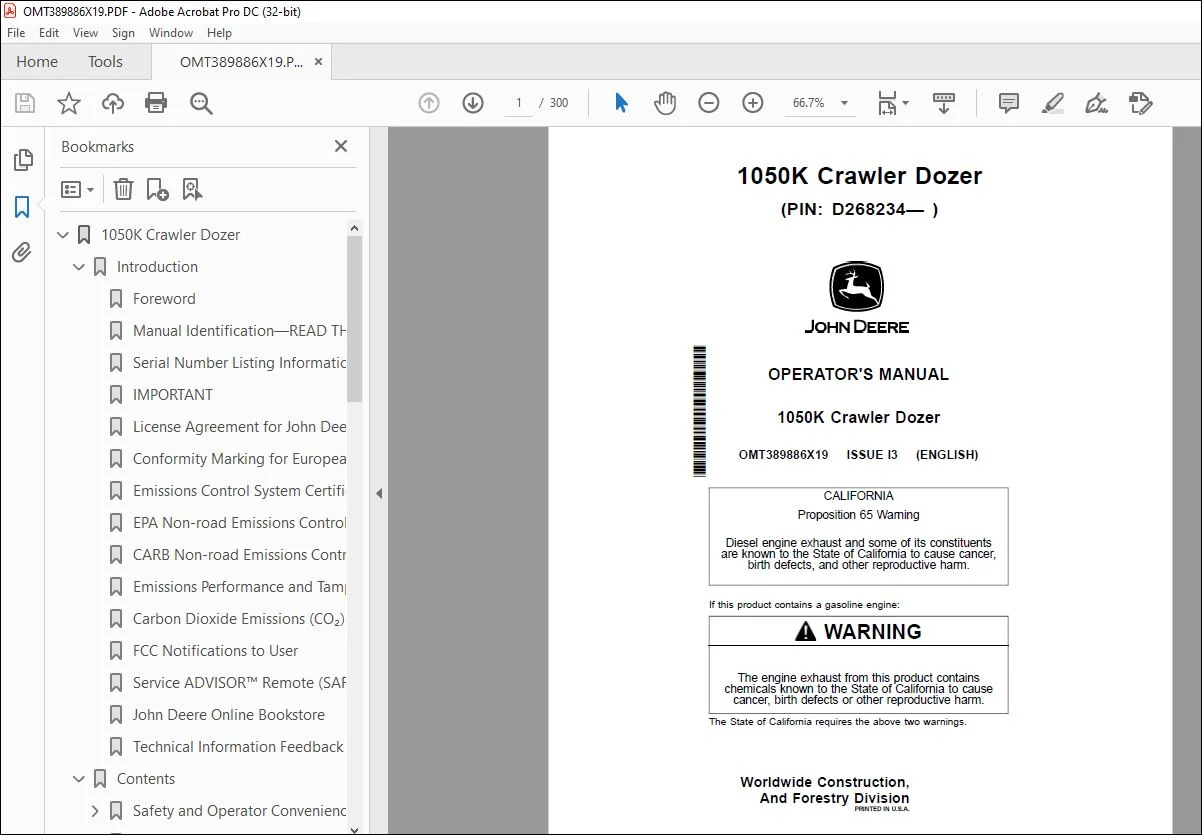
John Deere 1050K Crawler Dozer Operator’s Manual OMT389886X19 PDF
$28.95
John Deere 1050K Crawler Dozer Operator’s Manual OMT389886X19 – PDF DOWNLOAD
Description
John Deere 1050K Crawler Dozer Operator’s Manual OMT389886X19 – PDF DOWNLOAD
FILE DETAILS:
John Deere 1050K Crawler Dozer Operator’s Manual OMT389886X19 – PDF DOWNLOAD
- P/N: OMT389886X19_Z4
- Language: English
- Division: Construction
- Product Lines: Crawler Dozers
- Publication Type: Operator’s Manuals
- Associated Models: 1050K
- Serial: 1T01050K_ _D268234—
IMAGES PREVIEW OF THE MANUAL:
TABLE OF CONTENTS:
John Deere 1050K Crawler Dozer Operator’s Manual OMT389886X19 – PDF DOWNLOAD
1050K Crawler Dozer 1
Introduction 2
Foreword 2
Manual Identification—READ THIS FIRST! 2
Serial Number Listing Information 4
IMPORTANT 4
License Agreement for John Deere Software 5
Conformity Marking for European Union (EU), United Kingdom (UKCA), Eurasian Economic Union (EAEU), and Canada (CA) 8
Emissions Control System Certification Label 9
EPA Non-road Emissions Control Warranty Statement—Compression Ignition 10
CARB Non-road Emissions Control Warranty Statement—Compression Ignition 12
Emissions Performance and Tampering 18
Carbon Dioxide Emissions (CO₂) 19
FCC Notifications to User 20
Service ADVISOR™ Remote (SAR)—SOFTWARE TERMS AND CONDITIONS 21
John Deere Online Bookstore 24
Technical Information Feedback Form 25
Contents 27
Safety and Operator Conveniences 31
Safety and Operator Convenience Features 31
Safety—General Precautions 32
Information for European Union Directives and Eurasian Economic Union Technical Regulations Compliance 32
Recognize Safety Information 34
Follow Safety Instructions 35
Operate Only If Qualified 35
Wear Protective Equipment 35
Protect Against Noise 36
Avoid Unauthorized Machine Modifications 36
Inspect Machine 36
Stay Clear of Moving Parts 36
Avoid High-Pressure Fluids 37
Avoid High-Pressure Oils 37
Work In Ventilated Area 37
Avoid Static Electricity Risk When Refueling 38
High Debris Applications 38
Prevent Fires, Clean Debris From Machine 39
In Case of Machine Fire 39
Prevent Battery Explosions 40
Handle Chemical Products Safely 40
Handle Starting Fluid Safely 40
Decommissioning — Proper Recycling and Disposal of Fluids and Components 41
Prepare for Emergencies 41
Clean Debris from Machine 42
Add Cab Guarding for Special Uses 42
Safety—Operating Precautions 43
Use Steps and Handholds Correctly 43
Start Only From Operator’s Seat 43
Use and Maintain Seat Belt 43
Prevent Unintended Machine Movement 44
Avoid Work Site Hazards 45
Keep Riders Off Machine 45
Avoid Backover Accidents 46
Avoid Machine Tip Over and Machine Damage 47
Use Special Care When Operating 47
Inspect and Maintain ROPS 48
Travel Safely 48
Prevent Acid Burns 49
Add and Operate Attachments Safely 49
Safety—Maintenance Precautions 50
Park and Prepare for Service Safely 50
Service Machines Safely 50
Service Cooling System Safely 50
Remove Paint Before Welding or Heating 51
Make Welding Repairs Safely 51
Drive Metal Pins Safely 51
Use Proper Lifting Equipment 52
Safety—Safety Signs and Other Instructions 53
Safety Signs and Other Instructions 53
Operation—Operator’s Station 59
Primary Display Unit (PDU) Functions 59
Sealed Switch Module (SSM) Functions 62
Transmission Control Lever 64
Blade Control Lever 64
Auxiliary Control Switches—If Equipped 65
Using Park Lock Levers 66
Heating and Air Conditioning System 67
Seat Adjustment 68
Seat Heater—If Equipped 68
Under Seat Heater 69
Windshield Wipers and Washers 70
Work and Drive Lights 71
Reversing Fan 71
Horn 72
Dome Light 72
Radio—If Equipped 73
Auxiliary Power Outlets 75
Door Latch 76
Alternative Exits—Cab Units 77
Cab Windows 78
Fire Extinguisher Mounting Location 78
Beacon Light—If Equipped 79
Operation—Operating the Machine 80
Before Starting Work 80
Inspect Machine Daily Before Starting 80
Check Instruments Before Starting 81
Battery Disconnect Switch 82
Engine Break-In Period 82
Engine Block Heater—If Equipped 83
Starting the Engine 84
Engine Warm-Up 86
Cold Weather Warm-Up 86
Cold Start Package—If Equipped 87
Operator Ability 87
Driving the Machine 88
Setting Travel Speed 89
Setting Engine Speed 89
Auto-Idle Operation 90
Economy (ECO) Mode Operation 90
Decelerator/Brake Pedal and Decelerator Mode Switch 91
Stopping the Machine 92
Parking the Machine 93
Hydraulic System Pressure Release 95
Blade Release 95
Service ADVISOR™ Remote (SAR) Software Delivery Process 96
Operating in Water and Mud 96
Operating on Steep Hills 96
Avoid Track Damage 97
Extend Undercarriage Life 97
Hydraulics Enable 98
Changing Blade Pitch 98
Mechanical Angle Blade—If Equipped 101
Operating IGC System—Topcon® Factory Installation, If Equipped 103
Ripper Operation—If Equipped 104
Winch Operation—If Equipped 106
Rear Auxiliary Operation—If Equipped 107
Loading Machine on a Trailer 108
Lifting the Machine 108
Releasing Park Brake to Tow the Machine 110
Operation—Monitor Operation 112
Primary Display Unit (PDU) 112
Main Menu 113
Operation—Stop Watch 113
Operation—Job Timer 113
Operation—Software Update 114
Operation—Final Drive Flushing 114
Diagnostics—Codes 114
Diagnostics—Machine Readings 115
Diagnostics—Engine Readings 115
Diagnostics—Transmission Readings 116
Diagnostics—JDLink Readings 116
Diagnostics—Controller ID 117
Diagnostics—Machine ID 117
Diagnostics—Sealed Switch Module (SSM) 117
Diagnostics—Diagnostic Help Screens 118
Setup—Monitor 118
Setup—Anti-Theft/Security 119
Setup—Machine Preference 120
Setup—Machine Configuration 121
Maintenance—Machine 122
Required Emission-Related Information 122
Diesel Fuel 122
Lubricity of Diesel Fuel 122
Handling and Storing Diesel Fuel 123
Biodiesel Fuel 124
Testing Diesel Fuel 125
Supplemental Diesel Fuel Additives 125
Fuel Filters 125
Minimizing the Effect of Cold Weather on Diesel Engines 126
Diesel Engine Break-In™ Oil 127
Diesel Engine Oil — Tier 3 and Stage IIIA 128
Engine Oil and Filter Service Intervals—Tier 3 and Stage IIIA Engines 129
Diesel Engine Oil Service Interval for Operation at High Altitude 130
Diesel Engine Oil Service Interval for Operation at High Altitude 130
Oil Filters 130
Diesel Engine Coolant (engine with wet sleeve cylinder liners) 131
Water Quality for Mixing with Coolant Concentrate 132
Operating in Warm Temperature Climates 132
Testing Coolant Freeze Point 133
Disposing of Coolant 133
Alternative and Synthetic Lubricants 134
Final Drive and Track Frame Pivot Oil 134
Hydraulic and Hydrostatic Oil 135
Track Rollers, Front Idler, and Carrier Roller Oil 135
Multipurpose Extreme Pressure (EP) Grease 136
Lubricant Storage 136
Mixing of Lubricants 136
Maintenance—Periodic Maintenance 137
Service Machine at Specified Intervals 137
Prepare Machine for Maintenance 137
Check Hour Meter Regularly 139
Fuel Tank 140
Fast Fill Fuel System—If Equipped 140
Fluid Analysis Program Test Kits and 3-Way Coolant Test Kit 140
Service Intervals 141
Required Parts 142
Service Intervals 143
Required Parts 144
Maintenance—As Required 145
Inspect or Replace Belt and Check Automatic Belt Tensioner 145
Replace Primary and Secondary Engine Air Filter Elements 146
Check Air Cleaner Dust Unloader Valve 147
Check and Replace Cab Fresh Air and Recirculation Filter Elements 147
Check and Drain Primary Fuel Filter and Water Separator 148
Check and Drain Auxiliary Fuel Filter and Water Separator 148
Check and Fill Windshield Washer Fluid 149
Inspect and Clean Cooling System 150
Check and Adjust Track Sag 151
Clean and Tighten Battery Terminals 153
Maintenance—Every 10 Hours or Daily 154
Check Coolant Level at Surge Tank 154
Check Engine Oil Level 155
Check Hydraulic System Oil Level 156
Check Hydrostatic Transmission Oil Level 156
Lubricate Pushbeam Dozer Linkage 157
Lubricate Mechanical Outside Angle Dozer Linkage—If Equipped 157
Maintenance—Every 50 Hours 159
Lubricate Right, Left, and Center Crossbar Pivots 159
Lubricate Lift Cylinder Pivots 159
Lubricate Rear Ripper—If Equipped 160
Maintenance—Every 250 Hours 161
Check Inner and Outer Final Drive Oil Level 161
Take Engine Oil Sample 162
Maintenance—Every 500 Hours 163
Replace Primary and Final Fuel Filters 163
Replace Auxiliary Fuel Filter 164
Drain Water and Sediment From Fuel Tank 165
Drain and Refill Engine Oil and Replace Filter 166
Check Hybrid Battery Electrolyte Level—If Equipped 167
Flush and Drain Final Drive Seal Cavity Oil 169
Take Fluid Samples 169
Maintenance—Every 1000 Hours 170
Replace Cab Fresh Air and Recirculation Filters 170
Drain and Refill Inner and Outer Final Drive Oil 171
Check and Refill Track Frame Pivot Shaft Bushing Oil 172
Check Air Intake Hoses and Connections 173
Check Coolant Condition 173
Maintenance—Every 2000 Hours 174
Drain and Refill Hydraulic System Oil and Replace Filter 174
Replace Hydraulic Fan Drive System Oil Filter 175
Replace Hydraulic Tank Breather 175
Replace Fuel Tank Breather 176
Drain and Refill Transmission Oil and Replace Hydrostatic Charge Oil Filter 177
Replace Hydrostatic Tank Breather 178
Check and Adjust Engine Valve Lash 178
Maintenance—Every 6000 Hours 179
Drain and Refill Engine Cooling System 179
Miscellaneous—Machine 181
Clean Machine Regularly 181
Pushbeams and Blade Installation 181
Operator’s Station Tilting Procedure 198
Verified Anchor Point Information 201
Quick Service Connectors—If Equipped 202
Draining Fuel From Fuel Tank 203
Bleed Fuel System 203
Replacing Ripper Teeth—If Equipped 204
Track Shoe Cap Screw Torque 204
Track Shoe Cap Screw Torque—Master Link 205
Do Not Service or Adjust Injection Nozzles or High-Pressure Fuel Pump 205
Track Sag General Information 205
Do Not Service Control Valves, Cylinders, Pumps, or Motors 206
Precautions for Alternator and Regulator 206
Handling, Checking, and Servicing Batteries Carefully 206
Using Battery Charger 208
Using Booster Batteries—24-Volt System 210
Removing Batteries 210
Replacing Batteries 211
Welding on Machine 211
Keep Electronic Control Unit Connectors Clean 211
Replacing Fuses 212
Resetting Circuit Breaker 214
Checking Park Lock Start System 214
Checking Transmission Start System 215
Keep ROPS Installed Properly 215
JDLink™ Machine Monitoring System (MMS) 215
Fluid Sampling Test Ports 216
Replacing Seat Belt 217
Remove and Install Halogen Bulbs 218
Checking Idlers and Rollers for Oil Leakage 218
Track Sag General Information 219
Check Track Shoe Hardware 220
Hardware Torque Specifications 220
Unified Inch Bolt and Screw Torque Values 221
Metric Bolt and Screw Torque Values 222
Miscellaneous—Operational Checkout 223
Operational Checkout 223
Miscellaneous—Troubleshooting 270
Troubleshooting Procedure 270
Engine 271
Electrical System 274
Hydraulic System 276
Hydrostatic Transmission System 277
Air Conditioning System 278
Heater System 279
Software Update 279
Miscellaneous—Storage 280
Prepare Machine for Storage 280
Monthly Storage Procedure 281
Miscellaneous—Machine Numbers 282
Record Product Identification Number (PIN) 282
Record Engine Serial Number 282
Keep Proof of Ownership 282
Keep Machines Secure 283
Miscellaneous—Specifications 284
Crawler Dozer Dimensions 284
Crawler Dozer Specifications 286
Crawler Dozer Weights 287
Ripper Dimensions 288
Crawler Dozer Drain and Refill Capacities 289
Eurasian Economic Union 290
Machine Design Life 290
Page Number 31
Section 1-1 31
Section 1-2 32
Section 1-3 43
Section 1-4 50
Section 1-5 53
Section 2-1 59
Section 2-2 80
Section 2-3 112
Section 3-1 122
Section 3-2 137
Section 3-3 145
Section 3-4 154
Section 3-5 159
Section 3-6 161
Section 3-7 163
Section 3-8 170
Section 3-9 174
Section 3-10 179
Section 4-1 181
Section 4-2 223
Section 4-3 270
Section 4-4 280
Section 4-5 282
Section 4-6 284
S.V 04/24