John Deere 244H Loader Operators Manual – PDF DOWNLOAD
$28.95
John Deere 244H Loader Operators Manual – PDF DOWNLOAD
Description
John Deere 244H Loader Operators Manual – PDF DOWNLOAD
FILE DETAILS:
John Deere 244H Loader Operators Manual – PDF DOWNLOAD
Division: Construction
Product Lines: Loaders
Publication Type: Operator’s Manuals
Associated Models: 244H
Series: H SERIES
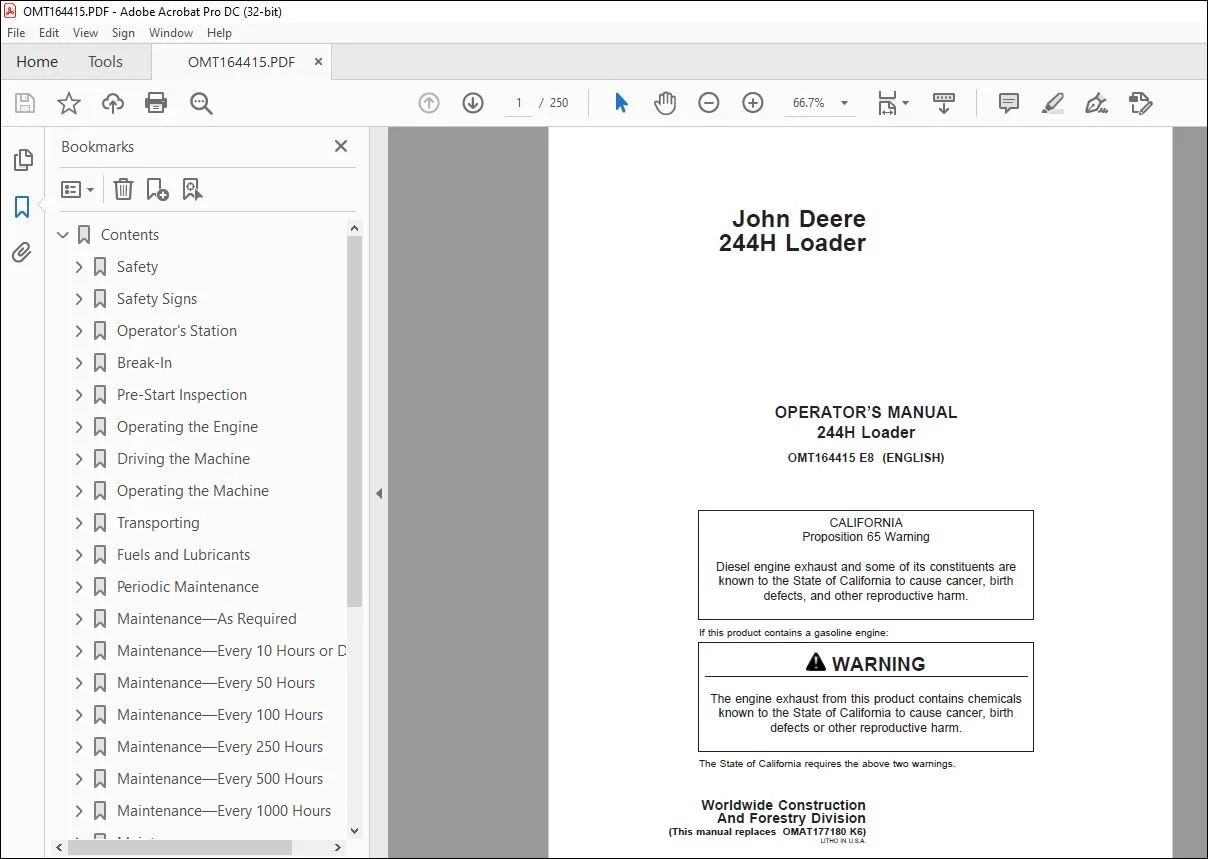
IMAGES PREVIEW OF THE MANUAL:
TABLE OF CONTENTS:
John Deere 244H Loader Operators Manual – PDF DOWNLOAD
Contents 5
Safety 9
Safety 9
Recognize Safety Information 10
Understand Signal Words 10
Follow Safety Instructions 10
Avoid Injury from Rollover Accidents Wear Your Seat Belt Do Not Attempt to Jump Clear of Tipping Machine Serious or Fatal Crushing Injuries Will Result 11
Avoid Injury from Backover Accidents Before Moving Machine, be Sure All Persons are Clear of Area Always be Alert for Bystanders Moving into the Work Area Use Horn or Other Signal to W 12
Avoid Injury from Rollaway Accidents To Prevent Rollaway, Always Make Sure Machine is Properly Secured Before Leaving Operator’s Seat Death or Serious Injury May Result If You Attempt to Mo 13
Inspect Machine 13
Use Handholds and Steps 14
Prevent Machine Runaway 14
Use Seat Belt Properly 14
Maintain Seat Belt 15
Travel Safely 15
Drive Machine Safely 16
Operate Machine with Caution 16
Operating on Slopes 17
Carrying Loads 17
Avoid Power Lines 18
Beware of Exhaust Fumes 18
Keep Riders Off Machine 18
Handle Fuel Safely—Avoid Fires 19
Prepare for Emergencies 19
Do Not Use Starting Fluid 19
Clean Trash from Machine 20
Protect Against Flying Debris 20
Wear Protective Clothing 20
Protect Against Noise 21
Handle Chemical Products Safely 21
Use Safety Lights and Devices 22
Keep ROPS Installed Properly 22
Warn Others of Service Work 23
Practice Safe Maintenance 24
Support Machine Properly 25
Remove Paint Before Welding or Heating 25
Avoid Heating Near Pressurized Fluid Lines 26
Avoid High Pressure Fluids 26
Clean the Machine Regularly 27
Service Cooling System Safely 27
Store Attachments Safely 27
Dispose of Waste Properly 28
Safety Signs 29
Safety Signs 29
Operator’s Station 39
Indicators and Gauges 39
Engine Oil Pressure Indicator 40
Alternator Voltage Indicator 40
Hydrostatic (HST) and Hydraulic Oil Filter Restriction Indicator 40
Hydrostatic (HST) Oil Temperature Indicator 41
Engine Air Filter Restriction Indicator 41
Brake Oil Level Indicator 41
Park Brake Indicator 41
Hydrostatic (HST) Charge Pressure Indicator 42
Left Turn Signal Indicator 42
Right Turn Signal Indicator 42
Fuel Gauge 42
Engine Coolant Temperature Gauge 43
Engine Pre Heat Indicator 43
Pedals 43
FNR Lever 44
Neutral Lock Lever 44
Turn Signal Lever 45
Park Brake Switch 45
Hydraulic Lock Lever 45
Boom/Bucket Control Lever and Auxiliary Lever—If Equipped 46
Work Lights—If Equipped 46
Flasher Lights 47
Driving Lights 48
High Beam Operation 49
Horn 49
Adjust Seat 49
Heater Blower Switch 50
Heater Shut Off Valve 50
Heat Ventilation Lever 50
Mirrors 50
Opening Right Side Window 51
Operating Windshield Wiper and Washer 51
Dome Light 52
Cab Door Release 52
Operator’s Manual Holder 52
Seat Belt 53
Break In 54
Observe Engine Operation Closely 54
After the First 10 Hours 54
After the First 50 Hours 55
After the First 100 Hours 55
Pre Start Inspection 56
Inspect Machine Before Starting 56
Operating the Engine 57
Check Instruments Before Starting 57
Starting the Engine 57
Engine Oil Pressure Indicator 58
Using Booster Batteries—24 Volt System 59
Check Instruments After Starting 59
Cold Weather Starting (Below 5°C Æ25°Fš) 60
Engine Warm Up 60
Cold Weather Warm Up 60
Stopping the Engine 61
Driving the Machine 62
Driving on Public Roads 62
General Driving Precautions 62
HI LO Transmission 63
Travel Speeds 63
Neutral Lock Lever 64
Stopping the Machine 64
Parking the Machine 65
Lock All Compartments 66
Operating the Machine 67
Boom and Bucket Control Lever 67
Service Brake/Inching Pedals 68
Adjust Return to Dig 69
General Operating Tips 70
Excavating Banks or Stockpiles 70
Using the Loader Bucket 71
Backdragging 72
Truck Loading 73
Transporting 74
Transporting Precautions 74
Loading Machine on a Trailer 74
Towing Procedure—Engine Operational 75
Procedure For Towing Machine Less Than 460 M (500 Yd)—Engine Non Operational 76
Procedure For Towing Machine More Than 460 M (500 Yd)—Engine Non Operational 78
Lifting the Machine 80
Fuels and Lubricants 81
Diesel Fuel 81
Low Sulfur Diesel Fuel Conditioner 81
Lubricity of Diesel Fuels 82
Handling and Storing Diesel Fuel 82
Do Not Use Galvanized Containers 83
Fuel Tank 83
Diesel Engine Oil 84
Transmission Oil, Hydraulic System, Park Brake, and Differential Oil 85
Brake Oil 86
Grease 87
Alternative and Synthetic Lubricants 88
Lubricant Storage 88
Mixing of Lubricants 89
Periodic Maintenance 90
Service Your Machine at Specified Intervals 90
Check the Service Meter Regularly 90
Use Correct Fuels and Lubricants 90
Prepare Machine for Maintenance 91
Locking Machine Frame 92
Opening Hood 93
Removing Service Access Panel 93
Maintenance and Repair Record Keeping System 94
OILSCAN Plus® andCoolScan Plus™ 95
Maintenance and Repair Record Keeping System 96
Maintenance—As Required 99
Check Air Cleaner 99
Clean or Replace Air Cleaner Elements 99
Clean Dusty Primary Element 100
Inspect Element 101
Check Tire Pressure 102
Drain Fuel Tank Sump and Clean Strainer 103
Inspect Belt, Check and Adjust Tension 104
Maintenance—Every 10 Hours or Daily 105
Check Fuel Tank Level 105
Check Radiator Coolant Level 105
Check HI LO Transmission Oil Level 106
Check Hydrostatic/Hydraulic Oil Level 107
Check Engine Oil Level 108
Grease Front Driveline Support Bearing 109
Maintenance—Every 50 Hours 110
Grease Loader Linkage and Cylinder Pivots 110
Grease Frame Hinge Pivots 111
Maintenance—Every 100 Hours 112
Grease Steering Cylinder Pivots 112
Grease Transmission to Front Differential Telescoping Shaft 112
Maintenance—Every 250 Hours 113
Grease Oscillating Rear Axle 113
Change Engine Oil and Replace Filter 113
Maintenance—Every 500 Hours 115
Check Air Intake Hoses 115
Check Battery Electrolyte Level and Terminals 115
Replace HI LO Transmission Filter 117
Replace Hydrostatic (HST) Oil Filter 119
Replace Hydraulic System Oil Filter 120
Replace Fuel Filter 121
Check Front and Rear Differential Oil Level 122
Maintenance—Every 1000 Hours 123
Replace Air Cleaner Elements 123
Change HI LO Transmission Oil and Replace Filter 124
Drain and Flush the Cooling System 126
Fill the Cooling System 128
Engine Coolant 129
Test the Coolant Freeze—Protection Level 129
Drain HST/Hydraulic Oil and Clean Strainer 130
Clean Engine Crankcase Vent Tube 132
Check and Adjust Engine Valve Lash (Clearance) 133
Check Engine Speeds 135
Grease Transmission to Differential Drivelines 135
Change Front and Rear Differential Oil 136
Maintenance 137
Do Not Service Injection Nozzles 137
Do Not Adjust Injection Pump 137
Do Not Service Control Valves, Cylinders, Pumps or Motors 137
Adjusting Engine Speed Linkage 138
Service Batteries Carefully 139
Adding 12 Volt Accessories 141
Precautions for Alternator and Regulator 142
Checking Electrolyte Specific Gravity 143
Using Battery Charger 144
Replacing Batteries 145
Removing Battery 145
Replacing Fuses 146
Checking Neutral Start System 147
Park Brake Adjustment 148
Changing Brake Oil 148
Do Not Service Control Valves, Cylinders, Pumps or Motors 150
Hardware Torque Specifications 150
Metric Bolt and Cap Screw Torque Values 151
Additional Metric Cap Screw Torque Values 152
Unified Inch Bolt and Cap Screw Torque Values 154
Check Oil Lines and Fittings 155
Service Recommendations for O Ring Boss Fittings 156
Service Recommendations for Flat Face O Ring Seal Fittings 158
Service Recommendations for Metric Series Four Bolt Flange Fitting 159
Service Recommendations for Inch Series Four Bolt Flange Fittings 160
Operational Checkout 162
Operational Checkout 162
Gauge and Indicator Checks 162
Transmission and Engine Linkages, Neutral Start Switch, and Reverse Warning Alarm Switch Checks 166
Gauge and Indicator Checks—Engine Running 168
Brake System and Transmission Lockout Checks 170
Steering System Checks 173
Driving Checks 175
Hydraulic System Checks 178
Accessory Checks 181
Cab Component and Vandal Protection Checks 185
Troubleshooting 189
Using Troubleshooting Charts 189
Engine 190
Hydraulic System 199
Steering System 202
Transmission 205
Brake System 209
Axle and Differential System 210
Electrical System 211
Storage 221
Prepare Machine for Storage 221
Monthly Storage Procedure 223
Machine Numbers 225
Record Product Identification Number (PIN) 225
Record Engine Serial Number 225
Record Transmission Serial Number 225
Record HST Pump Serial Number 225
Specifications 226
244H Specifications 226
Refill Capacities 230
Operating Information 231
Crime Prevention Tips 232
Help Prevent Crime 232
Record Identification Numbers 232
Keep Proof of Ownership 232
Park Indoors Out of Sight 232
When Parking Outdoors 233
Reduce Vandalism 233
Report Thefts Immediately 234
John Deere Service Literature Available 241
Technical Information 241
Checklists 243
Maintenance and Repair Record Keeping System 243
John Deere Service Keeps You On The Job 247
John Deere Is At Your Service When You Need It 247
S.V 03/24