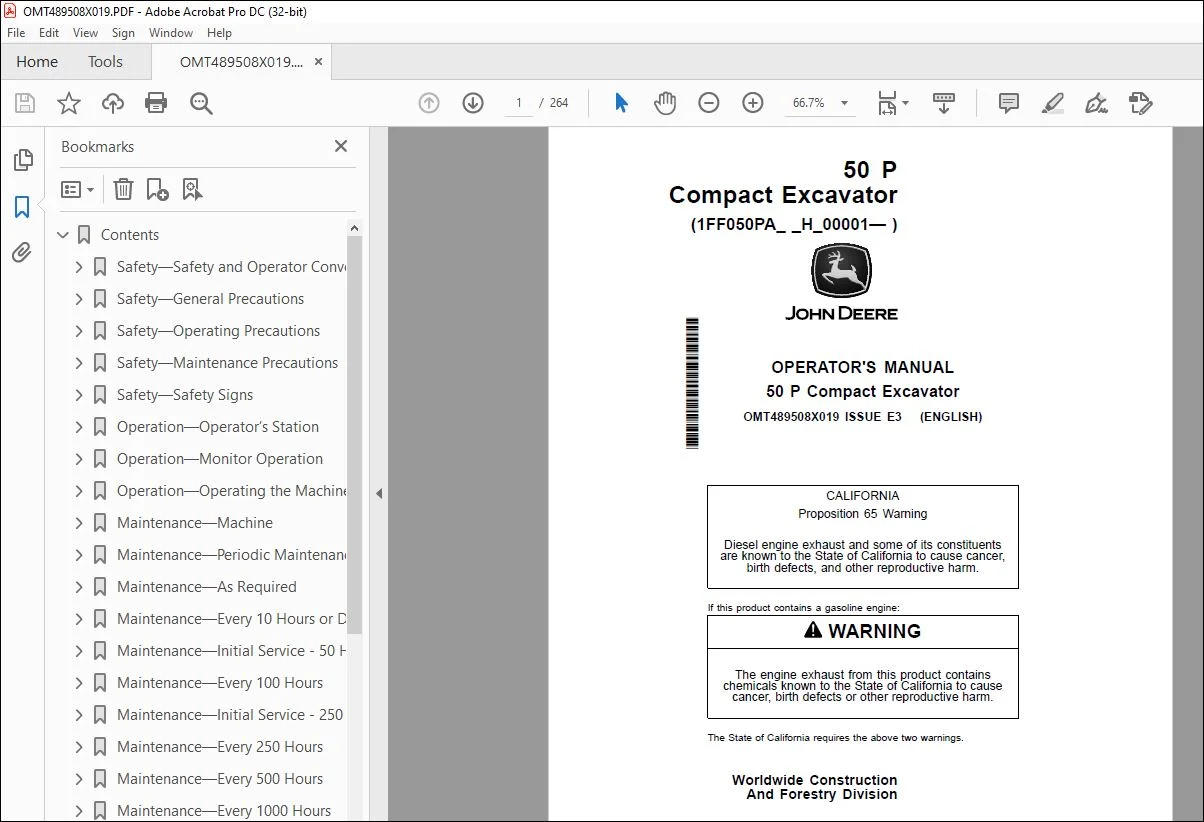
John Deere 50 P Compact Excavator Operator’s Manual – PDF DOWNLOAD
$28.95
John Deere 50 P Compact Excavator Operator’s Manual – PDF DOWNLOAD
Description
John Deere 50 P Compact Excavator Operator’s Manual – PDF DOWNLOAD
FILE DETAILS:
John Deere 50 P Compact Excavator Operator’s Manual – PDF DOWNLOAD
P/N: OMT489508X019_63
Language: English
Division: Construction
Product Lines: Excavators
Publication Type: Operator’s Manuals
Associated Models: 50 P
Serial Range: 1FF050PA_H_00001
IMAGES PREVIEW OF THE MANUAL:
TABLE OF CONTENTS:
John Deere 50 P Compact Excavator Operator’s Manual – PDF DOWNLOAD
Contents 13
Safety—Safety and Operator Conveniences 17
Safety and Operator Convenience Features 17
Safety—General Precautions 18
Recognize Safety Information 18
Follow Safety Instructions 18
Operate Only If Qualified 18
Wear Protective Equipment 19
Avoid Unauthorized Machine Modifications 19
Control Pattern Selector—If Equipped 19
Add Cab Guarding for Special Uses 19
Inspect Machine 20
Stay Clear of Moving Parts 20
Avoid High-Pressure Oils and Fluids 20
Work In Ventilated Area 21
Avoid Static Electricity Risk When Refueling 21
Prevent Fires, Clean Debris From Machine 22
Prevent Battery Explosions 22
Handle Chemical Products Safely 23
Decommissioning — Proper Recycling and Disposal of Fluids and Components 23
Exhaust Filter Ash Handling and Disposal 23
Prepare for Emergencies 24
Clean Debris from Machine 24
Safety—Operating Precautions 25
Use Steps and Handholds Correctly 25
Start Only From Operator’s Seat 25
Use and Maintain Seat Belt 25
Prevent Unintended Machine Movement 26
Avoid Work Site Hazards 26
Keep Riders Off Machine 27
Avoid Backover Accidents 27
Avoid Machine Tip Over and Machine Damage 28
Inspect and Maintain ROPS 28
Prevent Acid Burns 29
Travel Safely 29
Use Special Care When Lifting Objects 30
Add and Operate Attachments Safely 30
Safety—Maintenance Precautions 31
Park and Prepare for Service Safely 31
Service Cooling System Safely 31
Remove Paint Before Welding or Heating 32
Make Welding Repairs Safely 32
Drive Metal Pins Safely 32
Clean Exhaust Filter Safely 33
Safety—Safety Signs 34
Safety Signs 34
Operation—Operator’s Station 40
Right Console—Cab 40
Right Console—Canopy 40
Key Switch 41
Pedals and Levers 41
Engine Speed Dial 42
Horn 42
Pilot Shutoff Lever 43
Travel Alarm Cancel Switch 43
Exhaust Filter Parked Cleaning Switch 44
Cab Heater and Air Conditioner—If Equipped 45
Operating AM/FM Radio—If Equipped 48
Cab Dome Light—If Equipped 50
Door Release Lever—If Equipped 50
Front (Alternative Exit) Window—If Equipped 51
Removing Lower Front Window—If Equipped 52
Fire Extinguisher Mounting Location 52
Alternative Exit Tool—If Equipped 53
Opening Right Side Window—If Equipped 53
Adjusting Operator Seat 54
Toolbox and Operator’s Manual Compartment 55
Operation—Monitor Operation 56
Monitor 56
Monitor Functions 57
Monitor Start-Up 58
Menu 59
Menu—Alarm List 60
Menu—Auto-Shutdown 63
Menu—Auto Exhaust Filter Cleaning 64
Menu—Clock 65
Menu—Trip 66
Menu—Brightness Adjustment 67
Operation—Operating the Machine 68
Operating in High Altitude 68
Before Starting Work 68
Inspect Machine Daily Before Starting 68
Engine Break-In Period 69
Starting the Engine 69
Starting the Engine in Cold Weather 70
Checking Instruments After Starting 71
Warm-Up Operation 71
Cold Weather Warm-Up 72
Operate Within Machine Limits 72
Digging and Grading Operation 73
Travel Pedals and Levers 74
Exhaust Filter 75
Exhaust Filter Parked Cleaning 77
Control Lever Pattern Operation 79
Control Lever Pattern Conversion 80
Multi-Function Control Lever 81
Boom-Swing Pedal 82
Positioning Auxiliary Line Selector Valve 83
Operating Backfill Blade 84
Operating Angle Blade—If Equipped 85
Operating Tips—Backfill Blade 85
Operating in Water and Mud 85
Selecting Correct Track 85
Driving Up a Steep or Slippery Slope 86
Lower Boom With Engine Stopped 86
Parking the Machine 88
Loading Machine for Transport 89
Recovery Procedure 92
Lifting 93
Lifting Machine 94
Maintenance—Machine 95
Required Emission-Related Information 95
Diesel Fuel 95
Diesel Fuel Specifications 96
Lubricity of Diesel Fuel 96
Biodiesel Fuel 97
Supplemental Diesel Fuel Additives 98
Fuel Filters 98
Minimizing the Effect of Cold Weather on Diesel Engines 99
Testing Diesel Fuel 100
Handling and Storing Diesel Fuel 100
Alternative and Synthetic Lubricants 100
Lubricant Storage 100
Mixing of Lubricants 101
Diesel Engine Oil — Interim Tier 4, Final Tier 4, Stage IIIB, Stage IV, and Stage V 101
Engine Oil and Filter Service Intervals — Interim Tier 4, Final Tier 4, Stage IIIB, Stage IV, and Stage V Engines 102
Diesel Engine Oil Service Interval for Operation at High Altitude 102
Oil Filters 103
Hydraulic Oil 103
Travel Gear Case Oil 104
Grease 105
Diesel Engine Coolant (engine without wet sleeve cylinder liners) 106
Water Quality for Mixing with Coolant Concentrate 107
Supplemental Coolant Additives 107
Operating in Warm Temperature Climates 108
Testing Coolant Freeze Point 108
Disposing of Coolant 109
Maintenance—Periodic Maintenance 110
Service Machine at Specified Intervals 110
Check the Hour Meter Regularly 110
Prepare Machine for Maintenance 111
Engine Access Door 112
Open Maintenance Access Doors 113
Tilting Operator’s Station 114
Fuel Tank 118
Check Windshield Washer Fluid Level—If Equipped 119
Hydraulic Breaker and Crusher Attachments 119
Fluid Analysis Program Test Kits and 3-Way Coolant Test Kit 120
Service Intervals 121
Required Parts 122
Maintenance—As Required 123
Clean Radiator Core and Oil Cooler 123
Check and Clean Air Cleaner Dust Unloader Valve 123
Replace Engine Air Filter 124
Check and Adjust Air Conditioner Belt—If Equipped 125
Check Track Sag—Rubber Track 126
Check Track Sag—Steel Track—If Equipped 127
Adjust Track Sag 128
Clean and Tighten Battery Terminals 128
Maintenance—Every 10 Hours or Daily 129
Check Engine Oil Level 129
Check Hydraulic Tank Oil Level 130
Drain Water and Sediment from Fuel Tank Sump 131
Drain Water and Sediment from Primary Fuel Filter and Water Separator 131
Check Engine Coolant Level 132
Check Bucket Teeth 132
Check Seat Belt 132
Lubricate Bucket and Link Pins 133
Lubricate Front End Pin Joints 134
Maintenance—Initial Service – 50 Hours 135
Check and Adjust Fan Belt Tension 135
Maintenance—Every 100 Hours 136
Lubricate Bucket and Link Pins 136
Lubricate Front End Pin Joints 137
Check and Adjust Fan Belt Tension 138
Maintenance—Initial Service – 250 Hours 139
Replace Hydraulic Tank Oil Filter 139
Maintenance—Every 250 Hours 141
Lubricate Swing Bearing 141
Check Travel Gear Case Oil Level 141
Drain Water and Sediment from Hydraulic Tank 142
Take Engine Oil Sample 142
Maintenance—Every 500 Hours 143
Drain and Refill Engine Oil and Replace Filter 143
Lubricate Front End Pin Joints 144
Lubricate Swing Bearing Gear 145
Lubricate Control Lever Universal Joint 145
Lubricate Blade Pins 146
Replace Primary Fuel Filter and Water Separator 147
Replace Final Fuel Filter 148
Replace Hydraulic Tank Oil Filter 149
Take Fluid Samples 150
Maintenance—Every 1000 Hours 151
Replace Pilot System Oil Filter 151
Drain and Refill Travel Gear Case Oil 152
Check and Adjust Engine Valve Lash 153
Check Starter and Alternator 153
Maintenance—Every 2000 Hours 154
Drain and Refill Hydraulic Tank Oil 154
Drain Cooling System 157
Cooling System Fill and Deaeration Procedure 158
Maintenance—Every 3000 Hours 159
Service Exhaust Filter 159
Miscellaneous—Machine 160
Bleed Fuel System 160
Do Not Service or Adjust Injection Nozzles or High-Pressure Fuel Pump 160
Do Not Service Control Valves, Cylinders, Pumps, or Motors 160
Precautions for Alternator and Regulator 161
Using Booster Batteries—12-Volt System 161
Handling, Checking, and Servicing Batteries Carefully 162
Using Battery Charger 163
Replacing the Battery 165
Welding On Machine 165
Bleed Hydraulic System 166
Clean Machine Regularly 167
12 Volt Auxiliary Power Outlet 167
Connecting and Disconnecting Auxiliary Lines 168
Replacing Fuses 170
Clean Cab Fresh Air and Cab Recirculating Air Filters—If Equipped 171
Replacing Bucket Teeth 172
Replacing Bucket Teeth—TK Series 173
Installing Bucket With Quick Coupler 174
Track Sag General Information 175
Check Track Shoe Hardware 175
Rubber Track Care 176
Removing and Installing Rubber Track 176
Converting the Track 177
Hardware Torque Specifications 177
Unified Inch Bolt and Screw Torque Values 178
Metric Bolt and Screw Torque Values 179
Miscellaneous—Operational Checkout 180
Operational Checkout 180
Diagnostic Trouble Code Check 180
Operational Checks—Key Switch Off, Engine Off Checks 180
Operational Checks—Key Switch On, Engine Off Checks 181
Operational Checks—Key Switch On, Engine On Checks 190
Miscellaneous—Troubleshooting 219
Troubleshooting Procedure 219
Engine 220
Electrical System 225
Hydraulic System 228
Miscellaneous—Storage 230
Prepare Machine for Storage 230
Monthly Storage Procedure 231
Miscellaneous—Serial Numbers 232
Record Product Identification Number (PIN) 232
Record Engine Serial Number 232
Keep Proof of Ownership 232
Keep Machines Secure 233
Miscellaneous—Specifications 234
Engine Specifications 234
Drain and Refill Capacities 234
Machine Specifications 235
Working Ranges 237
Excavator Lift Capacity—KG (LB ) (Canopy, Standard Arm, Standard Counterweight, and Rubber Track with Blade) 239
Excavator Lift Capacity—KG (LB ) (Canopy, Standard Arm, Standard Counterweight, and Steel Track with Blade) 240
Excavator Lift Capacity—KG (LB ) (Canopy, Long Arm, Standard Counterweight, and Rubber Track with Blade) 241
Excavator Lift Capacity—KG (LB ) (Canopy, Long Arm, Standard Counterweight, and Steel Track with Blade) 242
Excavator Lift Capacity—KG (LB ) (Canopy, Standard Arm, Extra Counterweight, and Rubber Track with Blade) 243
Excavator Lift Capacity—KG (LB ) (Canopy, Standard Arm, Extra Counterweight, and Steel Track with Blade) 244
Excavator Lift Capacity—KG (LB ) (Canopy, Long Arm, Extra Counterweight, and Rubber Track with Blade) 245
Excavator Lift Capacity—KG (LB ) (Canopy, Long Arm, Extra Counterweight, and Steel Track with Blade) 246
Excavator Lift Capacity—KG (LB ) (Cab, Standard Arm, Standard Counterweight, and Rubber Track with Blade) 247
Excavator Lift Capacity—KG (LB ) (Cab, Standard Arm, Standard Counterweight, and Steel Track with Blade) 248
Excavator Lift Capacity—KG (LB ) (Cab, Long Arm, Standard Counterweight, and Rubber Track with Blade) 249
Excavator Lift Capacity—KG (LB ) (Cab, Long Arm, Standard Counterweight, and Steel Track with Blade) 250
Excavator Lift Capacity—KG (LB ) (Cab, Standard Arm, Extra Counterweight, and Rubber Track with Blade) 251
Excavator Lift Capacity—KG (LB ) (Cab, Standard Arm, Extra Counterweight, and Steel Track with Blade) 252
Excavator Lift Capacity—KG (LB ) (Cab, Long Arm, Extra Counterweight, and Rubber Track with Blade) 253
Excavator Lift Capacity—KG (LB ) (Cab, Long Arm, Extra Counterweight, and Steel Track with Blade) 254
Page Number 13
Section 1-1 17
Section 1-2 18
Section 1-3 25
Section 1-4 31
Section 1-5 34
Section 2-1 40
Section 2-2 56
Section 2-3 68
Section 3-1 95
Section 3-2 110
Section 3-3 123
Section 3-4 129
Section 3-5 135
Section 3-6 136
Section 3-7 139
Section 3-8 141
Section 3-9 143
Section 3-10 151
Section 3-11 154
Section 3-12 159
Section 4-1 160
Section 4-2 180
Section 4-3 219
Section 4-4 230
Section 4-5 232
Section 4-6 234
S.V 04/24