John Deere 750 Excavator Operator’s Manual – PDF DOWNLOAD
$28.95
John Deere 750 Excavator Operator’s Manual – PDF DOWNLOAD
Description
John Deere 750 Excavator Operator’s Manual – PDF DOWNLOAD
FILE DETAILS:
John Deere 750 Excavator Operator’s Manual – PDF DOWNLOAD
Division: Construction
Product Lines: Excavators
Publication Type: Operator’s Manuals
Associated Models: 750
Series: METRIC
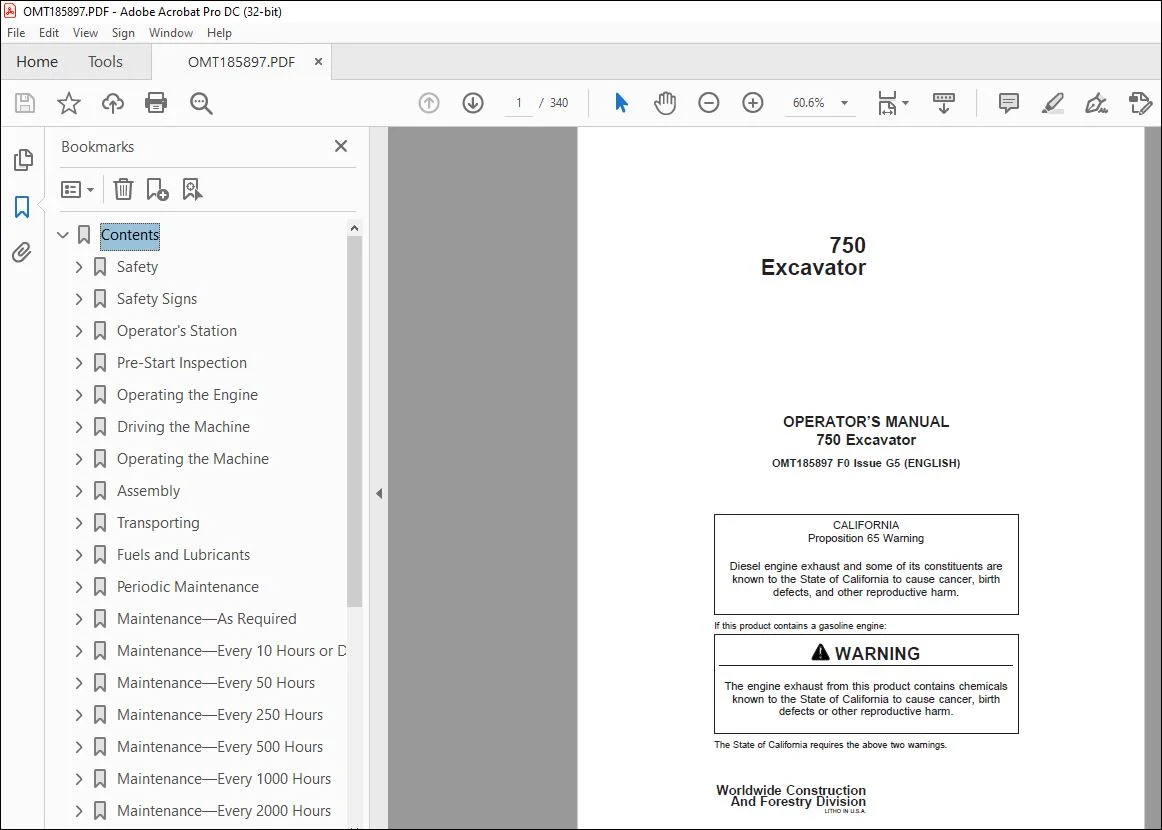
IMAGES PREVIEW OF THE MANUAL:
TABLE OF CONTENTS:
John Deere 750 Excavator Operator’s Manual – PDF DOWNLOAD
Contents 5
Safety 9
John Deere Excavator Safety Features 9
Recognize Safety Information 10
Understand Signal Words 10
Follow Safety Instructions 10
Avoid Injury from: Loading Machine on a Trailer, Fastening Machine to Trailer, Unloading Machine from Trailer Always Use Caution When Loading and Unloading Machines on a Trailer Always 11
Avoid Injury from Backover Accidents Before Moving Machine, Be Sure All Persons Are Clear of Area Always Be Alert for Bystanders Moving Into the Work Area Use Horn or Other Signal to W 12
Avoid Injury from Rollaway Accidents To Prevent Rollaway, Always Make Sure Machine Is Properly Secured Before Leaving Operator’s Seat Death or Serious Injury May Result If You Attempt to Mo 13
Inspect Machine 13
Use Handholds and Steps 14
Use Seat Belt 14
Maintain Seat Belt 15
Move and Operate Machine Safely 15
Operate Only from Operator’s Seat 16
Secondary Exits 16
Operate Machine Safely 16
Dig with Caution 17
Operate with Caution 17
Avoid Tipping 17
Avoid Power Lines 18
Drive Machine Safely 18
Beware of Exhaust Fumes 18
Park Machine Safely 19
Keep Riders Off Machine 19
Operate Attachment Safely 20
Handle Fluids Safely—Avoid Fires 20
Prepare for Emergencies 21
Handle Starting Fluid Safely 21
Clean Trash from Machine 21
Protect Against Flying Debris 22
Wear Protective Clothing 22
Protect Against Noise 22
Handle Chemical Products Safely 23
Warn Others of Service Work 23
Stay Clear of Moving Parts 24
Support Machine Properly 24
Service Cooling System Safely 24
Practice Safe Maintenance 25
Remove Paint Before Welding or Heating 26
Avoid Heating Near Pressurized Fluid Lines 26
Avoid High Pressure Fluids 27
Prevent Battery Explosions 27
Clean the Machine Regularly 28
Store Attachments Safely 28
Dispose of Waste Properly 29
Safety Signs 30
Safety Signs 30
Operator’s Station 37
Pedals, Levers, and Panels 37
Right Front Panel and Right Console Panel 38
Monitor Panel 39
Engine Coolant Temperature Gauge 39
Warm Up Indicator 39
Fuel Gauge 40
S/P (Super Power) Mode Indicator 40
E (Economy) Mode Indicator 40
Auto Idle Indicator 40
Coolant Level Indicator (Warning) 41
Hydraulic Oil Level Indicator 41
Fuel Level Indicator 41
Air Filter Restriction Indicator 42
Operating Lights Indicator 42
Quick Idle Indicator 42
Engine Coolant Temperature Indicator 43
Engine Oil Pressure Indicator 43
Alternator Voltage Indicator 43
Engine Oil Level Indicator 44
Coolant Level Indicator 44
Switch Panel 44
Buzzer Stop Switch 45
Wiper Switch 45
Washer Switch 46
Operating Lights Switch 46
Quick Idle Switch 47
Key Switch 47
Engine RPM Dial 47
Cab Heater and Air Conditioner 48
Control Panel Switches 49
Cab Heater Operation 50
Air Conditioner Operation 51
Defroster Operation 51
Cab Door Release Lever 52
Left Side Console 52
Setting the Clock 52
Operating the AM/FM Radio 53
Horn 53
Hour Meter 53
Cab Light 54
Secondary Exit Tool 54
Opening Upper Front (Secondary Exit) Window 54
Closing Upper Front Window 55
Removing and Storing the Lower Front Window 56
Opening Side Windows 57
Opening and Closing the Roof Exit Cover 57
Adjusting the Seat 58
Adjusting the Armrest 58
Seat Belt 59
Operator’s Manual Compartment 59
Pre Start Inspection 60
Inspect Machine Daily Before Starting 60
Operating the Engine 61
Check Instruments Before Starting 61
Level Check 62
Starting the Engine 62
Using Booster Batteries—24 Volt System 63
Starting Fluid—If Equipped (Cold Weather Start Aid) 63
Check Instruments After Starting 66
Warming the Machine 66
Cold Weather Warm Up 67
Stopping the Engine 68
Driving the Machine 69
Steering the Machine Using Pedals 69
Steering the Machine Using Levers 71
Removing Propel Levers 72
Propel Speed Switch 72
Travel Alarm and Travel Alarm Cancel Switch 73
Parking the Machine 73
Parking Machine During Freezing Weather 74
Lock All Compartments 74
Operating the Machine 75
ISO/SAE Excavator Control Pattern 75
Control Lever Pattern Conversion 76
Deere Backhoe Control Pattern 78
Pilot Control Shut Off Lever 79
Auto Idle Switch 80
Quick Idle Switch 81
Work Mode Selection Switch 82
E (Economy) Mode 83
S/P (Super Power) Mode 84
Standard Mode 84
Operating Tips 85
Select Correct Track Shoes 85
Driving Machine 86
Driving on Slopes 86
Driving Down a Slope 87
Driving Up a Slope 87
Parking the Machine On A Slope 87
Moving Machine Off an Embankment 88
Leveling Machine 89
Using Bucket 89
Grading 91
Planning Spoil Piles 91
Trenching 92
Backfilling 93
Truck Loading 94
Operating in Water and Mud 95
Clean Track Frame Area 95
Lifting 96
Hydraulic Breaker And Crusher Attachments 98
Using Quick Coupler Type Attachments 99
Assembly 100
Precautions for Assembling 100
Precautions for Lifting Work 102
Precautions for Operating Machine 103
Avoid High Pressure Fluids 104
Installation Sequence 105
Installing Boom Cylinder 106
Installing Boom 109
Connecting Hoses Between Boom and Machine 110
Connecting Boom Cylinder Rod 112
Installing Arm 113
Connecting Arm Cylinder Rod 114
Connecting Bucket Cylinder Hoses 115
Installing Bucket 117
Extending the Side Frame 118
Check Hydraulic Oil Level 122
Lubricate Working Tool Pivots 125
Installing Counterweight (Without Hydraulic Removal Option) 126
Counterweight Installation (With Hydraulic Removal Option) 127
Transporting 132
Transporting by Road 132
Transporting the Machine by Trailer 133
Types of Packings for Transportation 135
Packing Dimensions and Weights for Transportation 136
Retracting or Extending the Side Frame 142
Retracting the Side Frame 143
Extending the Side Frame 144
Counterweight Removal—If Equipped 149
Counterweight Installation—If Equipped 154
Fuels and Lubricants 158
Diesel Fuel 158
Lubricity of Diesel Fuels 158
Low Sulfur Diesel Fuel Conditioner 159
Diesel Fuel Storage 159
Fuel Tank 160
Do Not Use Galvanized Containers 160
Diesel Engine Oil 161
Hydraulic Oil 162
Gear Oil 163
Track Roller, Front Idler, and Carrier Roller Oil 163
Track Adjuster, Working Tool Pivot, Swing Bearing, and Swing Bearing Gear Grease 164
Oil Filters 164
Lubricant Storage 165
Alternative and Synthetic Lubricants 165
Mixing of Lubricants 166
Periodic Maintenance 167
Service Your Machine at Specified Intervals Location 167
Check the Hour Meter Regularly 167
Use Correct Fuels and Lubricants 167
Prepare Machine for Maintenance 168
Open Access Doors for Service 169
Open Hood for Service 169
Maintenance and Repair Record Keeping System 170
OILSCAN Plus® COOLSCAN Plus®And 3 Way Coolant Test Kit 171
Maintenance and Repair Record Keeping System 172
Maintenance—As Required 175
Clean Fuel Tank Inlet Screen 175
Drain Fuel Tank Sump 175
Check Air Cleaner Element 176
Clean Radiator Air Inlet Screen 176
Inspect Belts and Check Tension 177
Drain Fuel Filter/Water Separator Sediment 178
Check Track Sag 178
Adjusting Track Sag 180
Windshield Washer Fluid Level 180
Maintenance—Every 10 Hours or Daily 181
Check Recovery Tank Coolant Level 181
Check Engine Oil Level 182
Check Hydraulic Oil Level 183
Maintenance—Every 50 Hours 186
Lubricate Working Tool Pivots 186
Maintenance—Every 250 Hours 187
Check Swing Gearbox Oil Level 187
Clean Air Cleaner Element 188
Inspect Element 189
Check Radiator Coolant Level 190
Check Propel Gearbox Oil Level 191
Battery Filling Precautions 192
Checking Electrolyte Level 193
Change Engine Oil and Replace Filters 195
Check Pump Drive Gearbox Oil Level 196
Drain Hydraulic Tank Sump 197
Replace Fuel Filters/Water Separator 199
Maintenance—Every 500 Hours 200
Lubricate Swing Bearing 200
Lubricate Swing Bearing Gear 201
Check Air Intake Hose 202
Adjust Engine Valve Clearance 202
Replace Hydraulic Tank Oil Filter 202
Replace Engine Coolant Filter 204
Check Coolant In Radiator 205
Replace Pump Case Drain Filter 206
Maintenance—Every 1000 Hours 208
Change Swing Gearbox Oil 208
Replace Air Cleaner Elements 209
Engine Speed Check 210
Engine Speed Control Linkage Adjustment 210
Engine Speed Learning Procedure 212
Clean Engine Crankcase Ventilation Tube 212
Change Pump Drive Gearbox Oil 213
Replace Pilot Control Oil Filter 214
Replace Hydraulic Tank Cap 215
Maintenance—Every 2000 Hours 217
Drain, Flush and Refill Radiator 217
Diesel Engine Coolant 219
Cooling System Fill and Deaeration Procedure 220
Change Propel Gearbox Oil 221
Change Hydraulic Tank Oil, Clean Suction Screen 222
Maintenance 227
Test the Coolant Freeze—Protection Level 227
Coolant System Maintenance and Checks 227
Do Not Service Injection Nozzles 228
Do Not Change Injection Pump 228
Precautions for Alternator and Regulator 229
Handling Batteries Safely 230
Service Batteries Carefully 231
Checking Electrolyte Specific Gravity 233
Using Battery Charger 234
Replacing Batteries 235
Removing Batteries 235
Engine Speed Programming Procedure After Battery Disconnection 236
Replacing Fuses 237
Fuse (Blade Type) Color Codes 238
Adding 12—Volt Accessories 238
Welding On Machine 239
Checking Travel Alarm System 239
Check Bucket Teeth 240
Replacing Bucket Tooth Tip—Heavy Duty Bucket 242
Adjusting Bucket Linkage 243
Lubricator 244
Do Not Service Control Valves, Cylinders, Pumps or Motors 244
Track Sag General Information 245
Hardware Torque Specifications 245
Check Track Shoe Torque 246
Unified Inch Bolt and Screw Torque Values 247
Metric Bolt and Screw Torque Values 248
Additional Metric Cap Screw Torque Values 249
Check Oil Lines And Fittings 251
Service Recommendations for O Ring Boss Fittings 252
Service Recommendations For Flat Face O Ring Seal Fittings 254
Service Recommendations for 37° Flare and 30° Cone Seat Connectors 255
Service Recommendations For Flared Connections—Straight or Tapered Threads 256
Service Recommendations For Inch Series Four Bolt Flange Fittings 257
Service Recommendations for Metric Series Four Bolt Flange Fitting 258
Operational Checkout 259
Operational Checkout 259
Operator Station Checks—Key Switch On, Engine Off 259
Operator Station Checks—Engine On 261
Hydraulic System Checks 264
Undercarriage Checks 272
Accessories Checks 273
Air Conditioning Checks 275
Seat, Doors, Windows, Latches, and Locks Checks 276
Coolant Checks 281
Troubleshooting 284
Using Troubleshooting Charts 284
Engine 285
Electrical System 292
Hydraulic System 298
Storage 304
Prepare Machine for Storage 304
Monthly Storage Procedure 306
Machine Numbers 309
Record Product Identification Number (PIN) 309
Record Engine Serial Number 309
Record Propel Motor Serial Numbers 309
Record Swing Motor Serial Numbers 309
Record Hydraulic Pump Serial Number 310
Specifications 311
750 Excavator 311
Working Ranges 313
Engine Specifications 315
Drain and Refill Capacities 315
Lift Capacity—KG (LB) 316
Crime Prevention Tips 325
Help Prevent Crime 325
Record Construction Identification Numbers 325
Keep Proof of Ownership 325
Park Indoors Out of Sight 325
When Parking Outdoors 326
Reduce Vandalism 326
Report Thefts Immediately 327
Checklists 328
Maintenance and Repair Record Keeping System 328
John Deere Service Literature Available 337
Technical Information 337
John Deere Service Keeps You On The Job 339
AT YOUR SERVICE WHEN YOU NEED IT 339
S.V 03/24