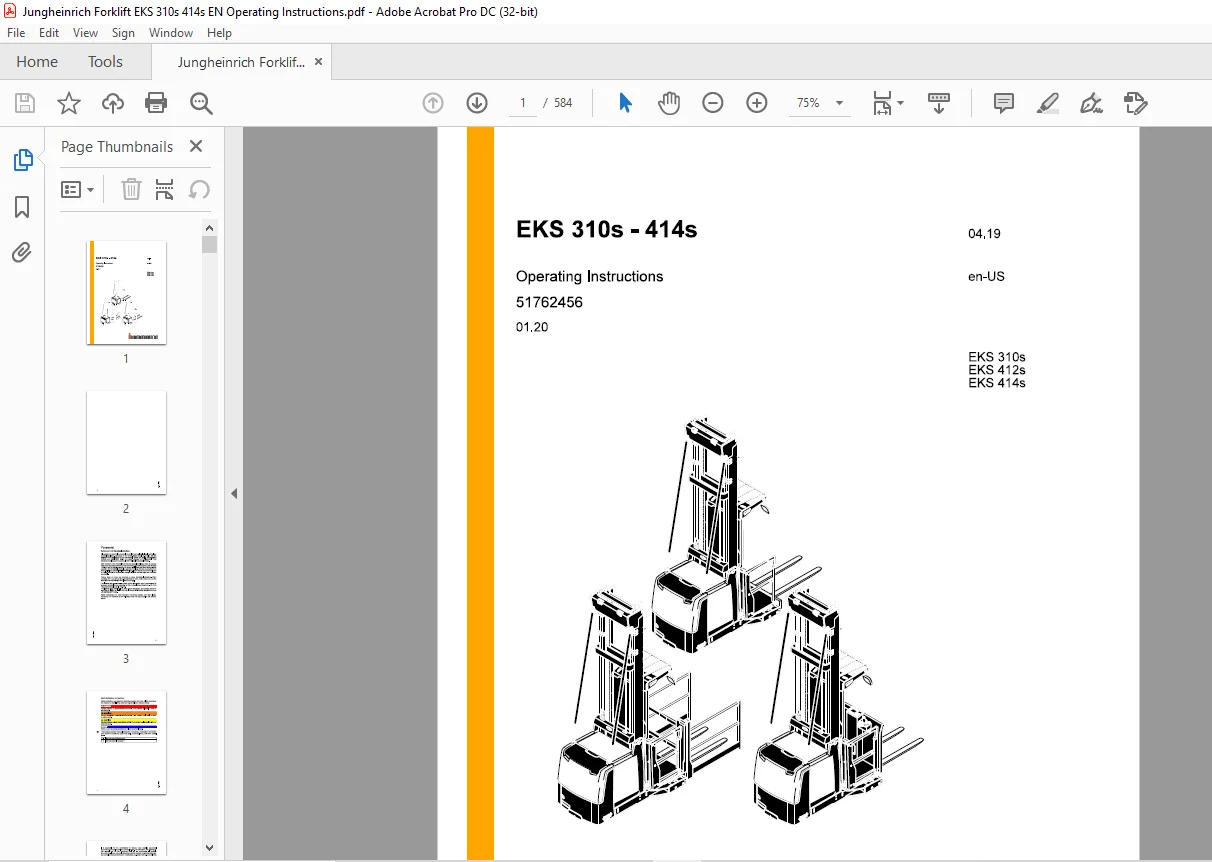
Jungheinrich Forklift EKS 310s – 414s Operating instructions Manual 51762456 – PDF DOWNLOAD
$25.95
Jungheinrich Forklift EKS 310s – 414s Operating instructions Manual 51762456 – PDF DOWNLOAD
EKS 310s
EKS 412s
EKS 414s
Description
Jungheinrich Forklift EKS 310s – 414s Operating instructions Manual 51762456 – PDF DOWNLOAD
FILE DETAILS:
Jungheinrich Forklift EKS 310s – 414s Operating instructions Manual 51762456 – PDF DOWNLOAD
Language : English
Pages : 584
Downloadable : Yes
File Type : PDF
DESCRIPTION:
Jungheinrich Forklift EKS 310s – 414s Operating instructions Manual 51762456 – PDF DOWNLOAD
EKS 310s
EKS 412s
EKS 414s
Foreword
References to the Operating Instructions
- All operators of industrial trucks should be familiar with applicable local, regional and national regulations. Operators in the United States should be familiar with the standards and regulations of the Occupational Safety and Health Administration (OSHA) and ANSI/ITSDF B56.
- 1, the safety standard of the Industrial Truck Standards Development Foundation (ITSDF) for low lift and high lift trucks. Safe operation of the industrial truck requires special knowledge, which is acquired from these operating instructions, from the training required by OSHA under 29 CFR 1910.178 and by training operators in factory installations and their functions.
- Safe operation of the industrial truck also requires knowledge that can be acquired from these ORIGINAL OPERATING INSTRUCTIONS. Information is set out concisely and in a clear format. The chapters are arranged by letter and the pages are numbered sequentially.
- Various types of trucks are described in these Operating Instructions. When operating the truck and carrying out maintenance work, make certain you use the description corresponding to the relevant truck type.
IMAGES PREVIEW OF THE MANUAL:
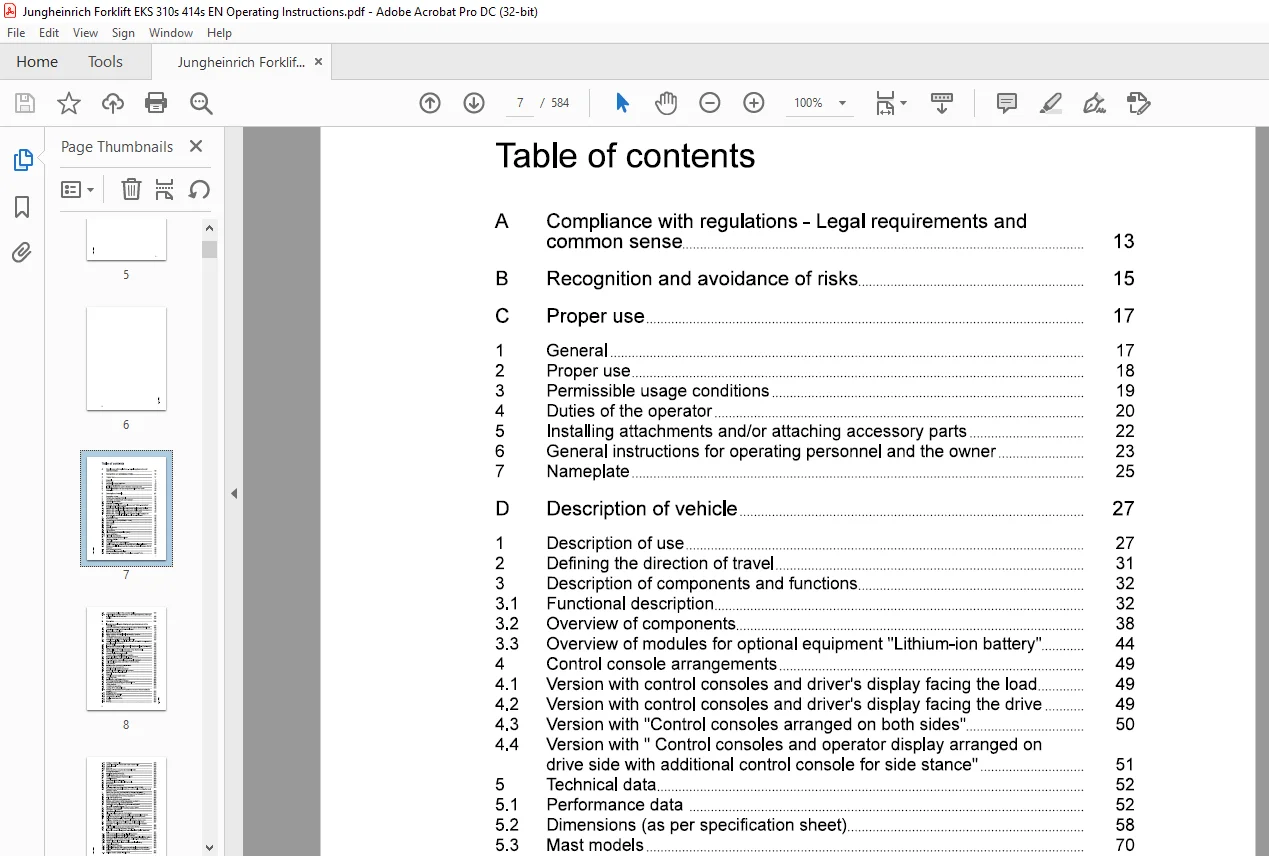
TABLE OF CONTENTS:
Jungheinrich Forklift EKS 310s – 414s Operating instructions Manual 51762456 – PDF DOWNLOAD
A Compliance with regulations – Legal requirements and
common sense 13
B Recognition and avoidance of risks 15
C Proper use 17
1 General 17
2 Proper use 18
3 Permissible usage conditions 19
4 Duties of the operator 20
5 Installing attachments and/or attaching accessory parts 22
6 General instructions for operating personnel and the owner 23
7 Nameplate 25
D Description of vehicle 27
1 Description of use 27
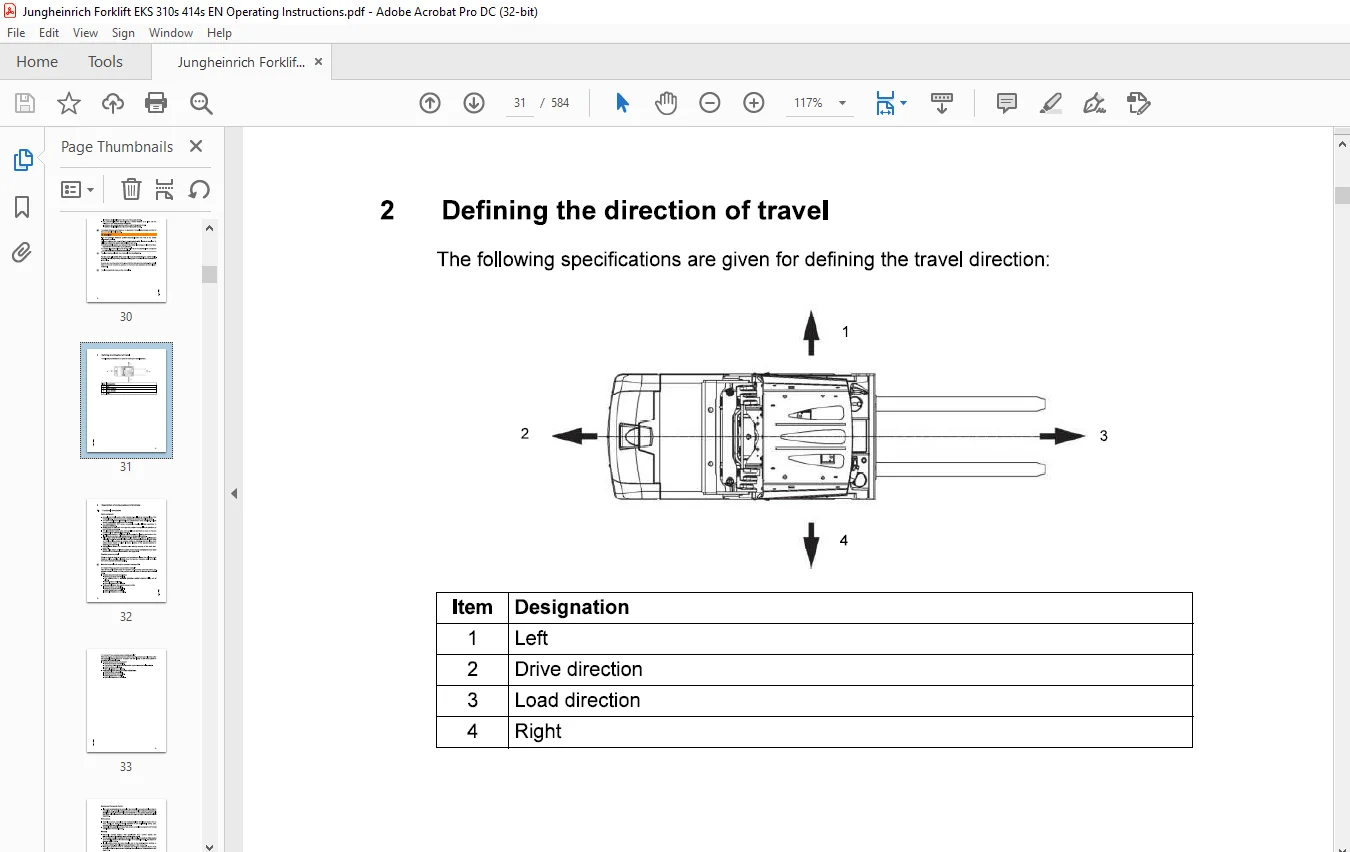
2 Defining the direction of travel 31
3 Description of components and functions 32
3 1 Functional description 32
3 2 Overview of components 38
3 3 Overview of modules for optional equipment “Lithium-ion battery” 44
4 Control console arrangements 49
4 1 Version with control consoles and driver’s display facing the load 49
4 2 Version with control consoles and driver’s display facing the drive 49
4 3 Version with “Control consoles arranged on both sides” 50
4 4 Version with ” Control consoles and operator display arranged on
drive side with additional control console for side stance” 51
5 Technical data 52
5 1 Performance data 52
5 2 Dimensions (as per specification sheet) 58
5 3 Mast models 70
5 4 Mast braces 79
5 5 Weights 80
5 6 Wheels, chassis 84
5 7 Motor data 85
5 8 US standards 86
5 9 Electromagnetic Compatibility (EMC) 88
5 10 Usage conditions 89
5 11 Electrical requirements 89
6 Position of signs and nameplates 90
6 1 Positions of signs 90
6 2 Nameplate 94
6 3 Load capacity of the industrial truck 96
6 4 Label “Load center distance for the EKS with walk-on platform” 98
6 5 Warning Label “Influencing of the Function of Medical Devices Due to
Magnets” 98
Jack attachment points 98
Attachment load capacity plate 99
Sign – tipping safety device “Residual load capacity” (0) 99
6 9 Load capacity display in the operator display 100
6 10 Reduced load capacity depending on the weight (operator, passenger
or loads) within the driver’s cab 102
7 Stability 104
E Operation 105
1 Important general issues affecting safe operation and use of the
industrial truck 105
1 1 Training, certification, and permission to operate the industrial truck 105
1 2 Damage and repairs to the industrial truck 110
1 3 Issues related to the load 110
1 4 Operating environment 112
1 5 Safety devices, warning labels and warning systems 118
1 6 Lifting persons 120
2 Description of indicators and controls 122
2 1 Controls and displays on the control console 122
2 2 Load-side auxiliary lift control elements with drive-side arrangement of
control console (version 2) 132
2 3 Driver’s display 134
2 4 Icons on the Operator Display (Vehicle States and Input Commands) 136
2 5 Operating hours counter 145
2 6 Additional Icons for Vehicle Guidance in the Narrow Aisle 146
2 7 “Bar display” battery discharge indicator 148
2 8 Driver’s display function symbols 150
3 Preparing the industrial truck for operation 158
3 1 Safety Regulations for Industrial Truck Operators 158
3 2 General operation of the industrial truck 158
3 3 Ensuring that the industrial truck is properly equipped 160
3 4 Daily visual inspections and actions before startup 161
3 5 Entry and exit 166
3 6 Setting up the operator’s compartment 168
3 7 Backrest/ driver’s seat (0) 168
3 8 Control console height adjustment 170
3 9 Safety belt with self-retracting lanyard (0) 172
4 Operation of the industrial truck 195
4 1 General 195
4 2 Travel routes and work areas 197
4 3 Driving conduct 199
4 4 Safe loading and transporting 205
4 5 Preventing overturning and tipping 207
4 6 Supervising and securing the industrial truck 209
4 7 Lifting persons 209
4 8 Preparing for operation 211
4 9 Turning off the industrial truck 212
4 10 Checks and operations to be carried out when the truck is ready for
operation 213
4 11 Setting the time 215
4 12 Referencing the main lift 217
4 13 EMERGENCY STOP 219
4 14 Single-handed operation
4 15 Driving
4 16 Braking 227
4 17 Driving in narrow aisles 229
4 18 Lifting / lowering – outside and inside narrow aisles 238
4 19 Diagonal travel 245
4 20 Steering 246
4 21 Switching off and securing the industrial truck 247
5 Picking and stacking 249
5 1 Adjusting the fork arms (0) 249
5 2 Replacing the fork arms (0) 253
5 3 Lifting, transporting and depositing loads 257
6 Troubleshooting 263
6 1 Emergency Stop equipment 263
6 2 Emergency lowering of load lifting tackle 263
6 3 Shutdowns 267
6 4 Aisle end safety device (0) 277
6 5 WG emergency operation (event messages 3670 / 3752) 279
6 6 Recovering the industrial truck from a narrow aisle / moving the truck
without a battery 280
7 Exiting the Operator Position with the Rescue Equipment 293
7 1 Rescue Equipment Storage Compartment in the Operator P 294
7 2 Test/ maintenance of the rescue equipment 295
7 3 Seal and equipment bag 296
7 4 Usage duration of rescue equipment 297
7 5 Storage and transport of the emergency equipment 298
7 6 Usage conditions and ambient conditions 298
7 7 Description and application of the rescue equipment 299
8 Personal Protection System ( 0) 315
8 1 Function of the Personal Protection System (PPS) 315
8 2 Description of functions 316
8 3 Environmental awareness 317
8 4 Cleaning the laser scanner front screen 318
8 5 Displays on the seven segment display and indicator light (LED) 319
8 6 Daily checks before starting the Personal Protection System 321
8 7 Function of the Personal Protection System 322
9 Collision Protection with the Personal Protection System (0) 325
9 1 Positions and Number of Reflectors on the Industrial Truck 327
9 2 Description of Collision Protection with the Personal Protection
System 329
9 3 Daily Visual Inspections and Checks before Startup 329
9 4 Description of Various Operating Situations 331
10 Industrial truck with load guard and walk-on load (pallet, mesh box,
etc ) 337
10 1 Order picking platform without load lifting option 339
10 2 Order picking platform with load lifting option 341
10 3 Order picking platform with monitored and secured load lifting option 345
10 4 Description of the function of the side and load-side safety gates 347
10 5 Additional symbols in driver’s display 349
10 6 Lifting or setting down loads depending on load locking 350
11 Optional equipment 361
11 1 Keyless access systems 361
General information about operation with keyless access systems 361
Keyless Access System – Starting up the Keypad and Transponder
Reader 362
Keyless access system – display unit 365
11 5 Keyless access system – keypad 370
11 6 Keyless access system – transponder reader 375
11 7 ISM Online “New Generation” ( 0) 380
11 8 Lockable safety gates (0) 380
11 9 Single telescopic forks (0) 381
11 10 Fork arms side shift (0) 383
11 11 Weighing system (0) 385
11 12 Lift height selection (0) 387
11 13 Horizontal positioning (0) 393
11 14 Ride-on mode for a second person in the operator position (0) 408
11 15 Rear view mirror (0) 412
11 16 Panorama Mirror (0) 413
11 17 Fire extinguisher (0) 414
11 18 Floor-Spot (0) 416
11 19 “Battery lock” sensors (0) 422
11 20 Camera System (0) 424
11 21 Working platform (0) 426
F Battery – maintenance, charging, and changing 429
1 Safety instructions for handling lead-acid batteries 429
1 1 General information for handling batteries 431
2 Safety provisions for the handling of lithium ion batteries 432
2 1 General information for handling batteries 434
2 2 Service life and maintenance of the battery 435
3 Dimensions of the battery compartment 436
4 Battery types 437
5 Opening the battery cover 440
6 Closing the battery cover 442
7 Charging the battery 444
7 1 Charging a lead battery 444
7 2 Charging the lithium-ion battery 448
8 Removing and installing the battery 454
8 1 Removing and Installing the Lithium-Ion Battery 454
8 2 Removing and installing the lead battery 455
9 Battery activation with the battery activation button 460
G Industrial truck maintenance and troubleshooting 461
1 Spare Parts 461
2 Operating safety and environmental protection 462
3 Safety regulations for maintenance 464
3 1 Working on the electrical system 468
3 2 Consumables and used parts 468
3 3 Wire Cables 469
3 4 Lift chain inspection 470
3 5 Hydraulic system 472
3 6 Repairs and inspection of attachments: 474
3 7 Inspection and Repair of Fork Arms 474
4 Consumables and lubrication chart 478 en
4 1 Handling consumables safely 478 => I
4 2 Lubrication chart 480 CJ)
4 3 Consumables 481 C ‘!
5 Description of maintenance and servicing jobs 482
5 1 Preparing the industrial truck for maintenance and servicing 482
5 2 Drive compartment cover disassembly/assembly 484
5 3 Wheels 486
5 4 Fuses 488
5 5 Check hydraulic oil level and refill if necessary 500
5 6 Safely lifting and jacking the industrial truck 506
5 7 Preventing the Operator Position from Accidentally Lowering 507
5 8 Cleaning 512
5 9 Lubricate the lift chains, clean and grease the contact surfaces in the
mast sections 516
5 10 Lift chain servicing 518
5 11 Restarting the industrial truck after maintenance and servicing work 520
6 Longterm storage of the industrial truck 521
6 1 Actions to be taken before shutting down the vehicle 521
6 2 Actions to be taken during shutdown 522
6 3 Restarting the industrial truck after shutdown 522
7 Safety check after time and unusual events 523
8 Permanent decommissioning and disposal 524
9 Measuring human vibration 524
10 Troubleshooting 525
10 1 Fault – industrial truck not ready for operation 526
10 2 Fault – industrial truck does not start 527
10 3 Fault – load lifting device cannot be raised 528
10 4 Fault – industrial truck cannot be steered 529
10 5 Fault – fast travel disabled 529
10 6 Event and information messages 530
10 7 Additional information or event messages when equipped with lithiumion
battery ( 0) 533
H Transport and initial startup 535
1 Transport 535
2 Handling by crane 536
2 1 Handling by crane with mast assembled 538
2 2 Handling of the basic truck by crane with mast tilted (0) 542
2 3 Handling the basic truck by crane 544
2 4 Handling by Crane of Mast Including Operator Position and Load
Lifting Device 548
2 5 Handling the battery by crane 552
3 Securing the industrial truck during transport 554
3 1 Transport locking device for basic truck with the mast assembled 556
3 2 Transport locking device for basic truck with the mast tilted (0) 558
3 3 Basic truck transport locking device 560
3 4 Mast transport locking device 562
4 Initial startup 564
4 1 Moving the industrial truck without a battery 565
4 2 Installing and removing the mast 565
4 3 Startup 566
Tipping safety device 567
Maintenance, inspection, and change of parts to be
changed 569
1 Contents of the Maintenance EKS 310s-414s 570
1 1 Operator 570
1 2 Customer service 575
Questions? Email us: [email protected]
PLEASE NOTE:
- This is the same manual used by the dealers to diagnose and troubleshoot your vehicle
- You will be directed to the download page as soon as the purchase is completed. The whole payment and downloading process will take anywhere between 2-5 minutes
- Need any other service / repair / parts manual, please feel free to contact [email protected] . We still have 50,000 manuals unlisted
S.M