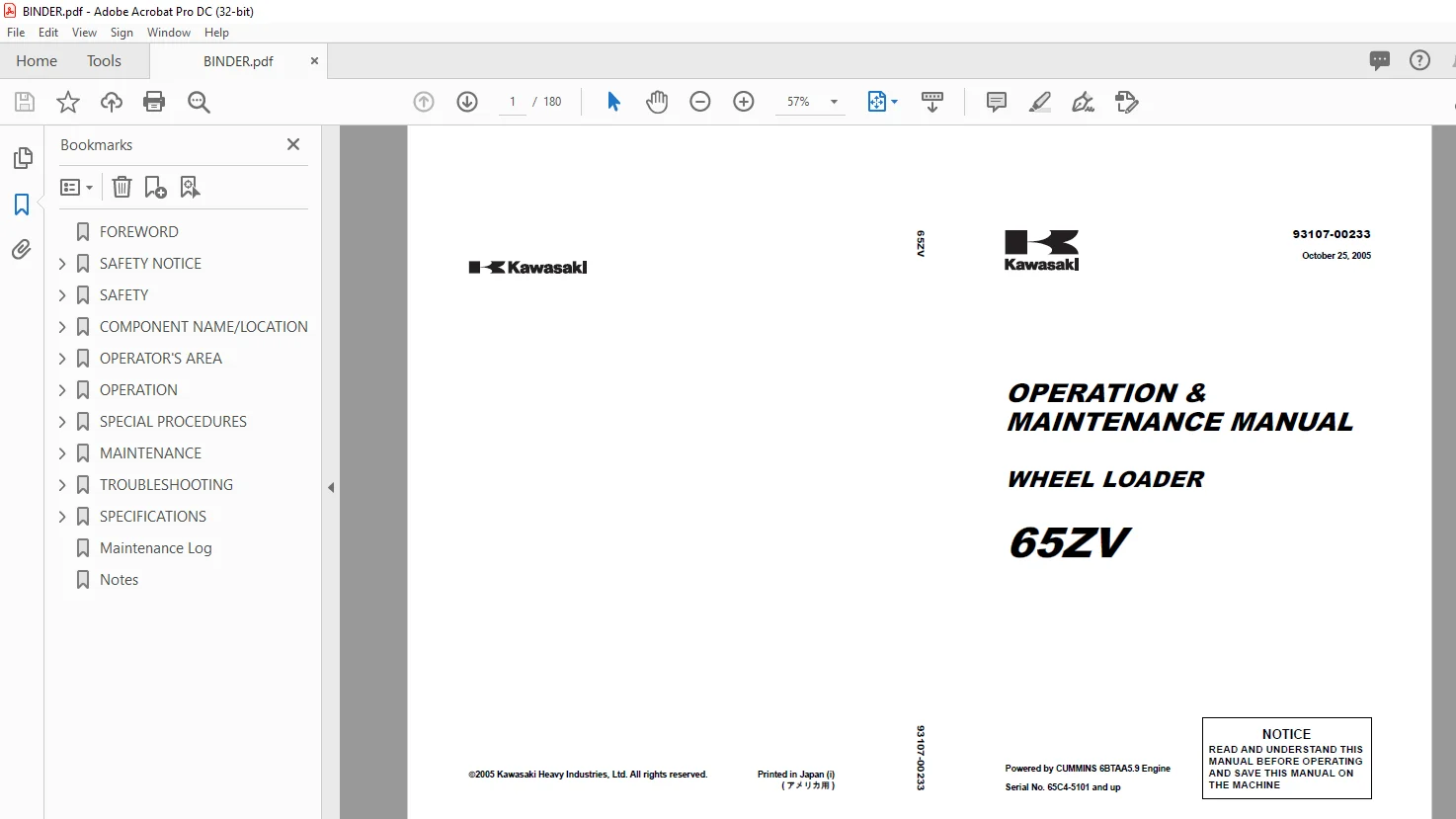
Kawasaki WHEEL LOADER 65ZV OPERATION & MAINTENANCE MANUAL 93107-00233 PDF
$28.95
Kawasaki WHEEL LOADER 65ZV OPERATION & MAINTENANCE MANUAL 93107-00233 – PDF DOWNLOAD
CUMMINS 6BTAA5.9 Engine
Serial No. 65C4-5101 and up
Description
Kawasaki WHEEL LOADER 65ZV OPERATION & MAINTENANCE MANUAL 93107-00233 – PDF DOWNLOAD
FILE DETAILS:
Kawasaki WHEEL LOADER 65ZV OPERATION & MAINTENANCE MANUAL 93107-00233 – PDF DOWNLOAD
Language :English
Pages :180
Downloadable : Yes
File Type : PDF
IMAGES PREVIEW OF THE MANUAL:
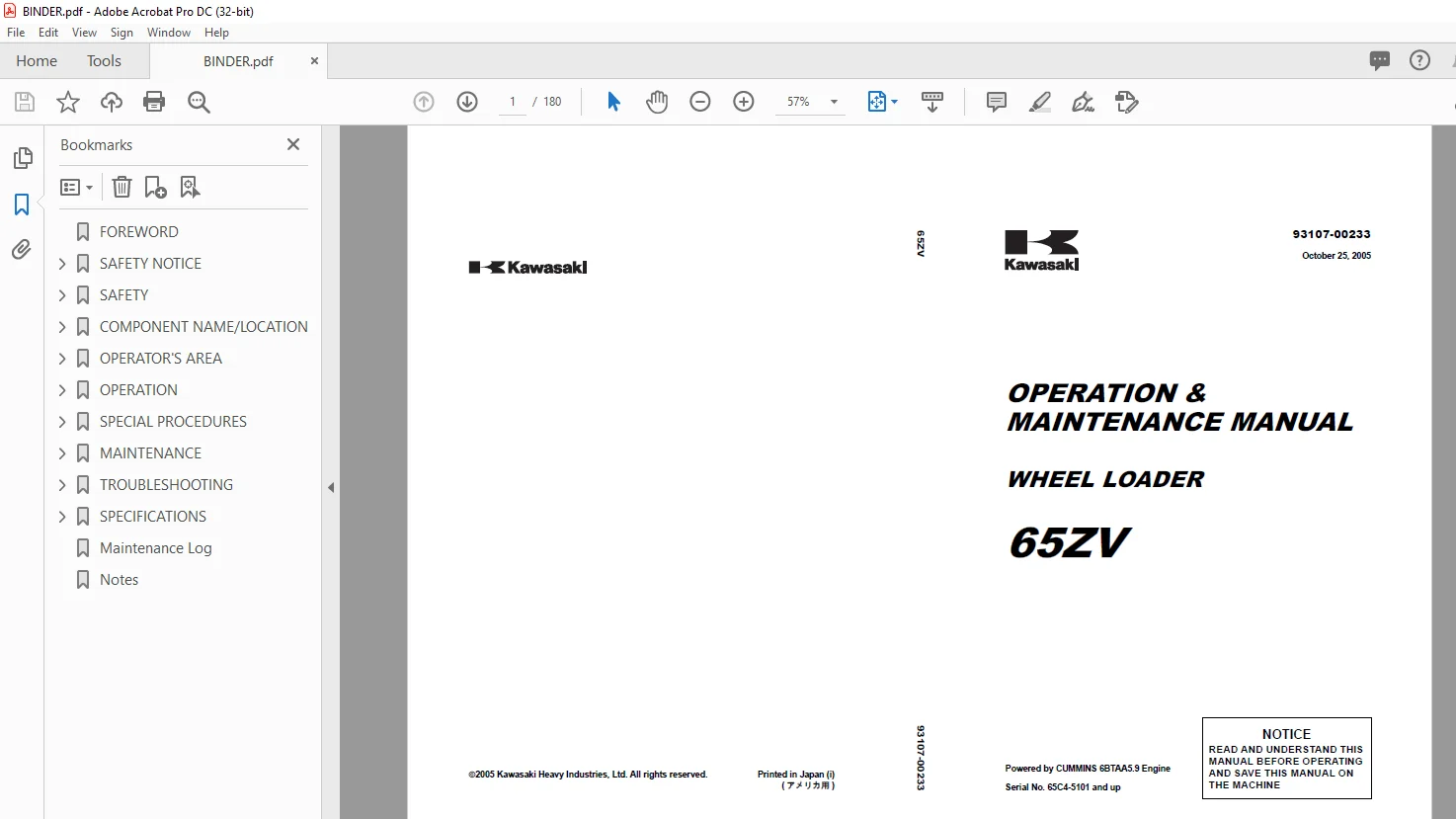
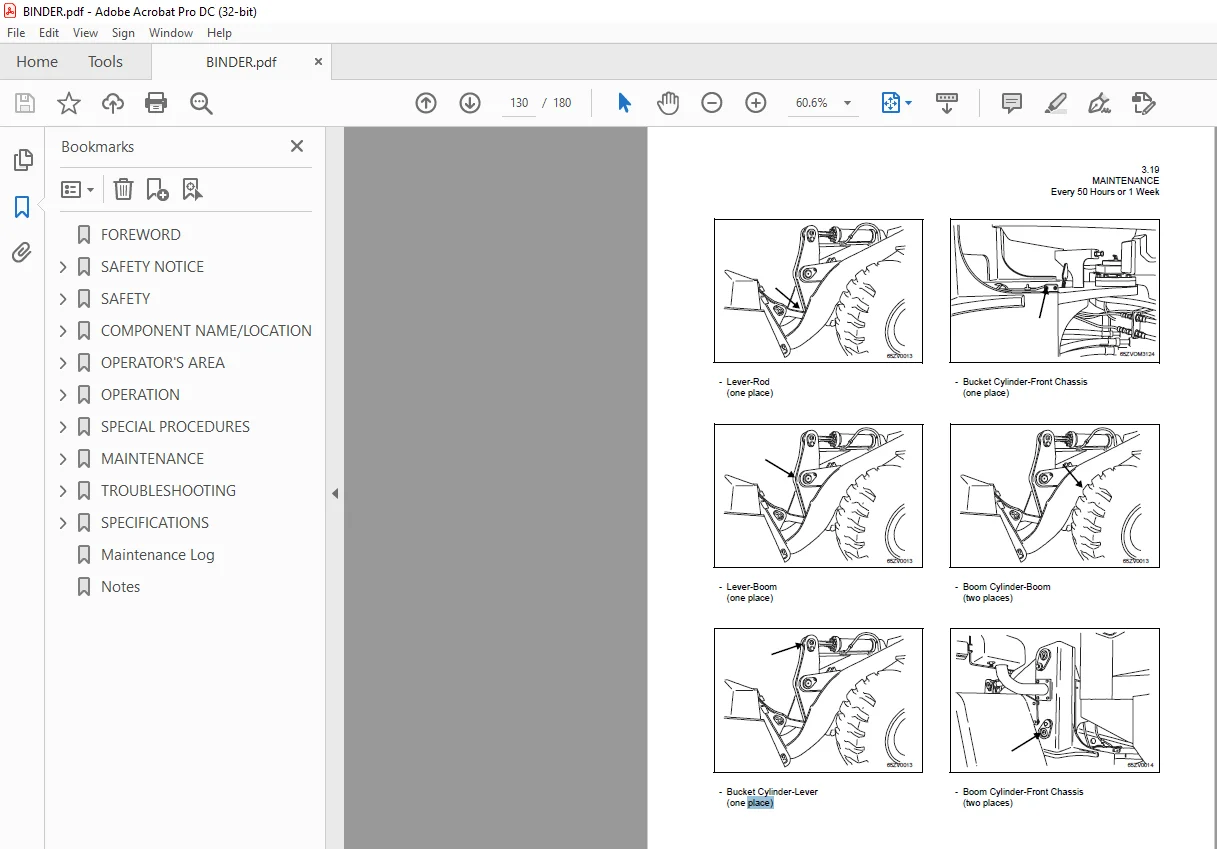
DESCRIPTION:
Kawasaki WHEEL LOADER 65ZV OPERATION & MAINTENANCE MANUAL 93107-00233 – PDF DOWNLOAD
CUMMINS 6BTAA5.9 Engine
Serial No. 65C4-5101 and up
FOREWORD
- Kawasaki pursues a policy of continuing improvement in design and performance of this machine. The right is therefore reserved to vary specifications without prior notice or obligation.
- This machine gives you, our customer, the maximum in performance and durability, state of the art technology and safety. Should you have any question regarding this machine or manual, please contact the Kawasaki dealer in your area during regular business hours. A satisfied customer is our goal.
- For additional details, for safe and efficient operation and maintenance of your Cummins engine, please refer to your Cummins operation & maintenance manual.
- There may be an optional supplemental operation & maintenance manual, and this also should be referred to when operating machines that are equipped with special packages.
- This manual is compiled for persons who understand English. If an operator or maintenance person does not understand English, please translate what said in this manual into his mother language.
TABLE OF CONTENTS:
Kawasaki WHEEL LOADER 65ZV OPERATION & MAINTENANCE MANUAL 93107-00233 – PDF DOWNLOAD
CUMMINS 6BTAA5.9 Engine
Serial No. 65C4-5101 and up
FOREWORD 4
SAFETY NOTICE 5
CONTENTS 6
1 SAFETY 1 1 6
SAFETY 1 2 6
Safe Operation 1 2 6
Safe Maintenance 1 11 6
Safety Signs 1 16 6
Safety Devices 1 21 6
2 OPERATION 2 1 6
COMPONENT NAME/LOCATION 2 2 6
OPERATOR’S AREA 2 3 6
Pedals and Levers 2 3 6
Switches 2 9 6
Indicators 2 17 6
Seat 2 24 6
Electrical Protection 2 26 6
Radio – AM / FM Cassette (24Volt Type) 2 28 6
Heater or Air Conditioner (option) 2 36 6
Ride Control System (option) 2 40 6
Grease Gun Holder 2 41 6
OPERATION 2 42 6
Check before Operation 2 42 6
Starting the Engine 2 52 6
Check after Starting the Engine 2 54 6
Operating the Machine 2 59 6
Parking 2 62 6
Stopping the Engine 2 63 6
Operating Techniques 2 64 6
SPECIAL PROCEDURES 2 71 6
Adjustments 2 71 6
Roading / Special Applications 2 73 6
Booster Batteries / Jumper Cables 2 74 6
Towing 2 76 6
Transportation 2 77 6
Long Term Storage 2 79 6
3 MAINTENANCE 3 1 7
MAINTENANCE 3 2 7
Serial Number Location 3 2 7
Inspection and Maintenance Table 3 5 7
When Required Inspection and Maintenance 3 8 7
Every 10 Hours or Daily 3 17 7
Every 50 Hours or 1 Week 3 18 7
Every 250 Hours or 1 Month 3 24 7
Every 500 Hours or 3 Months 3 31 7
Every 1000 Hours or 6 Months 3 35 7
Every 2000 Hours or 1 Year 3 41 7
Recommended Lubricants 3 50 7
Coolant Specification 3 51 7
TROUBLESHOOTING 3 52 7
SPECIFICATIONS 3 57 7
1 SAFETY 8
SAFETY 9
Safe Operation 9
Operator Safety 9
Mounting and Dismounting Safety 10
Before Starting Safety 11
Operational Safety 13
SITE SAFETY: 13
SAFETY DURING NORMAL OPERATIONS: 14
SPECIAL OPERATING CONDITIONS: 16
Parking Safety 17
Safe Maintenance 18
Safety Preparations Before Maintenance 18
Explosion / Fire / Burn Prevention 20
Other Maintenance Safety Concerns 21
Safety Signs 23
Safety Devices 28
Loading Control Lever Lock 28
Control Lever Lock for Quick Coupler Lock Pin [3rd spool valve specification (option)] 28
1 Place the control lever (attachment lever) for the quick coupler lock pin in the neutral position 28
2 Loosen the screw for the lock plate 28
3 Slide the lock plate to lock the control lever 28
4 Tighten the screw to fix the lock plate 28
1 Loosen the screw for the lock plate 29
2 Slide the lock plate to unlock the control lever 29
3 Tighten the screw to fix the lock plate 29
Articulation Stopper 29
1 Align the front and rear chassis straight ahead 29
2 Using a 13mm wrench remove the bolt that fixes the articulation stopper to the storage bracket on the front chassis 29
3 Remove the clip pin and pin from the end of the Articulation Stopper 29
4 Turn the link and fix the end to the bracket on the front chassis (as shown) 29
5 Insert the pin and clip pin (This is the LOCKED position ) 29
1 Remove the clip pin and pin from the end of the articulation stopper on the rear chassis bracket 30
2 Turn the link to the rear chassis bracket 30
3 Insert the pin and clip pin (This is the STORED position ) 30
4 Tighten the bolt to fix the articulation stopper on the bracket 30
Neutral Start System 30
Emergency Brake 30
Emergency Steering (option) 31
1 Keep the starter switch in the “ON” position even when the engine unexpectedly stops 31
2 Immediately operate the steering wheel to bring the machine to a road shoulder or safe location 31
3 Stop the machine If necessary, use the emergency brake or lower the attachment to stop the machine 31
4 Place wheel chocks in front of and behind the tires to prevent the machine from moving 31
5 Contact your local Kawasaki dealer for necessary testing and repair 31
ROPS (Roll Over Protective Structure) Cab 31
2 OPERATION 32
COMPONENT NAME/LOCATION 33
1 Bucket (Attachment) 33
2 Boom 33
3 “Z” Lever 33
4 Boom Cylinders (2) 33
5 Bucket Cylinder 33
6 Steering Cylinders (2) 33
7 Engine 33
8 Torque Converter & Transmission Ass’y 33
9 Radiator & Torque Converter Cooler (Lower tank) 33
10 Air Cooler (for engine intake air) 33
11 Hydraulic Oil Cooler 33
12 Fuel Tank 33
13 Hydraulic Oil Tank (Right hand side) 33
14 Front Axle / Differential Ass’y 33
15 Rear Axle / Differential Ass’y 33
16 Air Cleaner (Right hand side) 33
17 Parking Brake 33
18 2nd Propeller Shaft 33
19 3rd Propeller Shaft 33
20 Batteries (2) (one each side–two 12VDC=24VDC system) 33
21 Cooling Fan 33
22 Fan Motor (hydraulic type) 33
23 Exhaust Muffler 33
24 ROPS Cab 33
OPERATOR’S AREA 34
Pedals and Levers 34
1 Transmission Shift Lever 34
2 Horn Button 34
3 Loading Control Lever 34
4 Auxiliary Attachment Control Lever (option) 34
5 Wrist Rest (adjustable) 34
6 Accelerator Pedal 34
7 Brake Pedals 34
8 Steering Column Telescopic Tilt Handle 34
9 Loading Control Lever Lock 34
1 Transmission Shift Lever 34
2 Horn Button 34
3 Loading Control Lever 35
[Boom Control] 35
[Bucket Control] 35
4 Auxiliary Attachment Control Lever (option) 36
5 Wrist Rest (adjustable) 36
6 Accelerator Pedal 37
7 Brake Pedals 37
1 As a brake only pedal by turning the transmission cut-off (Declutch) switch (See page 2 13) to the “OFF” position Use this position when working on slopes or ramps 37
2 Disengage the transmission while applying the brakes This is normally used when loading trucks It allows higher engine spee 37
8 Steering Column Telescopic Tilt Handle 38
1 Pull up the telescopic tilt handle lock lever and move the steering wheel to the desired position 38
2 Push down the telescopic tilt handle lock lever fully to lock the steering wheel in position 38
9 Loading Control Lever Lock 39
Switches 40
1 Starter Switch 40
2 Parking Brake Switch 40
3 Light Switch 40
4 Front Working Light Switch 40
5 Rear Working Light Switch 40
6 High-Low Beam Lever / Turn Signal Lever (option) 40
7 Transmission Cut-Off (Declutch) Switch 40
8 Front Wiper Switch 40
9 Rear Wiper Switch 40
10 QUAD (Quick Up And Downshift) Switch 40
11 Four-way Flasher Switch (option) 40
12 Ride Control Switch (option) 40
13 12 Volt Power-outlet Socket (S/N 5257~) 40
14 Reversal Fan Switch (option) 40
1 Starter Switch 41
2 Parking Brake Switch 41
3 Light Switch 42
4 Front Working Light Switch 42
5 Rear Working Light Switch 43
6 High-Low Beam Lever / Turn Signal Lever (option) 43
7 Transmission Cut-Off (Declutch) Switch 44
8 Front Wiper Switch 44
9 Rear Wiper Switch 45
10 QUAD (Quick Up And Downshift) Switch 45
11 Four-way Flasher Switch (option) 46
12 Ride Control Switch (option) 46
13 12 Volt Power-outlet Socket (S/N 5257~) 46
14 Reversal Fan Switch (option) 47
Indicators 48
1 Tachometer 48
2 Engine Coolant Temperature Gauge 48
3 Torque Converter Oil Temperature Gauge 48
4 Fuel Gauge 48
5 Parking Brake Indicator Lamp (red) 48
6 Transmission Cut-Off (Declutch) Lamp (green) 48
7 Working Light Indicator Lamp (green) 48
8 Preheat Indicator Lamp (orange) 48
9 Central Warning Lamp (red) 48
10 Transmission Control Warning Lamp (red) 48
11 Brake Pressure Warning Lamp (red) 48
12 Engine Oil Pressure Warning Lamp (red) 48
13 Engine Coolant Temperature Warning Lamp (red) 48
14 Torque Converter Oil Temperature Warning Lamp (red) 48
15 Air Cleaner Warning Lamp (red) 48
16 Charge Lamp (red) 48
17 Turn Signal Indicator Lamp (Left) (green) 48
18 Turn Signal Indicator Lamp (Right) (green) 48
19 High Beam Indicator Lamp (blue) 48
20 Auto Shift Indicator Lamp 48
21 Neutral Indicator Lamp 48
22 Transmission Status Monitor 48
23 Hour Meter 48
24 Emergency Steering Warning Lamp (red) (option) 48
25 Ride Control Indicator Lamp (green) (option) 48
1 Tachometer 49
2 Engine Coolant Temperature Gauge 49
3 Torque Converter Oil Temperature Gauge 49
4 Fuel Gauge 49
5 Parking Brake Indicator Lamp (red) 50
6 Transmission Cut-Off (Declutch) Lamp (green) 50
7 Working Light Indicator Lamp (green) 50
8 Preheat Indicator Lamp (orange) 50
9 Central Warning Lamp (red) 50
10 Transmission Control Warning Lamp (red) 50
11 Brake Pressure Warning Lamp (red) 51
12 Engine Oil Pressure Warning Lamp (red) 51
13 Engine Coolant Temperature Warning Lamp (red) 51
14 Torque Converter Oil Temperature Warning Lamp (red) 52
15 Air Cleaner Warning Lamp (red) 52
16 Charge Lamp (red) 52
17 Turn Signal Indicator Lamp (Left) (green) 52
18 Turn Signal Indicator Lamp (Right) (green) 52
19 High Beam Indicator Lamp (blue) 53
20 Auto Shift Indicator Lamp 53
21 Neutral Indicator Lamp 53
22 Transmission Status Monitor 53
23 Hour Meter 53
24 Emergency Steering Warning Lamp (red) (option) 54
25 Ride Control Indicator Lamp (green) (option) 54
Seat 55
Seat Adjustment 55
Armrests 55
Lumbar Support 55
Reclining 55
Seat Height 55
Mechanical Suspension (If so equipped) 55
Air Suspension (If so equipped) 55
Forward / Backward 55
Seat Belt 56
1 Fasten seat belt along your body without kinking or twisting it The seat belt buckle should firmly “snap” when coupled Keep buckle free of dirt and debris 56
2 For releasing the seat belt, push the red button where the belt attaches 56
Electrical Protection 57
Fuse Boxes 57
Fusible Link 58
1 If the fusible link is blown, the following problem occurs 58
2 To check the cause and replace the fusible link, call your nearest Kawasaki dealer Replacing the blown fusible link without correcting the problem may damage components or cause a fire 58
Radio – AM / FM Cassette (24Volt Type) 59
Heater or Air Conditioner (option) 67
Ventilation Location and Mode 67
Switches 67
1 ON/OFF Switch 67
2 FAN ONLY Switch 67
3 TEMP UP/DOWN Switches (A) Temperature Display 67
4 FAN UP/DOWN Switches (B) Fan Speed Display 67
5 UPPER Mode Switch 67
6 LOWER Mode Switch 67
7 DEFROST Mode Switch 67
8 FAN ONLY Indicator LED 67
Operation of the Automatic Temperature Control unit 68
Front Panel Controls 68
1 ON/OFF Switch Turns the unit on and off 68
2 FAN ONLY Switch Switches the unit to the fan only mode and disables the Automatic Temperature Control 68
3 TEMP UP/DOWN Switches Allows the operator to adjust the temperature setpoint 68
4 FAN UP/DOWN Switches Allows the operator to adjust fan speed The “FAN ONLY” Indicator LED (8) will be turned on 68
5 UPPER Mode Switch Switches the unit into the upper air mode 68
6 LOWER Mode Switch Switches the unit into the lower air mode 68
7 DEFROST Mode Switch Switches the unit into the defog mode and routes the air to the defrost vents 68
Ventilation Location and Mode 69
Switches 69
Manual Heater Control 69
Manual Combo Control 69
1 Mode Control 69
2 Heat/AC Control 69
3 Temperature Control 69
4 Blower Control 69
Ride Control System (option) 71
Operation and Function 71
1 Before start the travelling machine, turn the ride control system switch (1) ON The ride control system pilot lamp (2) comes to ON 71
2 Move the machine forward The ride control system functions automatically when the machine travelling speed reaches more than 7 km/h 71
Grease Gun Holder 72
OPERATION 73
Check before Operation 73
Walk-Around Inspection 73
Items to Check and What to Look for: 73
Greasing 74
1 Park the machine on level ground, apply the parking brake, lower the attachment to the ground, and stop the engine 74
2 Lubricate fittings on the following components Wipe and clean all fittings before greasing Lubricate until fresh grease is 74
Check Engine Oil Level 74
1 Check the oil level with the dipstick 74
2 Keep the oil level between the “H” (high) mark and “L” (low) mark on the dipstick 74
3 If needed, add the required amount of the same brand and viscosity oil as originally used through the refill port Refer to “Recommended Lubricants” page 3 50 for the suitable viscosity of the oil according to the ambient temperature 74
4 If the oil is particularly dirty or contains water (milky appearance), replace the oil immediately If oil contains coolant, diagnose the problem and correct it immediately Refer to “Replace Engine Oil and Oil Filter Cartridge” page 3 25 75
Check Hydraulic Oil Level 75
1 Lower the attachment to the ground 75
2 Stop the engine 75
3 Check the oil level gauge on the side of the hydraulic oil tank 75
4 The oil level is OK if the oil reaches the middle of the level gauge 75
5 If needed, add the required amount of the oil Refer to “Recommended Lubricants” page 3 50 for the suitable viscosity of the oil according to the ambient temperature and oil type 76
Check Engine Coolant Level 76
1 Check the coolant level in the radiator subtank 76
2 Coolant level is normal if it is between FULL and LOW lines 76
3 If needed, add the required amount of the coolant to the subtank Refer to “Coolant Specification” page 3 51 for the correct mixture 76
4 Change the coolant if it is particularly dirty Refer to “Replace Coolant” page 3 14 76
5 If the coolant contains oil, diagnose the problem and correct it immediately 76
Drain Water and Sediment from Fuel Filter 77
Check Wiring Harnesses 77
Articulation Stopper 78
Check Tire for Damage , Air and Tread Depth 78
Check Drive Belt 80
1 Park the machine on level ground, apply the parking brake, lower the attachment to the ground, and stop the engine Remove the key and tag “Do Not Operate” 80
2 Open the engine side panel 80
3 Visually inspect the drive belt for looseness and damage 80
4 If the belt is too stretched to permit adjustment or shows cuts or cracks, replace it 80
Check Air Intake System 80
1 Park the machine on level ground, apply the parking brake, lower the attachment to the ground, and stop the engine 80
2 Check the engine intake hose, intake pipes, pipe clamps and hose bands for damage and tightness 80
3 If damaged or loose, replace or retighten or contact your nearest Kawasaki dealer 81
Check Cooling Fan 81
1 Park the machine on level ground, apply the parking brake, lower the attachment to the ground, and stop the engine Remove the key and tag “Do Not Operate” 81
2 Open the engine rear grill 81
3 Visually inspect the cooling fan for damage 81
4 If the fan shows cracks, loose rivets, bent or loose blades, replace it 81
Check Horn Operation 82
1 Push the horn button in the center of the steering wheel 82
2 The horn should sound loudly 82
ROPS (Roll Over Protective Structure) Cab 82
Adjust and Check Rear View Mirrors 82
Check Parking Brake 82
Check Monitor Panel Operation 82
1 Turn the starter switch to the “ON” position 82
2 All warning lamps (red) should come on for about three seconds Refer to “Indicators” page 2 17 82
3 Rotate and move the transmission shift lever to each position, pull the high-low beam lever, and operate the rear working light switch and transmission cut-off selector switch 82
4 The transmission status monitor lamps (green) and the indicator lamps (green or blue) should come on respectively 82
5 If any lamps do not light up, replace the bulbs Refer to “Indicators” page 2 17 82
Check Control Lever 82
Check Transmission Shift Lever 82
Starting the Engine 83
Normal Start 83
1 Do not depress the accelerator pedal 83
2 Turn the starter switch key to “ON” position and leave it there for 3 seconds Check the indicator lamps 83
3 The turn the starter switch key to “START” position to start the engine To protect starter and battery, do not keep the starter switch in the “START” position for more than 20 seconds 83
4 If the engine fails to start, wait about two minutes before trying to restart This allows the starter motor to cool which prevents starter motor damage 83
5 After the engine starts, release the key and it will return to the “ON” position 83
6 If the transmission shift lever is not in the “NEUTRAL” position, the engine will not crank 83
Cold Start 84
1 Do not depress the accelerator pedal 84
2 The turn the starter switch key to the “PREHEAT” position for about fifteen seconds 84
3 Turn the starter switch key to the “START” position to start the engine To protect starter and battery, do not keep the starter switch in the “START” position for more than 20 seconds 84
4 If the engine fails to start, wait about two minutes before trying to restart This allows the starter motor to cool which prevents starter motor damage 84
5 After the engine starts, release the key and it will return to the “ON” position 84
6 If the transmission shift lever is not in the “NEUTRAL” position, the engine will not crank 84
7 In case the engine does not start on the first attempt, repeat the above procedures after intervals of about one to two minutes 84
Check after Starting the Engine 85
Check Warning Lamps 85
1 Check the warning lamps on the instrument panel 85
2 If any red lamp (except for “PARKING”) is on, do not operate the machine 85
3 Refer to “Indicators” page 2 17 for the meaning of each lamp and the correction 85
Check Fuel Level 86
1 Check the fuel level with the fuel gauge on the instrument panel 86
2 Add fuel to fill the tank if the gauge shows below “F” Refer to “Recommended Lubricants” page 3 50 for the proper fuel 86
Check Transmission Oil Level 86
1 Park the machine on level ground, apply the parking brake, and lower the attachment to the ground Verify that oil is up on the dipstick prior to starting 86
2 Set the articulation stopper in the “LOCKED” position Refer to “Articulation Stopper” page 1 22 86
3 Check the oil level with engine at low idle 87
4 At low oil temperature, use the side of dipstick marked “COLD” Normal oil level is within shaded area as shown 87
5 At high oil temperature, use the side of dipstick marked “HOT” Normal oil level is within shaded area as shown 87
6 If the oil level is lower than the specified, add recommended oil while the engine is at idle Do not overfill Refer to “Recommended Lubricants” page 3 50 87
Check Service Brake Operation 87
1 Turn “OFF” the clutch cut-off selector switch 87
2 Firmly depress the right hand brake pedal 87
3 Release the parking brake 87
4 Select the transmission shift lever 2nd and FORWARD 87
5 Slowly accelerate the engine to full speed 87
6 The machine should not move 87
Check Parking Brake Operation 88
1 If the service brakes work normally, test the parking brake 88
2 Move the machine to a safe open place on a slope 88
3 Stop the machine with the service brake 88
4 Pull up the parking brake switch 88
5 Release the service brakes 88
6 The machine should not move 88
Check Steering Wheel Operation 88
1 Be sure the area is clear of bystanders 88
2 Release the brakes 88
3 Steer fully right and then left 88
4 Steering should be smooth in both directions 88
Check Back-up Alarm Operation 88
1 Apply the service brakes 88
2 Release the parking brake 88
3 Move the shift lever to “REVERSE” 88
4 The back-up alarm should sound and be heard in the operator’s seat 88
Check Exhaust Gas 89
1 Check the color of the exhaust gas Normal exhaust gas color is clear or light gray when engine is warm White, black, or blu 89
2 If abnormal exhaust gas color occurs, have the machine checked immediately Refer to “TROUBLESHOOTING” page 3 53 89
General Inspection 89
Operating the Machine 90
Starting the Machine 90
1 Raise the bucket to the carry position approximately 40cm (16in ) above the ground 90
2 Depress the brake pedal 90
3 Push the parking brake switch to release the parking brake 90
4 Turn the transmission shift lever to the desired travel speed mode and then shift to the desired direction 90
5 Release the brake pedal then depress the accelerator pedal to drive the machine 90
Starting the Machine on a Grade 91
1 Turn “OFF” the clutch cut-off (Declutch) switch 91
2 Depress the left brake pedal 91
3 Depress the accelerator pedal while releasing the left brake pedal to start the machine off slowly 91
Speed and Direction Change 91
1 Select the proper gear shifting mode by rotating the transmission shift lever Refer to the following tables on page 2 61 for 91
2 For a direction change, decelerate the machine then move the transmission shift lever to forward or reverse 91
3 When the transmission is in the 2nd gear, it can be quickly shifted down to the 1st gear by pressing the Quick Up And Downshift (QUAD) switch 92
4 Pressing the power up switch again, moving the transmission shift lever to the neutral position, or operating the parking bra 92
5 Running downhill on a steep slope 92
6 Running downhill on a slope 92
Parking 93
1 Release the accelerator pedal 93
2 Apply the service brake to stop the machine 93
3 Shift the transmission shift lever to “NEUTRAL” 93
4 Pull up the parking brake switch to apply the parking brake 93
5 Lower the attachment to the ground and apply a small amount of down pressure 93
Stopping the Engine 94
1 Let the engine idle for about five minutes before stopping 94
2 Turn the starter switch to the “OFF” position to stop the engine 94
3 After stopping the engine, remove the key and store it in a safe place 94
Operating Techniques 95
Loading 95
1 Move the machine forward to the material 95
2 Steer the machine in a straight ahead position when entering the material 95
3 Lower the bucket parallel to the ground 95
4 Drive the bucket straight into the material Use approximately 1/2 – full engine speed 96
5 Move the boom control lever to the “Raise” detent position and run the machine forward slowly in 1st or 2nd speed Reduce wheel slippage by slightly reducing engine speed 96
6 Move the bucket control lever to the “Roll Back” and the “Hold” position several times to get more material in the bucket 96
7 When the bucket is filled, move the bucket control lever to the “Roll Back” position 96
8 Release the bucket control lever to the “Hold” position and the boom will rise 96
9 Reverse the machine 96
10 On later passes, aim the center of the bucket at the protruding portion of the material 96
Excavating 97
1 Move the machine forward to the material 97
2 Steer the machine in a straight ahead position when entering the material 97
3 Lower the bucket parallel to the ground or dump it slightly forward 97
4 Run the machine slowly in 1st or 2nd speed Increase engine speed as the bucket digs deeper 97
5 When the bucket is filled, move the bucket control lever to the “Roll Back” position 97
6 Move the boom control lever to the “Raise” position to clear the ground 97
Dozing 97
Ground Levelling 98
1 Keep the loaded bucket slightly above the ground 98
2 While running the machine backward, dump the bucket little by little to evenly spread material on the ground 98
3 Dump the bucket, allow the cutting edge to contact the ground, and run the machine backward 98
4 To get smoother surface, put some material in the bucket, place the bucket parallel to the ground, run the machine backward with the boom control lever in the “Float” position 98
Carrying 99
1 Fully roll back the loaded bucket before carrying to prevent spillage 99
2 Keep the bucket approximately 40cm (16in ) above the ground when carrying 99
Dumping into Truck or Hopper 99
1 Move the boom control lever to the “Raise” position to raise the loaded bucket while approaching the truck or the hopper 99
2 Use the transmission cut-off selector switch in the “ON” position if working on a level site When the left brake pedal (declutch pedal) is depressed, the transmission is placed automatically in neutral and the boom rises faster 99
3 Return the boom control lever to the “Hold” position when the bucket reaches the enough height to clear the truck or hopper s 100
4 Position the machine in the center of the truck body or hopper to dump the load 100
5 Push the bucket control lever forward to the “Dump” position to empty the bucket 100
6 Roll back the bucket to clear the truck or hopper sideboards and lower the boom while reversing the machine 100
Typical Truck Loading Methods 101
I Cycle Operation 101
V or L Cycle Operation 101
T Cycle Operation 101
SPECIAL PROCEDURES 102
Adjustments 102
Bucket / Attachment Positioner Adjustment 102
1 Park the machine on level ground and apply the parking brake 102
2 Lower the attachment to the ground, adjust it to the desired angle, set the bucket control lever to the hold position, and stop the engine 102
3 Loosen the bolts (1) with a 17mm wrench 102
4 Move the bracket (2) forward to increase, or rearward to decrease the attachment preset angle 102
5 Tighten the bolts (1) 102
6 To test the adjustment; start the engine, raise the boom approximately half way, dump the attachment, and move the bucket con 102
Boom Kickout Adjustment 103
1 Park the machine on level ground and apply the parking brake 103
2 Raise the boom to the desired height and stop the engine 103
3 Lock the bucket and boom control levers in the “Hold” position using the loading control lever lock 103
4 Block the boom and linkage from falling down using a proper support 103
5 Loosen the two bolts (1) Align the plate (2) with the switch (3) 103
6 Move the plate (2) clockwise to decrease, or counterclockwise to increase the boom lift kickout height 103
7 Tighten the bolts (1) 103
8 Remove the support from the boom and linkage 103
9 To test the adjustment; start the engine, slowly lower the boom to the ground, and move the boom control lever to the “Raise” 103
Roading / Special Applications 104
Booster Batteries / Jumper Cables 105
1 Before connecting jumper cables: 105
2 Raise and lock the battery box covers 105
3 Be sure vent caps are tight and level Place damp cloth over vent caps on both batteries 105
4 Move back the protective rubber covers (red) from the positive post (+) of the battery 105
5 Connect one end of the red jumper cable to the positive post (+) of the discharged battery 105
6 Connect the other end of the red jumper cable to the 24 volt side of the booster battery set or power source 105
7 Connect one end of the black jumper cable to the ground side of the booster battery set or power source 105
8 The final connection should be the remaining end of the black jumper cable to the rear chassis close to starter motor ground being jump started 105
9 Start the booster machine’s engine or turn the auxiliary power source on 105
10 Allow a few minutes to provide partial charge to the discharged batteries 105
11 Start the machine being boosted as described on “Starting the Engine” page 2 52 106
12 As soon as the engine starts, disconnect the jumper cables in the reverse order (Step 8, Step 7, Step 6, Step 5) 106
13 Remove the damp cloth and replace the protective covers over the battery terminals and close the battery box covers 106
14 Test the starting / charging system to determine the cause of the problem and correct it 106
Towing 107
1 Inspect the cable for damage Never use a damaged cable 107
2 Connect the cable to the drawbar Make sure the drawbar and split pin are in the original position 107
3 Connect the other end of the cable to the troubled machine 107
4 If the service brake on the towed machine does not work; do not allow an operator on the towed machine, and attach another vehicle of adequate size to the rear to act as a braking vehicle 107
5 Keep personnel away from between the towing machine and the towed machine 107
6 Tow the machine slowly with gradual and smooth movement (Towing speed: Max 10km/h) (6MPH) 107
7 Use flashing lights or other warning signals when towing 107
Transportation 108
1 Park the trailer on flat firm roadbed Keep a fairly long distance between the road shoulder and the machine 108
2 Properly apply the brakes of the trailer and place wheel chocks in front of and behind the tires to ensure that the trailer does not move 108
3 Fix the ramp in line with the centers of the trailer and the machine 108
4 Determine the position of the ramp, then slowly load the machine onto the specified part of the trailer 108
5 Lower the bucket and lock each control lever using the loading control lever lock (page 1 21) 108
6 Apply the parking brake and set the articulation stopper in the “LOCKED” position (page 1 22) 108
7 Tape over the exhaust stack outlet to prevent turbo “Wind-milling” damage 108
8 Place blocks in front of and behind the tires to prevent the machine from moving 108
9 Fasten the machine to the trailer with chains or cables at lower part of the rear chassis Additional cables or chains may be used but do not damage brake lines or cylinder rods 108
10 Determine the route for transporting the machine by taking into account the width, height and weight of the machine and truck 109
Long Term Storage 110
Before Storage 110
1 Wash and clean all parts of the machine 110
2 Lubricate every greasing point described in “Greasing” section page 3 18, 3 24 and 3 42 110
3 Replace engine oil, transmission oil, differential and planetary oil and hydraulic system oil 110
4 Idle the engine for about 15 minutes so that fuel and lubricant circulate throughout the engine, transmission and torque converter 110
5 Store the machine indoors and keep it dry Never leave it outdoors If forced to leave it outdoors, choose a flat place, place the machine on wooden blocks and securely cover it with a canvas or plastic cover, etc 110
6 Disconnect the cables from the batteries or if freezing temperatures are expected, remove the batteries from the machine and store separately in a heated area 110
7 If freezing temperatures are expected, check and adjust the antifreeze/water mixture Refer to “Coolant Specification” page 3 51 for the mixing ratio 110
8 Securely cover the inlet and outlet ports of the air cleaner and muffler 110
During Storage 110
1 Check the following points Refer to “Check before Operation” page 2 42 and “Check after Starting the Engine” page 2 54 110
2 Operate the machine as follows 110
After Storage 111
1 Loosen the drain cock or plug of the fuel tank and the hydraulic oil tank to drain any water into a suitable container Dispose of properly 111
2 Remove the covers and start the engine 111
3 Replace engine and transmission oil with new specified oil after warming up both engine and transmission Refer to “Replace Engine Oil and Oil Filter Cartridge” page 3 25 and “Replace Transmission Oil” page 3 35 111
4 Start the engine and check for any abnormalities 111
5 Warm up the machine until all gauges reach the normal range 111
3 MAINTENANCE 112
MAINTENANCE 113
Serial Number Location 113
1 Machine Serial Number 113
2 Engine Serial Number 113
3 Transmission / Torque Converter Serial Number Model Serial Number Design Number 113
4 Bucket or Attachment Serial Number 114
5 Seat Serial Number 114
6 Air Conditioner and Heater Serial Number 114
7 Cab Serial Number Model Number Serial Number 114
Inspection and Maintenance Table 116
△: First time replacement or cleaning only 116
△: First time replacement or cleaning only 117
△: First time replacement or cleaning only 118
When Required Inspection and Maintenance 119
Replace Bucket Teeth (option) 119
1 Park the machine on level ground and apply the parking brake 119
2 Raise the bucket to a convenient height and put blocks under the bucket to prevent it from coming down 119
3 Stop the engine 119
4 Remove the bolts and nuts (1), then remove the bucket teeth (2) 119
5 Install the new teeth on the bucket with new bolts 119
6 To prevent any clearance between the tooth and the edge of the bucket, tighten the nut partially, then hit the top of the tooth 120
7 Tighten the nuts to 696 ~ 834N-m (514 ~ 615ft- lb) 120
8 Retighten them after operating the machine for a few hours 120
Replace Cutting Edge (option) 120
1 Park the machine on level ground and apply the parking brake 120
2 Raise the bucket to a convenient height and put blocks under the bucket to prevent it from coming down 120
3 Stop the engine 120
4 Remove the cutting edge Clean all contact surfaces (bottom of bucket, top of cutting edge) 120
5 If other side of the cutting edge is not worn, turn it around and install it so that the new side faces the front If both sides are worn, install a new cutting edge 120
6 Install all bolts and tighten them to 696 ~ 834N- m (514 ~ 615ft-lb) 120
7 Retighten them after a few hours operation 120
Check and/or Replace Seat Belt 121
1 Inspect the condition of the seat belt and all mounting hardware frequently 121
2 Replace the seat belt or any part of the mounting hardware if it is damaged 121
3 Replace the seat belt every three years regardless of its condition or appearance 121
Clean or Replace Air Cleaner Element 121
1 Park the machine on level ground, apply the parking brake, lower the attachment to the ground, and stop the engine 121
2 Remove the cover (2) by loosening wing nut (1) 121
3 Remove the outer element 121
4 If the element is clogged by dirt or dust, spray dry compressed air (196kPa (30psi)) along the inside of the element up and down to blow off dust Do not breathe the dust If necessary wear a protective mask 122
5 Insert a lamp inside of the element for checking a damaged element 122
6 If bright light spots are seen through the element, there are cracks or pinholes in the element Replace it with a new element 122
7 Inspect the rubber seal (3) If there is any damage to the seal, replace the element 122
8 Confirm that the wing nut is tight and the inner element is properly seated, then reinstall the outer element, cover (2) and wing nut (1) 122
9 Even after cleaning, if the engine exhaust gas is not clean enough (excessive black smoke), replace the element 122
10 After six cleanings or once a year replace the outer element together with the inner element 122
Clean Radiator / Air cooler / Hydraulic oil cooler Fins 122
1 Park the machine on level ground, apply the parking brake, lower the attachment to the ground, and stop the engine 122
2 Open the engine side panels and covers on both the right hand side and the left hand side for clean the radiator, air cooler and hydraulic oil cooler 122
3 Remove clean-out traps from bottom of radiator shroud 122
4 Blow off mud, dirt, or clogging debris from the radiator / air cooler / hydraulic oil cooler fins with compressed air Use a pressure washer to remove harder debris Compressed air or water should be directed from rear toward the engine 123
5 Reverse the direction to flush all debris from the radiator / air cooler / hydraulic oil cooler fins 123
6 Reinstall clean-out traps 123
7 Close the engine side panels and covers Be sure side cover doors are closed securely If the doors are not closed securely cooling air will leak out and cooling will be reduced 123
Check or Replace Fuses 123
1 Park the machine on level ground, apply the parking brake, and lower the attachment to the ground 123
2 Stop the engine and turn the starter switch key to the “OFF” position 123
3 Open the covers of the main fuse box, cab fuse box and additional fuse box 123
4 Check the fuses If any blown fuses are found, replace them with new ones Refer to “Fuse Boxes” page 2 26 123
5 Determine the cause of the blown fuses and repair 123
Check Windshield Washer Fluid 124
1 Park the machine on level ground, apply the parking brake, and lower the attachment to the ground 124
2 Check the fluid level 124
3 Replace the fluid if it is dirty 124
4 If the level is low, add fluid to proper level 124
5 Use windshield washer solvent for both better cleaning and to prevent freezing Adjust the mixture according to the manufacturer’s instructions 124
Clean Air Conditioner Condenser (option) 124
1 Park the machine on level ground, apply the parking brake, lower the attachment to the ground, and stop the engine 124
2 Inspect the condenser and replace it if any damage is found 124
3 Clean its fins using compressed air, a pressure washer or a soft brush Be sure the air pressure is below 196kPa (30psi) If a pressure washer is used, keep the nozzle about 50cm (20in) away from the fins to prevent fin damage 124
4 If water is used for the cleaning, cover the electrical parts of the engine and the electric condenser fan with plastic sheets Remove the plastic sheets after cleaning 124
Replace Coolant 125
1 Park the machine on level ground, apply the parking brake, lower the attachment to the ground, and stop the engine 125
2 Inspect all coolant hoses Replace any that are cracked, swollen, or brittle 125
3 Confirm the coolant in the radiator subtank is cool enough 125
4 Remove the subtank from the machine and drain coolant from it 125
5 Remove the drain plug and drain coolant (about 43 liters (11 4gal)) into a suitable container 125
6 Slowly open the radiator cap to drain coolant Follow the law and/or local regulations to properly dispose of or recycle the coolant 125
7 Install the drain plug and fill the cooling system with clean water and cooling system cleaner Follow the manufacturer’s instructions Do not install the radiator cap 125
8 Operate the engine for one hour with the coolant temperature above 80ºC (180ºF) Then let the engine cool down naturally with the engine shut “OFF” 126
9 Stop the engine and remove the drain plug to drain the cooling system 126
10 Install the drain plug and fill the cooling system with clean water Do not install the radiator cap or the new coolant filter 126
11 Operate the engine for five minutes with the coolant temperature above 80ºC (180ºF) 126
12 Stop the engine and remove the drain plug to drain the cooling system 126
13 If the water being drained is still dirty, the system must be flushed again until the water is clean (step 7 ~ 13) 126
14 Install the drain plug and fill the system with the premixed coolant Refer to “Coolant Specification” page 3 51 for the mixing instruction 126
15 Idle the engine for five minutes to purge air mixed into the coolant (Leave the radiator cap off ) 126
16 Add coolant as necessary 126
17 Reinstall the radiator cap 126
Replace Air Conditioner Filter Elements (option) 126
Outer filter replacement 126
1 Park the machine on level ground, apply the parking brake and lower the attachment to the ground 126
2 Turn the air conditioner “OFF” and stop the engine 126
3 The cover for the outer filter is located at the left rear side of the cab Turn the rings counterclockwise and then remove the cover 126
4 Remove the outer filter from the cab, and replace it with new one When installing the outer filter into the cab, be sure to align the air flow arrow on the outer filter to point toward the cab 126
5 Install the cover to the cab and turn the rings clockwise to fix the cover 127
Inner filter replacement 127
1 The inner filter is located at the right behind the operator’s seat Unscrew the turn knob to remove the filter cover Remove 127
Replace Air Conditioner Receiver Dryer (option) 127
Every 10 Hours or Daily 128
Every 50 Hours or 1 Week 129
Greasing 129
1 Park the machine on level ground, apply the parking brake, lower the attachment to the ground, and stop the engine 129
2 Lubricate fittings on the following components Wipe and clean all fittings before greasing Lubricate until fresh grease is 129
Drain Water and Sediment from Fuel Tank 132
1 Park the machine on level ground, apply the parking brake, lower the attachment to the ground, and stop the engine 132
2 Prepare a suitable container 132
3 Open the drain cock on the bottom of the fuel tank 132
4 Drain water and sediment along with fuel 132
5 Close the drain cock or plug 132
6 Dispose of the drained fuel and water properly 132
7 Add fuel 132
Check Battery Electrolyte Level 132
1 Park the machine on level ground, apply the parking brake, lower the attachment to the ground, and stop the engine 133
2 Clean the battery surface with a clean cloth or soft brush 133
3 Check the battery electrolyte level in each cell Electrolyte should cover the cell plates 133
4 If the level is low, add distilled water until it reaches the bottom of the filler neck 133
Check Tire Air Pressure 133
1 Before starting work and while the tires are still cool, measure the tire air pressure with the tire pressure gauge 133
2 Adjust air pressure according to the recommended pressures below When inflating a tire, stand behind the tread and use a self-attaching chuck with a remotely located valve to turn air pressure on and off 134
Every 250 Hours or 1 Month 135
Greasing 135
1 Park the machine on level ground, apply the parking brake, lower the attachment to the ground, and stop the engine 135
2 Lubricate fittings on the following components Refer to “Recommended Lubricants” page 3 50 for the correct grease Use lithium base grease for universal joints 135
Replace Engine Oil and Oil Filter Cartridge 136
1 If the machine is cold operate the engine to bring the engine coolant temperature about 40ºC (105ºF) When the needle of the coolant temperature gauge reaches the middle of the white zone, the temperature is about 40ºC (105ºF) 136
2 Park the machine on level ground, apply the parking brake, lower the attachment to the ground, and stop the engine 136
3 Loosen the drain plug 136
4 Drain oil, about 14liters (3 7gal), into a suitable container 136
5 Remove the oil filter and properly dispose of it Make sure the O-ring is removed with the filter 136
6 Clean the oil filter head gasket surface 136
7 Fill the new filter with clean engine oil Refer to “Recommended Lubricants” page 3 50 for the oil specifications 136
8 Apply a light film of engine oil to the gasket surface of the new filter cartridge 136
9 Install and tighten the filter until the gasket contacts filter head surface Then tighten it by hand an additional three-fourths to one turn Refer to the instructions supplied with the filter 136
10 Retighten the oil drain plug, and tighten to 80N-m (60ft-lb) torque 136
11 Fill the engine with clean oil to the proper level Refer to “Recommended Lubricants” page 3 50 for the oil specifications Total system capacity including the filter is 14liters (3 7gal) 137
12 Idle the engine to inspect for leaks at the filter and the drain plug 137
13 Stop the engine Wait approximately five minutes to let the oil drain back to the oil pan 137
14 Check the oil level again 137
15 Add the specified oil if necessary to bring the oil level to the “H” (High) mark on the dipstick 137
16 Properly dispose of or recycle the waste oil and filter 137
Check Differential Gear Oil 137
1 Park the machine on level ground, apply the parking brake, lower the attachment to the ground, and stop the engine 137
2 Remove the oil level plug (1) from the front axle housing, using a 12mm hex (Allen) wrench 137
3 If the oil level is lower than the level plug port, add the specified oil through the filling plug port (2) Refer to “Recommended Lubricants” page 3 50 137
4 If there is any sign of water in the oil, drain and replace the oil Oil containing water looks milky Dispose of the drained oil properly 138
5 Install and tighten the level plug 138
6 Check the rear axle oil level following the same steps 138
Check Tightness of Wheel Bolts 138
1 Park the machine on level ground, apply the parking brake, lower the attachment to the ground, and stop the engine 138
2 Check the wheel bolts are tightened to 892N-m (658ft-lb) 138
3 Retighten if necessary 138
Check and Adjust Air Conditioner Belt (option) 139
1 Park the machine on level ground, apply the parking brake, lower the attachment to the ground, and stop the engine Remove the key and page “Do Not Start” tag on the instrument panel 139
2 Open the engine side panel 139
3 Visually inspect the compressor belt on both top and bottom sides for looseness and damage 139
4 If the belt is too stretched to permit adjustment or shows cuts or cracks, replace it and adjust the tension correctly 139
5 Apply pressure approximately 98N (22lb) to the center of the belt between the pulleys; deflection of about 8 ~ 10mm (0 31 ~ 0 39in) is normal 139
6 If the belt is too loose or tight, adjust the tension by loosening the lock nuts (1) and turning the adjusting nut (2) on the compressor bracket 139
Clean Air Conditioner and Heater Filter Element (option) 140
Outer filter cleaning 140
1 Park the machine on level ground, apply the parking brake, lower the attachment to the ground 140
2 Turn the air conditioner “OFF” and stop the engine 140
3 The cover for the outer filter is located at the left rear side of the cab Turn the rings counterclockwise and then remove the cover 140
4 Remove the outer filter from the cab 140
5 Remove dust with compressed air Use air pressure below 196kPa (28psi) 140
6 To remove more stubborn debris, wash the filter with clean water Leave them for five to seven days to dry out of direct sunlight 140
7 After approximately 8 ~ 10 cleanings, replace the filter with new one (Part number 40330- 60270) Refer to “Replace Air Conditioner Filter Elements (option)” page 3 15 140
8 When installing the outer filter into the cab, be sure to align the air flow arrow on the outer filter to point toward the cab 140
9 Install the cover to the cab and turn the rings clockwise to fix the cover 140
Inner filter cleaning 140
1 The inner filter is located at the right behind the operator’s seat Unscrew the turn knob to remove the filter cover Remove the filter and clean 140
2 Remove dust with compressed air Use air pressure below 196kPa (28psi) 141
3 After approximately 8 ~ 10 cleanings, replace the filters with new one (Part number BER525777) Refer to “Replace Air Conditioner Filter Elements (option)” page 3 15 141
4 Install the filter elements, install the filter cover 141
Replace Filter 141
Every 500 Hours or 3 Months 142
Replace Transmission Oil Filter Cartridge 142
1 If the machine is cold, operate the machine to bring the torque converter oil temperature about 30 to 40ºC (85 to 105ºF) 142
2 Park the machine on level ground, turn “ON” the parking brake switch, lower the attachment to the ground, and stop the engine 142
3 Place a suitable container (about 4liters (1gal )) under the transmission oil filter 142
4 Turn the filter counterclockwise to remove Properly dispose of the oil and filter 142
5 Clean the filter head gasket surface 142
6 Apply a light film of clean engine oil to the gasket surface of the new filter 142
7 Install the filter on the filter head Turn it clockwise to tighten Follow the instructions on the filter 142
8 Idle the engine about ten minutes and inspect for leaks around the filter 142
9 Check transmission oil level Refer to “Check Transmission Oil Level” page 2 55 Add the specified oil as necessary to bring the oil level to the “H” (high) mark on the dipstick Refer to “Recommended Lubricants” page 3 50 for the specified oil 143
Replace Fuel Filter Cartridge 143
1 Park the machine on level ground, apply the parking brake, lower the attachment to the ground, and stop the engine 143
2 Place a small drain pan (about 1liter (1qt )) under the fuel filters 143
3 Remove and properly dispose of the fuel filters 143
4 Clean the filter head gasket surface 143
5 Apply a light film of clean engine oil to the gasket surface of the new filter 143
6 Fill the filter with clean fuel 143
7 Install the filter on the filter head Turn it until the gasket contacts the filter head surface 143
8 Tighten the filter an additional one-half to three-fourths turn after the gasket contacts the filter head surface Follow the instructions supplied with the filter 144
Clean Fuel Prefilter 145
Every 1000 Hours or 6 Months 146
Replace Transmission Oil 146
1 If the machine is cold operate the machine for a few minutes to bring the transmission oil temperature about 30 to 40ºC (85 to 105ºF) 146
2 Park the machine on level ground, turn “ON” the parking brake switch, lower the attachment to the ground, and stop the engine 146
3 Remove the drain plug (1) with a 17mm wrench 146
4 Drain oil into a suitable container (about 20liters (5 3gal)) Properly dispose of or recycle the waste oil 146
5 Loosen the four bolts (2) with a 14mm wrench 147
6 Remove the flange (3) together with the pipe and suction strainer 147
7 Remove the suction strainer from the flange, brush off any debris and clean with solvent It is normal for a few fine particl 147
8 Reinstall the drain plug and the strainer with a new gasket 147
9 Tighten the four bolts (2) to 68 6N-m (51ft-lb) 147
10 Fill with the specified oil Refer to “Recommended Lubricants” page 3 50 147
11 Idle the engine and check for leaks 147
12 Check the oil level with the dipstick Add the specified oil if necessary to maintain the proper oil level Refer to “Check Transmission Oil Level” page 2 55 and “Recommended Lubricants” page 3 50 147
Clean or Replace Transmission Breather 148
1 Park the machine on level ground, apply the parking brake, lower the attachment to the ground, and stop the engine 148
2 Remove the breather from the transmission case 148
3 Clean the breather in the cleaning oil tub, then spray dry compressed air from the bottom of the breather Even after cleaning, if the breather is not clean enough, replace the breather 148
4 Install the breather onto the transmission case 148
Replace Hydraulic Oil Return Filter 148
1 Park the machine on level ground, apply the parking brake, lower the attachment to the ground, and stop the engine 148
2 Open the access cover on the right deck 148
3 Press down the filler cap to relieve the tank pressure 148
4 Clean around the top of the filter cover (1) 148
5 Remove two bolts (2) with a 17mm wrench and open the filter cover (1) The two bolts (2) may be used as “Jacking screws” to push up the cover Install them into the two threaded holes in the cover Screw them in equally to force the cover up evenly 148
6 Remove the O-ring (3), spring (4), and bypass valve (5) from the filter housing 149
7 Remove and properly dispose of the filter (6) and waste oil 149
8 Clean the inside of the filter housing 149
9 Replace the O-ring (3) 149
10 Apply a light film of clean hydraulic oil on the filter cover O-ring surface 149
11 Install the filter element (6), bypass valve (5), spring (4), new O-ring (3) and filter cover (1) 149
12 Close the access cover 149
Adjust Parking Brake Lining 149
1 Park the machine in a safe place on firm level ground and steer it fully to one side for easier access 149
2 Lower the attachment to the ground and turn “OFF” the parking brake switch 149
3 Align the inspection hole (1) with the adjuster wheel by turning the hole 8º counterclockwise from the bottom Do not enter the articulation area or under the machine 149
4 Place wheel chocks in front of and behind the tires to prevent the machine from moving 150
5 Place a “DO NOT OPERATE” tag on the steering wheel 150
6 Remove a cap of the inspection hole (1) on the brake drum 150
7 Turn the adjuster wheel fully upward to close the clearance between the brake drum and the brake lining (shoe) The adjuster wheel can be reached through the inspection hole 150
8 Return the adjuster wheel eight clicks downward (Now the clearance is 0 23mm (0 009in )) 150
9 Check parking brake operation as described on page 2 57 150
Check Air Conditioner Refrigerant 150
1 Apply the parking brake and lower the attachment to the ground 150
2 Remove the cover 150
3 Press the flow control switch to set maximum air flow 150
4 Set the temperature control switch fully to the cool position and fully open the cab doors 150
5 Slightly accelerate the engine to about the middle speed range (compressor speed 1500 ~ 1800min-1 (RPM)) 150
6 Compare the flow of bubbles in the sight glass of the receiver drier with the drawings in the following table The new receiver drier also has moisture sensor window with color code to indicate moisture in the system 150
Inspect Automatic Belt Tensioner Pulley 151
1 Park the machine on level ground, apply the parking brake, lower the attachment to the ground, and stop the engine Remove the key and tag “Do Not Start” 151
2 Open the engine side panel 151
3 Visually inspect the tensioner pulley and body for cracks If any cracks are noticed, the tensioner pulley must be replaced 151
4 Check the tensioner pulley for dirt buildup If this condition exists, the tensioner pulley must be removed and steam-cleaned 151
Every 2000 Hours or 1 Year 152
Greasing 152
1 Park the machine on level ground, apply the parking brake, lower the attachment to the ground, and stop the engine 152
2 Lubricate fittings on the following components Refer to “Recommended Lubricants” page 3 50 for the correct grease Use lithium base grease for universal joints 152
Replace Hydraulic Oil, Clean Filter 154
1 Park the machine on level ground, apply the parking brake, lower the attachment to the ground, and stop the engine 154
2 Move the bucket and boom control levers back and forth to relieve the pressure 154
3 Insert the key into the side of the filler cap and turn the key counterclockwise 154
4 Press down the filler cap to relieve the tank pressure 154
5 Remove the inlet cap 154
6 Prepare a suitable container to catch the draining oil (about 75liters (19 8gal)) 154
7 Remove the drain plug (1) with a 12mm Hex (Allen) wrench to drain oil 154
8 Dispose of the waste oil properly 154
9 Remove the nuts with a 14mm wrench to remove the inspection cover (2) 154
10 Remove the suction strainer Inspect and clean them with solvent and compressed air A few small particles in the strainer is normal Large metal, rubber pieces, or a large amount of fine particles is abnormal If found, contact your Kawasaki dealer 154
11 Clean inside of the tank and magnet plug 154
12 Install the suction strainer, new gasket (Part number 31990-20020) and inspection cover (2), and tighten the nuts Do not overtighten 154
13 Install and tighten the drain plug 154
14 Add the specified hydraulic oil through the oil inlet hole Refer to “Recommended Lubricants” page 3 50 154
15 Close the oil inlet cap 154
16 Start the engine and allow the engine to idle for about five minutes 155
17 Operate the bucket, boom, and steering cylinders for about five minutes, then lower the attachment to the ground 155
18 Inspect for leaks 155
19 Make sure hydraulic oil is to the center of the oil level gauge Add hydraulic oil if necessary 155
Replace Axle Gear Oil 155
1 If the machine is cold operate the machine for a few minutes to bring the differential gear oil temperature about 40ºC (105ºF) 155
2 Park the machine on level ground, apply the parking brake, lower the attachment to the ground, and stop the engine 155
3 Remove the filling plug (1), level plug (2) and drain plug (3) from the front axle housing, with a 12mm Hex (Allen) wrench Some fine metallic powder will normally stick to the magnet plugs Simply wipe it off 155
4 Drain the oil (about 25liters (6 6gal)) into a suitable container 156
5 Dispose of the waste oil properly 156
6 Install the drain plug 156
7 Refill the recommended oil through the filling plug port (1) until the oil comes out from the level plug port (2) Refer to “Recommended Lubricants” page 3 50 156
8 Install and tighten the plugs (1) and (2) 156
9 Replace the rear axle oil following the same steps Required oil volume for the rear differential is about 25liters (6 6gal) 156
Clean Fuel Tank 156
1 Park the machine on level ground, apply the parking brake, lower the attachment to the ground, and stop the engine 156
2 Open the drain cock or remove the plug (1) on the bottom of the fuel tank 156
3 Drain the remaining fuel into a suitable container 156
4 Remove the nuts with a 17mm wrench to remove the inspection cover (2) and clean inside of the tank 156
5 Install the inspection cover with a new gasket (Part number 31990-20020) Tighten the nuts evenly Do not overtighten 156
6 Close the drain cock and fill the fuel tank 156
7 Check for any leaks at the cover and plug 156
Check Vibration Damper 157
1 Park the machine on level ground, apply the parking brake, lower the attachment to the ground, and stop the engine 157
2 Check the damper on the fan end of the engine crankshaft 157
3 Check the index lines (A) in the vibration damper hub (B) and the inertia member (C) If the lines are more than 1 59mm (0 06in) out of alignment, replace the vibration damper 157
4 Inspect the rubber member for deterioration If pieces of rubber are missing or if the elastic member is more than 3 18mm (0 157
5 If dents, cracks, or any deformations are found, contact your nearest Kawasaki dealer or Cummins Engine dealer for replacement 157
Check Brake Accumulator 158
1 Park the machine on level ground, apply the parking brake, and lower the attachment to the ground 158
2 Run the engine at low idle for five minutes to fill the brake accumulator with oil 158
3 Stop the engine 158
4 Turn the key switch to the “ON” position 158
5 Count the number of times you can depress the right hand brake pedal before the brake warning light comes on 158
6 If the number counted is less than twelve, there is some problem with the accumulator Contact your nearest Kawasaki dealer 158
Check Service Brake Disk Wear 158
Check and Adjust Valve Lash Clearance 158
Replace Filter in the Oil Tank Cap 158
1 Park the machine on level ground, apply the parking brake, lower the attachment to the ground, and stop the engine 158
2 Move the bucket and boom control levers back and forth to relieve the pressure 158
3 Insert the key into the side of the filter cap (1) and turn the key counterclockwise 158
4 Press down the filter cap (1) to relieve the tank pressure 158
5 Remove the filter cap 158
6 Remove spiral snap ring (2), valve assy (3), spring (4), filter element (5) 158
7 Replace element (5) (Part number 30981- 60030) 158
8 Install the element, spring, valve assy, and spiral snap ring 158
Clean Filter for Brake Line 159
1 Park the machine on level ground, turn “ON” the parking brake switch, lower the attachment to the ground, and stop the engine 159
2 Place a suitable container under the filter 159
3 Remove the nipple with filter and properly clean the filter 159
4 Install the nipple with filter and tighten it with 60 ~ 80N-m (44 ~ 59ft-lb) torque 159
5 Idle the engine about ten minutes and inspect for leaks around the filter 159
Clean Filter for Orbitrol® 159
1 Park the machine on level ground, turn “ON” the parking brake switch, lower the attachment to the ground, and stop the engine 159
2 Move the bucket and boom control levers back and forth to relieve the pressure 159
3 Move the steering each way about 2 ~ 3 times to relieve the pressure 159
4 Place a suitable container under the filter 159
5 Remove the nipple with filter and properly clean the filter 159
6 Install the nipple with filter and tighten it with 60 ~ 80N-m (44 ~ 59ft-lb) torque 160
7 Idle the engine about ten minutes and inspect for leaks around the filter 160
Check Ride Control Accumulator (option) 160
Recommended Lubricants 161
Coolant Specification 162
Recommended Mixture of Antifreeze 162
TROUBLESHOOTING 163
ENGINE 163
ELECTRICAL 165
STEERING 165
HYDRAULIC 166
BRAKE 166
TORQUE CONVERTER & TRANSMISSION 167
AIR CONDITIONER (option) 167
SPECIFICATIONS 168
INDEX 170
A 170
B 170
C 170
D 170
E 170
F 170
G 171
H 171
I 171
L 171
M 171
N 171
O 171
P 171
Q 171
R 171
S 171
T 171
W 172
Maintenance Log 173
Notes 177
S.M 5/2/2025