Labmax Plenno Clinical Chemistry Analyzer Service Manual Labtest PDF
Original price was: $95.00.$35.95Current price is: $35.95.
Complete Labtest Labmax Plenno clinical chemistry analyzer service manual (P/N MS100101). Comprehensive technical documentation covering installation, calibration, troubleshooting, parts replacement, and maintenance for 360 tests/hour automated analyzer. Includes detailed electrical/electronic schematics, mechanical diagrams, hydraulic schemes, communication protocols, validation procedures, disassembly instructions, and spare parts catalog. Essential manual for laboratory equipment technicians servicing photometric analyzers.
Description
Labmax Plenno Clinical Chemistry Analyzer Service Manual Labtest 100101 – PDF DOWNLOAD
DESCRIPTION
Complete Labtest Labmax Plenno Clinical Chemistry Analyzer Service Manual
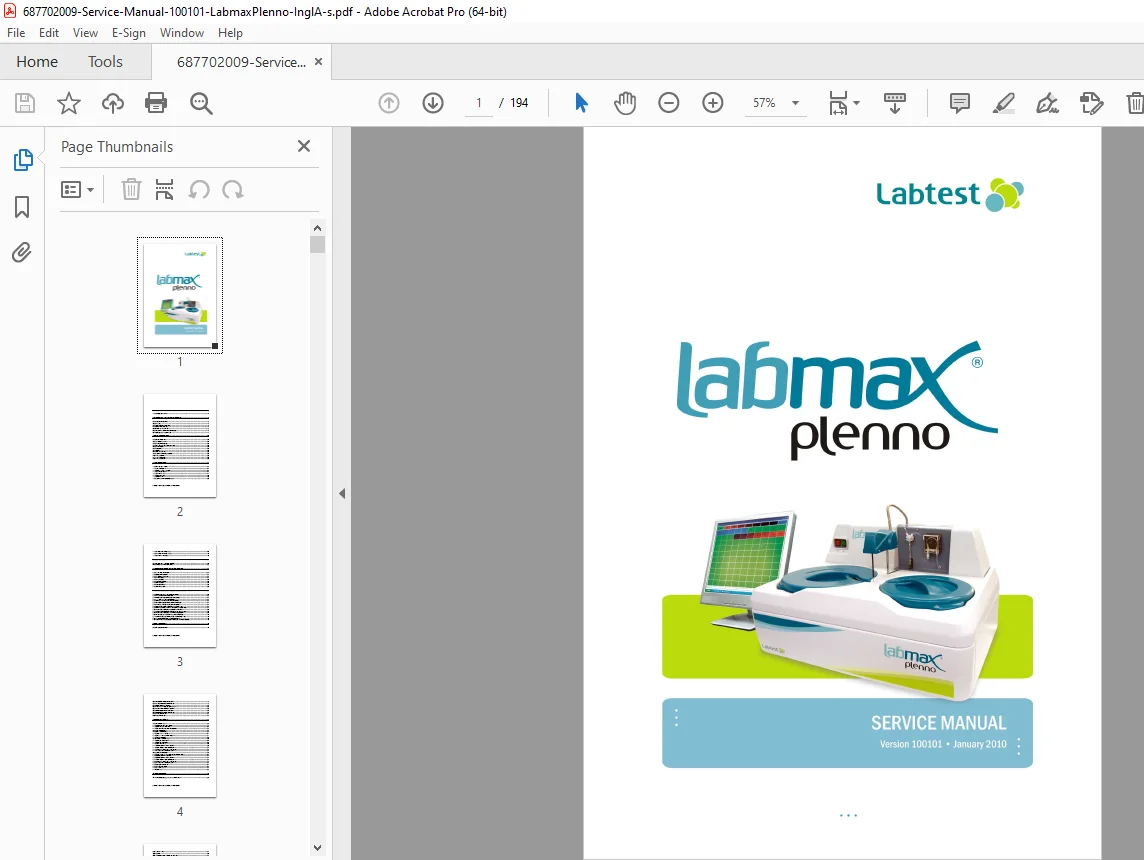
This is the official service manual (Part Number MS100101, Version 100104) for the Labtest Labmax Plenno automated clinical chemistry analyzer, published January 2010. This comprehensive 194-page professional service manual provides complete technical documentation for installation, calibration, troubleshooting, maintenance, and repair of this high-throughput laboratory analyzer featuring discrete photometric testing with 100-cuvette reaction capacity.
📋 File Details
- Manual Name: Labmax Plenno Service Manual
- Part Number: MS100101
- Version: 100104
- Publication Date: January 2010
- Manufacturer: Labtest Diagnostica S.A.
- Pages: 194 pages
- File Quality: High-resolution PDF (A4 size)
- File Size: 6.8 MB
- Language: English
🔬 Labmax Plenno Analyzer Specifications
Performance:
- Maximum throughput: 360 tests/hour
- Average throughput: 300 tests/hour
- Operation: Fully automatic with random access
- System type: Discrete photometric analyzer
- Incubation temperature: 37°C (warm air thermal)
Sample/Reagent System:
- Reagent positions: 30 positions (60 reagents with single/double bottles)
- Reagent bottles: 60ml single, 28ml/31ml double
- Sample positions: 60 tubes or sample cups (13×75mm primary tubes)
- Sample capacity: Continuous loading during operation
- Reagent tray: Independent refrigeration system
- Barcode reader: Optional for sample ID
Cuvettes/Reaction System:
- Number of cuvettes: 100 PMMA cuvettes (10 segments)
- Minimum reaction volume: 220 µl
- Maximum cuvette capacity: 600 µl (physical)
- Washing: Continuous automatic washing/drying
- Water consumption: 2.4 ml per cuvette
Dispensing System:
- Sample/reagent preheating: 37°C
- Dilutor type: High precision syringe
- Maximum aspiration: 500 µl
- Probe washing: Internal and external (peristaltic pump)
- Detection: Volume detection and probe impact sensors
Photometer:
- Optical filters: 10 interferential filters
- Wavelengths: 340, 380, 405, 450, 505, 546, 578, 600, 650, 700 nm
- Optional: 750 nm (11th filter)
- Light source: Krypton-halogen lamp (12V, 20W)
- Optical path: 6 mm
- Photometric range: -0.100 to 3.600 Absorbance
- Measurement types: Monochromatic and bichromatic
Physical Specifications:
- Dimensions: 80cm (W) × 45cm (H) × 58cm (D)
- Power requirement: 100-240 VAC, 50-60 Hz, 400 VA
- Operating temperature: 20-25°C
- Humidity: 40-85% (no condensation)
- Classification: Class 1, Type B, IPX0
PC Requirements:
- 2 GHz Pentium IV minimum
- 256 MB RAM
- Independent video card
- 40 GB hard drive
- Windows XP operating system
- RS232C serial port
📚 Comprehensive Manual Contents
CHAPTER 1: UNPACKING (Pages 1-4)
- Step-by-step unpacking instructions with detailed photos
- Wooden crate disassembly procedures
- Instrument release from shipping base
- Protective materials removal
- Safety warnings for trained personnel
CHAPTER 2: INSTALLATION AND CONNECTIONS (Pages 5-9)
- Electrical requirements – 110V/60Hz or 220V/50Hz specifications
- Physical dimensions and placement guidelines
- Environmental requirements – Temperature and humidity ranges
- PC minimum requirements – Hardware and software specifications
- Instrument placement and preparation:
- Counter positioning requirements
- Ventilation clearances (20cm minimum)
- Vibration and temperature considerations
- Grounding requirements
- Wires and tubing connections:
- RS232C communication setup
- Power supply interlock connection
- Waste and washing solution tubing routing
- Complete connection diagrams
CHAPTER 3: TECHNICAL SPECIFICATIONS (Pages 10-13)
- General specifications – Throughput, operation modes
- Sample/reagent tray – Capacity and configuration details
- Cuvettes/reaction tray – Volume specifications and incubation
- Dispensing arm and hydraulic system – Precision specifications
- Cuvette washer – Water consumption and cycle details
- Photometer – Complete optical specifications
- Software features:
- Menu system and interface
- Continuous loading capabilities
- STAT samples processing
- Unlimited method storage
- Quality control statistics
- Levy-Jennings plots
- Calibration curve management
- Data import/export capabilities
- Description of electronic circuits – 12 microcontroller architecture
- Types of samples, reactions, and methods supported
CHAPTER 4: GENERAL FUNCTIONS (Pages 14-20)
- Main parts and modules:
- Sample/reagent tray operation
- Dispensing arm and probe mechanisms
- Cuvettes/reaction tray system
- Cuvette washer functionality
- Hydraulic system components
- Optical system architecture
- Operating cycle descriptions:
- Reaction preparation cycle
- Incubation and reading cycle
- Cuvette washing cycle
- Complete timing diagrams
CHAPTER 5: BASIC OPERATIONS (Pages 21-25)
- Terminal program operation procedures
- Firmware parameter access and configuration
- Command-line interface usage
CHAPTER 6: DISASSEMBLY AND ASSEMBLY (Pages 26-32)
- Cabinet disassembly procedures
- Module-by-module disassembly:
- Robot/header module
- Sample/reagent module
- Cuvette module
- Washer module
- Photometer module
- Dilutor module
- Electronic module
- Hydraulic module
- Step-by-step instructions with safety precautions
CHAPTER 7: MOVEMENT ADJUSTMENT SEQUENCE (Pages 33-42) Complete calibration procedures for all modules:
- Reaction tray dispensing offset calibration
- Washer base cuvette calibration
- Photometer offset calibration
- Robot arm reference position adjustment
- Funnel base vertical movement calibration
- Head robot position calibrations (multiple positions)
- Reagent container vertical movement calibrations
- Sample tube base calibrations
- Volume meter calibrations (washing, waste, probe solution)
CHAPTER 8: PARTS REPLACEMENT (Pages 43-55) Detailed replacement procedures with photos:
- Light bulb replacement (krypton-halogen lamp)
- Interferential filters replacement
- Sample/reagent probe replacement
- Diluter syringe replacement
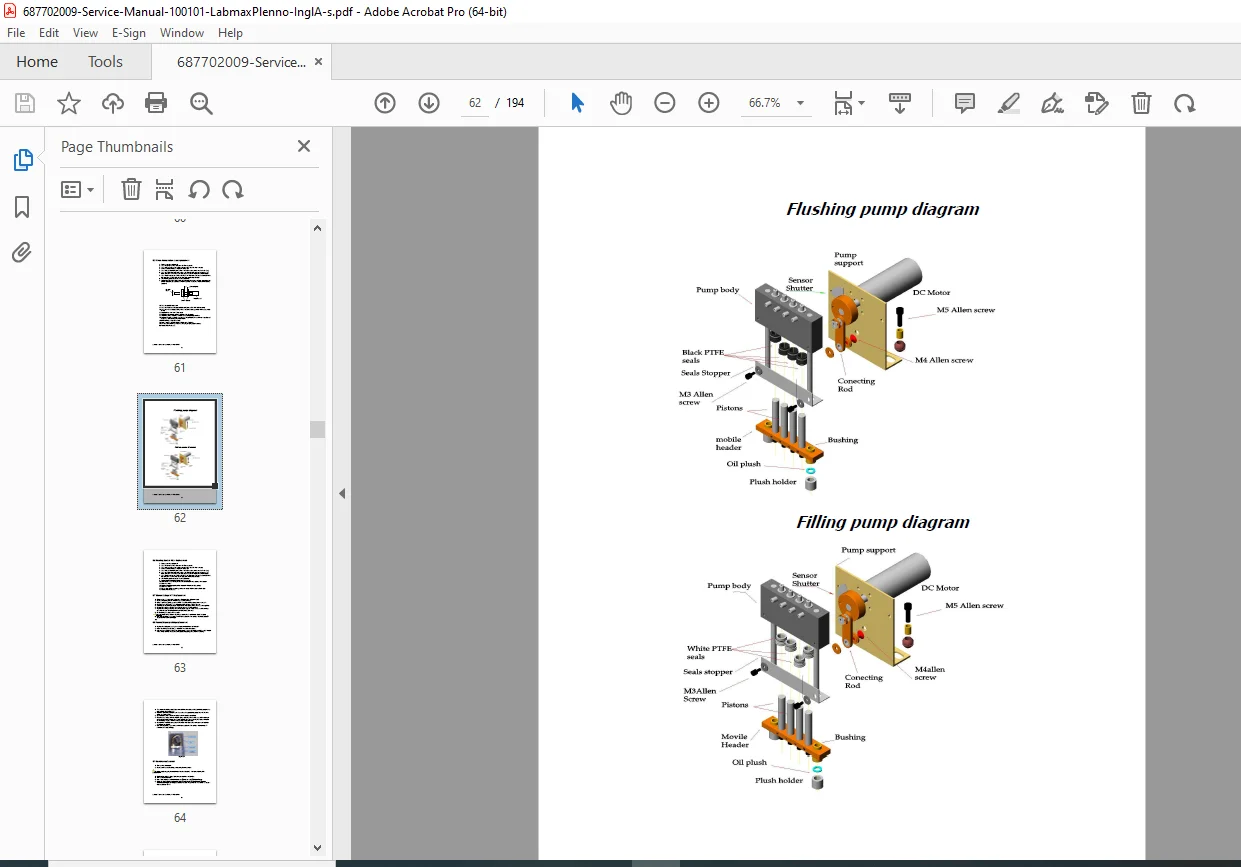
- Piston pump Teflon seals replacement
- Washing system filter replacement
- Diluter syringe PTFE replacement
- Peristaltic pump tubing replacement
- Cuvettes replacement
- Fuses replacement
CHAPTER 9: MAINTENANCE PROGRAM (Pages 56-62)
Daily Maintenance:
- Before starting operations
- During daily operation
- Upon finishing daily work
Weekly Maintenance:
- Routine cleaning procedures
- System checks
Monthly Maintenance:
- External cuvette washing
- General instrument washing
- Database backup procedures
Six-Monthly Maintenance:
- Reagent tray disinfection
- Tubing disinfection
- Axle lubrication
- Diluter syringe PTFE replacement
- Peristaltic pump tubing replacement
- Piston pump seals replacement
- Filter replacement
As-Needed Maintenance:
- Database initialization (every 10,000 determinations)
- Emergency repairs and replacements
- Special wash procedures
CHAPTER 10: TROUBLESHOOTING (Pages 63-108)
10.1 Hardware Error Messages:
- Complete error code reference (64+ pages)
- Diagnostic messages displayed on screen
- Detailed troubleshooting for each error
10.2 Log File Analysis:
- Detector status tables
- Level sensor interpretation
- System diagnostics
10.3 Fast Test Procedures:
- Quick diagnostic routines
- System verification tests
10.4 Chemical Problems:
- High results – Causes and solutions
- Low results – Troubleshooting guide
- Erratic results – Systematic diagnosis
- Single sample issues – All methods affected
- Single method issues – All samples affected
10.5 Instrumental Problems:
- Connections and supplies – Power, cables, fluids
- Hydraulic system – Pumps, valves, pressure
- Dilutor – Syringe, precision, leaks
- Washer – Flow, cleaning efficiency
- Sample/reagent probe – Movement, aspiration, dispensing
- Reaction cuvettes plate – Temperature, positioning
- Sample/reagent tray – Rotation, positioning
- Optical system – Lamp, filters, detectors
- Software – Communication, data integrity
CHAPTER 11: COMMUNICATION PROTOCOL (Pages 109-120) For technical service use:
- Protocol introduction and structure
- Message structure specifications
- Command descriptions for all modules:
- Sample probe commands
- Reaction tray commands
- Sample-reagent tray commands
- Pump control commands
- Heater commands
- Preheater commands
- Photometer commands
- Washer commands
- Dilutor commands
- Miscellaneous commands
- Synchronous answer descriptions
- Asynchronous answer descriptions
- EEPROM Version 1.04 address map:
- Main controller addresses
- All module address maps
- Filter wheel addresses
- Container addresses
- Barcode reader addresses
- Absorbance storage addresses
CHAPTER 12: VALIDATIONS (Pages 121-128) Performance verification procedures:
- Stray light testing – Optical system verification
- Photometer precision – Repeatability testing
- Photometric accuracy – Standard verification
- Photometric linearity – Range verification
- Diluter precision – Volume accuracy testing
CHAPTER 13: DIAGRAMS (Pages 129-179) Complete technical schematics:
- Electrical and electronic schemes (40+ pages)
- Power distribution diagrams
- Control circuit schematics
- PCB layouts
- Wiring harnesses
- Mechanical schemes (8 pages)
- Assembly drawings
- Movement mechanisms
- Mechanical linkages
- Hydraulic schemes (2 pages)
- Fluid flow diagrams
- Pump configurations
- Valve arrangements
CHAPTER 14: SPARE PARTS (Pages 180-194)
- Complete spare parts catalog with part numbers
- Component illustrations
- Ordering information
- Consumables list
⚙️ Key Technical Features Documented
Modular Electronic Architecture:
- 12 microcontroller system
- Main controller coordination
- Individual module control
- RS232C communication protocol
Random Access Testing:
- Continuous sample loading
- STAT priority processing
- User-defined processing order
- Interrupt capability for urgent samples
Discrete Analysis System:
- Individual cuvettes per reaction
- Minimized cross-contamination
- 100-cuvette capacity
- Automatic continuous washing
Advanced Photometry:
- 10 wavelength capability (11 optional)
- Wide photometric range (-0.100 to 3.600 A)
- Monochromatic and bichromatic modes
- 6mm optical path
High-Precision Fluid Handling:
- Precision dilutor syringe (500 µl max)
- Volume detection system
- Probe impact sensors
- Internal/external probe washing
- Preheating to 37°C
🎯 Who Should Use This Manual?
- Biomedical engineers servicing clinical chemistry analyzers
- Laboratory equipment technicians maintaining automated analyzers
- Hospital engineering departments supporting lab equipment
- Medical device service companies repairing Labtest instruments
- Clinical laboratory managers overseeing equipment maintenance
- Technical training programs teaching analyzer technology
- Independent service technicians specializing in lab automation
- Facility maintenance teams in diagnostic laboratories
✅ Why This Manual is Essential
✔ Official Labtest documentation – Authentic manufacturer service guide
✔ Complete system coverage – All modules and subsystems documented
✔ Detailed calibration procedures – Precise adjustment instructions
✔ Comprehensive troubleshooting – 60+ pages of diagnostic procedures
✔ Full electrical schematics – 40+ pages of circuit diagrams
✔ Mechanical and hydraulic diagrams – Complete system drawings
✔ Parts replacement procedures – Step-by-step with photographs
✔ Communication protocol – Complete command reference for diagnostics
✔ Validation procedures – Performance verification protocols
✔ Spare parts catalog – Component identification and ordering
✔ Maintenance schedules – Daily, weekly, monthly, six-monthly routines
✔ Error code reference – Every hardware message explained
📥 Instant Digital Download
Receive your PDF manual immediately after purchase. Compatible with all devices – desktop, laptop, tablet, smartphone. Print sections for lab bench reference or keep digital for quick access during service calls.