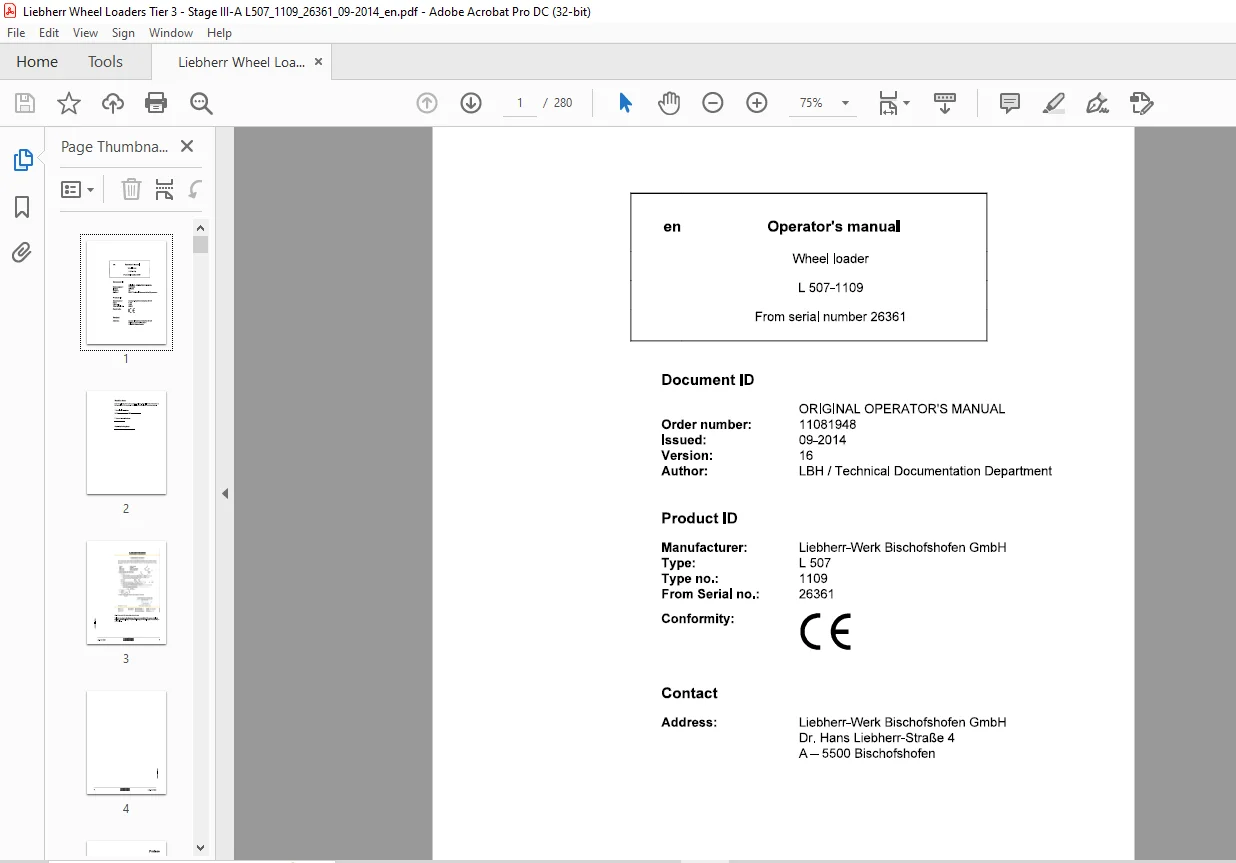
Liebherr L 507 1109 Wheel Loader Operator’s Manual SN 26361 – PDF DOWNLOAD
Original price was: $86.95.$28.95Current price is: $28.95.
Liebherr L 507 1109 Wheel Loader Operator’s Manual SN 26361 – PDF DOWNLOAD
Description
Liebherr L 507 1109 Wheel Loader Operator’s Manual SN 26361 – PDF DOWNLOAD
FILE DETAILS:
Liebherr L 507 1109 Wheel Loader Operator’s Manual SN 26361 – PDF DOWNLOAD
Language : English
Pages : 280
Downloadable : Yes
File Type : PDF
Size: 60.1 MB
DESCRIPTION:
Liebherr L 507 1109 Wheel Loader Operator’s Manual SN 26361 – PDF DOWNLOAD
Preface:
This operating manual has been written for the driver and for the maintenance personnel of the machine.
It contains the following descriptions:
- Chapter 1: Product description
- Chapter 2: Safety regulations
- Chapter 3: Handling and operation
- Chapter 4: Malfunctions
- Chapter 5: Maintenance
This operating manual must be carefully read before initial operation and should be read and used later at regular intervals by anyone who carries out work on the machine.
Working with or on the machine includes:
- Operation, including equipping, troubleshooting during operation, removing production debris, maintenance, removing operating and auxiliary materials.
- Servicing, including maintenance, inspection, and repairs.
- Transport or loading the machine.
This manual helps the driver to become acquainted with the machine and prevents malfunctions due to incorrect operation.
Observation of the operating manual by maintenance staff:
- Increases reliability during operation.
- Extends the service life of your machine.
- Reduces repair costs and downtime.
This manual must be kept with the machine. Make sure a copy is always kept in the glove compartment of the driver’s cab.
In addition to the operating manual, follow the instructions based on existing national accident prevention and environmental protection regulations.
In addition to the operating manual and applicable national and local legal accident prevention rules, observe the recognized technical regulations for safe and correct operation.
This operating manual contains all the information you need to operate and service your machine.
- Some illustrations in this manual may show details and equipment that are different from those on your machine.
- On some pictures, protective devices and covers have been removed for a better view.
- We constantly make improvements to our machines, which means there may have been modifications to your machine which are not mentioned in this manual.
However, if you should require explanations or information, the Liebherr technical information and customer services departments will be happy to provide assistance.
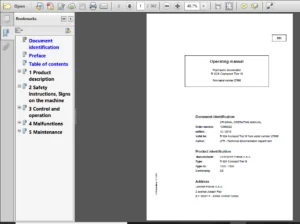
IMAGES PREVIEW OF THE MANUAL:
TABLE OF CONTENTS:
Liebherr L 507 1109 Wheel Loader Operator’s Manual SN 26361 – PDF DOWNLOAD
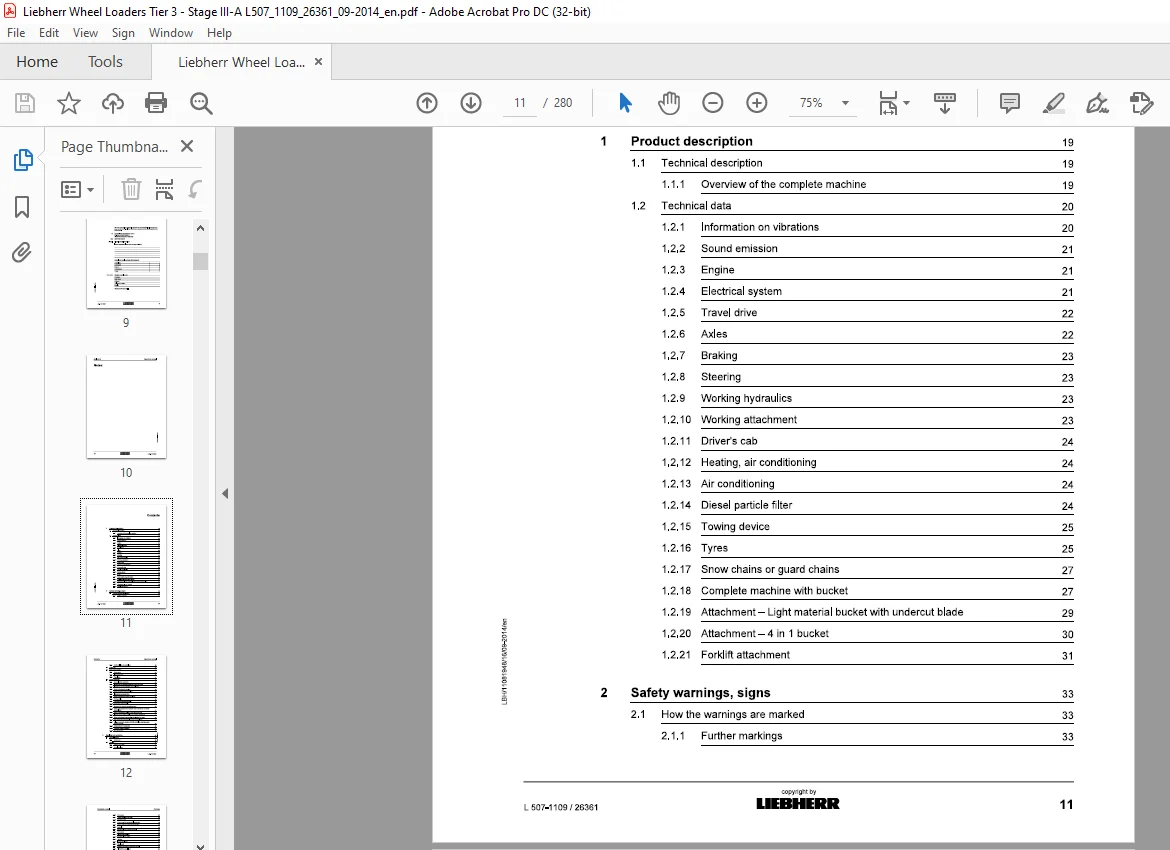
1.1 Technical description 19
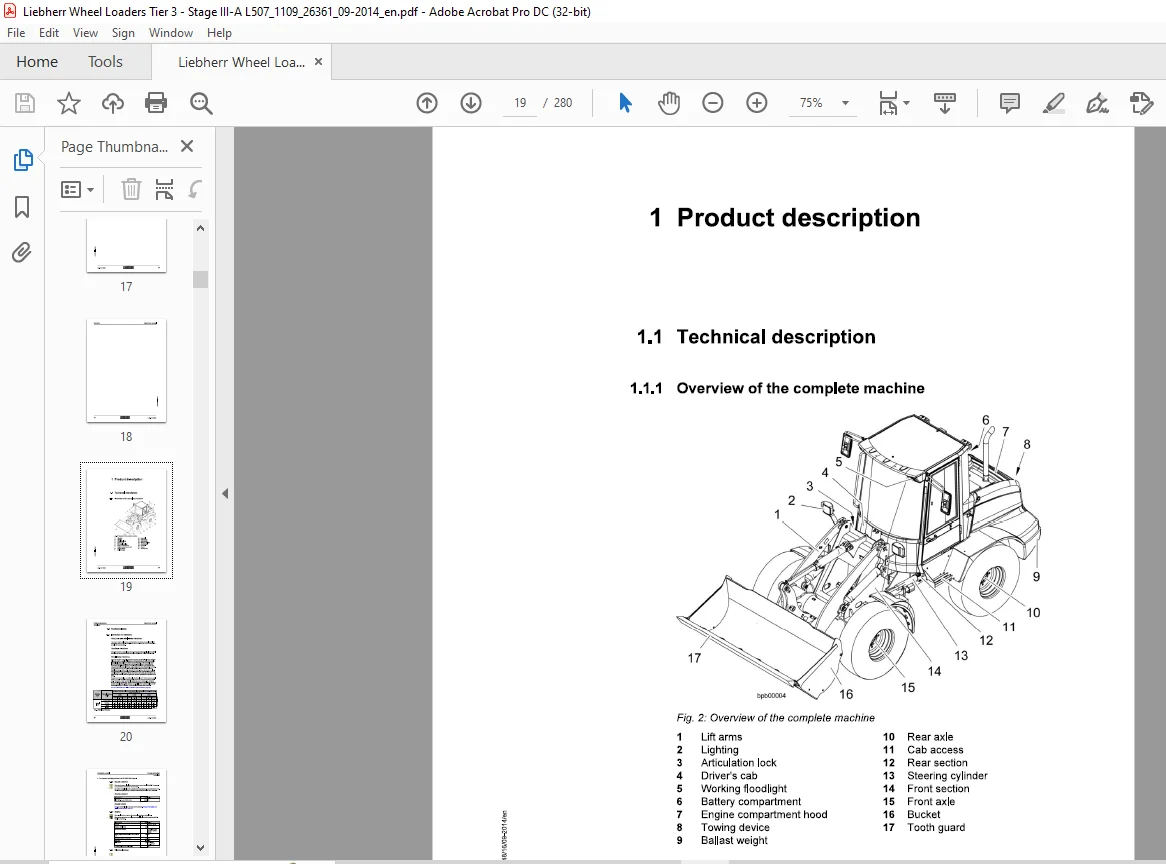
1.1.1 Overview of the complete machine 19
1.2 Technical data 20
1.2.1 Information on vibrations 20
1.2.2 Sound emission 21
1.2.3 Engine 21
1.2.4 Electrical system 21
1.2.5 Travel drive 22
1.2.6 Axles 22
1.2.7 Braking 23
1.2.8 Steering 23
1.2.9 Working hydraulics 23
1.2.10 Working attachment 23
1.2.11 Driver’s cab 24
1.2.12 Heating, air conditioning 24
1.2.13 Air conditioning 24
1.2.14 Diesel particle filter 24
1.2.15 Towing device 25
1.2.16 Tyres 25
1.2.17 Snow chains or guard chains 27
1.2.18 Complete machine with bucket 27
1.2.19 Attachment — Light material bucket with undercut blade 29
1.2.20 Attachment —4 in 1 bucket 30
1.2.21 Forklift attachment 31
2 Safety warnings, signs 33
2.1 How the warnings are marked 33
2.1.1 Further markings
2.4.12 Safety instructions for maintenance work on machines with hydro
2.417 Roll-over protection structure (ROPS) and falling object protection
3.2.4 Hinged right-hand cab door 69
3.2.5 Emergency exit 69
3.2.6 Driver’s seat with mechanical suspension 70
3.2.7 Driver’s seat with pneumatic suspension 75
3.2.8 Seatbelt 80
3.2.9 Steering column and steering wheel 81
3.2.10 Start switch 82
3.2.11 Electronic immobiliser 83
3.2.12 Steering column switch 85
3.2.13 Lighting 86
3.2.14 Interior cab lighting 90
3.2.15 Display unit 90
3.2.16 Switches and buttons on the side console 94
3.2.17 LIEBHERR control lever 101
3.2.18 Control lever for additional working functions 104
3.2.19 Heating, air conditioning 106
3.2.20 Air conditioning system 108
3.2.21 Interior and exterior mirrors 109
3.2.22 Sun visor 110
3.2.23 Radio 110
3.2.24 Windscreen wiper and washer system 111
3.2.25 Back-up alarm 112
3.2.26 Reversible fan drive 115
3.2.27 LIiDAT 116
3.3 Operation 117
3.3.1 Daily start-up 117
3.3.2 Starting the engine 119
3.3.3 Driving 124
3.3.4 Shutting down the machine 133
3.3.5 Automatic engine shutdown 136
3.3.6 Operating the lift arms 136
3.3.7 Diesel particulate filter 146
3.3.8 4in1 bucket 150
3.3.10 Side dump bucket 155
3.3.11 Forklift 157
3.4.1 Picking up and moving material 160
3.4.2 Transporting and moving material 161
3.4.3 Grading work 163
3.44 Loading a heap 164
3.4.5 Removing material from a slope or wall 166
3.46 Loading a transport vehicle 167
3.47 Excavation 171
3.5 Fitting and removing the attachment 174
attachments 174
3.6 Transport 184
3.6.1 Transporting the machine 184
3.6.2 Transport safety retainer 190
3.7 Emergency operation 192
3.7.1 Towing the machine 192
3.7.2 Jump starting 197
Malfunctions 199
41 Problems – Cause – Remedy 199
4.1.1 Visible and audible warming signals 199
4.1.2 Troubleshooting 200
4.2 Problem remedy 204
4.21 Replacing fuses 204
Maintenance 209
5.1 Maintenance and inspection schedule 209
5.2 Filling quantities and lubrication chart 213
52.1 Recommended lubricants 213
5.2.2 Recommended operating fluids 214
5.2.3 Lubrication chart 214
5.3 Lubricants and fuels 217
5.3.1 General information on changing lubricants and fuels 217
harmless hydraulic fluids 217
5.3.3 Diesel fuels 218
5.3.4 Lubricating oils for diesel engines 219
5.3.5 Coolants for diesel engines 221
5.3.6 Hydraulic oil 223
5.3.7 Lubricating oils for axles and transmissions 227
5.3.8 Brake oil 228
5.3.9 Lubrication grease and other lubricants 228
5.4 Preparatory tasks for maintenance 231
5.4.1 Safety precautions for maintenance 231
5.4.2 Maintenance positions 232
5.4.3 Opening the engine compartment hood and the cooling system grille 233
5.4.4 Switching off the battery main switch 235
5.5 Complete machine 236
5.5.1 Remove loose parts, dirt, ice and snow from the machine 236
5.5.2 Checking the machine for external damage 236
5.5.3 Making sure the bolted connections are tight 236
5.5.4 Sealing leaks 236
artificial fertilizers 236
5.5.6 Replacing VCI capsules 237
5.6 Engine 238
5.6.1 Check the engine oil level 238
5.6.2 Changing the engine oil 238
5.6.3 Changing the engine oil filter 238
5.6.4 Cleaning the fuel gauze filter and replace if necessary 239
5.6.5 Changing the fuel fine filter 239
5.6.6 Drain off condensate from the fuel fine filter 240
5.6.7 Bleeding the fuel system 241
5.6.8 Clean the air filter service cap and dust extraction valve 242
5.6.9 Changing the air filter main element 243
5.6.10 Changing the air filter secondary element 243
5.7 Diesel particulate filter 245
56.7.1 To drain the condensate separator 245
5.8 Cooling system 246
5.8.2 Checking the coolant antifreeze and corrosion inhibitor concentration 247
5.8.3 Cleaning the cooling system 250
Working hydraulics 251
5.9.1 Checking the oil level in the hydraulic tank 251
Steering system 252
5.10.1 Testing the steering 252
5.10.2 Lubricating the bearing points on the steering cylinders 252
Brake system 253
5.11.1 Testing the service brake and parking brake 253
5.11.2 Checking the gap and wear on the service and parking brake linings 254
5.11.3 Checking the oil level in the equalising reservoir of the brake system 255
Electrical system 256
5.12.1 Checking the indicator lamps 256
5.12.2 Checking the lights 256
Axles and tyres 257
5.13.1 Checking the tightness of the wheels (once after 50, 100 and 250 h) 257
5.13.2 Greasing the rear axle kingpin bearings 257
5.13.3 Checking and lubricating the cardan shaft(s) 258
5.13.4 Checking the tyre pressure 259
Machine frame and ballast weight 261
5.14.1 Lubricating the articulation bearing and rear oscillating bearing 261
5.14.2 Grease the contact faces of the articulation stops 262
Lubrication system 263
5.15.1 Checking the lubrication system grease reservoir level 263
5.15.2 Checking the pipes, hoses and lubrication points of the lubrication
5.16.3 Checking whether metered quantities are adequate at the bearing
Cab, heating and air conditioning 265
5.16.1 Greasing the cab door hinges 265
5.16.2 Checking / topping up the windscreen washer reservoir 265
5.16.3 Cleaning the fresh air and recirculated air filter 266
5.16.4 Changing the fresh air and recirculated air filter 266
Lift arms and quick-change device 268
5.17.1 Lubricating the lift arms and attachment 268
5.17.3 Lubricating and testing the quick-change device 269
5.18.1 Washing the machine 271
5.19.1 Protecting the piston rods from corrosion 273
5.19.2 Protecting the fuel tank from corrosion 273
Index 275
Questions? Email us: [email protected]
PLEASE NOTE:
- This is the same manual used by the DEALERSHIPS to SERVICE your vehicle.
- The manual can be all yours – Once payment is complete, you will be taken to the download page from where you can download the manual. All in 2-5 minutes time!!
- Need any other service / repair / parts manual, please feel free to contact us at heydownloadss @gmail.com . We may surprise you with a nice offer
S.V