Liebherr L 542 (USA / CAN) 435 Wheel Loader Operating Manual SN 23816 – PDF DOWNLOAD
Original price was: $86.95.$28.95Current price is: $28.95.
Liebherr L 542 (USA / CAN) 435 Wheel Loader Operating Manual SN 23816 – PDF DOWNLOAD
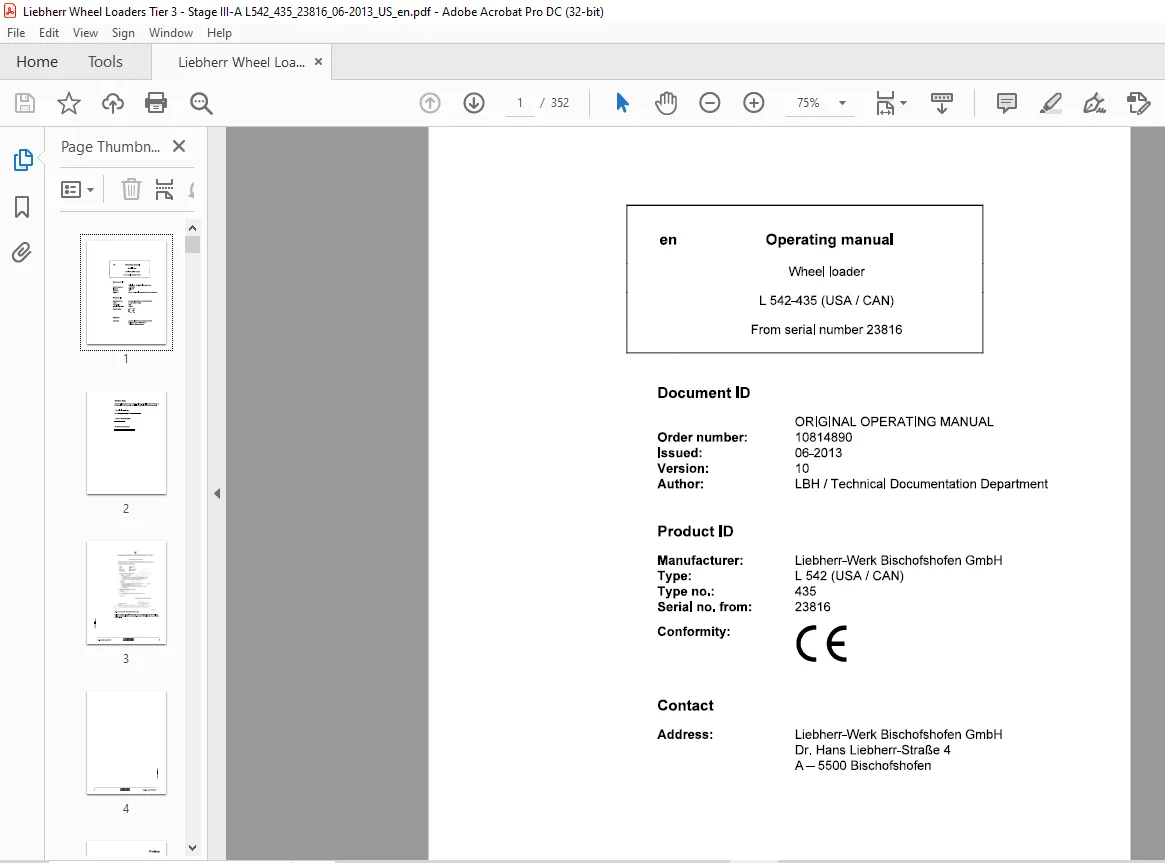
Product ID
Manufacturer: Liebherr-Werk Bischofshofen GmbH
Type: L 542 (USA / CAN)
Type no.: 435
From Serial no.: 23816
Description
Liebherr L 542 (USA / CAN) 435 Wheel Loader Operating Manual SN 23816 – PDF DOWNLOAD
FILE DETAILS:
Liebherr L 542 (USA / CAN) 435 Wheel Loader Operating Manual SN 23816 – PDF DOWNLOAD
Language : English
Pages : 352
Downloadable : Yes
File Type : PDF
Size: 73.1 MB
DESCRIPTION:
Liebherr L 542 (USA / CAN) 435 Wheel Loader Operating Manual SN 23816 – PDF DOWNLOAD
Product ID
Manufacturer: Liebherr-Werk Bischofshofen GmbH
Type: L 542 (USA / CAN)
Type no.: 435
From Serial no.: 23816
Preface:
This operating manual has been written for the driver and for the maintenance personnel of the machine.
It contains the following descriptions:
- Chapter 1: Product description
- Chapter 2: Safety regulations
- Chapter 3: Handling and operation
- Chapter 4: Malfunctions
- Chapter 5: Maintenance
This operating manual must be carefully read before initial operation and should be read and used later at regular intervals by anyone who carries out work on the machine.
Working with or on the machine includes:
- Operation, including equipping, troubleshooting during operation, removing production debris, maintenance, removing operating and auxiliary materials.
- Servicing, including maintenance, inspection, and repairs.
- Transport or loading the machine.
This manual helps the driver to become acquainted with the machine and prevents malfunctions due to incorrect operation.
Observation of the operating manual by maintenance staff:
- Increases reliability during operation.
- Extends the service life of your machine.
- Reduces repair costs and downtime.
This manual must be kept with the machine. Make sure a copy is always kept in the glove compartment of the driver’s cab.
In addition to the operating manual, follow the instructions based on existing national accident prevention and environmental protection regulations.
In addition to the operating manual and applicable national and local legal accident prevention rules, observe the recognized technical regulations for safe and correct operation.
This operating manual contains all the information you need to operate and service your machine.
- Some illustrations in this manual may show details and equipment that are different from those on your machine.
- On some pictures, protective devices and covers have been removed for a better view.
- We constantly make improvements to our machines, which means there may have been modifications to your machine which are not mentioned in this manual.
However, if you should require explanations or information, the Liebherr technical information and customer services departments will be happy to provide assistance.
Liability and warranty:
Because of the many products on offer from other manufacturers (such as fuels, lubricants, attachments, and replacement parts), Liebherr cannot test the suitability and faultless function of all third-party products in or on Liebherr products. The same applies to any effects caused by combining third-party products with Liebherr products.
- The use of third-party products together with Liebherr products is at the risk of the operator. Liebherr accepts no warranty or liability for damage of any kind in the event of breakdowns or damage to Liebherr machines caused by the use of third-party products.
- In addition, Liebherr will also reject any warranty claims for damage caused by improper use, insufficient maintenance, or failure to observe safety instructions.
IMAGES PREVIEW OF THE MANUAL:
TABLE OF CONTENTS:
Liebherr L 542 (USA / CAN) 435 Wheel Loader Operating Manual SN 23816 – PDF DOWNLOAD
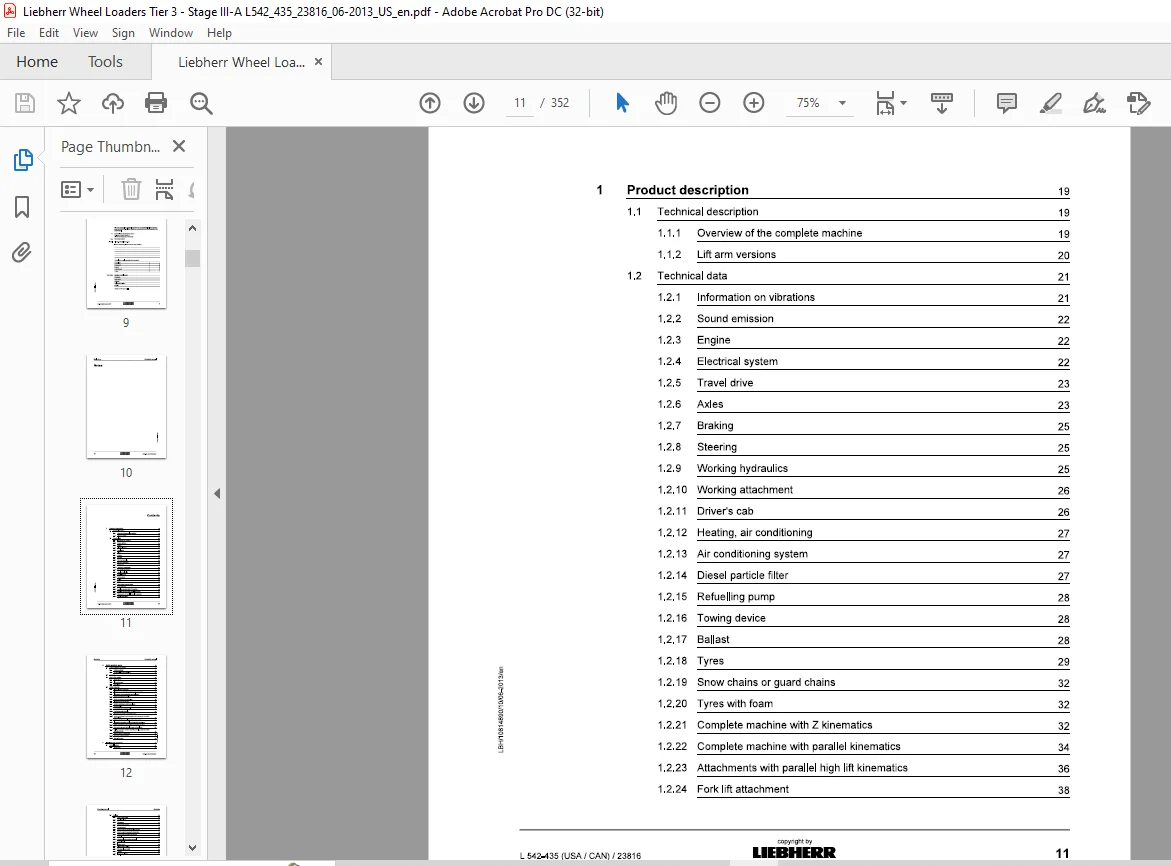
1.1 Technical description 19
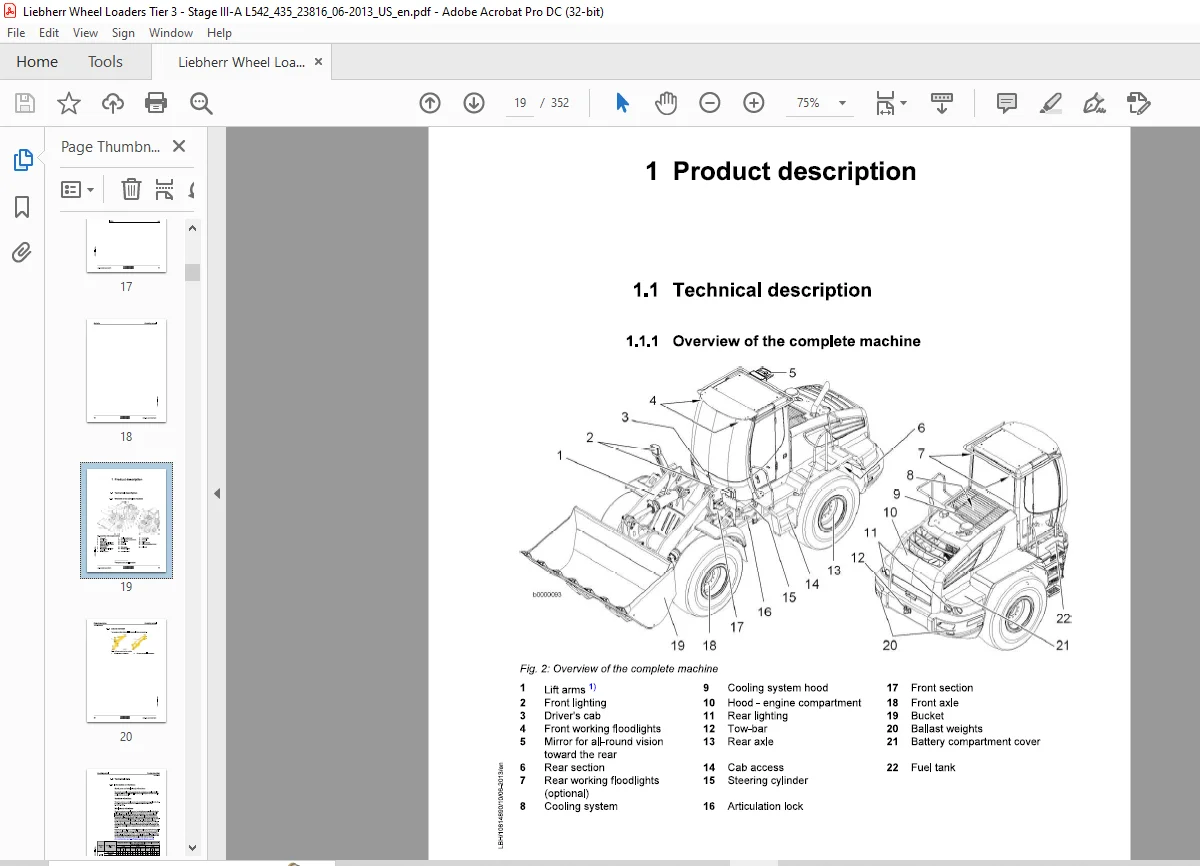
1.1.1 Overview of the complete machine 19
1.1.2 Lift arm versions 20
1.2 Technical data 21
1.2.1 Information on vibrations 21
1.2.2 Sound emission 22
1.2.3 Engine 22
1.2.4 Electrical system 22
1.2.5 Travel drive 23
1.2.6 Axles 23
1.2.7 Braking 25
1.2.8 Steering 25
1.2.9 Working hydraulics 25
1.2.10 Working attachment 26
1.2.11 Driver’s cab 26
1.2.12 Heating, air conditioning 27
1.2.13 Air conditioning system 27
1.2.14 Diesel particle filter 27
1.2.15 Refuelling pump 28
1.2.16 Towing device 28
1.2.17 Ballast 28
1.2.18 Tyres 29
1.2.19 Snow chains or guard chains 32
1.2.20 Tyres with foam 32
1.2.21 Complete machine with Z kinematics 32
1.2.22 Complete machine with parallel kinematics 34
1.2.23 Attachments with parallel high lift kinematics 36
1.2.24 Fork lift attachment 38
2.4.12 Safety instructions for maintenance work on machines with hydro
2.4.17 Roll-over protection structure (ROPS) and falling object protection
3.2 Handling 69
3.2.1 Battery main switch 69
3.2.10 Steering column and steering wheel 94
3.2.11 Control panel 95
3.2.12 Ignition switch 96
3.2.13 Electronic immobiliser 97
3.2.14 Steering column switch 99
3.2.15 Lighting 100
3.2.16 Interior cab lighting 104
3.2.17 Display unit 104
3.2.18 Control unit 111
3.2.19 LIEBHERR control lever 125
3.2.20 Control lever for additional working functions 129
3.2.21 Heating, ventilation, air conditioning (optional) 130
3.2.22 Automatic heating/ventilation/air conditioning 136
3.2.23 Rear window heater and mirror heater (optional) 140
3.2.24 Interior and exterior mirrors 141
3.2.25 Sun visor 141
3.2.26 Radio 142
3.2.27 Windscreen wiper and washer system 143
3.2.28 LIEBHERR automatic lubrication system 145
3.2.29 Back-up alarm 148
3.2.30 Reversible fan drive 1561
3.2.31 LIiDAT 152
3.3.1 Daily start-up 154
3.3.4 Shutting down the machine 172
3.3.5 Automatic engine shutdown 175
3.3.6 Operating the lift arms 175
3.3.7 Diesel particulate filter 183
3.3.8 Filling the tank using the filling pump 187
3.3.9 High dump bucket 188
3.3.10 Forklift 190
3.4 Working methods 194
3.4.1 Picking up and moving material 194
3.4.2 Transporting and moving material 195
3.4.3 Grading work 197
3.44 Loading a heap 198
3.4.5 Removing material from a slope or wall 200
3.4.6 Loading a transport vehicle 201
3.4.7 Excavation 205
3.5 Fitting and removing the attachment 208
3.5.1 Hydraulically actuated quick-change device 208
3.5.2 Electro-hydraulically actuated quick-change device 214
the comfort control or button control 220
3.6 Transport 230
3.6.1 Lifting the machine by crane 230
3.6.2 Transporting the machine by lorry or rail 232
3.6.3 Transport safety retainer 236
3.7 Emergency operation 238
3.7.1 Towing the machine 238
3.7.2 Emergency steering function when the steering system fails 243
3.7.3 Jump starting 244
4 Malfunctions 247
4.1 Servicecodes 247
4.1.1 Service code indication on the display 247
4.2 Problems – Cause – Remedy 259
42.1 Visible and audible warning signals 259
4.3 Problem remedy 264
4.3.1 Replacing fuses 264
5 Maintenance 269
5.1 Maintenance and inspection schedule 269
5.2 Filling quantities and lubrication chart 273
5.2.1 Recommended lubricants 273
5.22 Recommended operating fluids 274
5.2.3 Lubrication chart 274
5.3 Lubricants and fuels 277
5.3.1 General information on changing lubricants and fuels 277
harmless hydraulic fluids 277
53.3 Diesel fuels 278
5.3.4 Lubricating oils for diesel engines 279
5.3.5 Coolants for diesel engines 281
5.3.6 Hydraulic oil 284
5.3.7 Lubricating oils for transmissions 287
5.3.8 Lubricating oils for axles 288
5.3.9 Lubrication grease and other lubricants 289
5.4 Preparatory tasks for maintenance 23
5.4.1 Safety precautions for maintenance 29
5.4.2 Maintenance positions 292
5.4.3 Opening the engine compartment and grille 294
5.4.4 Turning off the battery main switch 295
5.5 Complete machine 297
5.5.1 Remove loose parts, dirt, ice and snow from the machine 297
5.5.2 Checking the machine for external damage 297
5.5.3 Making sure the bolted connections are tight 297
5.5.4 Sealing leaks 297
artificial fertilizers 297
5.5.6 Replacing VCI capsules 298
5.6 Engine 299
5.6.1 Checking the engine ail level 298
5.6.3 Changing the engine oil filter 300
5.6.4 Checking the engine heating flange 301
5.6.5 Changing the fuel pre-filter 302
5.6.6 Changing the fuel fine filter 304
5.6.7 Draining off condensate from the fuel pre-filter 305
5.6.8 Bleeding the fuel system 305
5.6.9 Draining off condensate and sediment from the fuel tank 307
5.6.10 Cleaning the air filter service cap and dust extraction valve 308
5.6.11 Changing the air filter main element 309
5.6.12 Changing the air filter secondary element 310
Cooling system 312
5.7.1 Checking the coolant antifreeze and corrosion inhibitor concentration 312
5.7.2 Cleaning the cooling system 316
5.7.3 Changing the coolant 317
Working hydraulics 319
5.8.1 Checking the oil level in the hydraulic tank 319
5.8.2 Check and clean the magnetic rod on the hydraulic tank 320
Steering system 322
5.9.1 Testing the steering 322
5.9.2 Lubricating the bearing points on the steering cylinders 322
Brake system 323
5.10.1 Testing the service brake and parking brake 323
Electrical system 325
5.11.1 Checking the indicator lamps 325
5.11.2 Checking the lights 325
Axles and tyres 326
5.12.1 Checking the tightness of the wheels (once after 50, 100 and 250 h) 326
5.12.2 Checking the tyre pressure 326
Machine frame and ballast weight 328
5.13.1 Lubricating the articulated bearing and the rear oscillating bearing 328
Central lubrication system 329
5.14.1 Checking the lubrication system grease reservoir level 329
5.14.2 Checking the pipes, hoses and lubrication points of the lubrication
Customer Support: [email protected]
PLEASE NOTE:
- This is the SAME exact manual used by your dealers to fix your vehicle.
- The same can be yours in the next 2-3 mins as you will be directed to the download page immediately after paying for the manual.
- Any queries / doubts regarding your purchase, please feel free to contact [email protected]
S.V