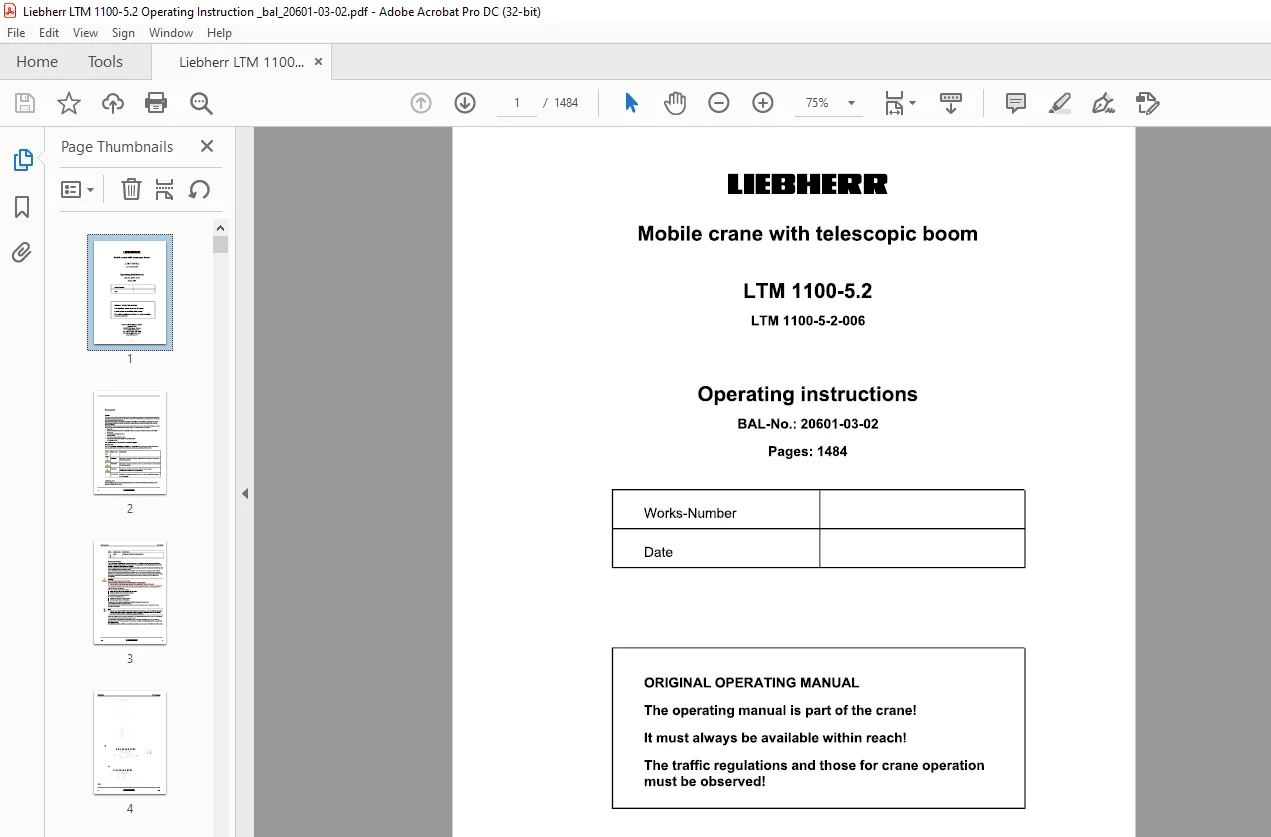
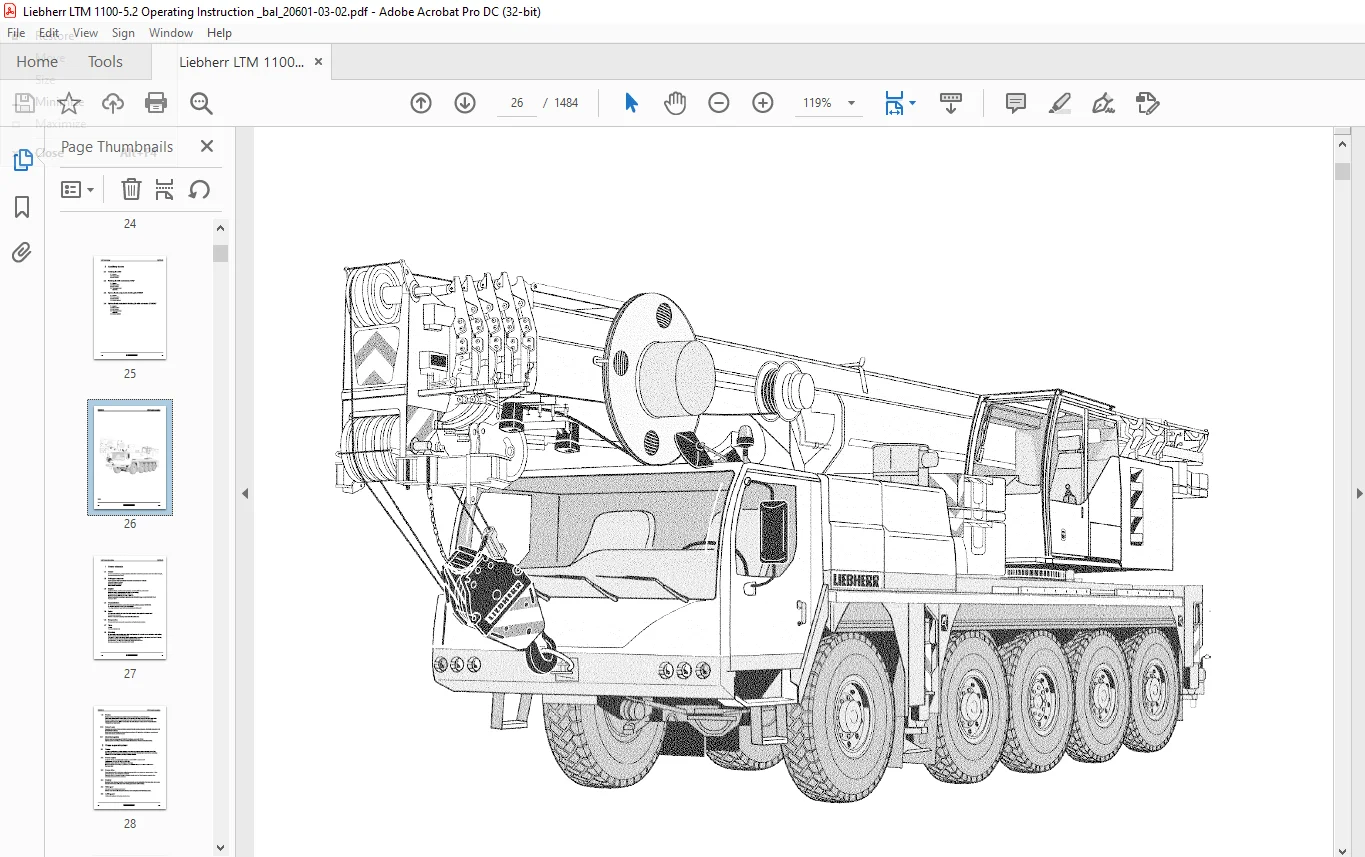
Liebherr Mobile Crane with telescopic Boom LTM 1100-5.2 Operating Instructions Manual 20601-03-02 – PDF DOWNLOAD
$36.95
Liebherr Mobile Crane with telescopic Boom LTM 1100-5.2 Operating Instructions Manual 20601-03-02 – PDF DOWNLOAD
Description
Liebherr Mobile Crane with telescopic Boom LTM 1100-5.2 Operating Instructions Manual 20601-03-02 – PDF DOWNLOAD
FILE DETAILS:
Liebherr Mobile Crane with telescopic Boom LTM 1100-5.2 Operating Instructions Manual 20601-03-02 – PDF DOWNLOAD
Language : English
Pages : 1484
Downloadable : Yes
File Type : PDF
IMAGES PREVIEW OF THE MANUAL:
DESCRIPTION:
Liebherr Mobile Crane with telescopic Boom LTM 1100-5.2 Operating Instructions Manual 20601-03-02 – PDF DOWNLOAD
Foreword:
General:
- This crane was built according to the state of technology and recognized safety technical regulations.
Despite that, dangers to body and life for the user and / or third persons or damage to the crane and /
or other material assets can occur. - This crane may only be used in flawless technical condition and according to its mission as well as
with constant awareness of safety and dangers. Any problems, which could affect safety must be
fixed immediately.
Modifications on the crane may only be made with written approval by Liebherr-Werk Ehingen GmbH.
This crane is equipped with a data recording device. The following data is recorded:
– Date, time
– Selected configuration (boom configuration, ballast, outrigger extension, reeving, hook block)
– Actual load
– Percentage of loading the crane
– Working radius
– Main boom angle, luffing jib angle
– Total length of tele boom, length of each tele section
– All bridging devices
The recorded data can be real with the respective software.
Destined use:
- The destined use of the crane consists solely in vertical lifting and lowering of free and non-adhered
loads, whose weight and center of gravity are known. - To do so, a hook or hook block approved by Liebherr must be reeved on the hoist rope and it may
only be operated within the permissible crane configurations. - Driving with the crane, with or without an attached load is only permissible if a corresponding driving
or load chart is available. The crane configurations intended for it and the safety conditions must be
observed according to the corresponding operating instructions. - Any other use or any other exceeding utilization is not destined use.
- Part of destined use is also adherence of required safety regulations, conditions, preconditions, crane
configurations and working steps as noted in the crane documentation (operating instructions, load
chart, job planner). - The manufacturer is not liable for damages, which are caused by non-destined use or improper use
of the crane. Any associated risk it is carried solely by the owner, the operator and the user of the
crane.
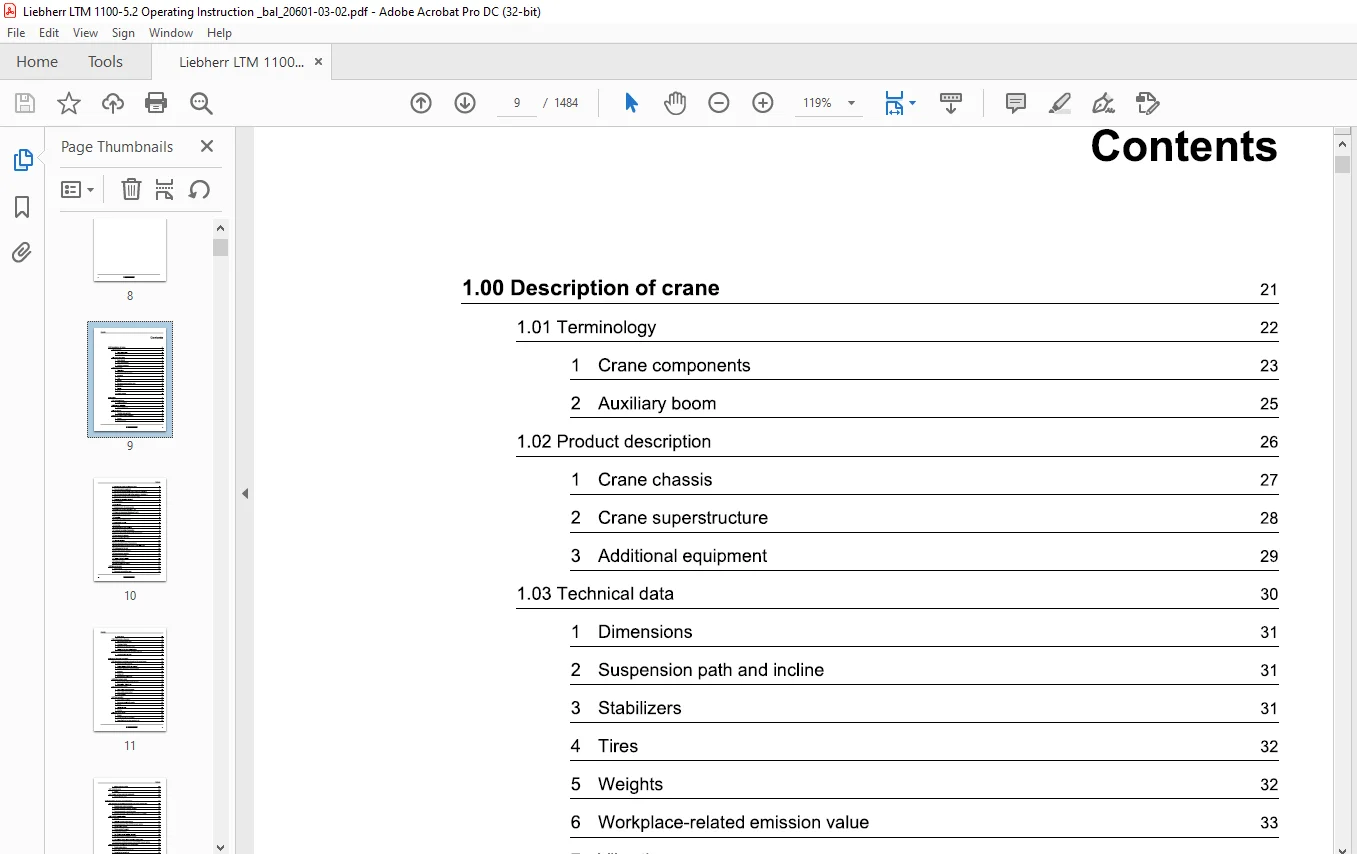
TABLE OF CONTENTS:
Liebherr Mobile Crane with telescopic Boom LTM 1100-5.2 Operating Instructions Manual 20601-03-02 – PDF DOWNLOAD
1.00 Description of crane 21
1.01 Terminology 22
1 Crane components 23
2 Auxiliary boom 25
1.02 Product description 26
1 Crane chassis 27
2 Crane superstructure 28
3 Additional equipment 29
1.03 Technical data 30
1 Dimensions 31
2 Suspension path and incline 31
3 Stabilizers 31
4 Tires 32
5 Weights 32
6 Workplace-related emission value 33
7 Vibrations 33
8 Speeds 33
9 Ropes 35
10 Hoisting heights 35
2.00 Safety 43
2.01 Traffic regulations 44
1 Traffic regulations 45
2.02 Break-in instructions 46
1 Break-in instructions 47
2.03 Job planning 48
1 Planning crane operation 49
2.04 General safety technical guidelines 50
1 General 51
2 Emergency exit 57
IIEBHEIIII 9
Contents
3 Checking the rigging and fastening points 59
4 Personal protective equipment 61
5 Use of single-stranded height safety equipment, illustration 1 65
6 Use of double-stranded height safety equipment, illustration 2 65
7 Securing the assembly personnel against falling 65
8 Rescuing the assembly personnel 67
9 Documentation 67
10 Identification 67
11 Requirements for the crane operator 67
12 Selecting the location, illustrations 1 to 3 73
13 Slopes and excavations, illustrations 4 and 5 76
14 Permissible ground pressures 76
15 Supporting 81
16 Checking the safety measures 82
17 Endangering air traffic 82
18 Grounding 83
19 Consideration of wind conditions 83
20 Working in the vicinity of transmitters 91
21 Dangers when working together with several cranes 93
22 Hand signals for guidance 94
23 Crane operation with a load 101
24 Lifting of personnel 104
25 Crane operation in case of thunderstorms 105
26 Safety instructions for external power supply (230 V AC) 106
27 Welding work on the load 106
28 Interruption of crane operation 107
29 Resuming crane operation 107
30 Ending crane operation 108
31 Turning/ driving in reverse 108
32 Parking the vehicle 108
33 Safety guidelines for ladders 111
2.05 Signs on the crane 117
1 Warning signs 119
2 Command and prohibition signs 125
10 IIEBHEIIII
Contents
3 Notice signs 129
2.06 Antifall guards on the crane 134
1 Fall arresters on the crane 135
2 Providing a ladder 137
3 Attachment and fastening points 139
4 Railings on the crane superstructure 145
2.10 General safety technical notes for driving with dolly 146
1 Travel operation with dolly 147
3.00 Crane chassis operation 157
3.01 Operating and monitoring instruments on the crane chassis 158
1 General operating elements 159
2 Control elements DTCO trip recorder* 163
3 Operating elements on camera-monitor* 165
4 Keyboard 167
5 Display unit 171
6 Grounding the mobile crane 177
3.02 Before starting to travel 178
1 General checks before starting to travel 179
2 Work station – Driver’s cab 185
3.03 Axle suspension system 194
1 Crane vehicle axles suspended 195
2 Crane vehicle axles blocked 197
3 Level regulation 199
3.04 Travel operation 212
1 Crane driving conditions 213
2 Starting and stopping the engine 217
3 Travel 225
4 Differential locks 265
5 Steering 271
3.05 Crane at the job site 277
1 General 279
2 The Bluetooth™ Terminal (BTT) 287
3 Supporting from the crane operator’s cab 323
IIEBHEIIII 11
Contents
4 Before leaving the jobsite 343
3.07 Towing the crane 344
1 Towing 345
3.80 Transport of crane and crane components 346
1 Transporting the crane 347
4.00 Operation of crane superstructure 353
4.01 Operating and monitoring instruments on the crane superstructure 354
1 Operating and control instruments 355
2 Operating elements on camera – monitor* 359
3 Operating elements on control consoles 361
4 Operating elements on the operating and control unit (BKE) 401
4.02 LICCON computer system 408
1 General 409
2 LICCON computer system boot up 411
3 Operating elements of the LICCON computer system 413
4 “Configuration” program 415
5 “Crane operation” program 433
6 “Telescoping” program 491
7 The “Working range limitation” program* 495
8 The “Support force monitoring” program* 497
9 The settings window “Speed reduction master switch” 505
10 Power-Save and Stand-by mode in the LICCON computer system 513
4.03 Crane start up and taking the crane out of service 518
1 Checks before start up 519
2 Work station – Crane operator’s cab 523
3 Preheating the hydraulic oil* 537
4 Starting and stopping the engine 539
5 Engine regulation from the crane driver’s cab 559
6 LICCON computer system after engine start 563
4.04 Safety equipment 566
1 General 567
2 LICCON computer system 567
3 Safety devices on the crane 571
12 IIEBHEIIII
Contents
4 Safety systems 575
4.05 Crane operation 578
1 General 579
2 LICCON computer system 585
3 Luffing 587
4 Lifting/ lowering 593
5 Turning 599
6 Telescoping 607
4.06 Rope reeving 630
1 Wire ropes and rope end connections 631
2 Reeving the hoist rope with the auxiliary reeving rope 633
3 Reeving the hook block in and out 637
4 Securing and removing the load hook* 643
5 Attaching / removing the hoist limit switch weight 647
6 Assembling / disassembling the wedge lock 651
7 Crane operation with auxiliary block* on the telescopic boom 653
8 Rope reeving 653
4.07 Counterweight 654
1 General 655
2 Assembly 665
3 Disassembly of the counterweight plates 671
4.08 Working with a load 678
1 Technical safety instructions for working with a load 679
2 Checks before starting to work with the crane 680
3 Crane movement – Telescoping 681
4 Taking on a load 683
5 Crane operation 687
4.10 Driving from the crane operator’s cab 689
1 General 691
2 Brakes 699
3 Travel operation 703
4 Differential locks 717
5 Steering 723
4.15 Reeving plans 728
IIEBHEIIII 13
Contents
1 Reeving plans 729
4.20 Procedure for shut off of crane movements 740
1 General 741
2 Instructions for resuming crane movements for cranes with CE mark 743
3 Instructions for resuming crane movements for cranes without CE mark 777
5.00 Equipment 811
5.01 Safety technical guidelines for assembly and disassembly 812
1 Checking the retaining elements 813
2 Rope pulleys 813
3 Checking the ropes 813
4 Inspection procedures 814
5 Dangerous conditions without shut off 816
6 Transporting components 816
7 Pneumatic springs for assembly support of components 817
8 Manual rope winches for assembly support of components 817
9 Weights 818
10 Guy rods 818
11 Exceeding the overload protection 821
12 Assembly I disassembly 823
13 Erection / take down 849
5.02 Folding jib – TK 851
1 General 853
2 Fitting the folding jib 859
3 Reeving in the hoist rope 881
4 Changing over mechanical folding jib from 0° to 20° or 40° 883
5 Hydraulic connections 897
6 Electrical connections 899
7 Erection 907
8 Adjusting the folding jib angle hydraulically* 909
9 Changing over mechanical folding jib from 20° or 40° to 0° 911
10 Unreeving the hoist rope 923
11 Removing the folding jib 925
5.09 Hoist gear 2 940
14 IIEBHEIIII
Contents
1 General 941
2 Assembly 941
3 Disassembly 943
5.10 Boom nose – telescopic boom 944
1 General 945
2 Assembly 945
3 Disassembly 951
5.12 Auxiliary boom 954
1 General 955
2 Assembly of the auxiliary boom 957
3 Electrical connections on auxiliary boom 969
4 Erection 975
5 Disassembling the auxiliary boom 977
5.19 Hook blocks 988
1 Minimum required hook block weight 989
2 Procedure in case of slack rope 992
3 Hook block overview 995
4 Installing the single blocks 997
5 Removing the single blocks 1001
5.25 Telescopic boom extension 1004
1 General 1005
2 Assembly 1007
3 Establishing the electrical/ hydraulic connections 1009
4 Erection 1009
5 Disassembly 1011
5.31 Bluetooth™ Terminal (BTT) 1014
1 Operating and control instruments Bluetooth TM Terminal (BTT) 1015
2 The Bluetooth™ Terminal back in plugged into the instrument console 1029
3 Bluetooth™ Terminal (BTT) removed from its charging cradle 1035
4 Operation of the Bluetooth™ Terminal (BTT) 1061
6.00 Additional equipment 1067
6.01 Heater I engine preheating /Air conditioning system Driver’s cab 1068
1 Heating the driver’s cab 1069
IIEBHEIIII 15
Contents
6.02 Heater I engine preheating /Air conditioning system Crane operator’s cab 1088
1 Heating the crane operator’s cab 1089
2 Menu “Air conditioning settings” 1089
6.04 Support beam monitoring / sliding beam monitoring 1122
1 General 1123
2 Support bases 1123
3 Working with sliding beam monitoring 1125
6.05 Emergency take-down 1126
1 Emergency operation 1127
6.07 Emergency operation of support 1132
1 Emergency operation of support 1133
7.00 Service and maintenance 1137
7.01 Maintenance and service – General 1138
1 General 1139
2 Cleaning and care of the crane 1140
3 Measures taken upon work interruption or transport 1141
4 Maintenance work on the crane superstructure or boom 1141
5 Maintenance and inspection guidelines 1142
7.02 Maintenance intervals – Crane chassis 1145
1 Crane chassis maintenance and inspection schedule 1147
7.03 Maintanance intervals – Crane superstructure 1155
1 Crane superstructure maintenance and inspection schedule 1157
7.04 Maintenance guidelines – Crane chassis 1166
1 Diesel engine 1167
2 Automatic transmission 1173
3 Transfer gear box 1177
4 Hydraulic system 1181
5 Compressed air and brake system air dryer 1191
6 Tires / wheels 1191
7 Axles 1193
8 Wheel alignment 1195
9 Tilting the driver’s cab 1197
10 Electrical system – Lighting 1197
16 IIEBHEIIII
Contents
7.05 Maintenance guidelines – Crane superstructure 1200
1 Crane engine 1201
2 Hydraulic system 1209
3 Central lubrication system 1215
4 Rotary connection 1223
5 Hoist gears 1225
6 Air dryer of the compressed air system of the crane superstructure 1229
7 Slewing gear 1231
8 Counterweight plates 1233
9 Electrical system – Lighting 1233
10 Telescopic boom 1235
7.06 Fill quantities, lubrication chart 1236
1 Fill quantities 1237
2 Lubrication schedule 1241
7.07 Service fluids and lubricants 1244
1 Service items and lubricants required for LIEBHERR cranes 1245
7.15 Procedure in case of problems 1254
1 Procedure to follow in case of a problem 1255
2 Measures in clear problem cases 1259
3 Carry out error diagnostics 1271
4 Measures for defective components 1273
8.00 Inspections of cranes 1279
8.01 Periodic crane inspections 1280
1 General 1281
2 Inspection of carrying crane structures, especially steel structures 1282
3 Inspection of tires and disk wheels 1347
4 Inspecting the hoist and luffing winches 1349
5 Inspecting load hooks 1361
6 Inspecting the rope feed mechanics in the telescopic boom 1361
7 Inspection of locking system of telescopic boom 1363
8 Inspection of membrane accumulator 1363
9 Inspection of relapse cylinders 1363
10 Inspection of the safety controls on the relapse cylinders 1364
IIEBHEIIII 17
Contents
11 Inspecting the cable pulleys 1364
12 Inspecting the function of the overload protection 1364
13 Inspecting the roller ring connection 1364
14 Inspecting the mounting of the load bearing equipment 1364
15 Inspection of the tele extension with eccentric, illustration 1 1367
16 Inspection of change over pulleys, illustration 2 1367
17 Inspecting the oil and fuel reservoirs 1367
18 Inspection of the auxiliary reeving winch, towing winch and spare wheel winch 1367
19 Appendix 1368
8.04 Inspection of crane wire ropes 1378
1 Introduction 1379
2 Wire rope 1379
3 Operating behavior of steel ropes 1385
4 Condition of equipment that is functionally associated with the rope 1385
5 Rope inspection log 1385
6 Rope storage and marking 1385
7 Wire ropes and rope end connections 1385
8 Twisting caused by stretching in rotation-resistant ropes and its remedy 1389
9 Appendix 1 1393
10 Appendix 2 1395
11 Appendix 3 1397
12 Appendix 4 1397
8.07 Inspection of pneumatic brake system for drum brakes 1400
1 General 1401
2 Visual inspection 1401
3 Operation and performance test 1401
4 Internal inspection of the wheel brakes 1402
9.00 General notes 1405
9.02 Supplementary service work 1406
1 Checks before start up 1407
2 Repair and maintenance tasks 1407
3 Important service tasks 1407
4 Maintenance notes for replacement parts 1408
18 IIEBHEIIII
Contents
5 Recommendations for travel operation 1408
6 Disposal of fuels and lubricants 1408
7 Tires 1408
15.00 Driving with the equipment in place 1417
15.01 Travel mode with the equipment in place 1418
1 Measures to be taken before driving with the equipment in place 1421
2 Driving with the equipment in place 1425
3 Charts for driving with the equipment in place 1427
15.05 Charts for driving with the equipment in place 1428
1 Charts for driving with the equipment in place 1429
90.00 Appendix 1469
90.01 Foreword to appendix 1470
1 Preface 1471
90.05 Update confirmation 1472
1 Update confirmation 1473
Index 1475
Need help? Contact: [email protected]
https://vimeo.com/873597572?share=copy
PLEASE NOTE:
- This is the same manual used by the dealers to diagnose and troubleshoot your vehicle
- You will be directed to the download page as soon as the purchase is completed. The whole payment and downloading process will take anywhere between 2-5 minutes
- Need any other service / repair / parts manual, please feel free to contact [email protected] . We still have 50,000 manuals unlisted
S.V