Liebherr T 33-10 1695 05S, 1695 3AS Telescopic handler Operator’s Manual SN 20156 – PDF DOWNLOAD
Original price was: $86.95.$29.95Current price is: $29.95.
Liebherr T 33-10 1695 05S, 1695 3AS Telescopic handler Operator’s Manual SN 20156 – PDF DOWNLOAD
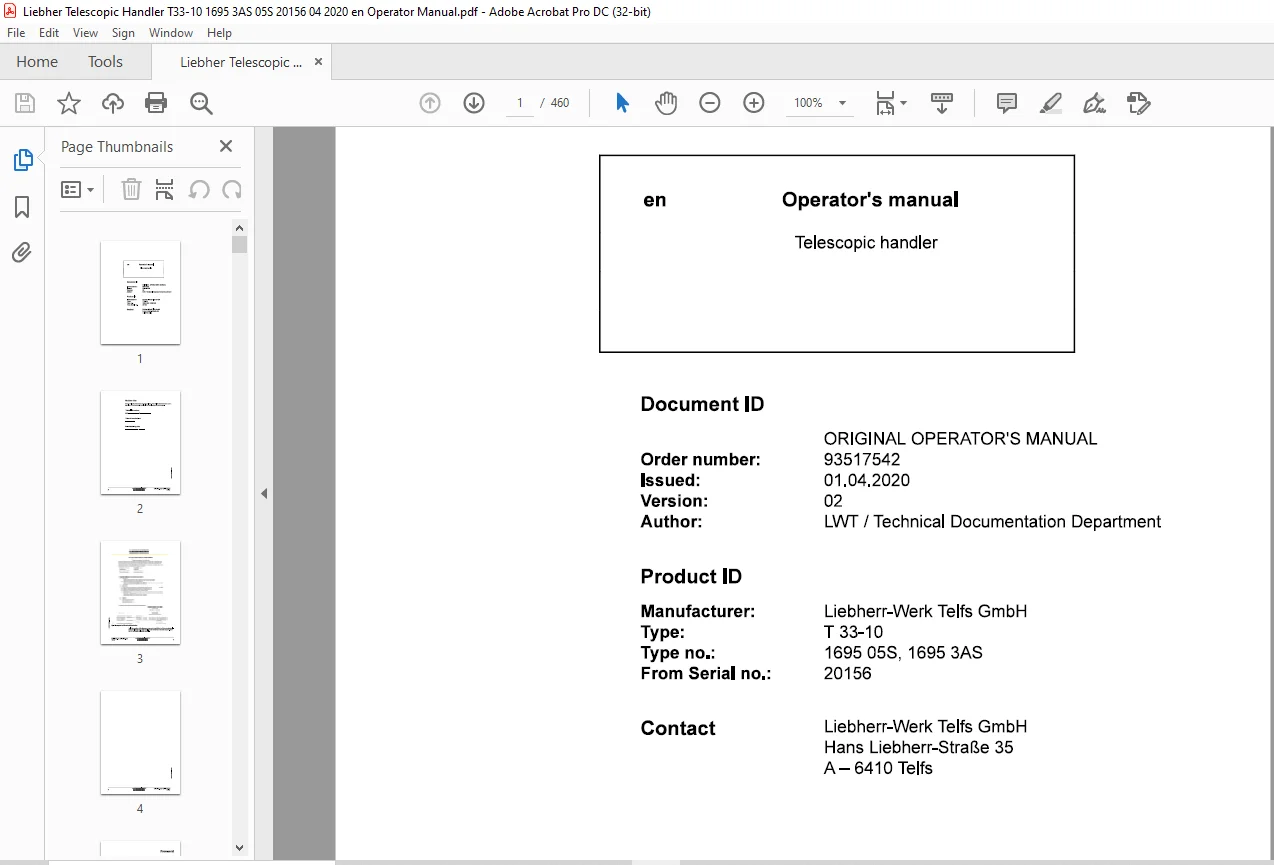
Product ID
Manufacturer : Liebherr-Werk Telfs GmbH
Type : T 33-10
Type no. : 1695 05S, 1695 3AS
From Serial no. : 20156
Description
Liebherr T 33-10 1695 05S, 1695 3AS Telescopic handler Operator’s Manual SN 20156 – PDF DOWNLOAD
FILE DETAILS:
Liebherr T 33-10 1695 05S, 1695 3AS Telescopic handler Operator’s Manual SN 20156 – PDF DOWNLOAD
Language : English
Pages : 460
Downloadable : Yes
File Type : PDF
Size: 100 MB
IMAGES PREVIEW OF THE MANUAL:
DESCRIPTION:
Liebherr T 33-10 1695 05S, 1695 3AS Telescopic handler Operator’s Manual SN 20156 – PDF DOWNLOAD
Preface:
This operator’s manual has been written for the operator and for the maintenance
staff of the machine.
It contains the descriptions for:
– Chapter 1 “Product description”
– Chapter 2 “Safety instructions”
– Chapter 3 “Control, operation”
– Chapter 4 “Malfunctions”
– Chapter 5 “Maintenance”
The operator’s manual must be read and used carefully by all persons who carry
out work with or on the machine before putting the machine into service for the first
time and later, at regular intervals.
Work with or on the machine includes, for example:
Operation including set up, troubleshooting during work procedure, disposal of production wastes, care, disposal of service and auxiliary materials.
Service including maintenance, inspection and repair work
Transport or loading the machine
This allows the machine operator to familiarize himself with the machine more
easily and prevent malfunctions due to improper operation.
Observation of the operator’s manual by maintenance staff:
– increases reliability in use
– extends the service life of your machine
– reduces repair costs and downtime
- The operator’s manual belongs with the machine. Make sure that a copy is
always readily available in the operator’s cab. - The operator’s manual should be supplemented with instructions for accident
prevention and environmental protection based on existing national regulations.
In addition to the operator’s manual and legally binding regulations on accident
prevention which apply in the user country and at point of use, authorized specialist
rules for safe and correct working procedures are also to be observed. - These operator’s manual contains all required information for control, operation
and maintenance of your machine. - Some illustrations in this operator’s manual may depict details and working devices
which differ to your machine. - In some illustrations, protective devices and covers have been removed in the
interests of better presentation. - Improvements, which are always being incorporated into our machines, may result
in changes to your machine which are not yet indicated in this operator’s manual.
If you need additional explanations or instructions, please don’t hesitate to contact
the Technical Documentation and Service Department.
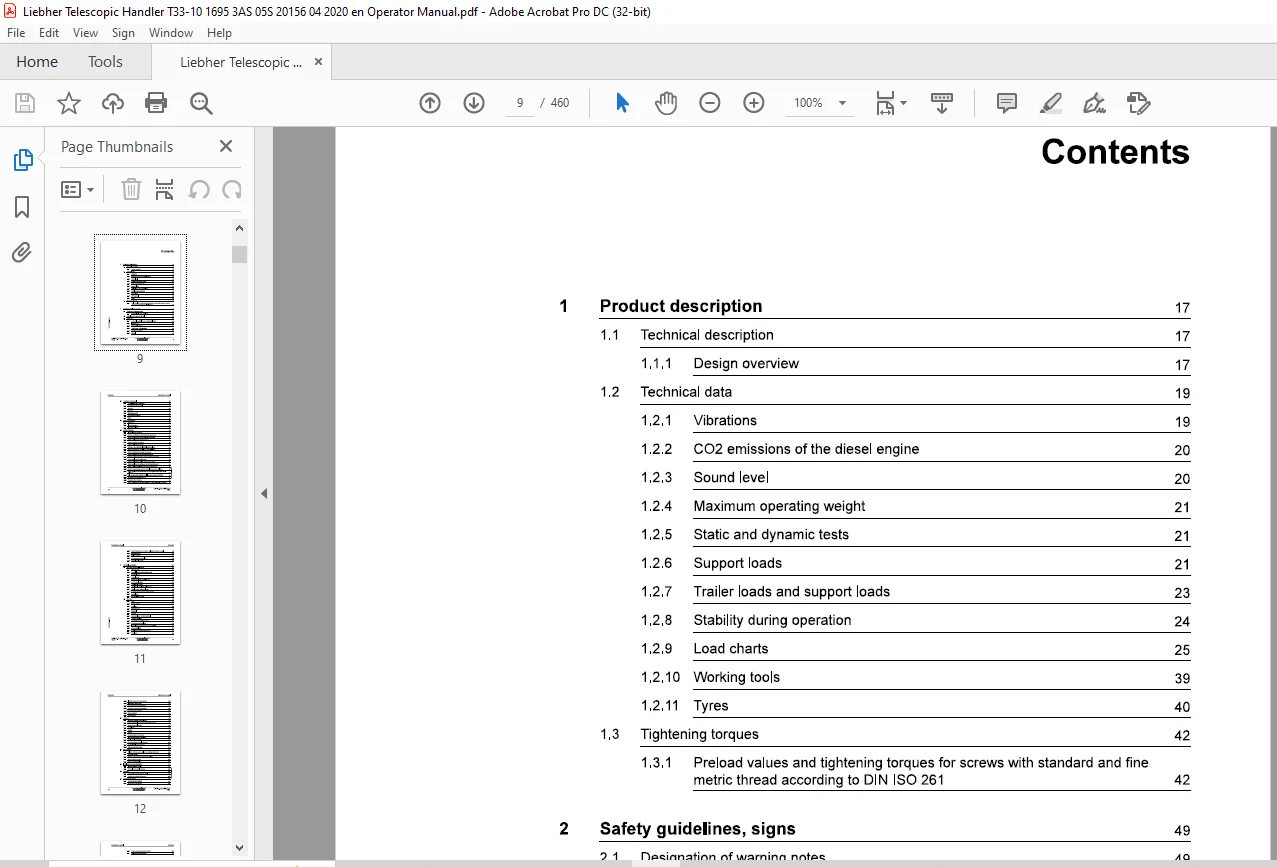
TABLE OF CONTENTS:
Liebherr T 33-10 1695 05S, 1695 3AS Telescopic handler Operator’s Manual SN 20156 – PDF DOWNLOAD
1 Product description 17
1.1 Technical description 17
1.1.1 Design overview 17
1.2 Technical data 19
1.2.1 Vibrations 19
1.2.2 CO2 emissions of the diesel engine 20
1.2.3 Sound level 20
1.2.4 Maximum operating weight 21
1.2.5 Static and dynamic tests 21
1.2.6 Support loads 21
1.2.7 Trailer loads and support loads 23
1.2.8 Stability during operation 24
1.2.9 Load charts 25
1.2.10 Working tools 39
1.2.11 Tyres 40
1.3 Tightening torques 42
1.3.1 Preload values and tightening torques for screws with standard and fine
metric thread according to DIN ISO 261 42
2 Safety guidelines, signs
2.1 Designation of warning notes
2.1.1 Additional rules and guidelines
2.2 Symbols in the operator’s manual
2.3 Proper use
2.3.1 Laws, rules, guidelines and safety regulations
2.3.2 Intended use
2.3.3 Foreseeable misuse
2.3.4 Hazard zone of the machine
Operating conditions
Disposal
Description of personnel 55
2.4.1 Personal protective equipment 55
2.4.2 Requirements for personnel 56
2.4.3 Operator 56
2.4.4 Operator 57
2.4.5 Maintenance staff 58
2.4.6 Person attaching loads 58
2.4.7 Guide 59
Signs on the machine 60
2.5.1 Safety signs 60
2.5.2 Information signs 66
2.5.3 Identification plates 79
Safety instructions 80
General safety instructions 80
Safety instructions for crushing and burn prevention 82
Safety guidelines for fire and explosion prevention 82
Safety guidelines for machine start up 83
Safety instruction for start up 83
Safety guidelines for working 83
Working in the vicinity of electrical overhead lines 85
Safety instructions for travelling on downhill slopes 86
Safety instructions for parking the machine 86
Safety guidelines for transporting the machine 86
Safety instructions for towing and recovering the machine 87
Safety guidelines for maintenance 88
Safety guidelines for welding work on the machine 90
Safety guidelines for working on the working attachment 90
Safety guidelines for loading the machine with a crane 91
Safety notes for maintenance of hydraulic hoses and hose lines 91
Safety guidelines for maintenance work on machines with hydro accumulators
92
Roll over protection (ROPS) and falling object protection (FOPS) 92
Equipment and attachment parts 93
Protection from vibrations 93
Safety guidelines for machine application in material handling operation 94
2.6.22 Safety instructions for machine application with quick coupler
2.6.23 See and be seen
2.6.24 Trailer operation
2.6.25 Air brake system for trailers
2.6.26 Hydraulic trailer brake
3 Control, operation
3.1 Operating and control elements
3.1.1 Operator’s cab
3.1.2 Control elements in the operator’s cab
3.1.3 3.5″ display unit
3.1.4 7″ display unit
3.1.5 Status symbols of the display units
3.1.6 Load torque limitation
3.1.7 Level display (option)
3.1.8 Level display on floating axle (option)
3.1.9 Display unit on steering column
3.1.10 Air brake system pressure gauge (option)
3.1.11 Control lever
3.1.12 Steering-column switch
3.2 Operation
3.2.1 Entry
3.2.2 Emergency exit
3.2.3 Door lock
3.2.4 Operator’s seat
3.2.5 Safety belt
3.2.6 Armrest
3.2.7 Steering column and steering wheel
3.2.8 Heating, ventilation
3.2.9 Air conditioning system (option)
3.2.10 Cab window and sun blind
3.2.11 Interior light of operator’s cab and reading light
3.2.12 Side marker lights
3.2.13 Visual aid in operator’s cab (option)
3.2.14 Visual aids
3.2.15 Electric windscreen washer system 165
3.2.16 Windscreen washer tank 166
3.2.17 Compartment for documentation 167
3.2.18 Reversing warning device (option) 168
3.2.19 Fire extinguisher (Option) 169
3.2.20 Beacon (option) 169
3.2.21 LiDAT (option) 171
3.3 Operation 172
3.3.1 Operating machine on a daily basis 172
3.3.2 Using machine at low or high ambient temperatures 178
3.3.3 Starting the diesel engine 179
3.3.4 Travel mode 187
3.3.5 Driving 188
3.3.6 Braking 199
3.3.7 Taking machine out of service 201
3.3.8 Working with working attachment 206
3.3.9 Trailer couplings (option) 228
3.3.10 Air brake system for trailers (option) 243
3.3.11 Hydraulic trailer brake (option) 247
3.3.12 Exhaust treatment system 251
3.4 Work methods 260
3.4.1 Collision between quick coupler and working attachment 260
3.4.2 Transport position 260
3.4.3 Working in the vicinity of overhead power lines 261
3.4.4 Working with the bucket 261
3.4.5 Working with the forklift 264
3.5 Install and remove the attachment 271
3.5.1 Mechanical quick coupler 271
C:
,!1 3.5.2 Hydraulic quick coupler (option) 282 0 “0 ‘ “‘
3.6 Transport 295 ~
3.6.1 Transporting machine by truck or rail
3.6.2 Loading the machine with a crane
3.7 Emergency operations
300
3.7.1 Emergency down (option) 300
3.7.2 Emergency mode function 301
3.7.3 Towing and recovering the machine
3.7.4 Auxiliary starting procedure
4 Operating problems
4.1 Servicecodes
4.1.1 Service code list
4.1.1 Explanation of terms for service code list
4.2 Problems – Cause – Remedy
4.2.1 Diesel engine
4.2.2 Hydraulic system
4.2.3 Steering system
4.2.4 Brake system
4.2.5 Electrical system
4.2.6 Heating system
4.2.9 Air filter system
4.2.10 Working attachment
4.2.11 Central lubrication system (option)
4.3 Problem remedy
4.3.1 Changing fuses
4.3.2 Changing the relays
5 Maintenance
5.1 Maintenance and inspection schedule
5.2 Fill quantities, lubrication schedule
5.2.1 Recommended lubricants
5.2.2 Recommended fuel and operating fluids
5.2.3 Lubrication chart
5.2.4 Lubrication chart symbols
5.3 Lubricants and fuels
5.3.1 General information about lubricants and fuels
5.3.2 Diesel fuels
5.3.3 Engine oils
5.3.4 Coolant
5.3.5 Diesel exhaust fluids
5.3.6 Hydraulic oils
5.3.7 Lube oils for axles 376
5.3.8 Oil for the brake system 377
5.3.9 Lube oils for travel gearbox 377
5.3.10 Grease and other lubricants 378
5.3.11 Grease for telescopic boom 380
5.3.12 Oil for hinges and joints 380
5.4 Preparatory maintenance tasks 381
5.4.1 Maintenance position 381
5.4.2 Turn the electrical system off 386
5.5 Overall machine 387
5.5.1 Lubricating the machine 387
5.6 Diesel engine 393
5.6.1 Diesel engine: checking oil level 393
5.6.2 Checking engine compartment for contamination and cleaning it, if
necessary 394
5.7 Cooling system 395
5.7.1 Cooling system: checking the coolant level 395
5.7.2 Cooling system: checking radiator and condenser for contamination
and cleaning them, if necessary 396
5.8 Fuel system 398
5.8.1 Notes for working on the fuel system 398
5.8.2 Draining the fuel pre-filter condensation 398
5.8.3 Fuel tank: draining condensation and sediments 399
5.9 Air filter system 400
5.9.1 Air filter system: changing air filter 400
5.9.2 Air filter: cleaning the service cover and dust discharge valve 403
5.10 Hydraulic system 405
5.10.1 Checking the oil level in the hydraulic tank and topping up oil 405
5.11 Electrical system 407
5.11.1 Checking lighting 407 0 “0 ‘ “‘
5.11.2 Electrical system: Checking function of load torque limitation 407
5.12 Heater, ventilation, air conditioning system 412 .~…
5.12.1 Cleaning the cab air pre-filter and changing it if necessary (option) 412 “~’
5.13 Steering system 414
5.13.1 Checking function of steering system 414
5.14 Brake system 415
copyright© Liebherr-Well< Telfs GmbH 2020
T33-10-1695_05S, T33-10-1695_3AS 14 llEBHERR / 20156
Operator’s manual Contents
5.14.1 Service brake and parking brake: Checking function and effectiveness
5.14.2 Brake system: Checking oil level in the expansion tank
5.15 Axles, tires
5.15.1 Wheels: checking mounting tightness of wheel lugs
5.15.2 Tyres: checking and adjusting air pressure in tyres
5.16 Travel gear
5.17 Telescopic boom
5.17.1 Checking front glide elements for wear and tight seating Lubricating
glide surfaces on telescopic boom
5.18 Lubrication system
5.18.1 Grease container: check the fill level
5.19 Cleaning the machine
5.19.1 Wet cleaning the machine
5.20 Preservation tasks
5.20.1 Protecting the piston rods
5.20.2 Taking the machine out of service
5.21 Options
5.21.1 Air brake system: draining pressure tank
Index
Questions? Email us: [email protected]
https://vimeo.com/823679766?share=copy
PLEASE NOTE:
- This is the same manual used by the DEALERSHIPS to SERVICE your vehicle.
- The manual can be all yours – Once payment is complete, you will be taken to the download page from where you can download the manual. All in 2-5 minutes time!!
- Need any other service / repair / parts manual, please feel free to contact us at heydownloadss @gmail.com . We may surprise you with a nice offer
S.V