Liebherr Tractor PR 776 1296_05 G6.0, 1296_ 4F G6.0 Crawler Dozer Operator’s Manual 16877 – PDF DOWNLOAD
Original price was: $86.95.$28.95Current price is: $28.95.
Liebherr Tractor PR 776 1296_05 G6.0, 1296_ 4F G6.0 Crawler Dozer Operator’s Manual 16877 – PDF DOWNLOAD
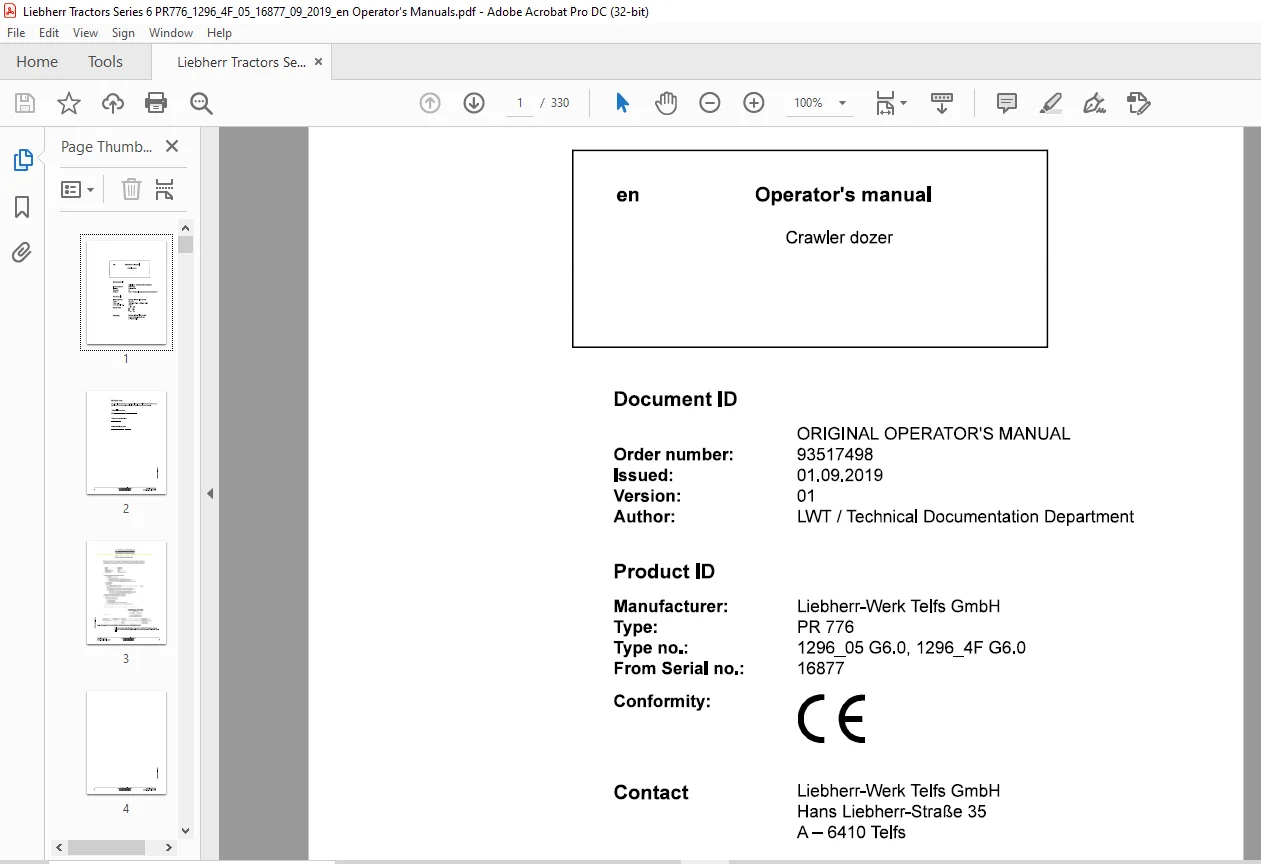
Product ID
Manufacturer: Liebherr-Werk Telfs GmbH
Type: PR 776
Type no.: 1296_05 G6.0, 1296_ 4F G6.0
From Serial no.: 16877
Description
Liebherr Tractor PR 776 1296_05 G6.0, 1296_ 4F G6.0 Crawler Dozer Operator’s Manual 16877 – PDF DOWNLOAD
FILE DETAILS:
Liebherr Tractor PR 776 1296_05 G6.0, 1296_ 4F G6.0 Crawler Dozer Operator’s Manual 16877 – PDF DOWNLOAD
Language : English
Pages : 330
Downloadable : Yes
File Type : PDF
Size: 72 MB
DESCRIPTION:
Liebherr Tractor PR 776 1296_05 G6.0, 1296_ 4F G6.0 Crawler Dozer Operator’s Manual 16877 – PDF DOWNLOAD
Product ID
Manufacturer: Liebherr-Werk Telfs GmbH
Type: PR 776
Type no.: 1296_05 G6.0, 1296_ 4F G6.0
From Serial no.: 16877
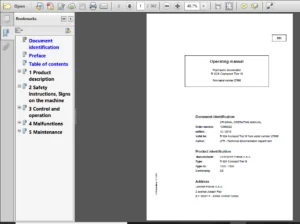
Preface:
This operator’s manual has been written for the operator and for the maintenance
staff of the machine.
It contains the descriptions for:
– Chapter 1 “Product description”
– Chapter 2 “Safety instructions”
– Chapter 3 “Control, operation”
– Chapter 4 “Malfunctions”
– Chapter 5 “Maintenance”
The operator’s manual must be read and used carefully by all persons who carry
out work with or on the machine before putting the machine into service for the first
time and later, at regular intervals.
Work with or on the machine includes, for example:
Operation including set up, troubleshooting during work procedure, disposal of production wastes, care, disposal of service and auxiliary materials.
Service including maintenance, inspection and repair work
Transport or loading the machine
This allows the machine operator to familiarize himself with the machine more
easily and prevent malfunctions due to improper operation.
Observation of the operator’s manual by maintenance staff:
– increases reliability in use
– extends the service life of your machine
– reduces repair costs and downtime
- The operator’s manual belongs with the machine. Make sure that a copy is
always readily available in the operator’s cab. - The operator’s manual should be supplemented with instructions for accident
prevention and environmental protection based on existing national regulations.
In addition to the operator’s manual and legally binding regulations on accident
prevention which apply in the user country and at point of use, authorized specialist
rules for safe and correct working procedures are also to be observed. - These operator’s manual contains all required information for control, operation
and maintenance of your machine. - Some illustrations in this operator’s manual may depict details and working devices
which differ to your machine. - In some illustrations, protective devices and covers have been removed in the
interests of better presentation. - Improvements, which are always being incorporated into our machines, may result
in changes to your machine which are not yet indicated in this operator’s manual. - If you need additional explanations or instructions, please don’t hesitate to contact
the Technical Documentation and Service Department.
IMAGES PREVIEW OF THE MANUAL:
https://vimeo.com/824726471?share=copy
TABLE OF CONTENTS:
Liebherr Tractor PR 776 1296_05 G6.0, 1296_ 4F G6.0 Crawler Dozer Operator’s Manual 16877 – PDF DOWNLOAD
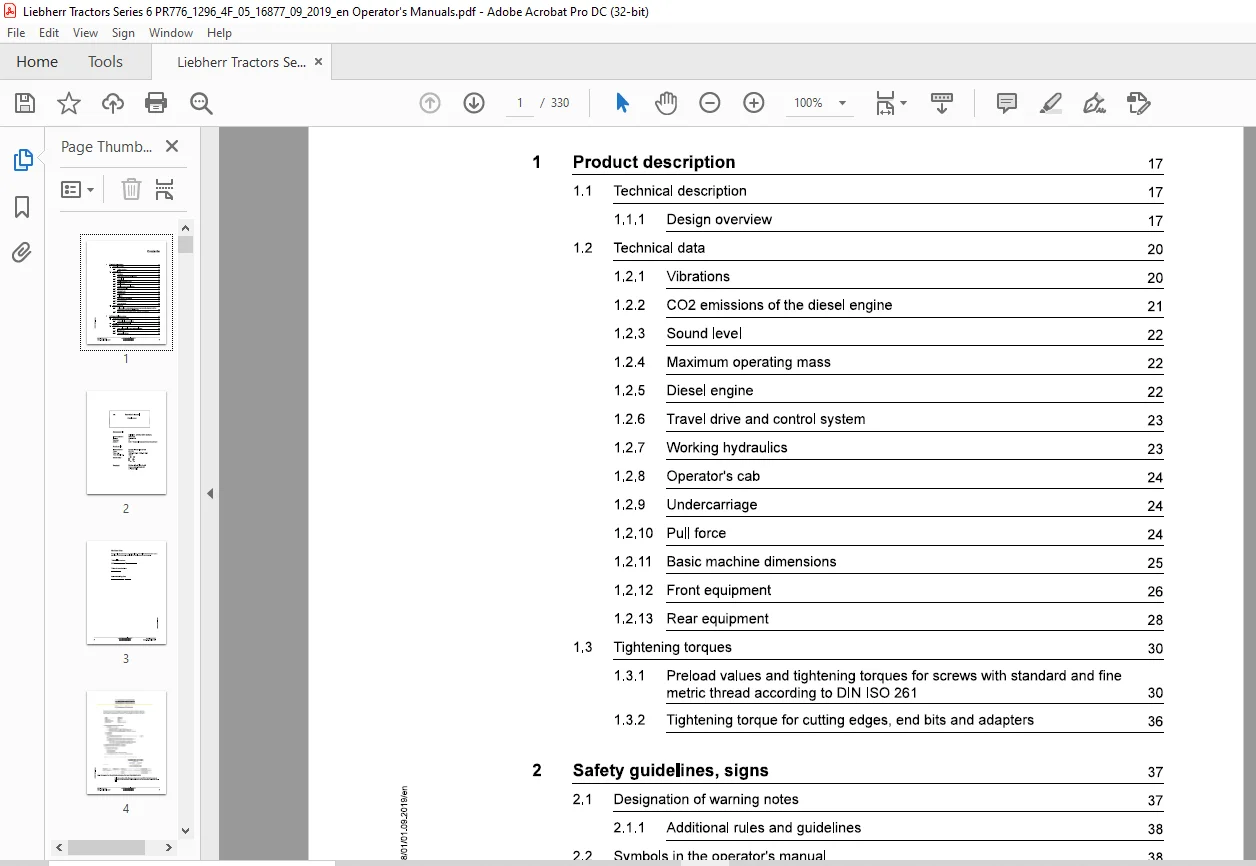
1 Product description
1.1 Technical description
1.1.1 Design overview
1.2 Technical data
1.2.1 Vibrations
1.2.2 CO2 emissions of the diesel engine
1.2.3 Sound level
1.2.4 Maximum operating mass
1.2.5 Diesel engine
1.2.6 Travel drive and control system
1.2.7 Working hydraulics
1.2.8 Operator’s cab
1.2.9 Undercarriage
1.2.10 Pull force
1.2.11 Basic machine dimensions
1.2.12 Front equipment
1.2.13 Rear equipment
1.3 Tightening torques
1.3.1 Preload values and tightening torques for screws with standard and fine
metric thread according to DIN ISO 261
1.3.2 Tightening torque for cutting edges, end bits and adapters
2 Safety guidelines, signs
Designation of warning notes
2.1.1 Additional rules and guidelines
Symbols in the operator’s manual
Proper use
2.3.1 Laws, rules, guidelines and safety regulations
2.3.2 Intended use
2.3.3 Foreseeable misuse
2.3.4 Danger area of the machine 40
2.3.5 Operating conditions 41
2.3.6 Disposal 42
Description of personnel 43
2.4.1 Personal protective equipment 43
2.4.2 Requirements for personnel 43
2.4.3 Operator 43
2.4.4 Operator 44
2.4.5 Maintenance staff 45
2.4.6 Guide 46
Signs on the machine 46
2.5.1 Safety signs 46
2.5.2 Information signs 50
2.5.3 Identification plates 54
Safety instructions 55
2.6.1 General safety instructions 55
2.6.2 Safety guidelines for crushing and burn prevention 57
2.6.3 Safety guidelines for fire and explosion prevention 57
2.6.4 Safety instructions for machine start up 57
2.6.5 Safety guidelines for start up 58
2.6.6 Safety guidelines for working 58
2.6.7 Safety guidelines for turning machine off 59
2.6.8 Safety instructions for transporting machine 60
2.6.9 Safety instructions for towing machine 60
2.6.10 Safety instructions for maintenance 61
2.6.11 Safety guidelines for welding work on machine 63
2.6.12 Safety guidelines for working on attachment 63
2.6.13 Safety guidelines for loading machine with a crane 64
2.6.14 Safety notes for maintenance of hydraulic hoses and hose lines 64
Safety guidelines for maintenance work on machines with hydro accumulators
Roll over protection (ROPS) and falling object protection (FOPS) 65
Equipment and attachment parts
Protection from vibrations
See and be seen
2.6.20 Safety notes for Diesel engines with electronic control units 69
2.6.21 Safety notes for working on Common Rail System of Diesel engines 69
3 Control, operation
Operating and control elements
3.1.1 Overview of the operator’s cab
3.1.2 Control elements in the operator’s cab
3.1.3 Display unit
3.1.4 Exhaust gas treatment
Operation
3.2.1 Battery main switch
3.2.2 Access light
3.2.3 Entering and exiting the machine
3.2.4 Emergency exit
3.2.5 Using emergency hammer (option)
3.2.6 Door lock
3.2.7 Premium operator’s seat
3.2.8 Safety belt
3.2.9 Adjust the armrests and joysticks
3.2.10 Heating system
3.2.11 Air conditioning
3.2.12 Sliding window
3.2.13 Sun blind
3.2.14 Interior lighting of cab
3.2.15 Inside mirror
3.2.16 Electrical windscreen wiper system and windscreen washer system
3.2.17 Compartment for documentation
3.2.18 Turn the engine compartment lighting on
3.2.19 Reversing warning device
3.2.20 Disengageable reversing warning device
3.2.21 Fire extinguisher
3.2.22 Assembly of third party installations in the cab
3.2.23 Rotating beacon
3.2.24 LiDAT (option)
3.3.1 Operating machine on a daily basis 152
3.3.2 Using the machine at low or high ambient temperatures 160
3.3.3 Starting diesel engine 161
3.3.4 Travel mode 166
3.3.5 Driving 172
3.3.6 Braking 174
3.3.7 Taking machine out of service 176
3.3.8 Working in water 181
3.3.9 Working with attachment 182
3.3.10 Working with optional attachments 191
3.4 Work methods 196
3.4.1 Grading 196
3.4.2 Fine grading 197
3.4.3 Using several machines simultaneously 198
3.4.4 Creating and banking up trenches 199
3.4.5 Land clearing 200
3.4.6 Ripping 202
3.5 Install and remove the attachment 204
3.5.1 Installation guidelines for installation and removal of working attachment
204
3.5.2 Install the bearing shells of the attachment 204
3.5.3 Installing and removing push frame with straight blade 206
3.6 Transport 218
3.6.1 Transporting machine by truck or rail 218
3.6.2 Loading the machine with the crane 223
3.7 Emergency operations 226
3.7.1 Emergency mode function 226
3.7.2 Towing machine 226
3.7.3 Jump start procedure 234
Operating problems 237
4.1 Servicecodes
4.1.1 Service code – Display unit
4.2 Problems – Cause – Remedy
4.2.1 Diesel engine
4.2.2 Hydraulic system
4.2.3 Travel gear
4.2.4 Electrical system
4.2.5 Heating
4.2.6 Working attachment
4.3 Problem remedy
4.3.1 Changing fuses and relays
5 Maintenance
Maintenance and inspection schedule
Fill quantities, lubrication schedule
5.2.1 Recommended lubricants
5.2.2 Recommended fuel and operating fluids
5.2.3 Lubrication chart
5.2.4 Symbols in the lubrication chart
Lubricants and fuels
5.3.1 General information about lubricants and fuels
5.3.2 Diesel fuels
5.3.3 Engine oils
5.3.4 Coolant
5.3.5 Diesel exhaust fluids
5.3.6 Hydraulic oils
5.3.7 Lube oils for splitterboxes
5.3.8 Lube oils for travel gearbox
5.3.9 Oil for duo cone (slipring) seal Travel gear
5.3.10 Oil for axle bearing
5.3.11 Grease and other lubricants
5.3.12 Oil for hinges and joints
Take oil samples
5.4.1 Oil samples and oil analysis
Preparatory maintenance tasks
5.5.1 Safety instructions for maintenance
5.5.2 Maintenance position
5.5.3 Turn the electrical system off
Overall machine
5.6.1 Lubricating all lube points according to lubrication chart 283
5.6.2 Checking and changing windscreen wiper blade 283
Diesel engine 284
5.7.1 Diesel engine: checking oil level 284
5.7.2 Checking the diesel engine configuration and the belly pans for contamination
and cleaning them 285
Cooling system 287
5.8.1 Check the coolant level and refill 287
5.8.2 Check the cooling system for contamination and clean it 289
Fuel system 292
5.9.1 Notes for work on the fuel system 292
5.9.2 Fuel preliminary filter: Drain the condensation 292
5.9.3 Fuel tank: Drain condensation and sediments 293
5.9.4 Empty and clean the fuel tank 294
Air filter system 297
5.10.1 Replacing the air filter 297
Hydraulic system 300
5.11.1 Checking the oil level in the hydraulic tank and topping up oil 300
5.11.2 Filling with hydraulic oil 303
Splitterbox 305
5.12.1 Splitterbox: Check the oil level 305
Electrical system 306
5.13.1 Check the display unit and lighting 306
5.13.2 Change the light bulbs 306
Heater, ventilation, air conditioning system 307
5.14.1 Inspection of the air conditioning system by HVAC specialist staff 307
5.14.2 To check the capacitor 307
Drive gear 308
5.15.1 Travel gearbox: checking the condition 308
5.15.2 Check the oil level in the duo cone (slipring) area 308
Track components 310
5.16.1 Checking the nuts and bolts of the travel gear components are firmly
seated 310
5.16.2 Checking and adjusting the track tension 311
Working attachment 316
5.17.1 Checking the cutting edges, corners and ripper teeth for wear 316
5.17.2 Lubricate the working attachment and hoist cylinder bearing 316
5.17.3 Checking the mounting screws and pin retainers of the working attachment
for tight seating 317
5.17.4 Removing and installing the ripper tooth tips 317
5.18 Cleaning the machine 322
5.18.1 Wet cleaning the machine 322
5.19 Preservation tasks 324
5.19.1 Protecting the piston rods 324
5.19.2 Taking the machine out of service 324
Index 325
Contact us: [email protected]
https://vimeo.com/824726471?share=copy
PLEASE NOTE:
- This is not a physical manual but a digital manual – meaning no physical copy will be couriered to you. The manual can be yours in the next 2 mins as once you make the payment, you will be directed to the download page IMMEDIATELY.
- This is the same manual used by the dealers inorder to diagnose your vehicle of its faults.
- Require some other service manual or have any queries: please WRITE to us at [email protected]
S.V