Linkbelt 130X2 Excavator Service Manual – PDF DOWNLOAD
$37.95
Linkbelt 130X2 Excavator Service Manual – PDF DOWNLOAD
Description
Linkbelt 130X2 Excavator Service Manual – PDF DOWNLOAD
FILE DETAILS:
Linkbelt 130X2 Excavator Service Manual – PDF DOWNLOAD
Language : English
Pages : 1116
Downloadable : Yes
File Type : PDF
IMAGES PREVIEW OF THE MANUAL:
DESCRIPTION:
Linkbelt 130X2 Excavator Service Manual – PDF DOWNLOAD
Structure and operation explanation
- This pump has a structure with 2 pumps positioned on the same shaft coupled with the 1st gear (116) and rotation force is distributed to different shafts by the gear structure. The 2 pumps are driven by transmitting the rotation of the power source to the front side drive shaft (111). Auxiliary pumps installed on different shafts can also be driven at the same time.
- The pump can be roughly divided into the rotary group, which is the main part of the pump rotating, the swash plate group, which changes the discharge flow, the valve block group, which switches between oil suction and discharge, and the PTO group that transmits the gear pump drive shaft.
- The rotary group is made up of drive shafts (111 and 113), cylinder block (141), piston shoes (151and 152), holder plate (153), sphere bushing (156), bearing spacer (127), and cylinder spring (157). The drive shaft is supported at both ends with bearings (123 and 124). The shoe is caulked to the piston and forms the spherical joint, reduces the thrust force generated by the load pressure, and has a pocket section for balancing the pressure for sliding lightly on the shoe plate (211). The piston shoe sub-group is pressed against the shoe plate by the cylinder spring via the holder plate and spherical bushing so that it can slide smoothly on the shoe plate. Also, in the same way, the cylinder block is pressed against the valve plates (313 and 314) by the cylinder spring.
- The swash plate group comprises the swash plate (212), shoe plate, swash plate support board (251), tilting bushing (214), tilting pin (531), and servo piston (532). The swash plate is supported by the swash plate support board at the cylindrically shaped section formed by the opposite side of the shoe sliding surface. By leading the hydraulic pressure force controlled by the regulator into the hydraulic pressure chambers on both sides of the servo piston, the servo piston moves left and right. This moves the swash plate back and forth on the swash plate support board via the tilting pin spherical section and changes the tilting angle (α).
- The valve block group comprises the valve block (312), valve plates (313 and 314), and spring pin (886). The valve plate, which has two hook-shaped ports, is installed on the valve block. Its function is to feed oil to the cylinder block and recover it from the cylinder block. The oil switched by the valve plate is connected through the valve block to the outside pipes.
- The PTO group comprises the 1st gear, 2nd gear (117), and 3rd gear (118). The 2nd and 3rd gear are supported by their respective bearings (125 and 126) and can install the valve block.
- Now when the drive shaft is driven by the power source (motor, engine, etc.), the cylinder block is also rotated at the same time via the spline coupling. When the swash plate tilts, the piston located at the center of the cylinder block moves reciprocally relative to the cylinder while turning with the cylinder block. Therefore, if looking at one piston while the cylinder block turns one rotation, the piston moves away from the valve plate (oil intake stroke) for 180 ° of the cylinder block rotation, then moves toward the valve plate (oil discharge stroke) for the remaining 180°. When the swash plate tilting angle (α) is 0, the piston subassemblies (151 and 152) do not move through a stroke and oil is not discharged.
- Also, at the same time, the drive shaft rotation is taken out by the 1st gear and transmitted
through the 2nd gear to the 3rd gear to drive the pilot gear pump coupled with the 3rd gear.
TABLE OF CONTENTS:
Linkbelt 130X2 Excavator Service Manual – PDF DOWNLOAD
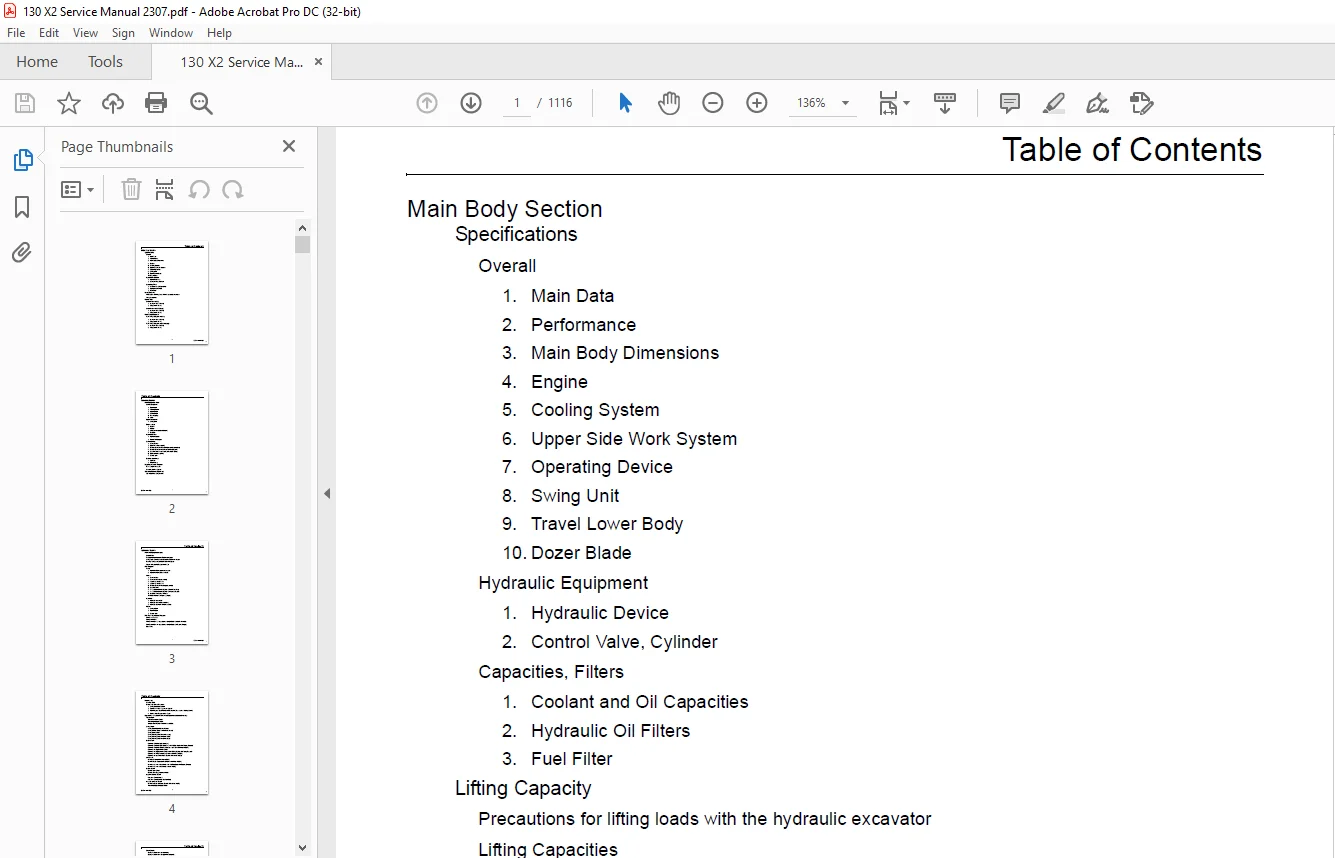
Main Body Section
Specifications
Overall
1. Main Data
2. Performance
3. Main Body Dimensions
4. Engine
5. Cooling System
6. Upper Side Work System
7. Operating Device
8. Swing Unit
9. Travel Lower Body
10. Dozer Blade
Hydraulic Equipment
1. Hydraulic Device
2. Control Valve, Cylinder
Capacities, Filters
1. Coolant and Oil Capacities
2. Hydraulic Oil Filters
3. Fuel Filter
Lifting Capacity
Precautions for lifting loads with the hydraulic excavator
Lifting Capacities
Overall View
Overall View (130X2)
1. Standard Arm (2.50 m)
2. Long Arm (3.01 m)
Overall View (130X2(Blade))
1. Standard Arm (2.50 m)
2. Long Arm (3.01 m)
Work Range Diagram
Work Range Diagram (130X2 )
1. Standard Arm (2.50 m)
2. Long Arm (3.01 m)
Work Range Diagram (130X2 (Blade))
1. Standard Arm (2.50 m)
2. Long Arm (3.01 m)
Summary Section
Main Equipment Table
Lower Component
1. Travel Unit
2. Take-up Roller
3. Upper Roller
4. Lower Roller
5. Recoil Spring
6. Shoe
Upper Component
1. Swing Unit
Engine-related
1. Engine
2. Muffler
3. Air Cleaner (double element)
4. Radiator
Hydraulic Device
1. Hydraulic pump
2. Pump P-Q Diagram
Control-related
1. Control Valve
2. Solenoid Valve (4 stack)
3. Remote Control Valve (left/right, travel operations)
4. Remote Control Valve Characteristic Diagram
5. Cushion Valve (heat circuit, with shuttle valve)
6. Selector Valve (option)
7. Center Joint
Backhoe Attachment
1. Cylinder
2. Attachments
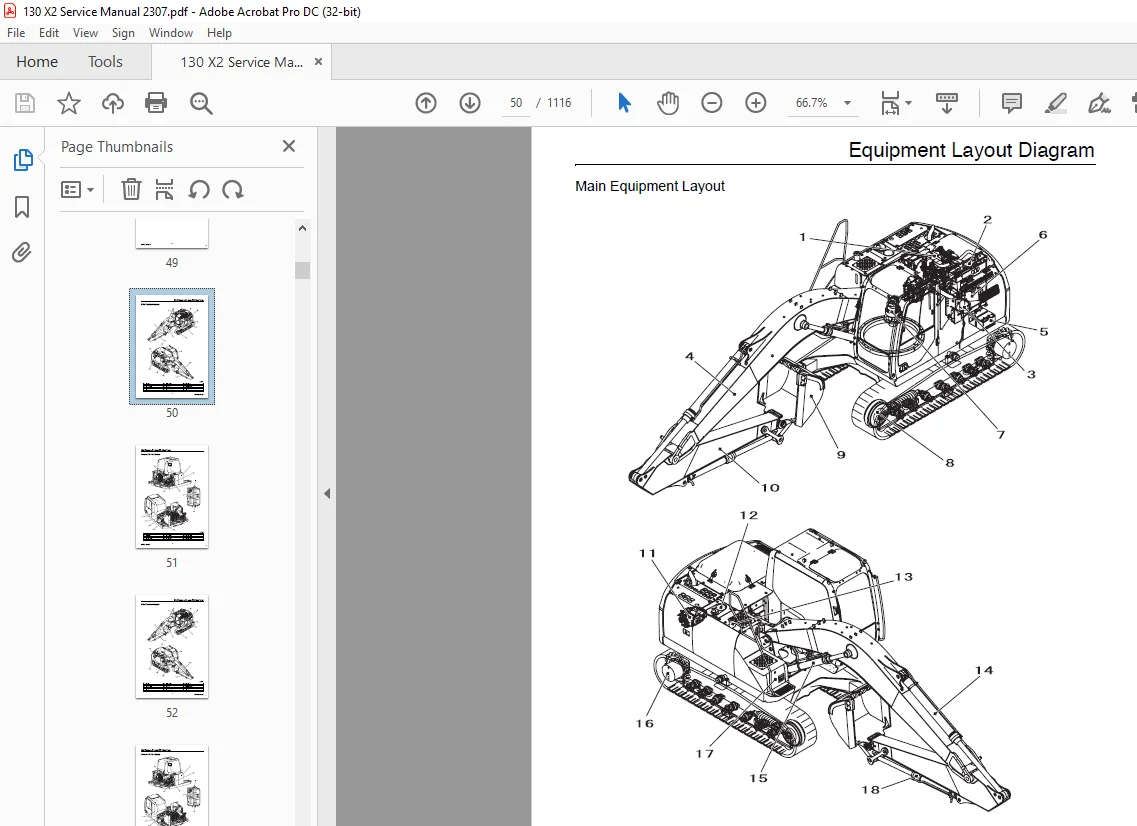
Equipment Layout Diagram
Main Equipment Layout
Consumable Part Layout
Standard Machine Option List
List of Optional Components
Hydraulics Section
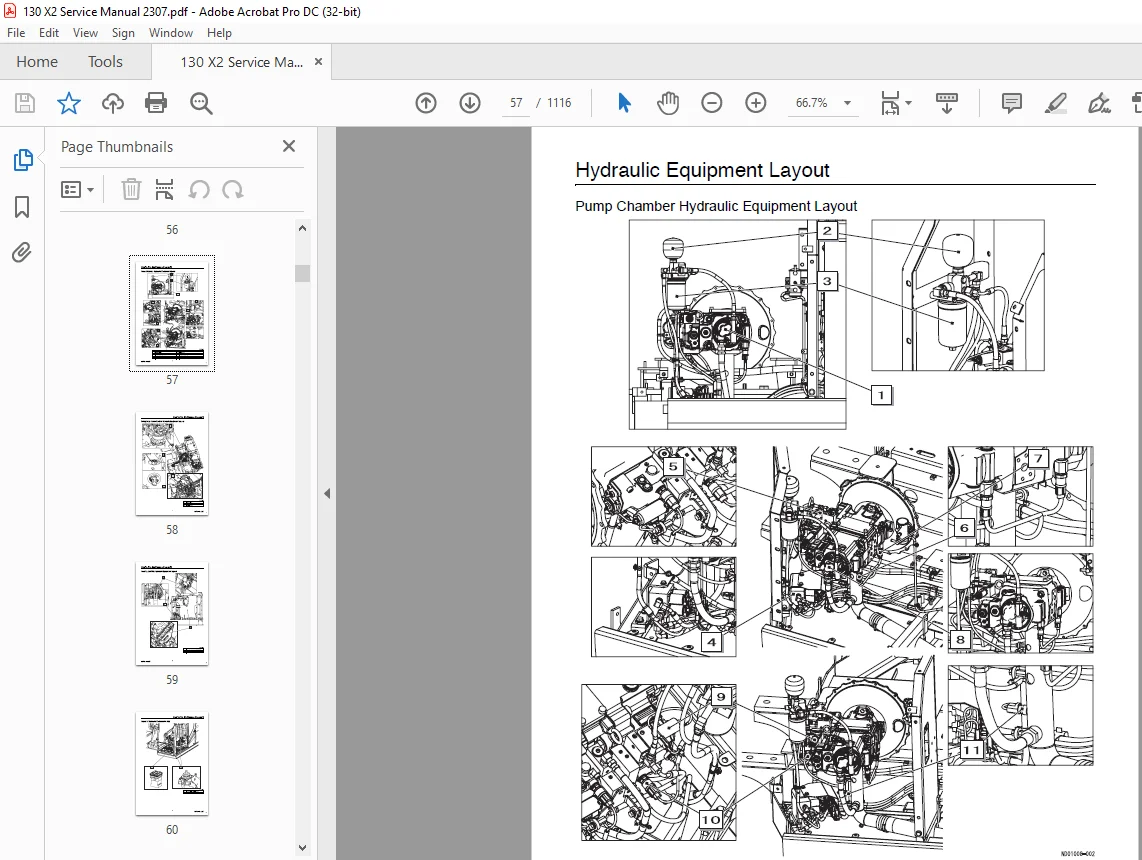
Hydraulic Equipment Layout
Overall View
Pump Chamber Hydraulic Equipment Layout
Swing Body Center Section Hydraulic Equipment Layout
Housing Left Side Hydraulic Equipment Layout
Layout of Hydraulic Equipment in Cab
Port Diagram
Pump
1. Hydraulic Pump (standard model)
2. Hydraulic Pump (blade model)
Valves
1. Control Valve
2. Control Valve (blade model)
3. 4 Stack Solenoid Valve
4. 2 Stack Solenoid Valve
5. Remote Control Valves (upper, travel)
6. Cushion Valve
7. 2-way Selector Valve (Option for North America)
8. 4-way Selector Valve (Option for Export, Europe)
9. Direction Valve/Shut-off Valve
10.HBCV (Option for Export, Europe)
Manifolds
1. Manifold Under Cab
2. Manifold (accumulator section)
3. Manifold (hydraulic oil tank section)
Motors
1. Swing Motor
2. Travel Motor
3. Center Joint
Pilot Hose Connection Diagram
Pilot P and T Lines
Pilot Control Line
Pilot Control Line (2-way selector valve) (Option for North America)
Pilot Control Line (4-way selector valve) (Option for Export, Europe)
Blade Line
Function List
Function Table
Explanation of New Functions
1. Swing Relief Cut Control
2. Option Line Flow Adjustment Control
3. Multi Purpose Circuit (breaker ÅÃ crusher) One-touch Switching Control
4. Bucket-close Regenerative Circuit
Explanation of Hydraulic Circuit and Operations (standard model)
Travel Circuit
Travel Low-speed Circuit
Travel High-speed Circuit
Straight Travel Circuit (with/without HBCV)
Swing Circuit
Swing Relief Cut-off Control Circuit
Swing Priority Circuit (with/without HBCV)
Swing Brake Circuit
Swing Parking Circuit (lever in neutral)
Swing Parking Circuit (brake release)
Swing Parking Circuit (machine stop)
Boom Circuit
Boom-up Circuit (single operation)
Boom-up Circuit (single operation) (with HBCV) (Option for Export, Europe)
Boom-up Circuit (compound boom up + arm in) (with/without HBCV)
Boom-down Regenerative Circuit
Boom-down Regenerative Circuit (with HBCV) (Option for Export, Europe)
Boom-down Tilting Prevention Circuit (with/without HBCV)
Boom-down Load Hold Valve Circuit (with/without HBCV)
Arm Circuit
Arm-out Circuit (with/without HBCV)
Arm-in Forced Regenerative Circuit (with/without HBCV)
Arm-in Load Hold Valve Circuit (with HBCV) (Option for Export, Europe)
Arm-in Load Hold Valve Circuit (without HBCV)
Bucket Circuit
Bucket-open Circuit
Bucket-close Regenerative Circuit
Negative Control Circuit
Negative Control Circuit
Negative Control Circuit (bucket close)
Horsepower Boost Circuit
Arm-in Horsepower Boost Circuit (with/without HBCV)
Travel Horsepower Boost Circuit
Other Circuits
Cushion Circuit (arm-out operation)
Cushion Circuit (arm-out operation stopped)
Cushion Circuit (arm-out Å® arm-in operation)
Heat Circuit (lever in neutral)
Auto Pressure Boost Circuit (bucket close)
Explanation of Hydraulic Circuit and Operations (option)
Option Circuits
Breaker Circuit (single operation)
Shuttle Circuit (hydraulic fork)
Multi Purpose Circuit (breaker Q control)
Multi Purpose Circuit (2 pumps flow crusher)
2nd Option Circuit (hydraulic rotation fork)
Blade Circuit (blade-up Circuit)
Blade Circuit (blade-down Circuit)
Main Equipment Structure and Operation Explanation
Pump
1. Hydraulic Pump
2. Regulator
3. Gear Pump
Motor
1. Travel Motor
2. Swing Motor
Valve
1. Control Valve
2. 4 Stack Solenoid Valve Operation Explanation
3. Upper Pilot Valve (remote control valve)
4. Travel Pilot Valve (remote control valve)
5. Cushion Valve
6. Direction Valve (3 direction)
7. HBCV Holding Control Valve (Option for Export/Europe)
Electrics Section
Explanation of New Functions
Work Mode Select Switch
The Throttle Volume and Work Mode Select Switch are Linked!!
Computer Connection Method
Monitor Changes
Pilot Pressure Switch Changed to Pressure Sensor
Pump Electromagnetization Proportional Valve
1. Horsepower Control Proportional Valve
2. P1 Flow Control Proportional Valve
System Control for Energy Saving
1. Reduced Fuel Consumption Through Transient Load Reduction Control
2. Reduced Fuel Consumption Through Swing Relief Cut Control
Electrical Equipment Layout Diagram
Overall View
1. Main Unit Right Side Layout Diagram (radiator chamber)
2. Engine Section Layout Diagram
3. Main Unit Left Side Layout Diagram (pump chamber)
4. Main Unit Center Section Layout Diagram
5. Cab Layout Diagram
6 Layout Around Operator’s Seat
Stand Alone Parts Diagram
Main Equipment Structural Diagrams
Connection Connector Pin Layout
1. Computer A
2. Monitor
Electrical Circuit Diagram
Overall View
1. Sequence Circuit Diagram
Block Diagram
1. Computer A
2. ECM
3. Monitor Display
4. Air Conditioner
5. Lever Lock
6. Horn
7. Working Light
8. Option
9. Others
10. Electrical Symbol List
Electrical Connector Wiring Diagram
Wire Harness
1. Main Frame Harness
2. Cab Main Harness
3. Cab Sub Harness
4. In-Cab Harness
5. Engine Harness
6. Console Right Harness
7. Console Left Harness
Electrical Parts and Wiring Assembly Diagram
Main Frame
Cab
Explanation of Functions and Operations
Explanation of Electrical Functions
Engine Speed Control
1. Throttle Control
2. Idling Control (auto/one-touch)
3. Idling Start
4. Idle Up
5. Auto warm up
Engine Start/Stop Control
1. Engine Start/Stop Judgment
2. Power-cut Delay
3. Engine Emergency Stop
4. Neutral Start
Pump Control
1. Work Mode Control
2. Pump Horsepower Boost Control
3. Pump Horsepower Cut Control
Swing
1. Swing Brake
2. Swing Free Swing (Option for North America)
3. Swing Lock (for maintenance)
4. Swing Relief Cut
Travel
1. Travel Speed Switchover
2. Travel Alarm
Valve Control
1. Lever Lock
2. Solenoid Sticking Prevention
3. Pressure Boost Control
Monitor Control
1. Bar Graph (coolant temperature gauge, oil temperature gauge, fuel gauge)
Accessories
1. Horn
2. Working light
3. Wiper and Washer
4. Room Lamp
5. Radio Mute
Others
1. Anti-theft
2. Battery Save Function
3. Alternator Power Generation Detection
4. Overload Alarm (Option for Europe)
Options
1. Option Line Control
2. Option Line Control
3. Feed Pump Automatic Stop
4. Return Filter Clogging Detected
5. Beacon (Option for Europe)
Service Support
Screen Operations
1. Screen Shift
Screen Display List
1. CHK (status display) Screen List
2. DIAG (trouble diagnosis) Screen
3. HR (usage log) Screen List
4. CFG (setting change) Screen
5. CAL (troubleshooting support) Screen
6. Check the Monitor Switch (self-diagnosis function)
7. Option Flow Setting
8. Anti-theft Setting
9. Model Setting
10. Engine Screen Information
Screen Display Details
1. Message Display List
Trouble Display
1. Diagnostic Trouble Code Display
2. Main Unit Diagnostic Trouble Code List
3. Diagnostic Trouble Code (monitor display)
4. Sensor Trouble Operation Table
5. EPF (Engine Protection Feature)
Engine Section
Engine Summary
Main Data Table (changes from model 3)
Overall Appearance Diagram
Sensor and Auxiliary Equipment Layout (left)
Sensor and Auxiliary Equipment Layout (rear)
Engine System Diagram
Fuel System Diagram
Detailed Parts Diagrams
1. ECM (engine control module)
2. Supply Pump/SCV (suction control valve)
3. Common Rail
4. Common Rail Pressure Sensor/Pressure Limiter
5. Injector
6. Engine Coolant Temperature Sensor
7. Engine Oil Pressure Sensor
8. Cam Position Sensor (CMP sensor)
9. Crank Position Sensor (CKP sensor)
10. Atmospheric Pressure Sensor
11. Suction Air Temperature Sensor
12. Boost Pressure Sensor
13. Boost Temperature Sensor
14.Charge Fuel Pump
15. EGR Cooler
16. EGR Valve
Engine Control Summary
Explanation of Engine Terms
Function Explanation Table
Explanation of Engine Structure
Technology for Exhaust Gases
1. Common Rail System
2. Multi Stage Fuel Injection (multiple injection)
3. Inter Cooler
4. EGR (Exhaust Gas Recirculation)
Explanation of Engine Operation
Engine Overall
1. Comparison of 4BG1T and 4JJ1
Fuel Unit
1. Common Rail System Summary
2. Change Points for Injection Method (governor, common rail)
3. Explanation of Injector Operation
4. Explanation of Supply Pump Operation
5. Supply Pump Disassembly Diagram
6. Pressure Limiter
7. Cautions for Maintenance
Explanation of Engine Control
1. Fuel Injection Quantity Correction
2. Starting Q Correction
3. Preheat Control (QOS quick on start)
4. Atmospheric Pressure Correction (high altitude correction)
5. Control for Overheating
6. Control for Boost Temperature Rise
7. Control for Engine Oil Pressure Drop
8. Start Control (coolant temperature monitoring)
9. Long Cranking Control
10. Starting Control for Reduced Number of Cylinders
11. Normal Stop (key switch OFF operation)
12. Engine Start/Stop Judgment
Engine Maintenance Standards
Engine Information Screen
Monitor Operation Method
Engine Information (Q resistance, QR code, engine serial number) Copying Method
Rewriting Injector QR Codes
When Replacing Computer A at the Same Time
Engine Information Acquisition Timing
Redoing Engine Information Acquisition
Trouble Display
Engine Equipment Table
Exhaust Gas 3rd Accessory Electrical Parts Compatibility (Isuzu part number)
Exhaust Gas Regulations
Features of Materials Subject to Exhaust Gas Regulation
Exhaust Gas Regulation Values
Cautions for Fuel Used
Engine Fuel and Maintenance of Fuel Filters
1. Fuel to be applied
2. Maintenance of fuel filters
Air Conditioner Section
Changes from Model 3
Change List
Layout Diagram
Air Conditioner Overall Diagram
1. Frame
2. Cab
Explanation of Functions and Operations
Equipment Layout Diagram
Air Conditioner Circuit Diagram
Explanation of Control
1. Air Mix Motor Actuator Control
2. Blow Mode Motor Actuator Control
3. Refresh/Recirculate Switch Motor Actuator Control
4. Blower Amp Control
5. Compressor Clutch Control
6. COOLMAX Control and HOTMAX Control
7. Trouble Detection and Control after Trouble Detected
8. Monitor Mode
9. Door Switch Control
10. Inside Air Filter Clogging Detection Control
Actuator Inspection
Air Mix Motor Actuator Inspection
Refresh / Recirculate Motor Actuator Inspection
Mode Motor Actuator Inspection
Self-diagnosis Function With Panel Display
Trouble Display and Self-check Procedure
1. Trouble Display Position
2. Explanation of Trouble Display
3. Explanation of Monitor Mode
Part Function and OK / NG Judgment
Control Panel and Control Unit
Blower Amp
Relay
Air Mix Actuator
Refresh / Recirculate Actuator
Blow Mode Actuator
Evaporator Sensor
Dual Pressure Switch
Solar Radiation Sensor
New Machine Performance Section
New Machine Performance
Performance Evaluation Check Sheet
Performance Evaluation Recording Sheet
New Machine Performance Judgment Standards
Reference Values (130)
Measurement Method and Main Unit Posture
Engine Speed
Pressure in Each Section
Cylinder Falling Amount
Attachment Speed
Swing Speed
Swing (180Åã) Brake Angle
Travel Speed
Off Travel Amount
Travel Sprocket Speed
Shoe Tension Amount
Swing Ball Race Bearing Movement Amount and Bucket Tip Movement Amount
Maintenance Section
Pressure Measurement and Adjustment Procedures
Procedures for Pressure Measurement from the Monitor Display
1. Pressure Measurement Method
2. Operating Method
Procedures for Measuring Hydraulic Oil Temperature from the Monitor Display
1. Hydraulic Oil Temperature Measurement Method
2. Operating Method
Procedures for Pressure Measurement by Installing Pressure Gauge
1. Preparations
2. Items to Prepare
Pressure Measuring Ports
Control Valve
1. Location of Relief Valves
Pressure Measurement Preparations
Pressure Measurement and Adjustment Procedures
1. Main Pressure Measurement
2. Pilot Pressure Measurement
3. Negative Control Pressure Measurement
Pressure Adjustment
1. Main Pressure Adjustment
2. Pilot Pressure Adjustment
Hydraulic Pump Flow Measurement Procedure
Procedures for Flow Measurement from the Flow Meter Installation
1. Preparations
2. Items to Prepare
Work Preparations
Flow Measurement
Drain Volume Measurement Procedure
Preparations
Travel Motor Drain Volume Measurement
Swing Motor Drain Volume Measurement
Air Bleed Procedure
Hydraulic Pump
Travel Motor
Swing Motor
HBCV(for Export, Europe)
1. Boom Cylinder HBCV
2. Arm Cylinder HBCV
Procedures for Replacing Consumable Parts
Air Conditioner Belt and Fan Belt Replacement
1. Air Conditioner Belt Replacement
2. Fan Belt Replacement
Fuel Main Filter Replacement
1. Filter Replacement
2. Air Bleeding
Engine Oil Filter and Engine Oil Replacement
1. Engine Oil Replacement
2. Engine Oil Filter Replacement
Radiator Coolant Replacement
Air Cleaner Cleaning and Replacement
Hydraulic Oil Filter Replacement
1. Return Filter Replacement
2. Suction Filter Replacement
3. Air Breather Element Replacement
4. Pilot Oil Filter Replacement
5. Hydraulic Oil Replacement
Others
1. Coolant Filling
2. Washer Fluid Filling
Periodic Maintenance Procedures
Maintenance Every 250 Hours
1. Battery Inspection and Replacement
Maintenance after First 250 Hours for New Machine/Every 1000 Hours from Then on
1. Swing Reduction Gear Oil Replacement
2. Gear Oil Filling
Replace the Flange Packing at the Bottom of the Fuel Tank
Bolt Size and Torque Table
Bolt and Nut Tightening
Retightening Torque Table
Data Section
Main Unit Weight
Divided Weight (standard specifications)
Stand Alone Part Weight
Shoe Weight (per side)
Arm Weight
Interchangeability
Interchangeability
1. Main Part Interchangeability Table (130X2)
Attachment Installation Methods
Attachment Dimensions
Paint Colors
Paint Colors
Unit Conversion Ratio
Unit Conversion Ratio
Need help? Contact: [email protected]
https://vimeo.com/891801234?share=copy
S.S