
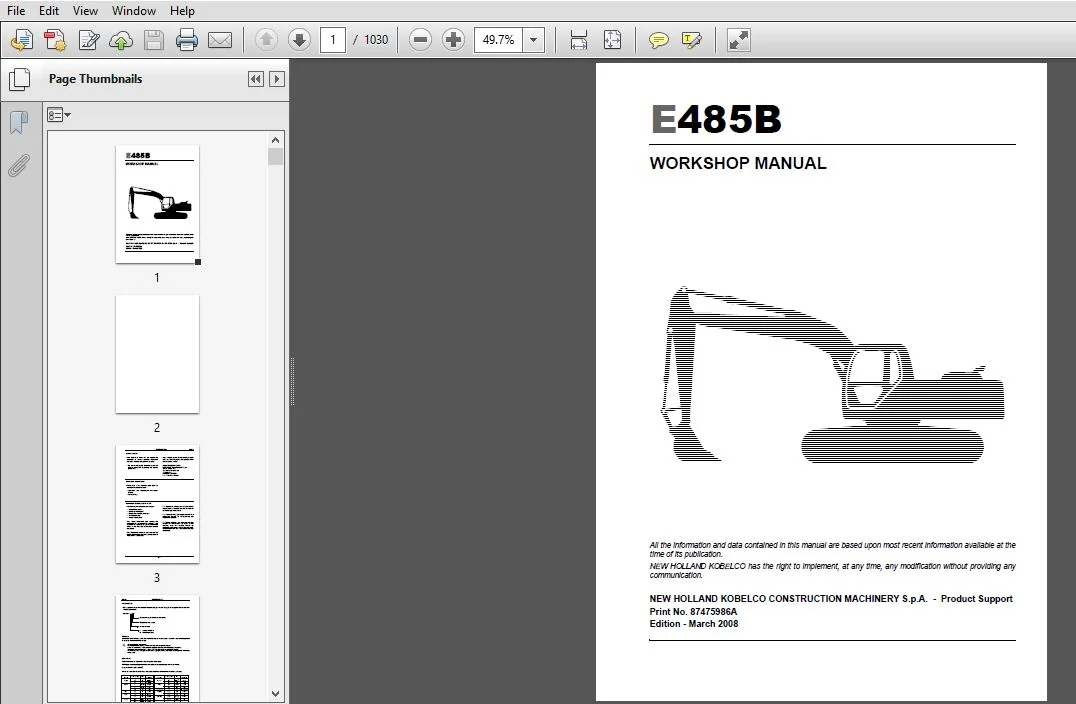
New Holland Crawler Excavator E485B Workshop Manual 87475986A – PDF DOWNLOAD
Original price was: $89.95.$36.95Current price is: $36.95.
New Holland Crawler Excavator E485B Workshop Manual
PART NUMBER: 87475986A
Description
New Holland Crawler Excavator E485B Workshop Manual
FILE DETAILS:
New Holland Crawler Excavator E485B Workshop Manual
Size: 94.7 MB
Format: PDF
Language: English
Number of Pages: 1030 pages
Brand: New Holland
Type of document: Service Manual
Model: E485B
Part No: 87475986A
DESCRIPTION:
New Holland Crawler Excavator E485B Workshop Manual
SAMPLE PAGE FROM THE MANUAL:
- Read the Operation and Maintenance Instruction Manual carefully before starting, operating, maintaining, fuelling or servicing the machine. Carefully read the explanation to each and all safety signs in the special section of this Manual before starting, operating, maintaining, fuelling or servicing the machine. Machine-mounted safety plates are colour coded yellow with black borders when they refer to points where special ATTENTION must be paid and failure to observe them may cause a serious DANGER to the integrity of machine operators. They are white with red borders and black lettering when they refer to a FORBIDDEN practice.
- It is fundamental that all machine operators know very well the meaning of each safety plate as this considerably decreases operating hazards and accidents. Do not allow unauthorised personnel to operate or service this machine. Do not wear rings, wrist watches, jewellery, loose or hanging garments, such as ties, torn clothing, scarves, unbuttoned or unzipped jackets that can get caught in moving parts. Wear certified safety clothes such as: hard hat, no-slip footwear, heavy gloves, ear protection, safety glasses, reflector vests, respirators every time the job requires it.
- Ask your employer about safety regulations in force and protective equipment. Always keep the operator’s compartment, step plates, grab-rails and handles clean and clear of foreign objects, oil, grease, mud or snow to minimise the danger of slipping or stumbling. Remove mud or grease from your shoes before operating the machine. Do not jump on or off the machine. Always keep both hands and one foot, or both feet and one hand in contact with steps and/or grab rails. Do not use controls or hoses as hand holds. Hoses and controls are movable parts and do not provide solid support.
- Besides, controls may be inadvertently moved and cause unexpected movement of the machine or its attachments. Never operate the machine or its attachments from any position other than sitting in the driver’s seat. Keep head, body, limbs, hands and feet inside the operator’s compartment at all times to reduce exposure to external hazards. Be careful of possible slippery conditions of the steps and hand rails as well as of the ground around the machine. Wear protective boots or shoes with the soles made of highly no-slip rubber Do not leave the machine until it has come to a complete stop.
- Always check height, width and weight limitations which may be encountered in the working site and ensure the machine does not exceed them. Assess exact paths of gas ducts, water mains, telephone lines, sewers, overhead and underground electric lines and all other possible obstacles. Such paths should be opportunely defined by competent Authorities. If necessary, require that the service is interrupted or said installations are moved prior to starting the work. You must know the working capacity of the machine. Define the rear upperstructure swing area and provide for opportune barriers to prevent access into it. Never exceed machine lifting capacity. Remain within the limits shown in the loading capacity chart which located on the machine.
- STARTING Never start or operate a failed machine. Walk all around the machine before mounting. Before operating the machine, make sure that any possible dangerous condition has been properly removed. Before starting machine, check that steering and attachment controls are in the neutral position and the safety lever is in the LOCK position. Immediately report any malfunction of parts or systems to the maintenance managers for proper action. Prior to starting the engine, check, adjust and lock the driver’s seat for maximum riding comfort and control accessibility.
- Prior to operating the machine and/or its attachments, check that bystanders are outside the machine operating range. Sound the horn. Obey all hand signals, safety indications and signs. Due to the presence of flammable fluids, never check fuel level, refuel, charge the batteries in the presence of smoking materials, open flames or sparks. Ensure that nobody is within the excavator operating area before starting the machine, swinging the upper structure or moving in any direction.
- Adjust all rear-view mirrors for maximum visibility of the area behind the machine. Ensure that engine speed is appropriate to the job to be carried out.Do not run the engine of this machine in closed buildings without proper ventilation capable to remove harmful exhaust gases which concentrate in the air. Keep the operator’s compartment free of foreign objects, especially if not firmly secured. Never use the machine to transport objects, unless proper securing points are provided. Do not carry riders on the machine. Study and familiarise with escape routes alternative to normal exit routes.
- For your personal safety, do not climb on or off the machine while it is in motion. Make sure that bystanders are clear of the machine operating range before starting the engine and operating the attachment. Sound the horn. Obey all hand signals, safety indications and signs. When backing, always look to where the machine is to be moved. Be alert of the position of bystanders. Should someone enter the work area, stop the machine. Maintain a safe distance from other machines or obstacles to ensure required visibility conditions.
- Always give way to loaded machines. Maintain a clear vision of the surroundings of the travel or work area at all times. Keep cab windows clean and repaired. When pulling loads or towing through a cable or chain, do not start suddenly at full throttle. Take-up slack carefully. Avoid kinking or twisting chains or cables. Carefully inspect the towing items for flaws or problems before proceeding. Do not pull through a kinked chain or cable as the high anomalous stresses existing in this condition may induce failures in the kinked portion. Always wear heavy gloves when handling chains or cables.
- Chains and cables should be securely anchored using suitable hooks. Anchor points should be strong enough to withstand the expected load. Keep anyone clear of anchor points and cables or chains. Do not pull or tow unless the operator’s compartments of the machines involved are properly protected against possible backlash in case of cable or chain failure or detachment. Be alert of soft ground conditions close to newly constructed walls. The fill material and machine weight may cause the wall to collapse under the machine. In darkness, check area of operation carefully before moving in with the machine.
- Use all lights provided. Do not move into low visibility areas. If the engine tends to slow down and stall for whatever reason under load or at idle, immediately report this problem to the maintenance managers for proper action. Do not operate the machine until this condition is corrected. Regularly check all exhaust system components, as exhaust fumes are toxic for the operator.
- Operators must know the performance of the machine they are driving. When working on slopes or near sudden level drops in the terrain, pay attention not to lose adherence and avoid loose soft ground since overturn or loss of machine control could result. If noise level is high and exceeds 90 dB (A) over 8 hours at the operator’s ear, wear approved ear protection in compliance with local regulations. Do not operate the machine if you are extremely tired or feel ill. Be especially careful towards the end of the working shift.
NEW HOLLAND CRAWLER EXCAVATOR E485B WORKSHOP MANUAL 87475986A – PDF DOWNLOAD:
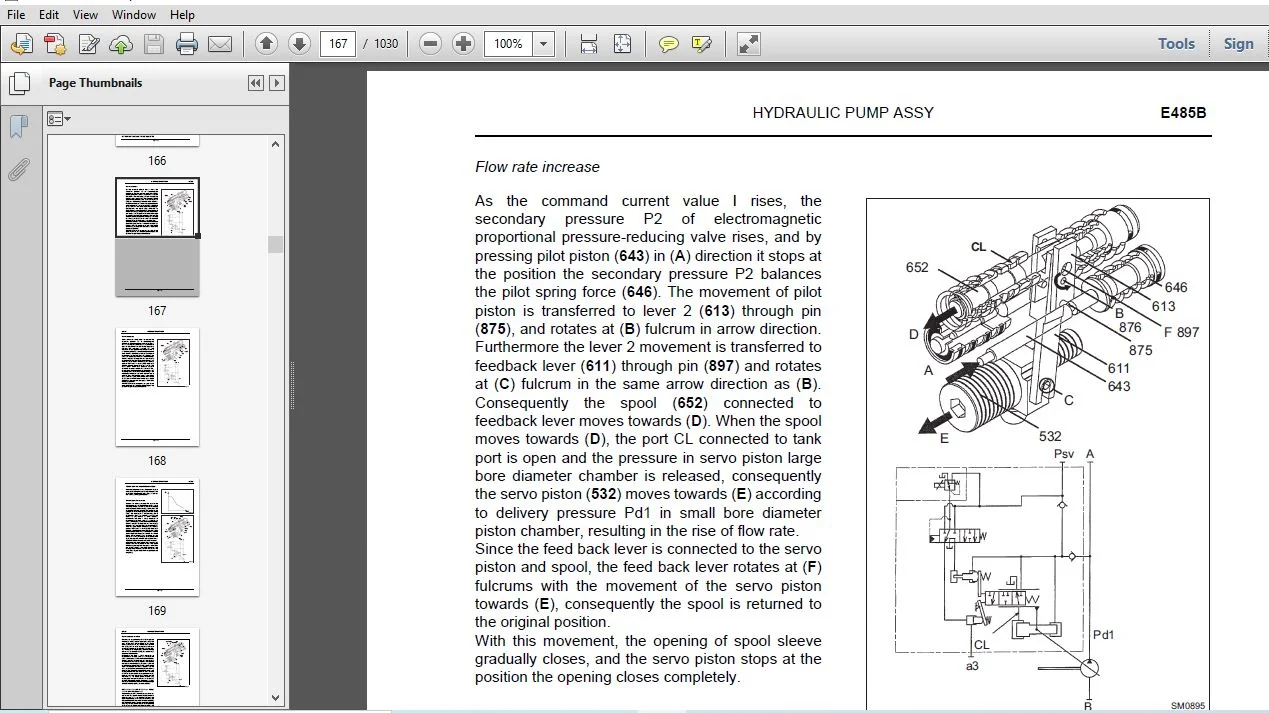
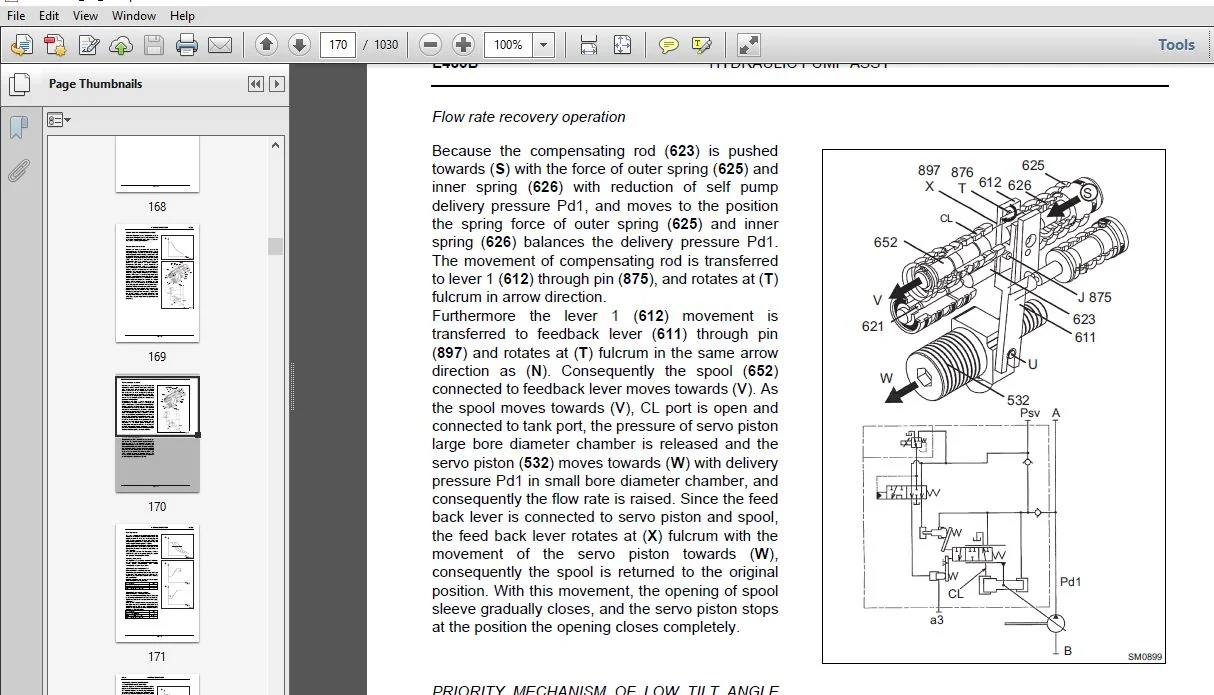
IMAGES PREVIEW OF THE MANUAL:
TABLE OF CONTENTS:
New Holland Crawler Excavator E485B Workshop Manual
SAFETY PRECAUTIONS Page
Section 1 GENERALITIES S1
Section 2 SAFETY PRECAUTIONS S2
Section 3 SAFETY PLATES S3
OPERATIONAL PRINCIPLE
Section 1 GENERAL
Group 1 Specifications T1-1
Section 2 SYSTEM
Group 1 Mechatro control system T2-1
Group 2 Hydraulic System T2-2
Group 3 Electrical System T2-3
Section 3 COMPONENT OPERATION
Group 1 Hydraulic Pump Assy T3-1
Group 2 Pilot Valve T3-2
Group 3 Control Valve T3-3
Group 4 Swing Device T3-4
Group 5 Travel Device T3-5
Group 6 Swivel Joint T3-6
Group 7 Cylinders T3-7
Group 8 Air Conditioner system T3-8
OPERATIONAL PERFORMANCE TEST
Section 4 OPERATIONAL PERFORMANCE TEST
Group 1 Introduction T4-1
Group 2 Standard Performances T4-2
Group 3 Test Procedures T4-3
Group 4 Mechatro Controller T4-4
TROUBLESHOOTING
Section 5 TROUBLESHOOTING
Group 1 Troubleshooting (by error codes) T5-1
Group 2 Troubleshooting (by trouble) T5-2
E485B INDEX
REPAIR INSTRUCTIONS
Section 1 GENERAL INFORMATION
Group 1 Precautions for Disassembly and Assembly W1-1
Group 2 Tightening Torque W1-2
Section 2 UPPERSTRUCTURE
Group 1 Upperstructure W2-1
Group 2 Pump Device W2-2
Group 3 Control Valve W2-3
Group 4 Swing Device W2-4
Group 5 Pilot Valve W2-5
Section 3 UNDERCARRIAGE
Group 1 Swing Bearing W3-1
Group 2 Travel Device W3-2
Group 3 Swivel Joint W3-3
Group 4 Track Adjuster W3-4
Group 5 Front Idler W3-5
Group 6 Upper and Lower Roller W3-6
Group 7 Tracks W3-7
Section 4 FRONT ATTACHMENT
Group 1 Front attachment W4-1
Section 5 ENGINE
Group 1 General W5-1
Group 2 Standard Value W5-2
Group 3 Parts to be prepared W5-3
Group 4 Engine assembly/disassembly W5-4
Group 5 Fuel System W5-5
Group 6 Emission Control W5-6
Group 7 Electrical W5-7
Group 8 Intake W5-8
Group 9 Engine Mechanical W5-9
Group 10 Exhaust W5-10
Group 11 Cooling W5-11
Group 12 Lubrication W5-12
Group 13 Starting and Charging W5-13
Group 14 Turbocharger W5-14
Group 15 Failure Diagnosis for each Engine Status W5-15
Group 16 Engine Diagnosis Code
PLEASE NOTE:
This is not a physical manual but a digital manual – meaning no physical copy will be couriered to you. The manual can be yours in the next 2 mins as once you make the payment, you will be directed to the download page IMMEDIATELY.
This is the same manual used by the dealers inorder to diagnose your vehicle of its faults.
Require some other service manual or have any queries: please WRITE to us at [email protected]