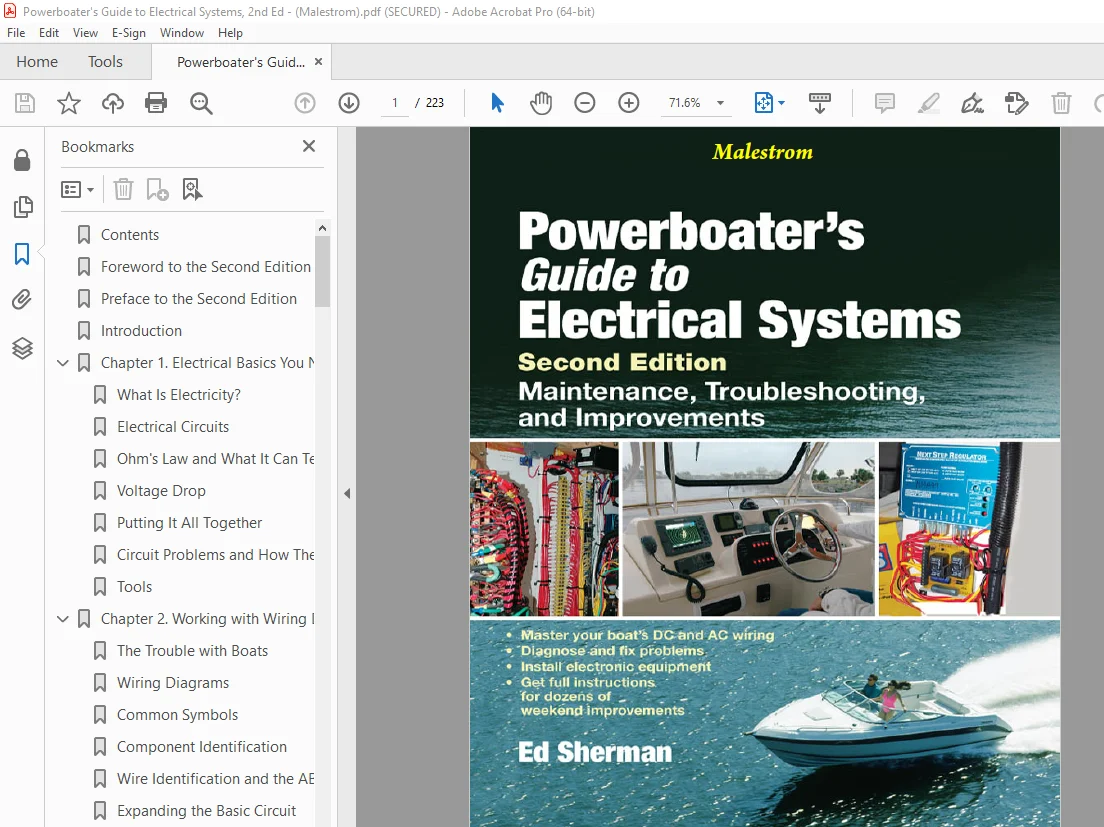
Powerboater’s Guide to Electrical Systems 2nd Ed (Malestrom) PDF
$28.95
Powerboater’s Guide to Electrical Systems 2nd Ed (Malestrom) – PDF DOWNLOAD
Description
Powerboater’s Guide to Electrical Systems 2nd Ed (Malestrom) – PDF DOWNLOAD
FILE DETAILS:
Powerboater’s Guide to Electrical Systems 2nd Ed (Malestrom) – PDF DOWNLOAD
Language : English
Pages : 223
Downloadable : Yes
File Type : PDF
IMAGES PREVIEW OF THE MANUAL:
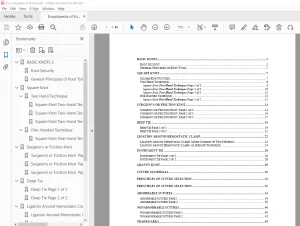
TABLE OF CONTENTS:
Powerboater’s Guide to Electrical Systems 2nd Ed (Malestrom) – PDF DOWNLOAD
Contents 6
Foreword to the Second Edition 9
Preface to the Second Edition 11
Introduction 12
Chapter 1 Electrical Basics You Need to Know 15
What Is Electricity? 15
Electrical Circuits 15
Ohm’s Law and What It Can Tell Us 19
Voltage Drop 22
Putting It All Together 23
Circuit Problems and How They Occur 23
Tools 24
Chapter 2 Working with Wiring Diagrams 26
The Trouble with Boats 26
Wiring Diagrams 27
Common Symbols 27
Component Identification 28
Wire Identification and the ABYC Color Code 29
Expanding the Basic Circuit 33
Locating Components 34
Drawing Your Own Wiring Diagram 36
Chapter 3 Selecting and Using a Multimeter 39
Multimeters 39
Selecting a Multimeter 39
Using Your Multimeter 44
Measuring Amperage 48
Measuring Resistance and Continuity 51
Chapter 4 Wire and Circuit Protection Standards and Repair Procedures 54
Order Out of Chaos 54
ABYC Standards and Recommendations 54
Basic Wiring 55
Wire Size 56
Wire Insulation 57
Fuses and Circuit Breakers 60
Ignition Protection 66
Testing Fuses and Circuit Breakers 67
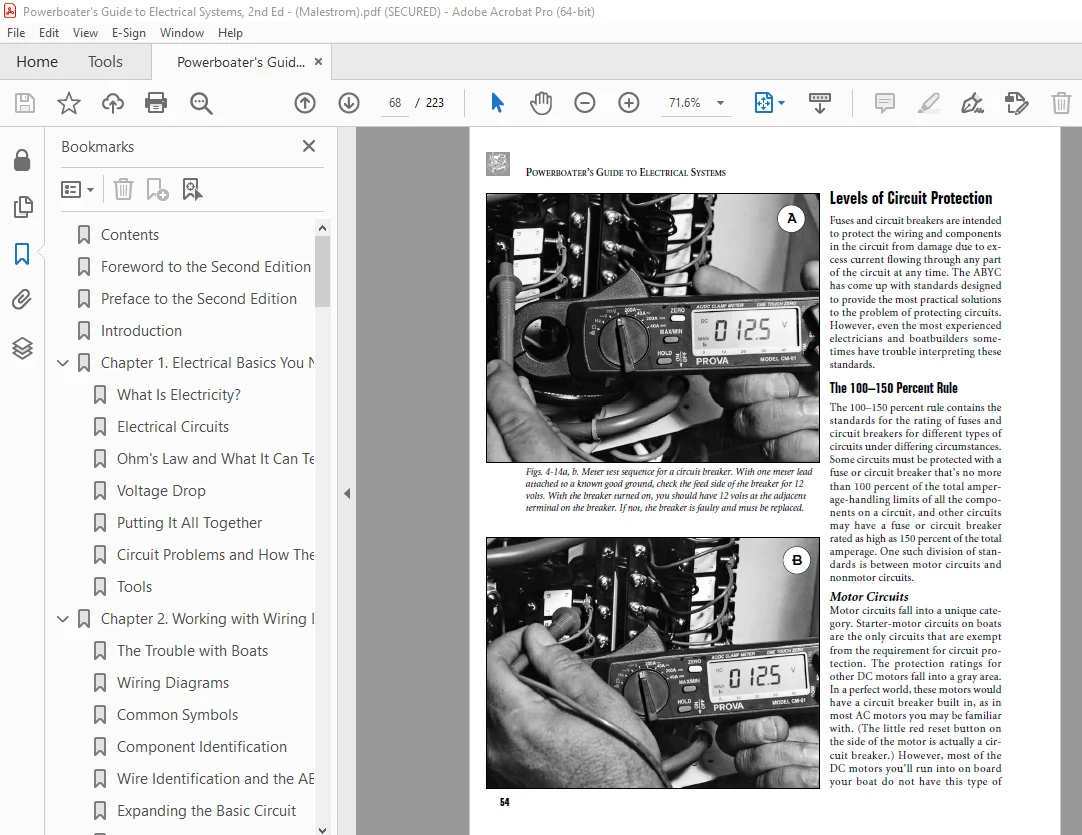
Levels of Circuit Protection 68
Acceptable Locations for Fuses and Circuit Breakers 69
Wire Routing and Support 71
Connecting the Dots: Making Wiring and Connection Repairs 73
Chapter 5 Batteries and Battery Systems 79
How Batteries Work: The Basics 79
Basic Chemistry 79
Types of Lead-Acid Batteries 80
Which Battery Is Right for You? 83
Battery Safety 86
Battery Maintenance and Testing 88
Battery Installations 90
Testing Your Batteries 96
Chapter 6 Battery-Charging Systems 100
Alternator Basics 100
Engine-Driven Marine Alternators 101
Alternator Problems 101
Outboard-Engine Charging Systems 108
Shore-Power Battery Charging Systems and Installations 110
Solar Cells 113
Chapter 7 Maintaining Marine Ignition Systems 114
Ignition-System Components 114
Regulations Regarding Ignition Systems 117
Outboard and PWC Ignition Systems 117
Maintaining Ignition Systems 118
MerCruiser Thunderbolt IV and Thunderbolt V Systems 121
Beyond the Basics: Outboard and PWC Ignition Systems 124
Outboard and PWC Ignition Tests 126
Testing Your Stop Switch 133
Final Checks and Ignition Timing 134
Chapter 8 Tracing and Repairing Starter-Motor Circuits 137
Coast Guard Regulations for Starter Motors 137
Starter-Motor Problems and Solutions 138
Troubleshooting Starter-Motor Circuits 139
Outboard-Engine Starter Circuits 142
Testing the Neutral-Safety Switch 146
Engine Ignition Switch 147
Other Outboard-Engine Starter-Motor Problems 149
Chapter 9 Installing Your Own DC Accessories 150
Before You Begin 150
Installing a New Cabin Light 153
Installing a New Bilge Pump 154
Adding a New Compact-Disc Player 158
Chapter 10 Engine Instrumentation Problems and Solutions 161
Mechanical Gauges 161
Common Instrument Interpretation Problems 161
Abnormal Instrument Readings 162
General Instrument Troubleshooting 163
The Future 169
Chapter 11 Alternating Current and AC Equipment 170
What Is Alternating Current? 170
AC on Your Boat 171
AC Safety 171
Color Coding for AC Wiring 172
Comparisons between AC and DC Circuits 173
AC Overcurrent Protection 176
Basic AC Outlet Connections 178
Ground-Fault Circuit Interrupters 180
Checking Voltage, Continuity, and Polarity on AC Circuits 181
Selecting a DC-to-AC Inverter 184
AC Generators 189
Galvanic Isolators 191
Chapter 12 Installing Marine Electronic Equipment 194
Electronic Gadgetry 194
Universal Installation Details 194
Power Supply 196
Installing a VHF Radio 197
How Much Can I Gain? 198
The Coaxial Question 198
Installing a Fish-Finder or Depth-Sounder 200
Installing a GPS Receiver 204
Installing Your Own Radar 205
Glossary 207
DESCRIPTION:
Powerboater’s Guide to Electrical Systems 2nd Ed (Malestrom) – PDF DOWNLOAD
It can arguably be said that harnessing the electron has been one of humankind’s crowning achievements.
- For thousands of years, people—including those who have sailed the seas—have been fascinated by lightning, static electricity, and harnessing light. Early humans must have wondered how to put that kind of power to practical use. But it wasn’t until the close of the 18th century that the path to everyday use of electrical power would begin to have a profound and lasting impact the world over, including at sea.
- We all know about Benjamin Franklin, who in 1752 proved that lightning was electrical when he flew a kite during a thunderstorm. He tied a metal key onto the string and, as he suspected it would, electricity from the storm clouds flowed down the string, which was wet, and he received an electrical shock. Maybe not the smartest of ideas, but it sure brought the point home fast!
- Throughout the next hundred years, many inventors and scientists tried to find a way to use electrical power to make light. In 1879, Thomas Edison was finally able to produce a reliable, long-lasting electric light bulb in his laboratory. From that point forward, the world would witness profound technological advances.
- By the end of the 1880s, small electrical stations based on Edison’s designs were springing up in a number of U.S. cities. But each station was able to power only a few city blocks. Elementary electrical systems were beginning to find their way onto ships, and onto pleasure craft reserved for the affluent few. During those early days, electrical safety standards were virtually nonexistent, both on land and at sea.
- Although the majority of people living in larger towns and cities had electricity by 1930, only 10 percent of Americans who lived on farms and in rural areas had electric power. But that was about to change rapidly through the 1940s and 1950s as America was thrust onto the world stage fighting a second world war, the Korean conflict, and the Cold War.
S.V 15/03/2025