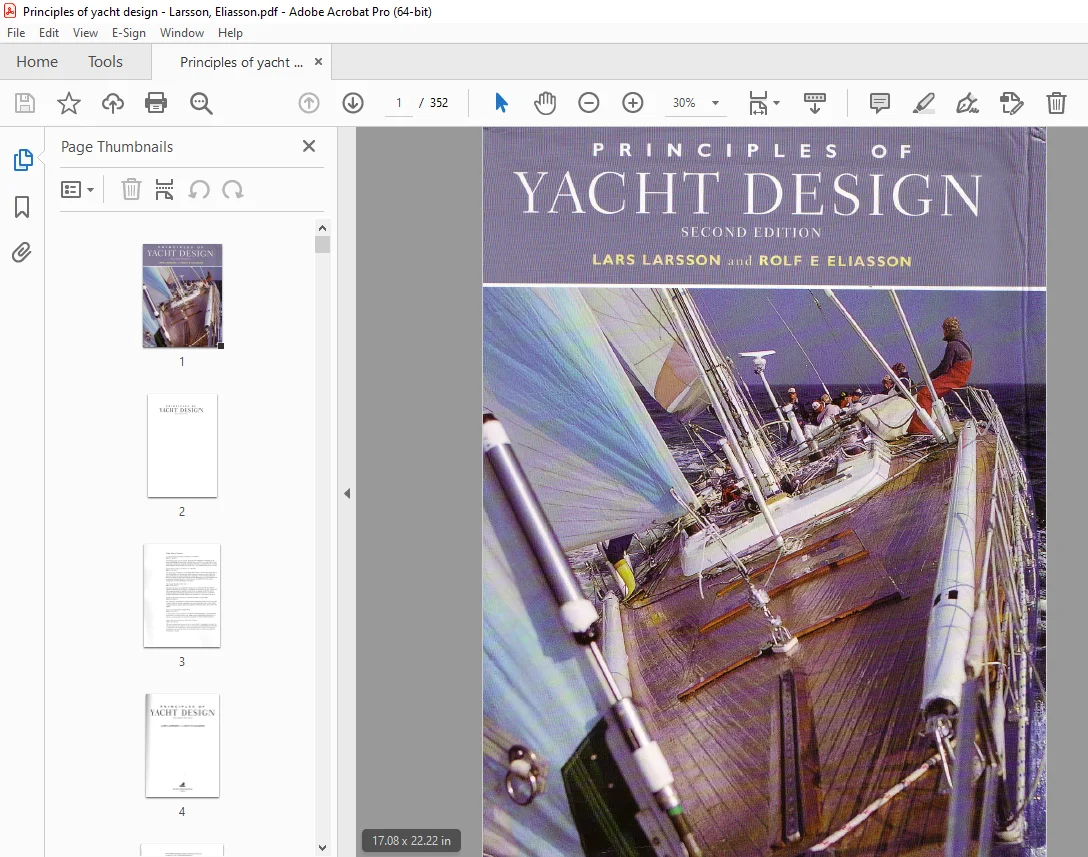
Principles of yacht design Larsson, Eliasson – PDF DOWNLOAD
$28.95
Principles of yacht design Larsson, Eliasson – PDF DOWNLOAD
Description
Principles of yacht design Larsson, Eliasson – PDF DOWNLOAD
FILE DETAILS:
Principles of yacht design Larsson, Eliasson – PDF DOWNLOAD
Language : English
Pages : 352
Downloadable : Yes
File Type : PDF
IMAGES PREVIEW OF THE MANUAL:
TABLE OF CONTENTS:
Principles of yacht design Larsson, Eliasson – PDF DOWNLOAD
Preface to the Second Edition
List of Symbols
Introduction
1. Design Methodology
The design spiral
Computer aided design (CAD)
557
2. Prellinioary Considerations
Choice of boat-type
Intended use
Main dimensions
Cost
Checklist of considerations
Checklist for
3. Hull Geometry
Definitions
Lines drawing
Tools
Work plan
Computer aided design of hulls
161620222627
4. Hydrostatics and Stability
Calculation of areas
Wetted surface
Displacement
Centre of buoyancy
Water plane area
Transverse and longitudinal stability at small angles
Transverse stability at large angles of heel
Curve of static stability
Rol耻g
Influence of waves on the righting moment
Stability statistics
Assessment of seawort皿ess
30303232343840424446495253
vi Principles of Yacht Design
5. Hull Design
Forces and moments on a sailing yacht
Resistance components
Viscous rnsistance, basic concepts
Frictional resistance
Viscous pressure resistance
Roug恤ess
Wave resistance, basic concepts
Influence of hull shape on wave resistance
Heel resistance
Added resistance in waves
Other seakeeping aspects
Hull statistics
6. Keel and Rudder Design
Flow around a wing
Definition of the keel planforn1
Classical wing theory
Tip shape
Advanced planJo1m design
Evaluation of some planform concepts
Defu1ition of the section
Three useful NACA sections
Influence of shape on section characteristics
Some practical conclusions regarding section shape
Influence of deviations from the theoretical section shape
Advanced section design
Statistics on keel and rudder area
The YD-40
7. Sail and Rig Design
Flow around sails
Planfom1
Sajl camber
Mast interference
Means for reducing mast disturbances
Streamlining
A practical model for sail and rig aerodynamics
Sail statistics
8. Balance
Effect of heel
Good balance
Centre of effort of the underwater body
Centre of effort of the sails
Lead
Rudder balance
9. Propeller and Engine
Resistance in calm and rough weather
Propeller characteristics
Design of an optimum propeller
Performance of the non-optimum propeller
Check of blade area
Propeller resistance
1 O. High Speed Hydrodynamics
Plao.ing
Deadrise
Forces on a planing hull
Spray rails, stepped bottoms and transom flaps
Dynamic stability
Alternative propulsion devices
An example
11. Rig Construction
Defi nitions and scope of the standard
Forces on the shrouds
Forces on the stays
Comparison between wire and rod
Transverse mast stiffness
Longitudinal mast stiffness
Fractional mast top
Boom
Spreaders
Holes in the mast
The YD-40 rig
12. H1tll Construction
Concepts in structural mechanics
Global loads
Local hydrostatic loads
Local hydrodynamic loads
Transverse load distribution
Local defonnations
Forces from the keel
Forces from grounding
Forces from the rudder
Summary of loadings
13. Materials
Glass reinforcement
Wet laminates
Fatigue
Exotic laminates
Sandwich
Principles of Yacht Design
Typical sandwich buckling
Sandwich bending
Sandwich in practice
Final remarks
14. Scantling Determination
Structure of the ISO Standard
Hull definitions
Basic laminate
Design loads for the bottom
Design loads for the topsides
Design loads for the decks and bulkheads
Design loads for the internals
Longitudinal impact distribution factor
Area reduction factor
Panel calculation
Stiffener calculation
Spade mdder stock
Cbainplates and keelbolts
Sand、vich construction
The YD-40 scantlings
15. Layout
Generic space requirements
Accommodation
Deck layout
16. Design Evaluation
Non-dimensionaJ parameters
The Velocity Prediction Program(VPP)
Towing tank testing
Computational Fluid Dyn血cs (CFD)
Appendix 1
Main particulars of tl1e YD-4O
Appendix 2
Weight calculation
Appendix 3
STIX calculation
References
Index
DESCRIPTION:
Principles of yacht design Larsson, Eliasson – PDF DOWNLOAD
- Since this book was first published we have received many Scornrnents and suggestions from interested readers, and we have tried to incorporate as much as possible of this valuable advice in the second edition. One major change has been the inclusion of more material relevant to power boats.
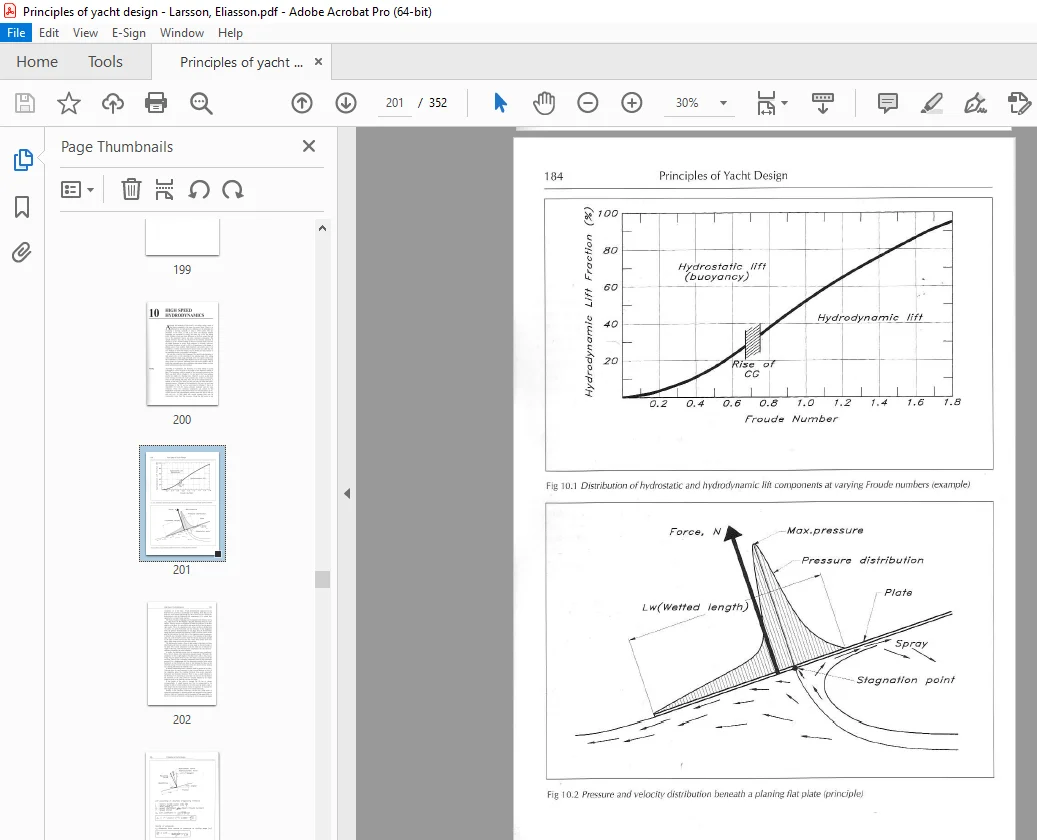
- Although the emphasis in the book has been on sailing yachts, many power boat enthusiasts have found it interesting and requested more information related to this area. In the new edition we have tried to accomplish this- There is an entirely new chapter on high speed hydrodynamics with Special reference to power boats, and in an updated chapter on scantling determination, both types of boats are considered.
- Since most of the other material is also useful, we feel confident that power boat designers and owners may benefit from reading this book. Another important task has been to update the material related to international standards. The ISO/T C188 Working Group 22 has delivered a final proposal for the seaworthiness of sailing craft between 6 m and 24m.
- This draft, which is most likely to be approved, dili‘ers from the one presented in the first edition of the book, and the new approach is described here, with the permission of the chairman, Mr Andrew Blyth- The ISO/’TC Working Group 18 dealing with scantlings has not yet arrived at a final proposal, but with the permission of the chairman, Mr Fritz Hartz, their main ideas are included in the updated chapter on scantlings. Previously this chapter was based entirely on the ABS rule.
S.V 15/03/2025