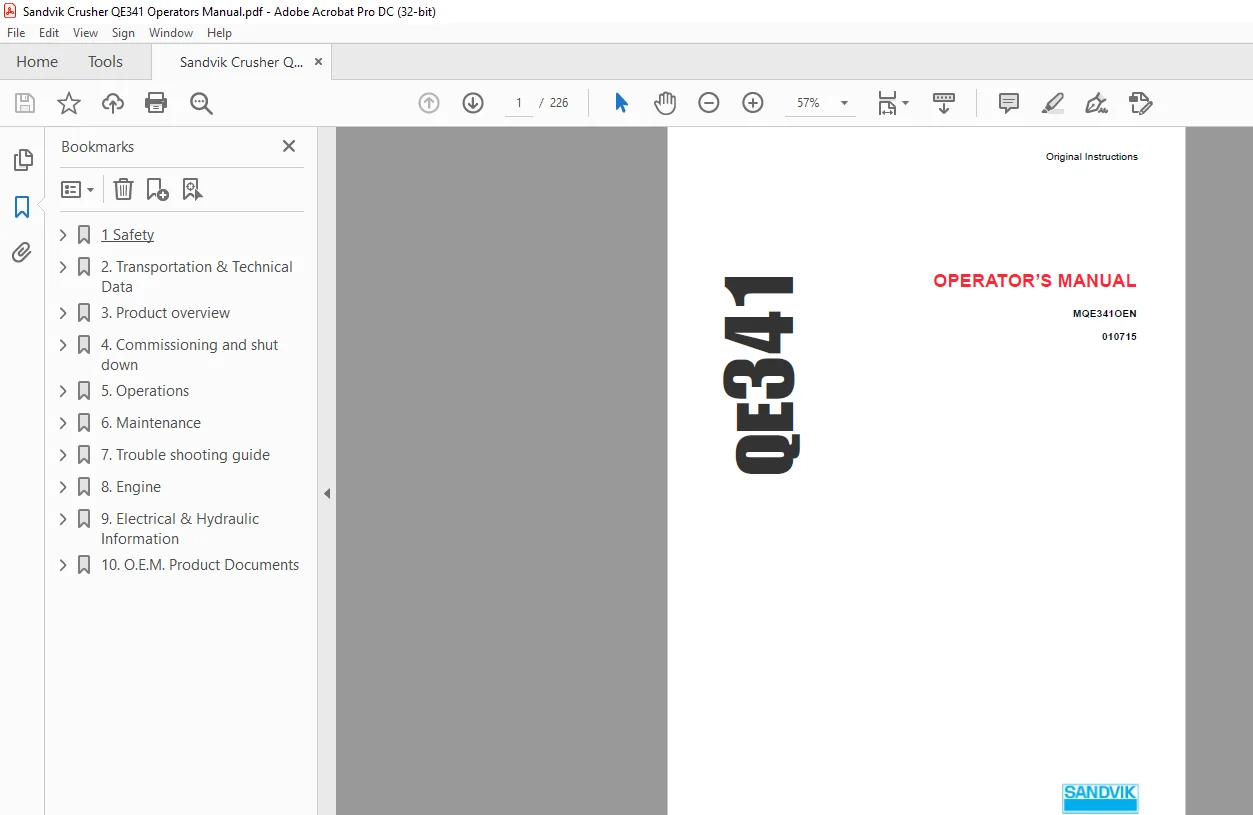
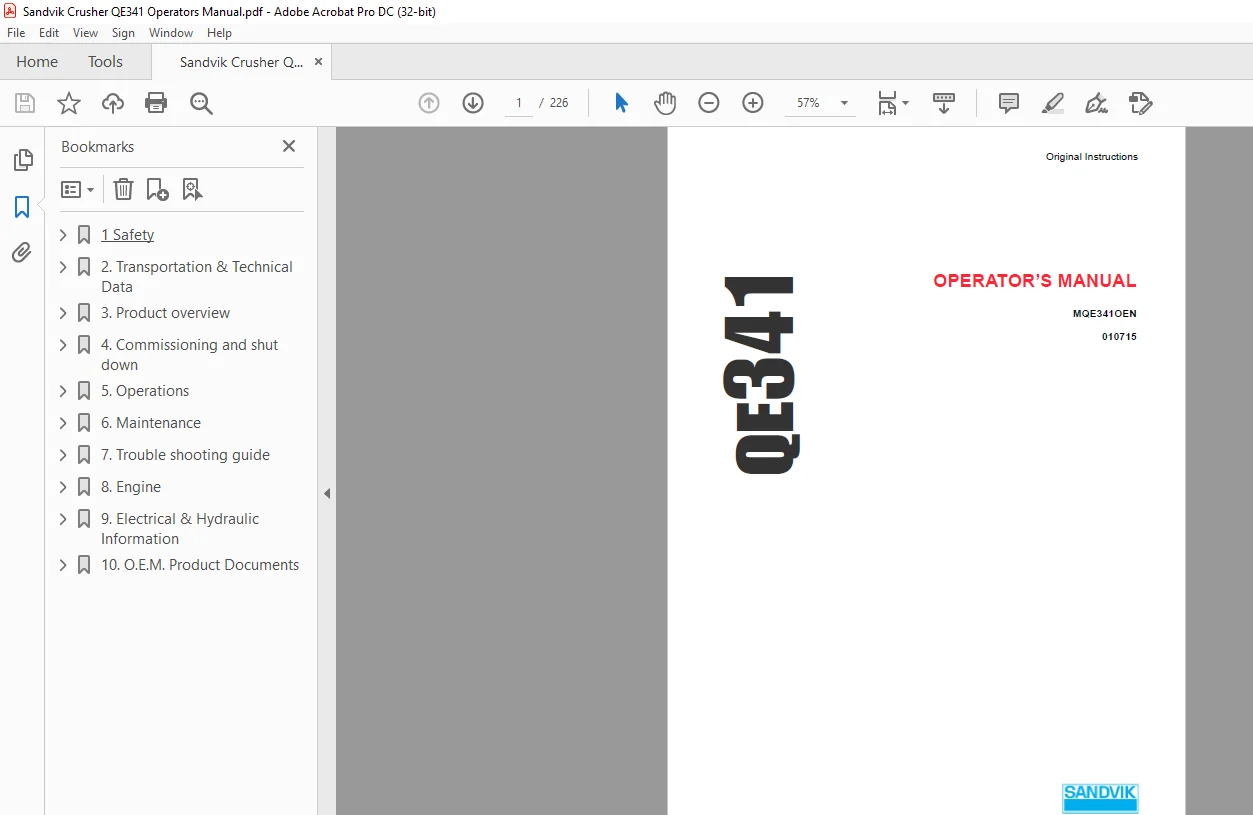
Sandvik Crusher QE341 Operators Manual – PDF DOWNLOAD
$28.95
Sandvik Crusher QE341 Operators Manual – PDF DOWNLOAD
Description
Sandvik Crusher QE341 Operators Manual – PDF DOWNLOAD
FILE DETAILS:
Sandvik Crusher QE341 Operators Manual – PDF DOWNLOAD
Language : English
Pages :226
Downloadable : Yes
File Type : PDF
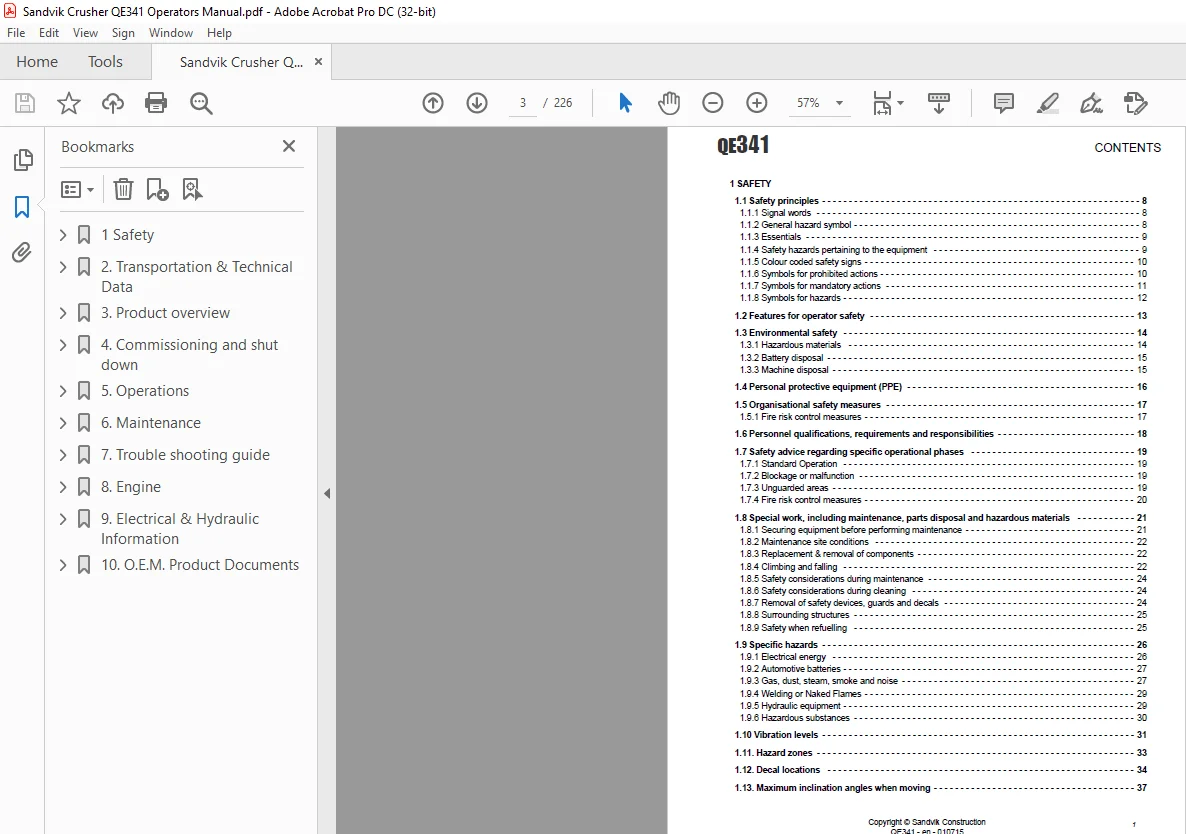
TABLE OF CONTENTS:
Sandvik Crusher QE341 Operators Manual – PDF DOWNLOAD
1 Safety……………………………………………………………………. 9
1.1 Safety principles…………………………………………………….. 10
1.1.1 Signal words……………………………………………………. 10
1.1.2 General hazard symbol……………………………………………. 10
1.1.3 Essentials……………………………………………………… 11
1.1.4 Safety hazards pertaining to the equipment…………………………. 11
1.1.5 Colour coded safety signs………………………………………… 12
1.1.6 Symbols for prohibited actions……………………………………. 12
1.1.7 Symbols for mandatory actions…………………………………….. 13
1.1.8 Symbols for hazards……………………………………………… 14
1.2 Features for operator safety…………………………………………… 15
1.3 Environmental safety………………………………………………….. 16
1.3.1 Hazardous materials……………………………………………… 16
1.3.2 Battery disposal………………………………………………… 17
1.3.3 Machine disposal………………………………………………… 17
1.4 Personal protective equipment (PPE)…………………………………….. 18
1.5 Organisational safety measures…………………………………………. 19
1.5.1 Fire risk control measures……………………………………….. 19
1.6 Personnel qualifications, requirements and responsibilities……………….. 20
1.7 Safety advice regarding specific operational phases………………………. 21
1.7.1 Standard Operation………………………………………………. 21
1.7.2 Blockage or malfunction………………………………………….. 21
1.7.3 Unguarded areas…………………………………………………. 21
1.7.4 Fire risk control measures……………………………………….. 22
1.8 Special work, including maintenance, parts disposal and hazardous materials…. 23
1.8.1 Securing equipment before performing maintenance……………………. 23
1.8.2 Maintenance site conditions………………………………………. 24
1.8.3 Replacement & removal of components……………………………….. 24
1.8.4 Climbing and falling…………………………………………….. 24
1.8.5 Safety considerations during maintenance…………………………… 26
1.8.6 Safety considerations during cleaning……………………………… 26
1.8.7 Removal of safety devices, guards and decals……………………….. 26
1.8.8 Surrounding structures…………………………………………… 27
1.8.9 Safety when refuelling…………………………………………… 27
1.9 Specific hazards……………………………………………………… 28
1.9.1 Electrical energy……………………………………………….. 28
1.9.2 Automotive batteries…………………………………………….. 29
1.9.3 Gas, dust, steam, smoke and noise…………………………………. 29
1.9.4 Welding or Naked Flames………………………………………….. 31
1.9.5 Hydraulic equipment……………………………………………… 31
1.9.6 Hazardous substances…………………………………………….. 32
1.10 Vibration levels…………………………………………………….. 33
1.11. Hazard zones……………………………………………………….. 35
1.12. Decal locations…………………………………………………….. 36
1.13. Maximum inclination angles when moving………………………………… 39
1.14. Safeguarding……………………………………………………….. 40
1.14.1. Guards……………………………………………………….. 40
1.15. Protective measures…………………………………………………. 41
1.15.1. Emergency stop positions……………………………………….. 41
1.16. Measured noise levels……………………………………………….. 42
2. Transportation & Technical Data…………………………………………….. 45
2.1. Preparation for transport…………………………………………….. 46
2.1.1. Special transport considerations…………………………………. 46
2.1.2. Stow the feeder for transport……………………………………. 47
2.1.3. Stow the maintenance platforms for transport………………………. 50
2.1.4. Stow the fines conveyor for transport…………………………….. 53
2.1.5. Stow the mid grade conveyor for transport…………………………. 57
2.1.6. Fold the oversize conveyor for transport………………………….. 60
2.1.7. Raise the optional legs…………………………………………. 61
2.1.8. Secure the hopper rear panel…………………………………….. 63
2.1.9. Moving the machine on or off transport vehicle…………………….. 64
2.2. Transport and Working Dimensions………………………………………. 66
2.2.1. Three Way Split………………………………………………… 66
2.2.2. Two Way Split………………………………………………….. 70
2.3. Machine information………………………………………………….. 74
2.3.1. Common applications and limitations………………………………. 74
2.3.2. Description……………………………………………………. 74
2.3.3. Processing operation……………………………………………. 74
2.3.4. Key features…………………………………………………… 74
2.4. Technical information………………………………………………… 76
2.5. Identification of main units………………………………………….. 77
2.6. Specification of main units…………………………………………… 78
2.6.1. Options……………………………………………………….. 79
3. Product overview………………………………………………………….. 81
3.1. Electrical system……………………………………………………. 82
3.2. Hydraulic lever controls……………………………………………… 83
3.3. Operational controls…………………………………………………. 85
3.4. Display screen………………………………………………………. 87
3.4.1. Auxiliary mode home screen………………………………………. 87
3.4.2. Operation mode home screen………………………………………. 88
3.4.3. Track mode home screen………………………………………….. 88
3.4.4. Engine information……………………………………………… 89
3.4.5. Machine diagnostics…………………………………………….. 90
3.4.6. Service mode…………………………………………………… 98
3.4.7. Active error display screen……………………………………… 98
3.4.8. Feeder radio remote control……………………………………… 99
3.4.9. Track controls…………………………………………………. 99
4. Commissioning and shut down…………………………………………………101
4.1. Pre-commissioning…………………………………………………….102
4.1.1. Safety…………………………………………………………102
4.1.2. Machine preliminaries……………………………………………102
4.1.3. Site working location……………………………………………104
4.2. Engine starting procedure……………………………………………..105
4.2.1. Before starting the engine……………………………………….105
4.2.2. Engine start……………………………………………………106
4.3. Stopping machine in an emergency……………………………………….108
4.3.1. Emergency Stop Locations…………………………………………108
4.3.2. How to operate an emergency stop………………………………….108
4.4. Moving machine on the tracks…………………………………………..109
4.4.1. Safety…………………………………………………………109
4.4.2. Before moving the machine………………………………………..109
4.4.3. Radio remote track control……………………………………….110
4.4.4. Umbilical track control………………………………………….110
4.4.5. Track control mode………………………………………………111
4.4.6. Operating track control………………………………………….111
4.5. Preparing for screening operation………………………………………114
4.5.1. Lower the optional legs………………………………………….115
4.5.2. Unfold the fines conveyor………………………………………..116
4.5.3. Unfold the Mid Grade Conveyor…………………………………….120
4.5.4. Unfold the Over Size Conveyor…………………………………….123
4.5.5. Set up the apron feeder………………………………………….124
4.5.6. Optional hopper extensions……………………………………….127
4.5.7. Hopper rear panel position options………………………………..128
4.5.8. Set up the maintenance platforms………………………………….129
4.5.9. Set up the screen box……………………………………………133
4.6. Machine shut down…………………………………………………….135
4.6.1. Machine shut down – Automatic…………………………………….135
4.6.2. Machine shut down – Manual……………………………………….137
4.6.3. Engine stop sequence…………………………………………….137
4.7. Lockout and tag procedure……………………………………………..139
4.7.1. Tag procedure…………………………………………………..139
4.7.2. The un-tag procedure…………………………………………….139
4.7.3. How to use a gang tag……………………………………………140
5. Operations………………………………………………………………..141
5.1. Before starting up the machine for operation…………………………….142
5.2. Screening operation…………………………………………………..144
5.2.1. Introduction……………………………………………………144
5.2.2. General………………………………………………………..144
5.2.3. Machine starting sequence – Automatic……………………………..145
5.2.4. Machine starting sequence – Manual………………………………..145
5.3. Loading the feeder……………………………………………………147
5.3.1. Loading efficiently……………………………………………..147
5.3.2. Avoid damage to equipment………………………………………..148
5.4. Machine blockage……………………………………………………..150
5.5. Set up the conveyor speeds…………………………………………….151
5.5.1. Introduction……………………………………………………151
5.5.2. How to adjust the fines collector speed……………………………151
5.5.3. How to adjust the mid grade conveyor speed…………………………152
5.5.4. How to adjust the over size conveyor speed…………………………152
5.5.5. How to adjust the feeder speed……………………………………152
5.6. Apron feeder radio remote control………………………………………153
5.6.1. Introduction……………………………………………………153
5.6.2. Feeder remote operation………………………………………….153
5.7. Screen angle adjustment……………………………………………….154
6. Maintenance……………………………………………………………….157
6.1. Maintenance – minimum safety requirements……………………………….158
6.1.1. Introduction……………………………………………………158
6.1.2. Safety instructions……………………………………………..159
6.1.3. Hydraulic equipment……………………………………………..159
6.1.4. Site conditions…………………………………………………160
6.1.5. Machine components………………………………………………160
6.1.6. Original equipment manufacturer’s products…………………………160
6.2. Scheduled maintenance intervals………………………………………..161
6.2.1. Daily maintenance schedule [minimum requirements]…………………..161
6.2.2. Weekly maintenance schedule [minimum requirements]………………….162
6.2.3. 100 hours maintenance schedule……………………………………163
6.2.4. 250 Hours maintenance schedule [minimum requirements]……………….163
6.2.5. 500 Hours maintenance schedule……………………………………164
6.2.6. 1000 Hours maintenance schedule…………………………………..164
6.2.7. 2000 Hours or 1 year maintenance schedule………………………….165
6.3. General machine maintenance procedures………………………………….166
6.3.1. Location of compartments for maintenance…………………………..166
6.3.2. Machine grease points……………………………………………168
6.3.3. Diesel fuel tank – check level/top up……………………………..169
6.3.4. Hydraulic tank – check level/top up……………………………….170
6.3.5. Hydraulic return filter – inspect indicator/replace filter…………..170
6.3.6. Hydraulic tank vent – inspect/replace filter……………………….172
6.3.7. Hydraulic tank – replace hydraulic fluid…………………………..172
6.3.8. Engine coolant – check level/top up……………………………….175
6.3.9. Engine oil – check level/top up…………………………………..176
6.3.10. Engine filter location………………………………………….178
6.3.11. Fuel system primary filter/water separator – drain…………………178
6.3.12. Engine air cleaner filter – servicing/replace……………………..179
6.3.13. Battery maintenance…………………………………………….182
6.3.14. Feeder gearbox – check level/top up………………………………182
6.4. Conveyor belt maintenance procedures……………………………………183
6.4.1. Safety…………………………………………………………183
6.4.2. Conveyor belt tracking…………………………………………..184
6.4.3. Conveyor belt tension – Mid grade and fines conveyors……………….187
6.4.4. Feeder conveyor belt – tension……………………………………190
6.4.5. Oversize conveyor belt – tension………………………………….191
6.4.6. Fines collector conveyor belt – tension……………………………192
6.4.7. Belt scraper – adjust……………………………………………193
6.5. Track maintenance procedures…………………………………………..194
6.5.1. Track gearbox oil – check top up………………………………….194
6.5.2. Track gearbox oil – replace………………………………………195
6.5.3. Tracks – inspect………………………………………………..196
6.5.4. Track tension – check……………………………………………196
6.5.5. Track tension – increase…………………………………………197
6.5.6. Track tension – reduce…………………………………………..199
6.6. Screen box maintenance procedures………………………………………200
6.6.1. Set up access to the screen box for mesh change…………………….201
6.6.2. Bottom screen mesh………………………………………………202
6.6.3. Lower screen box into working position…………………………….204
6.6.4. Top screen mesh or punched plate………………………………….205
6.6.5. Top screen tine bar……………………………………………..206
6.7. Lubricants and fluids used in manufacture……………………………….207
7. Trouble shooting guide……………………………………………………..209
7.1. General……………………………………………………………..210
7.2. Machine faults……………………………………………………….211
7.2.1. Engine Starting or running……………………………………….211
7.2.2. Moving the machine on the tracks………………………………….212
7.2.3. Conveyors – Maintenance platforms – Legs…………………………..212
7.2.4. Loading and operation……………………………………………214
7.2.5. The screen box………………………………………………….214
7.2.6. Radio, umbilical controls………………………………………..215
7.2.7. Problems not listed……………………………………………..215
7.3. Machine errors displayed on screen……………………………………..216
7.3.1. Original Equipment Manufacturer (OEM) Trouble shooting………………218
8. Engine……………………………………………………………………219
8.1. Engine in power pack………………………………………………….220
8.1.1. Engine manual…………………………………………………..220
8.1.2 Engine alternatives………………………………………………220
9. Electrical & Hydraulic Information…………………………………………..221
9.1 Schematic diagrams…………………………………………………….222
9.1.1 Electrical schematic diagram………………………………………222
9.1.2 Hydraulic schematic diagram……………………………………….222
10. O.E.M. Product Documents…………………………………………………..223
10.1. Original Equipment Manufacturer Information…………………………….224
10.2. Hazardous Substances…………………………………………………225
10.3. Variations and Options (if applicable)…………………………………226
IMAGES PREVIEW OF THE MANUAL:
S.M 5/24