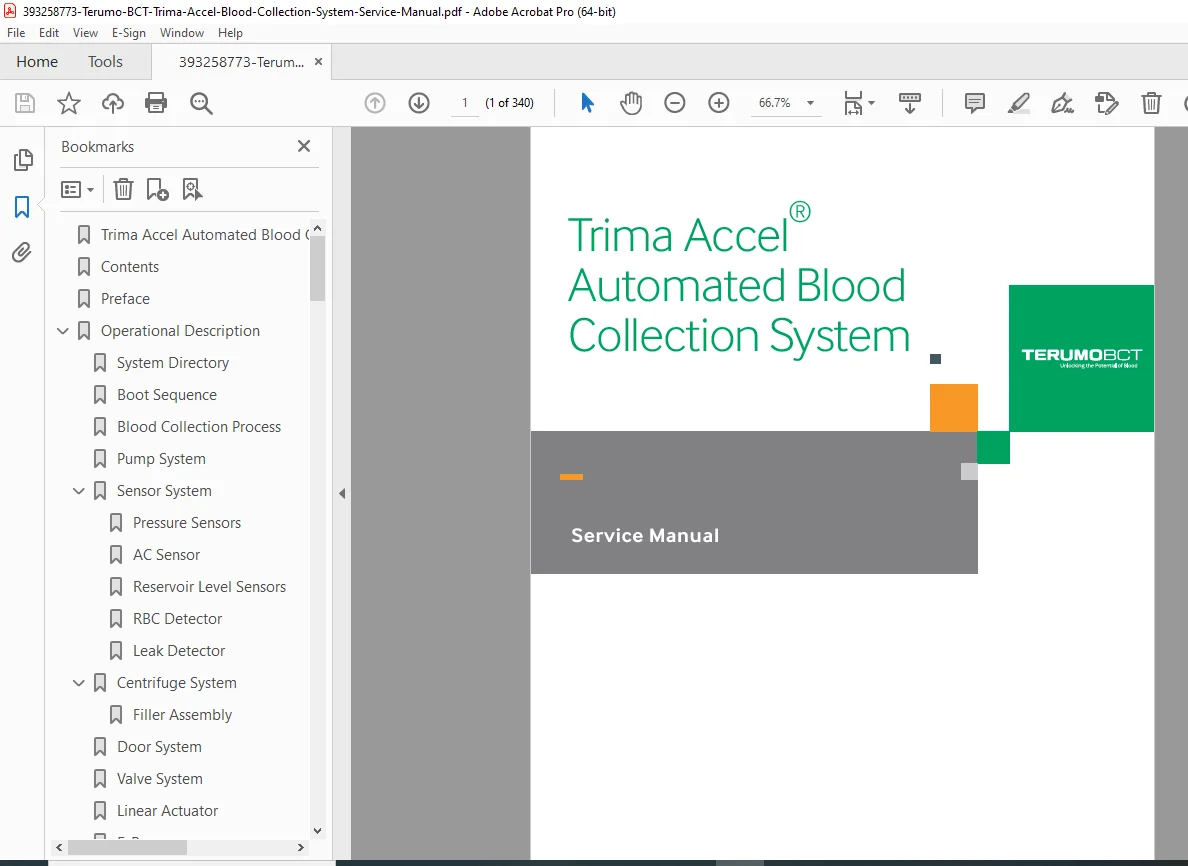
Terumo BCT Trima Accel Blood Collection System Service Manual – PDF
Original price was: $120.00.$35.95Current price is: $35.95.
Official Terumo BCT service manual for Trima Accel Automated Blood Collection System covering software versions 5.1, 6.0, and 6.1. This comprehensive 340-page technical manual provides complete operational descriptions, system schematics, troubleshooting procedures, maintenance protocols, and calibration instructions for apheresis equipment. Includes detailed coverage of centrifuge systems, pump controls, sensor diagnostics, valve operations, display systems, and safety protocols for platelet, plasma, and RBC collection procedures.
Description
Terumo BCT Trima Accel Blood Collection System Service Manual Apheresis v5-6 PDF DOWNLOAD
DESCRIPTION
Terumo BCT Trima Accel® Automated Blood Collection System – Complete Service Manual
This is the official Terumo BCT service manual (Part No. 777095-548) for the Trima Accel automated blood collection system, providing comprehensive technical documentation for professional servicing, troubleshooting, and maintenance of advanced apheresis equipment used in blood centers and hospitals worldwide.
📋 FILE DETAILS
- Manual Title: Trima Accel® Automated Blood Collection System Service Manual
- Part Number: 777095-548
- Publication Date: September 2015 (2015-09)
- Software Versions Covered: Version 5.1.0 and higher (5.1, 6.0, 6.1)
- Total Pages: 340 pages
- PDF Quality: High-resolution professional technical manual
- Language: English
- Manufacturer: Terumo BCT, Inc.
📖 COMPREHENSIVE TABLE OF CONTENTS
Chapter 1: Operational Description (Pages 1-1 to 1-52)
System Directory and Component Overview:
- Complete system component identification with front/rear views
- Display system location and function
- IV pole assembly and adjustment mechanisms
- Pump panel layout and components
- Seal Safe system description
- Cassette plate positioning
- Centrifuge door and chamber access
- Brake and caster systems for mobility
- System serial number location
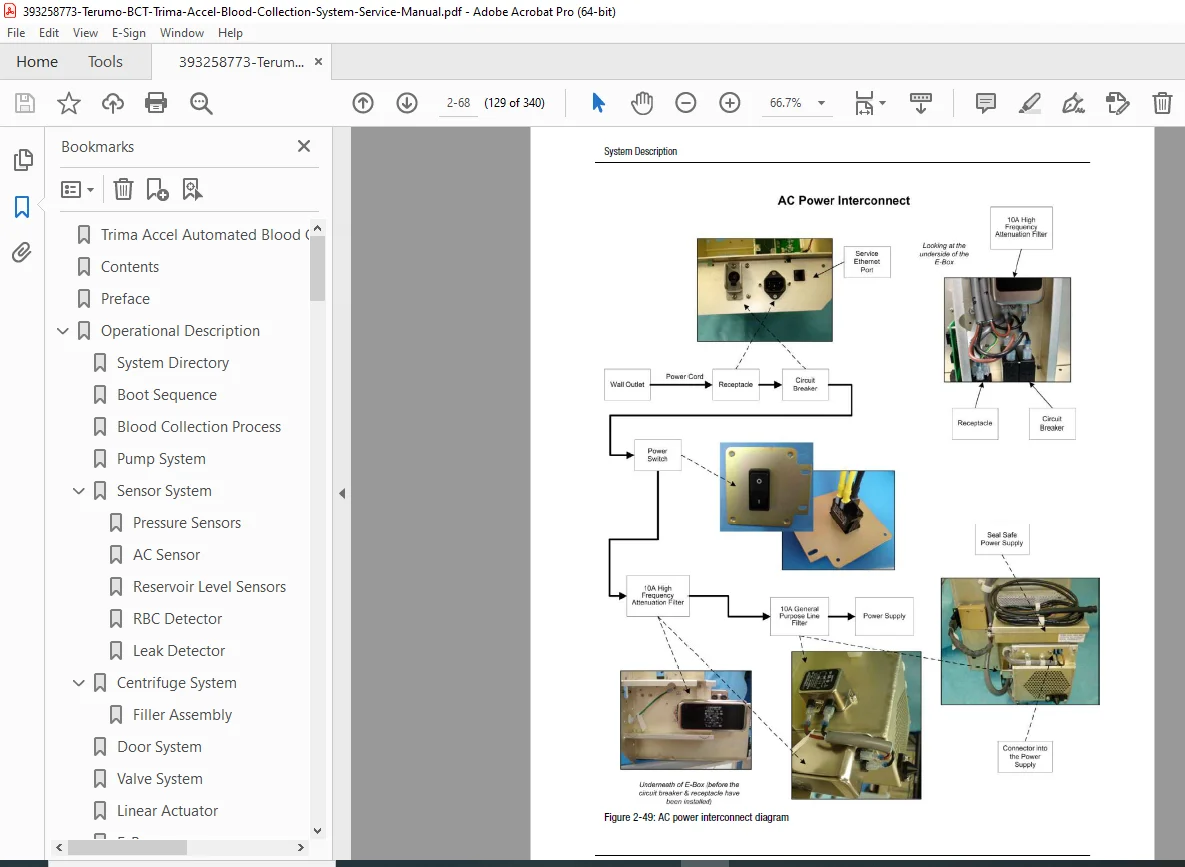
- Power connections and circuit breaker
Operational Systems:
- Boot Sequence – System startup procedures and initialization
- Blood Collection Process – Complete apheresis cycle description including:
- Platelet collection procedures
- Plasma collection operations
- Red blood cell (RBC) collection protocols
- Anticoagulant infusion control
- Donor interface procedures
Major System Operations:
- Pump System (Page 1-14)
- Inlet pump operation
- Return pump function
- AC (anticoagulant) pump control
- Platelet and plasma pump systems
- Pump flow rate control algorithms
- Sensor System (Page 1-19)
- Pressure sensors (draw/return and centrifuge)
- AC sensor operation and monitoring
- Reservoir level sensors (upper and lower detection)
- RBC detector function and spillover detection
- Leak detector system for fluid safety
- Centrifuge System (Page 1-27)
- Centrifugal separation principles
- RPM control and acceleration profiles
- Filler assembly operation
- Channel separation mechanics
- RBC/plasma interface optimization
- Door System (Page 1-32)
- Centrifuge door latch mechanisms
- Safety interlock systems
- Door alignment specifications
- Valve System (Page 1-36)
- Pneumatic valve operations
- Valve sequencing during procedures
- Flow control and routing
- Linear Actuator (Page 1-41)
- Positioning system for optical sensors
- Interface detection mechanics
- E-Box (Electronics Box) (Page 1-43)
- Control computer architecture
- Safety computer redundancy
- Motor driver systems
- Display System (Page 1-47)
- Touch screen interface
- Audio and visual communication
- Operator prompts and alerts
- Power System (Page 1-51)
- AC power distribution
- Circuit protection
- Power supply specifications
- Mechanical Systems (Page 1-52)
- Frame construction
- Mobility systems
- IV pole mechanisms
Chapter 2: System Description (Pages 2-1 to 2-71)
Detailed Component Analysis:
- Pump System (Page 2-2)
- Pump assembly construction details
- Motor specifications and control
- Flow calibration methodology
- Peristaltic pump mechanics
- Sensor System (Page 2-7)
- Pressure sensor electronic principles
- Transducer specifications and calibration
- Reservoir level sensor optics
- AC sensor detection methodology
- RBC detector optical system design
- Leak detector conductivity principles
- Centrifuge System (Page 2-18)
- Centrifuge drive assembly mechanics
- Motor controller specifications
- Hall-effect sensor feedback
- Speed control algorithms
- Vibration damping systems
- Door System (Page 2-26)
- Latch mechanism design
- Safety switch integration
- Alignment adjustment procedures
- Valve System (Page 2-31)
- Pneumatic actuator specifications
- Valve position sensing
- Timing and sequencing logic
- Linear Actuator System (Page 2-37)
- Stepper motor control
- Position feedback sensors
- Calibration requirements
- E-Box and Computer Systems (Page 2-40)
- Control and Safety Functions:
- Dual-computer redundancy architecture
- Safety monitoring protocols
- Control CCA (Circuit Card Assembly) – Main processing board
- Control Computer – VxWorks operating system
- Control Ethernet CCA – Network communications
- Safety CCA – Independent safety monitoring
- Safety Computer – Redundant safety processor
- Safety Ethernet CCA – Safety network redundancy
- Motor Driver CCA – Pump and centrifuge control
- 64V Switch CCA – Power distribution control
- Control and Safety Functions:
- Cooling Fans (Page 2-56)
- Thermal management system
- Fan control and monitoring
- Display System (Page 2-58)
- Display assembly construction
- LCD backlight control
- Touch screen CCA specifications
- Video signal processing
- Power System (Page 2-66)
- Power supply topology
- Voltage regulation
- Current monitoring
- Backup power considerations
- Mechanical System (Page 2-70)
- IV pole adjustment mechanism
- Wheel and brake system specifications
- Structural design elements
Chapter 3: Software Description (Pages 3-1 to 3-127)
Software Version 5.1 Description (Page 3-2)
- Trima Accel software architecture
- State and substate overview
- State machine operation:
- Self Test State
- Power Fail Recovery State
- Startup Tests State
- Disposable Tests State
- AC Connected State
- AC Prime State
- Donor Connected State
- Blood Prime State
- Blood Run State
- Rinseback State
- Donor Disconnect State
- Post Run State
Software Version 6.0 Description (Page 3-38)
- Enhanced software architecture
- Additional features and improvements
- All version 5.1 states plus:
- Metered Storage Solution State
- Metered Storage Solution Disconnect State
- Advanced algorithms and control logic
Software Version 6.1 Description (Page 3-83)
- Latest software revision
- Refined state machine operations
- Blood Rinseback State (enhanced)
- Optimized collection algorithms
- Improved safety monitoring
Chapter 4: Troubleshooting (Pages 4-1 to 4-24)
Comprehensive Diagnostic Procedures:
- Touch Screen Troubleshooting (Page 4-2)
- Display connectivity testing
- Touch screen calibration
- Connector test point diagrams
- Signal verification procedures
- Valve System Troubleshooting (Page 4-4)
- Pneumatic system diagnostics
- Valve position verification
- Timing issue resolution
- Version 6.0.6 Dlog information interpretation
- Door System Troubleshooting (Page 4-17)
- Door gap measurements and adjustments
- Latch alignment procedures
- Safety switch verification
- Door sensor diagnostics
- Version 6.0.6 Dlog analysis
Chapter 5: Maintenance and Calibration (Pages 5-1 to 5-14)
Essential Service Procedures:
- Aligning the Centrifuge Door (Page 5-2)
- Gap measurement specifications
- Latch plate adjustment procedures
- Front door alignment steps
- Verification procedures
- Calibrating the Centrifuge Motor Controller (Page 5-5)
- Motor controller calibration protocol
- RPM verification procedures
- Performance validation testing
- Positioning the Linear Actuator Sensors (Page 5-8)
- Sensor alignment specifications
- Position calibration procedures
- Optical alignment verification
- Removing the Side Panels (Page 5-11)
- Panel removal procedures for service access
- Fastener locations and specifications
- Reassembly instructions
- Saline Run (Page 5-14)
- System functional testing procedure
- Saline test protocol
- Performance verification
- Pump calibration validation
Chapter 6: Specifications (Pages 6-1 to 6-29)
Complete Technical Specifications:
- Physical Specifications (Page 6-2)
- Dimensions (height, width, depth)
- Weight specifications
- Mobility clearances
- Environmental Specifications (Page 6-3)
- Operating temperature range
- Storage temperature limits
- Humidity requirements
- Altitude specifications
- Electrical Power and Safety (Page 6-4)
- Voltage requirements (100-240V AC)
- Current consumption specifications
- Power cord specifications
- Electrical safety compliance
- Safety Certifications (Page 6-11)
- UL/CSA certifications
- CE marking compliance
- IEC medical device standards
- Performance Specifications (Page 6-12)
- Blood processing capabilities
- Collection rates and volumes
- Platelet yield specifications
- Plasma collection volumes
- Product Specifications (Page 6-13)
- System configurations
- Software version requirements
- Blood Tubing Sets (Page 6-14)
- Compatible disposable set specifications
- Channel configurations
- Centrifuge (Page 6-15)
- RPM range specifications
- Acceleration profiles
- G-force calculations
- Component Specifications:
- Draw/Return Pressure Sensor (Page 6-17)
- Centrifuge Pressure Sensor (Page 6-18)
- Reservoir Level Sensors (Page 6-19)
- Fluid Leak Detector (Page 6-20)
- Anticoagulant (AC) Detector (Page 6-21)
- RBC Spillover Detector (Page 6-22)
- Alarm Specifications:
- AC Flow Alarm (Page 6-22)
- AC Ratio Alarm (Page 6-23)
- AC Infusion Alarm (Page 6-24)
- Touch-Screen Display (Page 6-25)
- Display specifications
- Resolution and interface details
- Symbols and Certification (Page 6-26)
- Regulatory symbols guide
- Label specifications
- Seal Safe System Specifications (Page 6-29)
- Automated sealing system details
Comprehensive Index – Alphabetical reference guide
🔬 KEY TECHNOLOGIES COVERED
Apheresis Systems:
- Automated platelet collection (PLT apheresis)
- Plasma collection procedures (Plasma apheresis)
- Red blood cell collection (RBC apheresis)
- Double and triple product collection protocols
- Concurrent collection capabilities
Control Systems:
- Dual-computer redundancy architecture (Control + Safety)
- VxWorks real-time operating system
- State machine programming
- Algorithmic flow control
- Automatic interface detection
Sensor Technologies:
- Optical detection systems (RBC, reservoir levels)
- Pressure transducers (dual pressure monitoring)
- Conductivity-based leak detection
- Hall-effect motor feedback
- Position sensing systems
Safety Systems:
- Independent safety computer monitoring
- Air detection and prevention
- Pressure monitoring and alarms
- Flow rate verification
- Volume tracking algorithms
- Donor safety protocols
👨🔧 WHO SHOULD USE THIS MANUAL
- Biomedical Equipment Technicians (BMETs) – Servicing blood bank equipment
- Blood Center Technical Staff – Maintaining apheresis equipment
- Clinical Engineering Personnel – Managing blood collection device fleets
- Terumo BCT Service Partners – Authorized service providers
- Hospital Transfusion Service Technicians – Equipment maintenance responsibilities
- Medical Device Service Companies – Third-party service organizations
- Field Service Engineers – On-site equipment repair and calibration
🏥 APPLICATIONS & FACILITIES
Trima Accel systems are deployed in:
- Community blood centers and blood banks
- Hospital transfusion services
- American Red Cross blood collection facilities
- Military blood programs
- University medical center blood banks
- Commercial plasma collection centers
- Research institutions conducting apheresis studies
⚡ CRITICAL SYSTEMS DOCUMENTED
Blood Separation Technology:
- Continuous flow centrifugation principles
- Interface detection and optimization
- RBC spillover prevention
- Yield optimization algorithms
Pump Control Systems:
- Peristaltic pump mechanics and control
- Multi-pump synchronization
- Flow rate algorithms
- AC ratio control (blood to anticoagulant)
Centrifuge Operations:
- Variable speed control (up to specified RPM)
- Acceleration profile management
- Vibration monitoring and control
- Temperature management
Donor Safety Features:
- Volume tracking and limits
- Pressure monitoring (venous and arterial)
- Citrate infusion control
- Air detection systems
- Emergency disconnect procedures
📐 REGULATORY COMPLIANCE
This manual covers equipment designed to meet:
- FDA 21 CFR Part 820 Quality System Regulation
- ISO 13485 Medical Device Quality Management
- IEC 60601-1 Medical Electrical Equipment Safety
- AABB Standards for Blood Banks and Transfusion Services
- FDA Blood Establishment Computer System Validation requirements
- CE marking for European Medical Device Directive compliance
💡 WHY THIS MANUAL IS ESSENTIAL
This official Terumo BCT service manual is the definitive technical reference containing proprietary operational descriptions, detailed electronic schematics, software state machine documentation, and precise troubleshooting procedures unavailable anywhere else. With 340 pages of comprehensive technical information covering three major software versions (5.1, 6.0, 6.1), complete system diagnostics including Dlog interpretation, calibration procedures for critical components, and detailed specifications for every sensor and actuator, this manual enables you to maintain life-saving blood collection equipment at peak performance while ensuring donor safety and regulatory compliance. Download instantly and have immediate access to the exact technical information, wiring diagrams, and repair procedures you need to minimize equipment downtime and maintain the integrity of critical blood bank operations.
Pricing Rationale: This is an extensive 340-page professional service manual for highly sophisticated medical equipment used in critical blood banking operations. The Trima Accel system is a complex automated apheresis device valued at over $100,000, requiring specialized knowledge for service and maintenance. The manual covers three major software versions, includes proprietary diagnostic procedures, detailed electronic schematics, state machine programming documentation, and comprehensive troubleshooting for multiple interconnected systems (centrifuge, pumps, sensors, dual-computer architecture). The critical nature of blood collection equipment, specialized biomedical technician audience, and comprehensive technical depth justify premium pricing. Similar medical device service manuals for apheresis and blood processing equipment typically range from $44.95-$59.95 depending on complexity and scope.