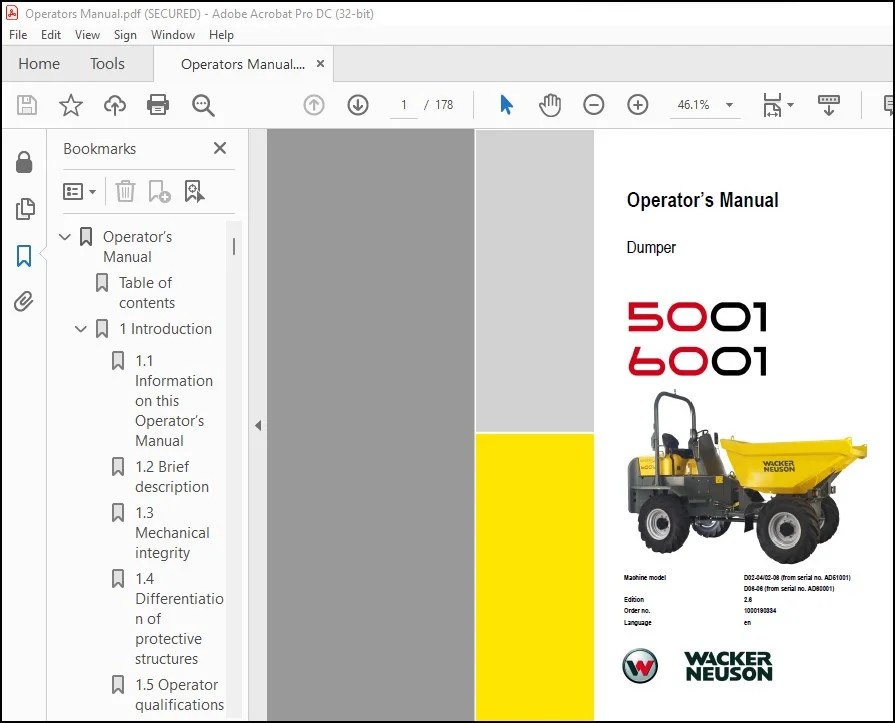
Wacker Neuson 5001 & 6001 Dumper Operator’s Manual 1000190334 – PDF DOWNLOAD
Original price was: $78.95.$27.95Current price is: $27.95.
Wacker Neuson 5001 & 6001 Dumper Operator’s Manual 1000190334 – PDF DOWNLOAD
Description
Wacker Neuson 5001 & 6001 Dumper Operator’s Manual 1000190334 – PDF DOWNLOAD
FILE DETAILS:
Wacker Neuson 5001 & 6001 Dumper Operator’s Manual 1000190334 – PDF DOWNLOAD
Language : English
Pages : 178
Downloadable : Yes
File Type : PDF
Size: 11.7 MB
IMAGES PREVIEW OF THE MANUAL:
Customer Support: [email protected]
https://vimeo.com/771873049
DESCRIPTION:
Wacker Neuson 5001 & 6001 Dumper Operator’s Manual 1000190334 – PDF DOWNLOAD
Please store the Operator’s Manual in the storage bin under the engine cover- This Operator’s Manual contains important information on how to work safely, correctly and economically with the machine. Therefore, it aims not only at new operators, but it also serves as a reference for experienced ones.
- It helps to avoid hazardous situations and reduce repair costs and downtimes. Furthermore, the reliability and the service life of the machine will be increased by following the instructions in the Operator’s Manual. This is why the Operator’s Manual must always be kept at hand on the machine.
- Your own safety, as well as the safety of others, depends to a great extent on how the machine is moved and operated. Therefore, carefully read and understand this Operator’s Manual prior to the first drive. This Operator’s Manual will help to familiarize yourself more easily with the machine, thereby enabling you to use it more safely and efficiently- Prior to the first drive, carefully read chapter “Safety Instructions” as well, in order to be prepared for possible hazardous situations, as it will be too late for it during operation. As a rule, keep the following in mind:
Careful and prudent working is the best way to avoid accidents! Operational safety and readiness ofthe machine do not only depend on your skill, but also on maintenance and servicing of the machine. This is why regular maintenance and servicing is absolutely necessary. Extensive maintenance and repair work must always be performed by a technician with appropriate training. Insist on using original spare parts when performing maintenance and repair work. This ensures operational safety and readiness of your machine, and maintains its value- Your Wacker Neuson dealer will be pleased to answer any further questions regarding the machine or the Operator’s Manual.
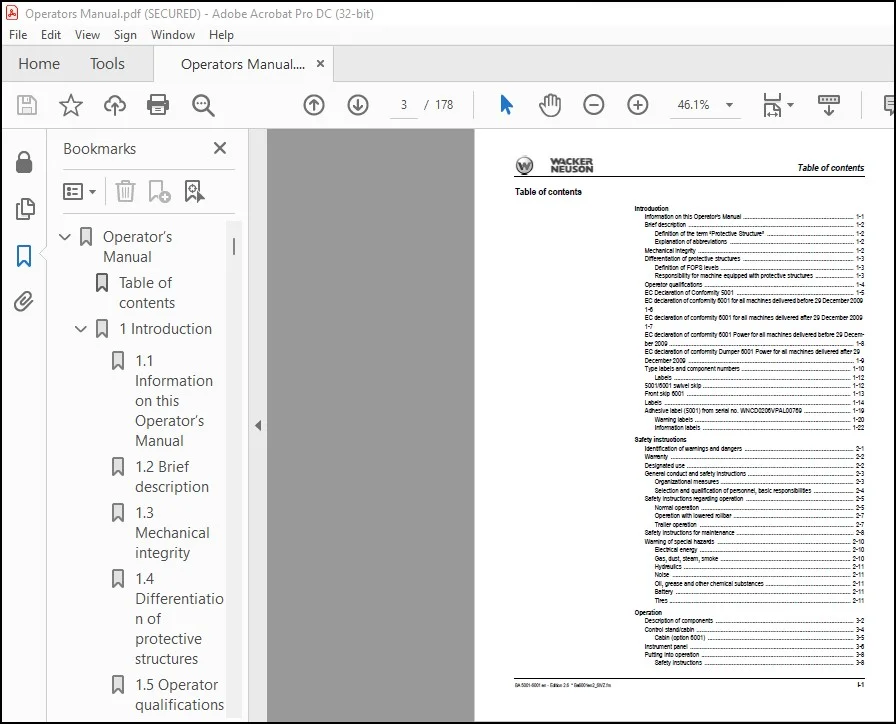
TABLE OF CONTENTS:
Wacker Neuson 5001 & 6001 Dumper Operator’s Manual 1000190334 – PDF DOWNLOAD
Operator’s Manual 1
Table of contents 3
1 Introduction 9
1 1 Information on this Operator’s Manual 9
1 2 Brief description 10
1 3 Mechanical integrity 10
1 4 Differentiation of protective structures 11
1 5 Operator qualifications 12
1 6 EC Declaration of Conformity 5001 13
1 7 EC declaration of conformity 6001 for all machines delivered before 29 December 2009 14
1 8 EC declaration of conformity 6001 for all machines delivered after 29 December 2009 15
1 9 EC declaration of conformity 6001 Power for all machines delivered before 29 December 2009 16
1 10 EC declaration of conformity Dumper 6001 Power for all machines delivered after 29 December 2009 17
1 11 Type labels and component numbers 18
1 12 5001/6001 swivel skip 20
1 13 Front skip 6001 21
1 14 Labels 22
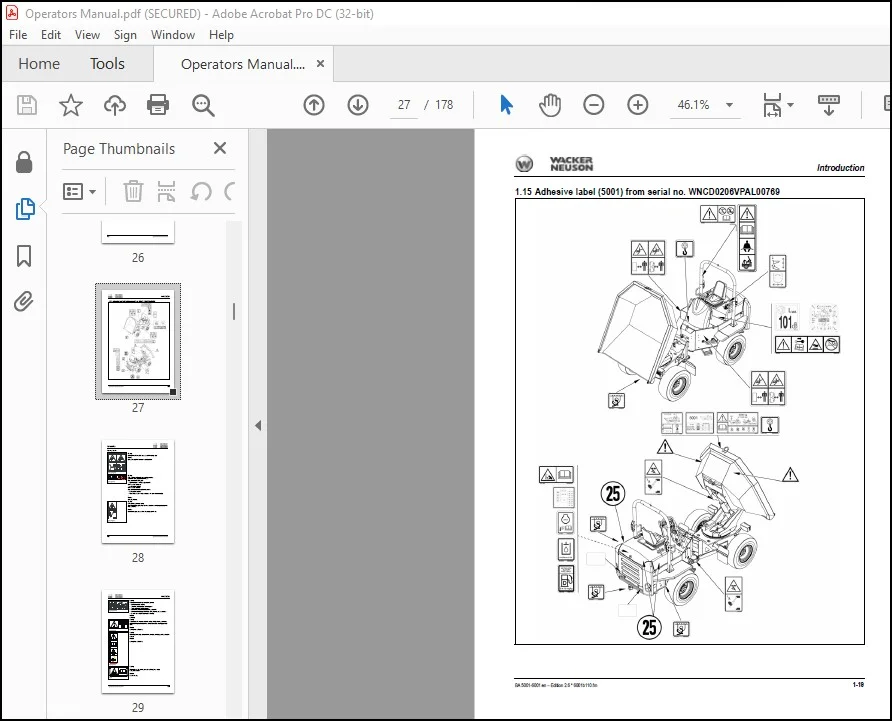
1 15 Adhesive label (5001) from serial no WNCD0206VPAL00769 27
2 Safety instructions 35
2 1 Identification of warnings and dangers 35
2 2 Warranty 36
2 3 Designated use 36
2 4 General conduct and safety instructions 37
2 5 Safety instructions regarding operation 39
2 6 Safety instructions for maintenance 42
2 7 Warning of special hazards 44
3 Operation 47
3 1 Description of components 48
3 2 Control stand/cabin 50
3 3 Instrument panel 52
3 4 Putting into operation 54
3 5 Cabin with integrated protective FOPS structure (option 6001) 59
3 6 Driving the dumper 63
3 7 Immobilizer (option) 65
3 8 Travel operation 67
3 9 Hazard warning system 70
3 10 Machine travel on slopes 70
3 11 Parking the machine 72
3 12 Loading the machine 73
3 13 Seat adjustment 74
3 14 Weight adjustment 74
3 15 Seat belt 75
3 16 Light system 76
3 17 Cabin heating and ventilation 80
3 18 Washer system 81
3 19 Doors 82
3 20 Machine operation 83
3 21 Skip operation 84
3 22 Rollbar 86
3 23 Sunshield (option) 87
3 24 Towing away the machine 89
3 25 Center-pivot prop 95
3 26 Locking the control lever (5001) 96
3 27 Locking the control lever (6001) 96
3 28 Crane-lifting the machine 97
3 29 Loading and transporting the machine 98
3 30 Tying down the machine 99
3 31 Battery master switch (5001) 99
3 32 Battery master switch (6001) 100
3 33 Engine cover (machines without cabin) 101
4 Malfunctions 103
4 1 Engine trouble 103
5 Maintenance 105
5 1 Introduction 105
5 2 Brake test 105
5 3 Maintenance props 106
5 4 Fuel system 109
5 5 Engine lubrication system 113
5 6 Engine cooling system 115
5 7 Axle mounting 5001 118
5 8 Axle mounting 6001 119
5 9 Air filter 121
5 10 V-belt 123
5 11 Hydraulic system 124
5 12 Tires 130
5 13 Axles 132
5 14 Electrical system 133
5 15 General maintenance 136
5 16 Fluids and lubricants 138
5 17 Maintenance plan (overview) 141
5 18 Lubrication plan 5001 145
5 19 Lubrication plan 6001 146
6 Technical data 149
6 1 Chassis 149
6 2 Engine 149
6 3 Drive pump 150
6 4 Brakes 150
6 5 Steering system 150
6 6 Operating hydraulics 151
6 7 Tires 151
6 8 Skip 151
6 9 Travel specifications 151
6 10 Electrical system 5001 152
6 11 Electrical system 6001 154
6 12 Noise levels 156
6 13 Vibration 156
6 14 Coolant compound table 159
6 15 Weights 159
6 16 Dimensions model 5001 160
6 17 Dimensions model 6001F (front skip) 161
6 18 Dimensions model 6001S (swivel skip) 162
6 19 Dimensions model 6001 Power 163
6 20 Dimensions model 6001S (swivel skip) with cabin 164
7 Safety instructions for operation of earth moving machines 165
7 1 Preliminary remark 165
7 2 Designated use 165
7 2 1 Earth moving machines may be used only in compliance with their designated use, and by following the instructions given in the Operator’s Manual of the manufacturer 165
7 2 2 Designated use means that the earth moving machine is used with the work equipment for work in compliance with the European or national work safety regulations, or that the earth moving machine is used for other work the manufacturer has deemed 165
7 2 3 The operator may not perform any safety-relevant modifications on the earth moving machine without the manufacturer’s authorization 165
7 2 4 Spare parts must comply with the technical requirements specified by the manufacturer 165
7 3 General 166
7 3 1 Earth moving machines may be driven and serviced only by persons who meet the following requirements: 166
7 3 2 Avoid any operational mode that might be prejudicial to safety 166
7 3 3 Do not exceed the authorized load of the earth moving machine 166
7 3 4 Operate the earth moving machine only in a safe and reliable state 166
7 3 5 Follow the instructions given in the Operator’s Manual of the manufacturer for all work involving operation, maintenance, repair, assembly and transport 166
7 3 6 If necessary, the operator must supplement the safety instructions by specific instructions adapted to the local conditions of the work site 166
7 3 7 The Operator’s Manual and safety-relevant instructions must be carefully stored in the control stand The manual and the safety instructions can be stored at the work site itself if the earth moving machine has no cabin 166
7 3 8 The Operator’s Manual and the safety instructions must be complete and legible 166
7 3 9 Do not disable the function of the earth moving machine’s safety equipment during operation 166
7 3 10 Wear protective work clothes during work Avoid wearing rings, scarves, unzipped or unbuttoned jackets Specific work can require wearing safety glasses, safety shoes, a hard hat, protective gloves, reflective vests, ear protectors, etc 166
7 3 11 Get informed on first aid and rescue possibilities (emergency physician, fire brigade, helicopter) before starting work 166
7 3 12 You must be familiar with the location and the operation of fire extinguishers on the earth moving machine, and with the local fire alarm and fire fighting facilities 166
7 3 13 Secure loose parts, such tools or other equipment, on the earth moving machine 166
7 3 14 Secure open doors, windows, covers, lids, etc , to prevent them from closing unintentionally 166
7 4 Danger zone 167
7 4 1 All persons must stay clear of the danger zone of the earth moving machine 167
7 4 2 The machine operator may work with the earth moving machine only if no one is in the danger zone 167
7 4 3 The machine operator must give warning signs in case of danger for persons 167
7 4 4 The machine operator must stop work with the earth moving machine if persons do not leave the danger zone in spite of his warnings 167
7 4 5 Do not step onto the articulation of articulation-steered earth moving machines if the engine is running 167
7 4 6 Keep a sufficiently safe distance (min 500 mm) to fixed elements of construction, for example buildings, walls to be pulled down, scaffolds or other machines to avoid crushing hazard 167
7 4 7 If a safe distance cannot be kept, seal off the area between fixed elements of construction and the work range of the earth moving machine 167
7 4 8 If the operator’s visibility onto his drive and work range is impaired by work-specific circumstances, instruct the operator or seal off the drive and work range with a fixed barrier 167
7 5 Stability 167
7 5 1 Always use, drive and operate the earth moving machine ensuring stability and safety from turning over (see also item 7 3) 167
7 5 2 The operator must adapt his travel speed to the prevailing conditions and lower the work equipment the closest possible to the ground when driving on sloping or uneven terrain 167
7 5 3 Follow the instructions given in the specific sections of the Operator’s Manual of the manufacturer when using an earth moving machine equipped with additional stabilizer legs or supporting equipment for increasing stability 167
7 5 4 Keep the earth moving machine at a safe distance from the edges of quarries, pits, ditches, slopes or embankments to avoid danger of falling 167
7 5 5 When driving or working near excavations, shafts, trenches or the edge of pits and embankments, secure the earth moving machine to prevent it slipping or rolling away 167
7 6 Operation 168
7 6 1 General 168
7 6 1 1 Machine operators must be appointed by the contractor for driving and servicing the earth moving machine 168
7 6 1 2 Controls (operating elements) may be actuated by the operator or from the operator seat only 168
7 6 1 3 Use the footholds and surfaces provided for to access the machine Keep them clean to ensure a safe hold at all times 168
7 6 1 4 If the work equipment of the earth moving machine can be picked up and set down with a quickhitch, the lock of which cannot be easily seen from the operator seat for reasons of design or dirt, take the following additional safety measures: 168
7 6 2 Transporting persons 168
7 6 2 1 Apart from the operator, persons may be transported on earth moving machines only if specific places have been provided for by the manufacturer 168
7 6 2 2 Persons may access or leave the earth moving machine only after the machine operator has allowed them to do so, and only after the machine is at a standstill 168
7 6 3 Travel operation 168
7 6 3 1 In order to ensure safe work, adjust the seat, the rearview mirrors and the controls before putting the earth moving machine into operation 168
7 6 3 2 Fasten the seat belt if the earth moving machine is fitted with a rollover protection structure (ROPS) 168
7 6 3 3 The windows must clean and free of mist or ice 168
7 6 3 4 Do not use cold-starting aids (ether) near heat sources, open flames or in poorly ventilated premises 168
7 6 3 5 The layout of roads and paths must ensure smooth and safe operation In other words, they must be sufficiently wide, have sufficient load-bearing capacity and the slightest possible slopes 168
7 6 3 6 Observe the load-bearing capacity of bridges, basement ceilings, vaults, etc , before moving the machine on them 168
7 6 3 7 Bear in mind the clear widths and heights of underpasses, tunnels, etc before driving through them 168
7 6 3 8 When driving on steep slopes, carry loads on the uphill side, if possible, in order to increase stability 168
7 6 3 9 Do not drive downhill with the clutch disengaged Shift to a gear adapted to the terrain before driving down a slope, and do not shift gears on the slope 168
7 6 3 10 When driving on slopes, select a route that will enable you to brake the earth moving machine safely 169
7 6 3 11 Avoid reversing over longer distances 169
7 6 3 12 Earth moving machines may be driven on public roads only if the operating and driving licenses as defined by national traffic regulations have been obtained for them 169
7 6 3 13 When not driving on public roads, construction sites, for example, apply the road traffic rules accordingly This also applies to driving permits 169
7 6 4 Load and unloading 169
7 6 4 1 The machine operator may move the work equipment across persons in operator seats or work stations of other machines only if they are protected by canopies (FOPS) 169
7 6 4 2 If not protected accordingly, the operator of this vehicle must leave the operator’s place if moving the work equipment across his place cannot be avoided 169
7 6 4 3 When loading vehicles, ensure that they are not overloaded and that they will not loose any material when driving Load them from the lowest possible height 169
7 6 4 4 If possible, the places where material is unloaded should enable the operator to avoid reversing over longer distances 169
7 6 4 5 At places where material is dumped, operate earth moving machines only after having taken appropriate measures to prevent the machines from falling down or rolling away under their own weight 169
7 6 5 Persons guiding the machine operator 169
7 6 5 1 Persons guiding the machine operator must be easily visible, by means of high-visibility warning clothes, for example They must maintain visual contact with the machine operator 169
7 6 5 2 When performing their duty, persons guiding the machine operator must not be assigned other tasks that could distract them from their duty 169
7 6 6 Operation with risk of falling objects 169
7 6 6 1 In case of danger of heavy objects falling down, use earth moving machines only if the operator seat is equipped with a canopy (FOPS), and with an additional front protection in the case of excavators 169
7 6 6 2 When working in front of earth and rock walls, if possible position and operate the earth moving machine with the control stand and the access to the control stand facing the side opposite the wall 169
7 6 6 3 Demolition work may be performed with earth moving machines only if no persons are at risk 169
7 6 6 4 If possible, the highest point of the work equipment of the earth moving machine must be higher than structure to be demolished 169
7 6 7 Working in the area of underground electric lines 170
7 6 7 1 Before excavating with earth moving machines, find out whether there are any underground electric lines on the job site that might put persons at risk 170
7 6 7 2 If there are underground electric lines, determine the positions and the routing of these lines, and define and perform the required safety measures after having agreed upon these activities with the owner or operator of the lines 170
7 6 7 3 Before starting excavation work, clearly mark the routing of lines in the area of the construction site in the presence of the owner or operator If the position of lines cannot be determined, dig trenches to search for the lines (by hand if 170
7 6 7 4 If the machine operator damages or unexpectedly comes across underground electric lines or their protective covers, he must stop work immediately and inform the person supervising the activities 170
7 6 8 Working next to overhead electric lines 170
7 6 8 1 When working next to overhead electric lines and contact lines with the earth moving machine, maintain a safe distance (depending on the rated voltage of the lines) between these lines and the earth moving machine and its work equipment in or 170
7 6 8 2 The following safe distances apply in Germany: 170
7 6 8 3 In doing so, also bear in mind all work movements of the earth moving machine, for example boom positions, swinging of ropes and the size of hitched loads Also bear in mind uneven ground resulting in an inclined position, and hence in a shor 170
7 6 8 4 If no sufficient distance can be kept to overhead electric lines and contact lines, the contractor must take other safety measures to avoid current transfer in agreement with the owner or operator of the lines This can be achieved, for examp 170
7 6 8 5 In case of a current transfer or if the machine touches a live wire, the following rules apply: 171
7 6 9 Operation below ground and in enclosed areas 171
7 6 10 Breaks/work interruptions 171
7 6 10 1 During breaks and at the end of a shift, the operator must park the earth moving machine on firm and level ground and secure the machine against unintentional movements 171
7 6 10 2 The operator may not leave the earth moving machine if the work equipment has not been secured or lowered to the ground 171
7 6 10 3 Park the earth moving machine only in places where it will not pose an obstacle, for example to traffic on public roads or construction sites If necessary, install warning devices, such as warning triangles, warning tape, flashing or warnin 171
7 6 10 4 The operator must move all controls to their zero positions and apply the brakes before leaving the control stand 171
7 6 10 5 The operator must stop the engines and secure them against unauthorized start-up if he goes away from the earth moving machine 171
7 6 11 Applications with lifting gear 171
7 6 11 1 Applications with lifting gear are understood as procedures involving raising, transporting and lowering loads with the help of slings and load-securing devices (ropes, chains, etc ) In doing so, the help of persons is necessary for securin 171
7 6 11 2 The earth moving machine may be used for applications with lifting gear only if the prescribed safety devices are in place and functional 171
7 6 11 3 Secure the load to prevent it from falling or slipping 172
7 6 11 4 Persons guiding the load or securing it must stay in visual contact with the machine operator 172
7 6 11 5 The machine operator must guide the load the nearest possible to the ground and avoid any oscillating or swinging movements 172
7 6 11 6 The earth moving machine may be driven with a raised load only if the path of the machine is as level as possible 172
7 6 11 7 When using earth moving machinery for lifting gear applications, the persons attaching or securing loads may approach the boom from the side only, and only after the machine operator has given his permission The machine operator may give hi 172
7 6 11 8 Do not use any lifting gear (ropes, chains) which is damaged or not of sufficient size Always wear protective gloves when working with lifting gear 172
7 7 Assembly, maintenance, repair 172
7 7 1 The earth moving machine may be assembled, modified or disassembled only in accordance with the Operator’s Manual of the manufacturer and only under the supervision of suitable personnel appointed by the contractor 172
7 7 2 For example, work on the 172
7 7 3 Stability must be ensured at all times during maintenance 172
7 7 4 Secure the work equipment against movement by lowering it to the ground or by taking appropriate measures, for example supporting brackets or sleeves If necessary, secure the upper carriage of the excavator against rotation 172
7 7 5 When performing maintenance and repair work on an earth moving machine with an articulated joint, secure the joint with a positive lock when working in the area of the articulated joint 172
7 7 6 When installing or removing counterweights, hitch them only at the points provided for by the manufacturer 172
7 7 7 When jacking up the earth moving machine, place the lifting device in a position that will avoid slipping Installing or placing the lifting device in inclined positions is not permissible 172
7 7 8 Secure the raised earth moving machine by supporting it with, for example, supporting frames or trestles, or with boards or square beams stacked crosswise 172
7 7 9 Before replacing the bucket blades of scrapers, ensure that the buckets are set down on a base avoiding tipping or damage 173
7 7 10 Maintenance and repair work on scraper buckets may be performed only if the lock flap is secured 173
7 7 11 Switch off all drives before performing maintenance and repair work 173
7 7 12 Disconnect the battery before performing arc welding or before working on the electrical system of an earth moving machine fitted with an internal combustion engine 173
7 7 13 First remove the negative terminal, and then the positive terminal as you disconnect the battery Proceed in the reverse order as you reconnect the battery 173
7 7 14 Cover the battery with insulating material as you perform repair work in the area of the battery; do not place any tools whatsoever on the battery 173
7 7 15 In the case of earth moving machines with electric drives, switch off the electric equipment and if necessary, the movable connecting lines as well, and secure against unintentional or unauthorized start-up 173
7 7 16 Open or remove protective devices of moving machine parts only if the drive has been switched off and secured against unauthorized start-up 173
7 7 17 Fit all the protective devices back on again correctly once assembly, maintenance or repair work is over 173
7 7 18 Welding work on load-bearing elements of the earth moving machine, for example lattice booms, loader units, may be performed only in compliance with the acknowledged welding regulations 173
7 7 19 Do not perform any welding, boring or drilling on rollover protection structures (ROPS) or canopies (FOPS) that could affect the stability of this equipment 173
7 7 20 Any modification, such as welding the hydraulic or compressed-air system, may be performed only with the manufacturer’s authorization 173
7 7 21 Before starting work on the hydraulic system, release the control and the back pressures, and the pressure inside the reservoir 173
7 7 22 Use only the hoses and lines prescribed by the manufacturer 173
7 7 23 Install and route hydraulic hoses and lines correctly 173
7 7 24 No smoking and no open flames during refueling 173
7 8 Towing and transporting 174
7 8 1 Tow the earth moving machine only with a towing facility of sufficient size 174
7 8 2 Use the towing points, such as eyelets, hooks, etc , prescribed by the manufacturer 174
7 8 3 Start machine travel slowly when towing All persons must stay clear of the towing facility 174
7 8 4 When loading and transporting the earth moving machine, secure the machine itself and the auxiliary means against unintentional movements 174
7 8 5 Remove mud, snow and ice from the running gear and the undercarriage of the earth moving machine in order to ensure safe driving on ramps with no slipping hazard 174
7 8 6 Place wooden boards on the access ramps of flat-bed trailers before driving on them with tracked machines 174
7 8 7 Inspect the planned route before starting machine travel, to ensure that the roads are sufficiently wide, that bridges and clearances are of sufficient size and that the roads, paths and bridges have sufficient load-bearing capacity 174
7 9 Monitoring 174
7 9 1 Adhere to the prescribed intervals for routine checks 174
7 9 2 Before every work shift, the operator must also check the function of the safety, drive and work equipment, such as the safe load indicator, brakes, steering system and lights in accordance with the manufacturer’s instructions 174
7 9 3 Replace hydraulic hosees as soon as the following damage is detected: 174
7 9 4 Check the coolant level only after the filler cap has cooled down Open the cap carefully to release overpressure 174
7 9 5 The operator must immediately report damage to the person supervising the activities If operators change, he must also report to the next operator 175
7 9 6 In case of malfunctions affecting the operational safety of the earth moving machine, put the machine out of operation until the malfunctions have been repaired 175
PLEASE NOTE:
- This is not a physical manual but a digital manual – meaning no physical copy will be couriered to you. The manual can be yours in the next 2 mins as once you make the payment, you will be directed to the download page IMMEDIATELY.
- This is the same manual used by the dealers inorder to diagnose your vehicle of its faults.
- Require some other service manual or have any queries: please WRITE to us at [email protected]
S.V