Trusted Business
Verified & Licensed
Virus Free Files
100% Safe Downloads
Secure Payment
SSL Protected
Instant Delivery
Available Immediately
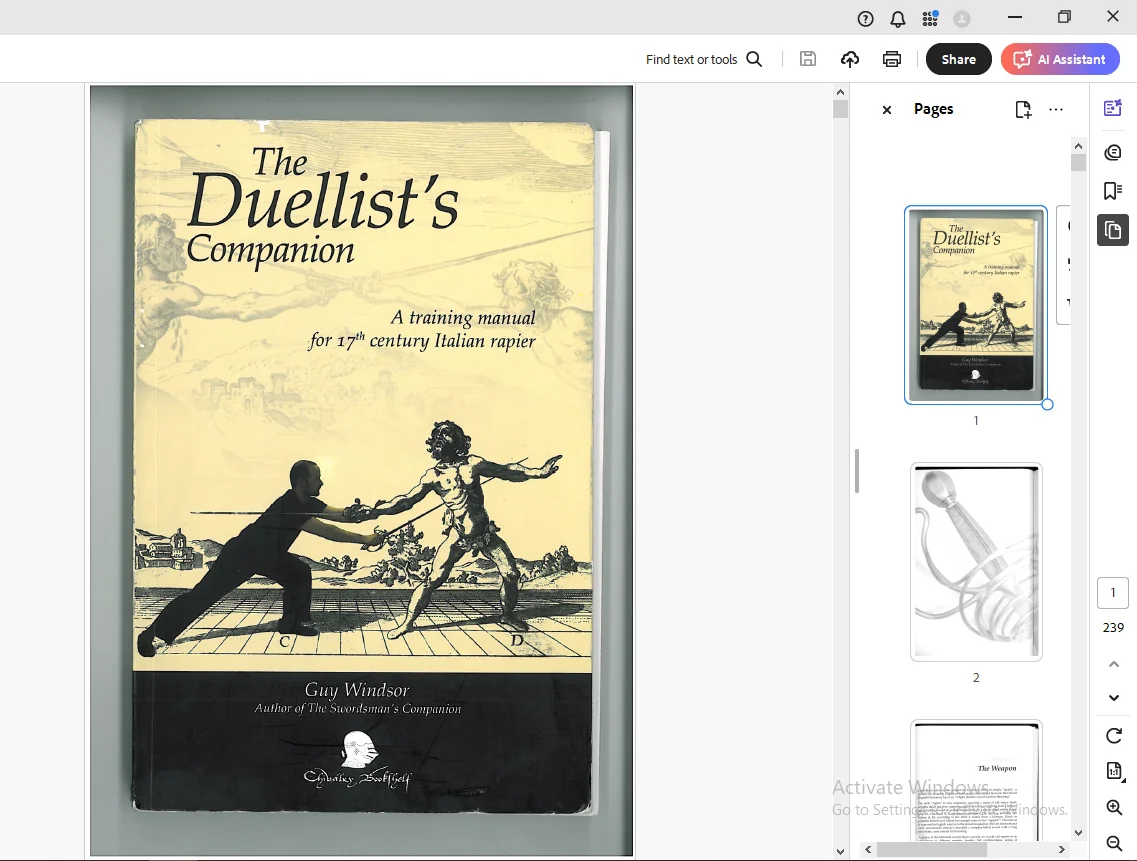
Windsor Guy Duellist’s Companion 17th Century Italian Rapier Training Manual – PDF
$28.95
Windsor Guy The Duellist’s Companion 17th Century Italian Rapier 2013 Training Manual – PDF DOWNLOAD
Instant PDF Download
Available immediately
Save to Your Device
Download & keep forever
Antivirus Scanned
100% virus-free
Trusted Worldwide
175,000+ customers
Description
Windsor Guy The Duellist’s Companion 17th Century Italian Rapier 2013 Training Manual – PDF DOWNLOAD
FILE DETAILS:
Windsor Guy The Duellist’s Companion 17th Century Italian Rapier 2013 Training Manual – PDF DOWNLOAD
Language : English
Pages : 239
Downloadable : Yes
File Type : PDF
IMAGES PREVIEW OF THE MANUAL:
DESCRIPTION:
Windsor Guy The Duellist’s Companion 17th Century Italian Rapier 2013 Training Manual – PDF DOWNLOAD
The Weapon:
- Capo Ferro refers to the weapon he is writing about as simply “spada”, a sword. It is certainly a rapier as most people understand the term: the Oxford English Dictionary has it as: “a light, slender sword used for thrusting”. The term “rapier” is very imprecise, covering a range of hilt styles, blade lengths, etc.
- It has been variously used to describe everything from a bronze- age thrusting sword (in archaeological texts) to a sports sabre with a funny grip (in a modern SCA equipment catalogue). The word is probably not Italian at all; according to the OED it comes from a German, Dutch or possibly French root.
- Meyer for example refers to the “rappier”. The term as it was used in English sources in the period in question (the late sixteenth and early seventeenth century) describes a complex-hilted sword with a long slim blade, used mainly for thrusting.
- A glance at the historical record shows swords we would call rapiers in an abundance of different weights, lengths, hilt configurations, points of balance, etc. For the sake of practicality, I will confine this chapter to the kind of swords that Capo Ferro’s method appears to be designed for, and take you though the main classifications that are part of the modern swordsman’s jargon. Further reading on this topic should include A.V.
- Norman’s The Rapier & Small-Sword 1460 to 1820, and Oakeshott’s European Weapons and Armour, from the Renaissance to the Industrial Revolution3. It may be so that the fundamental principles of swordsmanship found in Capo Ferro’s work can be applied to every sword type.
- However, it is vital to keep in mind the specific morphology of the weapon he was actually using and illustrates. As I see it, the hilt type that you choose matters much less than that the blade length, mass and point of balance be within the following parameters.
- In my opinion, Capo Ferro’s system works best with a sword that weighs between 900 and 1400 g (2.0-3.1 lb), with the point of balance between 6 and 15 cm (2.5-6 inches) in front of the crossguard, a complex hilt that allows you to put your forefinger over the crossguard safely, and a blade length from crossguard to point of at least 97 cm (38″) (for short people), up to a maximum of about 114 cm (45″). 9
G.B 05/04/25