
1998 Mazda 626 Workshop Manual FS KL Engine Chassis Service Repair
Original price was: $36.95.$22.95Current price is: $22.95.
1998 Mazda 626 workshop manual covering FS and KL engines, G25M-R manual and GF4A-EL/LA4A-EL automatic transaxles, OBD diagnosis, chassis, HVAC, restraints, and body electrical service procedures.
Description
1998 Mazda 626 Workshop Manual FS KL Engine Chassis Service Repair
This 1998 Mazda 626 Workshop Manual FS KL Engine Chassis Service Repair volume is the vehicle workshop book for 1998 626 models identified by VIN prefixes 1YV GF22C*W5 600001— and 1YV GF22D*W5 600001—. It walks a technician from how the book is organized through on-board diagnosis, mechanical service, driveline work, brakes, steering, HVAC, restraints, and body electrical repair. Related publications listed in the front matter include the 1998 626 Service Highlights (3311-10-97l), Engine Workshop Manual FS (1582-10-97l), Engine Workshop Manual KL (1583-10-97l), Manual Transaxle Workshop Manual G25M-R (1584-10-97l), Automatic Transaxle Workshop Manual GF4A-EL (1585-10-97l), Automatic Transaxle Workshop Manual LA4A-EL (1586-10-97l), and 1998 626 Wiring Diagram (5410-10-97l).
File Details
- Manual type: Workshop Manual
- Brand / model: Mazda 626 (1998)
- Language: English
- Page count: 1282
- File format: PDF
- VIN range shown: 1YV GF22C*W5 600001— / 1YV GF22D*W5 600001—
What This Workshop Book Is Built To Do
Section 00-00 explains how procedures are split into removal/installation, disassembly/assembly, replacement, inspection, and adjustment. Overview illustrations call out expendable parts, tightening torques, grease and sealant points, and special service tools. Advisory text is labeled Warning, Caution, Note, Specification, or Upper and Lower Limits. Troubleshooting is laid out as on-board diagnosis, engine tune-up in section 01, basic inspection in section 05, diagnostic index, quick diagnosis charts, then symptom troubleshooting. SAE-style names such as PCM, MAF, HO2S, TCC, and MIL are used throughout so scan-tool screens match the printed steps.
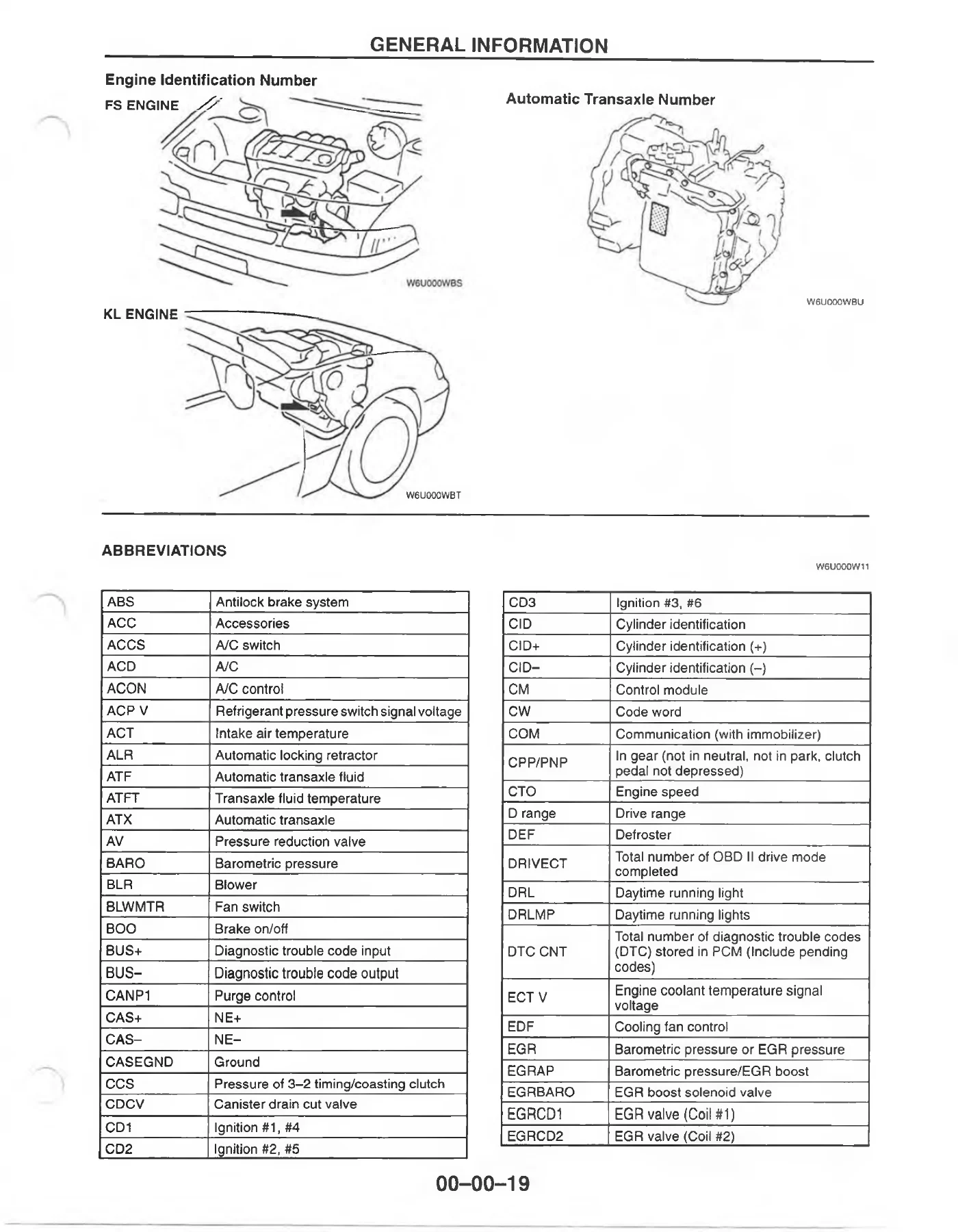
Fundamental shop rules are written in the same section: cover fenders and interiors, disconnect the negative battery cable and wait more than one minute so the SAS unit backup supply can deplete, plug open ports, replace oil seals, gaskets, O-rings, lockwashers, cotter pins, and nylon nuts, and recalculate torque when an SST extends a wrench. Jacking is specified at the center of the front or rear crossmember. Vehicle lifts and rigid racks go on the side sills. Towing notes require wheel-lift or flatbed equipment, front wheels off the ground when possible, and no sling-type pickup. Identification plates for VIN, chassis number, FS and KL engine numbers, and automatic transaxle number are mapped.
Engines, Transaxles, and Powertrain Control
The 1998 Mazda 626 Workshop Manual FS KL Engine Chassis Service Repair text treats two engine families separately. FS work lives in 01-01A, 01-10A, 01-13A, and 01-40A. KL work lives in 01-01B, 01-10B, 01-13B, and 01-40B. Shared systems cover lubrication, cooling, fuel, exhaust, emission, charging, ignition, starting, and cruise control. Transaxle coverage is split the same way: clutch and G25M-R manual unit in 05-10 / 05-15 / 05-16, LA4A-EL automatic diagnosis and overhaul in 05-01A / 05-17A, and GF4A-EL automatic diagnosis and overhaul in 05-01B / 05-17B.
On-board diagnosis uses the New Generation Star (NGS) tester on the data link connector. Tests include Key On Engine Off (KOEO), Key On Engine Running (KOER), continuous memory DTCs, PID/DATA monitor and record, output test mode, oxygen sensor monitoring results, and an OBD II drive mode. The drive cycle for FS vehicles specifies acceleration to 65 km/h {40 mph} within 20 seconds, a 56—73 km/h {35—45 mph} cruise for 340 seconds, then a higher-speed segment of 80—93 km/h {50—58 mph} for FS MTX or 80—96 km/h {50—60 mph} for FS ATX. KOER requires cycling the brake on/off switch, O/D OFF or HOLD switch, and power steering pressure switch so those circuits are proven during the running self-test.
DTC charts for engine control list circuits such as MAF, EGR boost, IAT, ECT, TP, heated oxygen sensors, adaptive fuel, fuel pump, misfire, ignition engine speed, knock, CMP, EGR flow, catalyst efficiency, evaporative leaks and vent control, VSS, IAC, PCM KAM/ROM, clutch or brake switches, immobilizer codes, cooling and condenser fans, and automatic transaxle solenoids that cross-reference into section 05. Symptom charts then chase no-crank, no-start, stall, rough idle, lack of power, knock, poor fuel economy, overheating, exhaust smoke, fuel odor, vibration, A/C always on, and fuel-fill issues with PID checks, fuel-pressure tests, spark tests, and compression references.
Chapters Covered
- 00-00 General Information — how to use the manual, units and SAE names, fundamental procedures, electrical handling, jacking and lift points, towing, identification numbers, abbreviations, pre-delivery inspection, scheduled maintenance
- 01-01A Troubleshooting [Engine Control FS] — OBD tests, DTC tables, pinpoint tests, engine symptom troubleshooting, diagnostic inspections
- 01-01B Troubleshooting [Engine Control KL] — OBD tests, DTC tables, pinpoint tests, engine symptom troubleshooting for the KL control system
- 01-01C Troubleshooting [Cruise Control System]
- 01-10A Mechanical [FS] — drive belt, valve clearance, compression, timing belt, cylinder head, oil seals, engine R&I, tune-up
- 01-10B Mechanical [KL] — drive belt, valve clearance, compression, timing belt, cylinder head, oil seals, engine R&I, tune-up
- 01-11 Lubrication System — oil level and replacement, filter, oil pressure, oil pan
- 01-12 Cooling System — coolant service, radiator, water pump, fans
- 01-13A / 01-13B Intake-Air System [FS] / [KL]
- 01-14 Fuel System — pressure release, pump, injectors, lines, pressure regulator
- 01-15 Exhaust System
- 01-16 Emission System — EGR, EVAP, PCV-related components
- 01-17 Charging System — battery and generator
- 01-18 Ignition System
- 01-19 Starting System
- 01-20 Cruise Control System
- 01-40A / 01-40B Control System [FS] / [KL] — PCM terminals, PIDs, MAF, TP, ECT, HO2S, PSP switch
- 01-50 Technical Data / 01-60 Special Tools
- 02 Suspension — alignment values, coil springs, links, engine mount member interface
- 03 Driveline / Axle — drive shafts, joint shaft, wheel hubs and bearings
- 04 Brakes and ABS/TCS — hydraulic service, parking brake, ABS hydraulic unit, traction control on-board diagnosis
- 05-01A / 05-01B Automatic transaxle troubleshooting [LA4A-EL] / [GF4A-EL]
- 05-10 Clutch / 05-15 Manual Transaxle / 05-16 Manual Shift Mechanism
- 05-17A / 05-17B Automatic Transaxle [LA4A-EL] / [GF4A-EL] — line pressure, stall, time lag, road test, ATF service, tester use, R&I
- 05-18 Automatic Transaxle Shift Mechanism / 05-50 Technical Data / 05-60 Service Tools
- 06 Steering — engine-speed-sensing power steering, pump and gear pressure tests, gear R&I
- 07 HVAC — A/C symptom diagnosis, refrigerant system, heater unit, control actuators
- 08 Restraints — air bag on-board diagnosis, SAS unit, modules, seat belts
- 09 Body Electrical — immobilizer reprogram, instrument cluster, lights, wipers, audio, interior trim, doors and lids
- Alphabetical Index
Taken together, those divisions give in-vehicle diagnosis plus the mechanical steps needed to replace belts, heads, engines, transaxles, hubs, brake units, steering gears, HVAC components, air bags, and body electrical assemblies without guessing torque or test limits.
Scheduled Maintenance and Pre-Delivery Checks
Pre-delivery inspection covers exterior fit, wheel lug torque 89—117 N·m {9—12 kgf·m, 66—86 ft·lbf}, fluid levels, battery terminals, clutch pedal height 196—204 mm {7.72—8.03 in} with carpet and free play 5.0—14.0 mm {0.20—0.55 in}, parking brake 5—7 notches at 98 N {10 kgf, 22 lbf}, idle-up, ignition timing, and a road test. Scheduled maintenance tables for except-Canada and Canada list valve clearance, drive belts, timing belt replacement (including the Canada note that the belt is required every 96,000 km {60,000 miles}), engine oil and filter, spark plugs separately for FS and KL, idle speed, fuel filter, coolant, brakes, steering, ball joints, driveshaft boots, ATF and manual/automatic transaxle oil, and A/C refrigerant and compressor checks. Unique-driving and Puerto Rico oil intervals are called out where they differ from the normal schedule.
Mechanical Limits a Shop Will Actually Use
Section 01-50 publishes the numbers used after a repair. Cold valve clearance is 0.225—0.295 mm {0.0089—0.0116 in} intake and exhaust on FS, and 0.245—0.315 mm {0.0097—0.0124 in} intake / 0.265—0.335 mm {0.0105—0.0131 in} exhaust on KL. Compression standard is 1177 kPa {12.0 kgf/cm², 171 psi} at 300 rpm on FS and 1393 kPa {14.2 kgf/cm², 202 psi} at 250 rpm on KL, with a 196 kPa {2.0 kgf/cm², 28 psi} maximum cylinder-to-cylinder spread. Idle speed windows are 550—850 rpm (FS MTX), 500—800 rpm (FS ATX), and 550—750 rpm (KL). Ignition timing is 6—18° BTDC in the FS idle band and 4—16° BTDC at 550—750 rpm on KL.
IMAGES PREVIEW
Oil pressure at 3000 rpm is 393—490 kPa {4.0—5.0 kgf/cm², 57—71 psi} on FS and 334—490 kPa {3.4—5.0 kgf/cm², 49—71 psi} on KL. Dry-engine oil capacity is 3.7 L {3.9 US qt, 3.3 Imp qt} on FS and 4.9 L {5.2 US qt, 4.3 Imp qt} on KL. Specified oil is API SG (Energy Conserving II), SH (Energy Conserving II), SJ or ILSAC GF-I / GF-II, SAE 10W-30 above -25 °C {-13 °F} and SAE 5W-30 below 0 °C {32 °F}. Coolant capacity is 7.5 L {7.9 US qt, 6.6 Imp qt}. Fuel line pressure with the PRC solenoid off is 260—320 kPa {2.6—3.3 kgf/cm², 37—46 psi} on FS and 270—310 kPa {2.7—3.2 kgf/cm², 39—45 psi} on KL. Power steering pump and gear housing pressure is 7.9—8.3 MPa {80—85 kgf/cm², 1138—1208 psi} on FS and 8.4—8.8 MPa {85—90 kgf/cm², 1209—1279 psi} on KL. HVAC data specifies R-134a at 750 g {26.5 oz} with SP-20 compressor oil.
Chassis, Brakes, Steering, and Safety Systems
Suspension and axle chapters give alignment inspection conditions (unloaded vehicle with fluids at spec), coil-spring compression with SSTs, lower-arm and trailing-link R&I, and drive-shaft length standards split by FS and KL left/right sides. Brake service includes pedal height and clearance, power-brake vacuum tests at 66.7 kPa {500 mmHg, 19.7 inHg}, parking-brake stroke 6—8 notches, and ABS/TCS on-board diagnosis with NGS active command modes for motor relay, solenoids, and desired engine torque. Traction-control notes explain TCS OFF lamp behavior when coolant is below 0 °C {32 °F}.
Engine-speed-sensing power steering covers air bleeding with ATF M-III or equivalent (e.g. Dexron®II), oil-pump and gear-housing pressure tests, and gear removal using an engine support. HVAC troubleshooting starts from “system will not work at all” and runs through mode doors, blower, refrigerant performance, and pressure checks with the engine held at 1,500 rpm. Restraints diagnosis uses SAS warning-light flash codes for connector, SAS unit, battery, driver module, and passenger module faults, plus deployment authorization, deployment, and disposal procedures. Immobilizer service documents key ID and code-word reprogramming after unit or steering-lock replacement so a registered key will continue to run the engine.
Special Tools Called Out in the Book
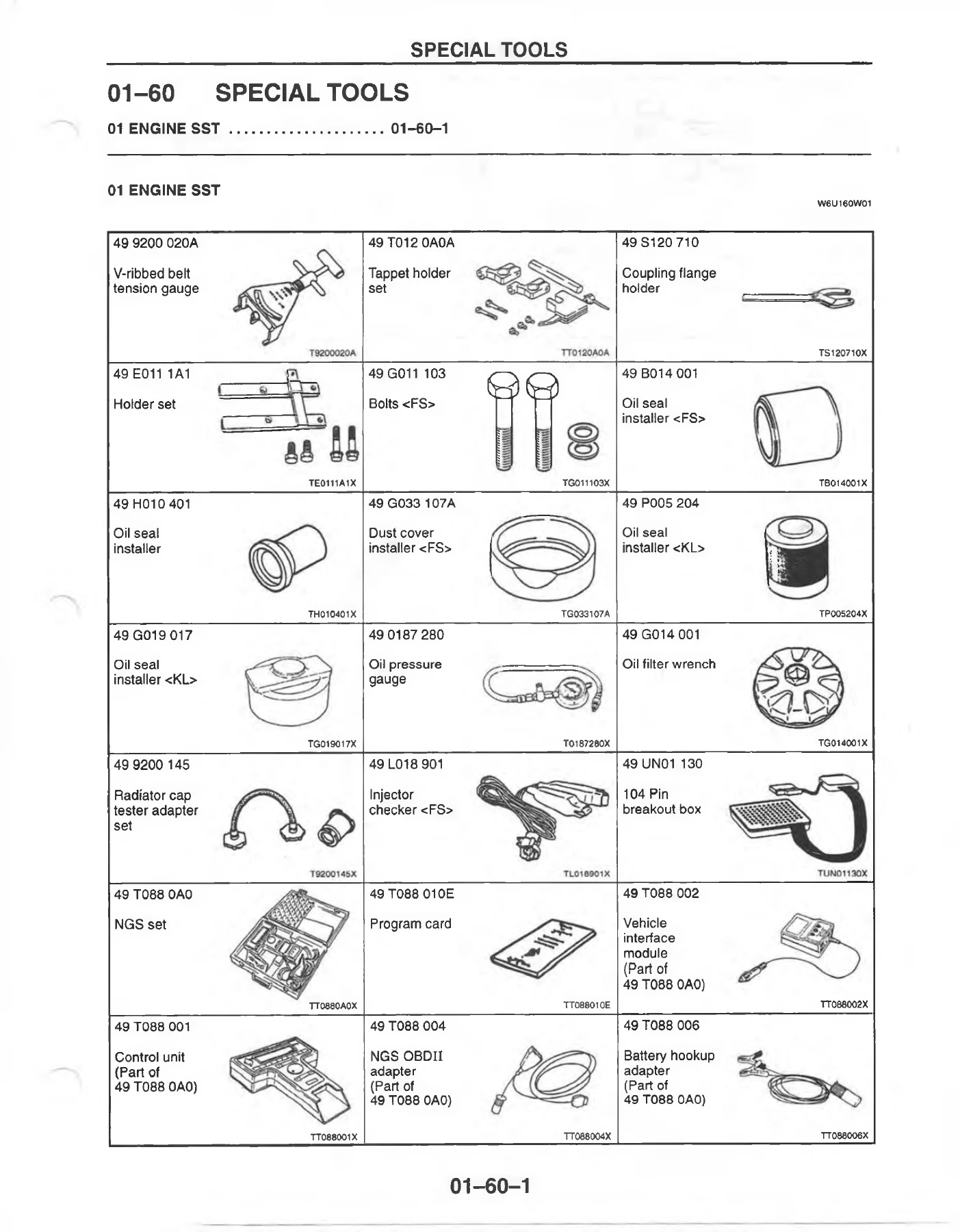
Illustrated SST lists include the NGS set 49 T088 0A0 with program card 49 T088 010E, 104-pin breakout box 49 UN01 130, oil seal installers for FS and KL, oil pressure gauge, injector checkers, compression gauge, radiator-cap tester adapter, V-ribbed belt tension gauge, power-steering gauge set 49 1232 670A, ball-joint puller 49 T028 3A0, and engine support 49 G017 5A0. Those tool numbers appear beside the steps that require them rather than as a detached catalog.
Get the Manual and Start the Job
With the 1998 Mazda 626 Workshop Manual FS KL Engine Chassis Service Repair on the bench, a technician can pull DTCs on FS or KL powertrain control, confirm a repair with KOEO/KOER and the published OBD II drive mode, set valve clearance and ignition timing to the 01-50 tables, change a timing belt or cylinder head, pressure-test LA4A-EL or GF4A-EL, R&I a G25M-R manual transaxle, bleed ABS or power steering, charge R-134a, and service SAS air bags without mixing FS and KL specifications. Using the printed torque, pressure, and clearance limits matters on this car because FS and KL idle windows, fuel pressures, oil capacities, and steering-pump pressures are not interchangeable. After payment the file is delivered instantly as a PDF you can open on any device and print the pages needed for the bay.
Reviews
There are no reviews yet.