
ABX Pentra 60C+ Technical Manual RAA021B Hematology Analyzer Service Guide
Original price was: $36.95.$20.95Current price is: $20.95.
ABX Diagnostics Pentra 60 C+ technical manual P/n RAA021B (revision B, 15/02/2004, software V2.2.9). Service-level coverage of specifications, hydraulics, electronics, analysis-cycle technology, maintenance kits, adjustment procedures, exploded views, and spare parts for the ABX PENTRA 60 C+ CBC and 5DIFF hematology analyzer.
Description
ABX Pentra 60C+ Technical Manual RAA021B Hematology Analyzer Service Guide
This ABX Diagnostics publication is the instrument technical manual for the ABX PENTRA 60 C+ fully automated hematology analyzer. Printed as P/n RAA021B, revision index B dated 15/02/2004, it matches software revision V2.2.9 (technical note RAN038A / RAN015A). The book is written for trained laboratory and field technicians who install, adjust, maintain, and repair the analyzer and its connected workstation, not as a substitute for the separate operator user manual used for daily rinsing.
The ABX PENTRA 60 C+ runs whole-blood testing in CBC mode (12 parameters) or CBC + 5DIFF mode (26 parameters) at 60 analyses per hour. Measurement methods documented here include impedance for WBC, Plt, RBC and BASO; photometry for Hgb; and combined impedance plus light scattering for LYM, MON, NEU, EOS, ALY and LIC. Computed indices include Hct, MCV, MCH, MCHC, RDW, MPV, Pct and PDW.
File Details
- Manual type: Technical manual (service, hydraulics, electronics, maintenance procedures)
- Brand / model: ABX Diagnostics / HORIBA Group — ABX PENTRA 60 C+ (Pentra 60C+)
- Language: English
- Page count: 314
- File format: PDF
- Document number: RAA021B
- Revision: Index B, 15/02/2004; software V2.2.9
- Prior issue: Index A, RAH801A, software V1.61, 14/04/2001
What the Analyzer Is Specified To Do
The specifications section of the ABX Pentra 60C+ Technical Manual RAA021B Hematology Analyzer Service Guide lists CBC parameters (WBC, RBC, Hgb, Hct, MCV, MCH, MCHC, RDW, Plt, PDW, MPV, Pct) and the additional 5DIFF populations (LYM, MON, NEU, EOS, BAS plus research-only LIC and ALY flags in some markets). Unit sets include STD, SI, mmol/l and JAPAN conventions.
Physical data printed in the manual includes 100–240 Vac ±10%, 50–60 Hz supply; analyzer plus computer consumption of 400 VA; analyzer dimensions of approximately 516 × 444 × 481 mm and about 35 kg; operating room temperature 16–34 °C; and minimum specimen volumes of 30 µl (CBC) and 53 µl (CBC + 5DIFF). Dilution ratios are 1/200 (WBC/BASO), 1/80 (LMNE), 1/10 000 (RBC/Plt) and 1/250 (Hgb). Counting apertures are 80 µm (WBC/BASO), 60 µm (LMNE) and 50 µm (RBC/Plt). Hemoglobin uses a modified Drabkin (cyanmethemoglobin) method with an electroluminescent diode at 550 nm ± 10 nm.
Reagents named for correct operation are ABX DILUENT (20 litres), integrated ABX CLEANER, ABX EOSINOFIX, ABX BASOLYSE II, and ABX ALPHALYSE or BIOLYSE. Consumption tables give millilitres used on CBC, 5DIFF, startup, shutdown, individual primes, autoclean and autocontrol cycles. Performance tables cover reproducibility on ABX MINOTROL controls, repeatability CVs, linearity ranges and limits, carry-over claims under 2.0% for WBC, RBC, HGB and PLT, published normal-range examples, and flags that force a DIL or “D” result when values leave the visible range.
IMAGES PREVIEW
Known limitations recorded in the book
Chapter 5 lists interfering conditions that can distort automated impedance and absorbance counts: unlysed red cells and L1 flags, multiple myeloma protein precipitation, fragile leukocytes in leukemia or chemotherapy, cryoglobulins (warm to 37 °C for 30 minutes), cold agglutinins, turbidity from high WBC or lipids affecting Hgb, giant platelets, platelet clumps, EDTA swelling of MPV, and matrix shifts that move cells into ALY or LIC zones. Those notes matter when a technician is deciding whether a hardware fault or a specimen phenomenon is driving an alarm.
Chapters Covered
- Introduction — warnings and precautions; limited guarantee conditions; electronic and moving-part safety; biological risks; external and internal cleaning; graphics and symbols; working conditions (environment, location, grounding, humidity/temperature, EMC, disposal, transport/storage)
- Specifications — technical parameters and units; throughput; tube identification; reagents; workstation computer minimums; measurement methods; physical specs; dilution ratios; Hgb optics; aperture diameters; reagent consumption; precision, linearity, carry-over, normal ranges, accuracy; flags; reagent and waste notes; limitations
- Hydraulic & Pneumatic Principles — hydropneumatic connection tables (length/diameter/from-to); function of valves 1–32; valve-block locations; full hydropneumatic diagram
- Electric & Electronic Principles — main-board test points TP1–TP61 with targets and tolerances; potentiometers; boards XAA 425 C, XAA 423 B, XAA 427 B, XAA 428 C, XAA 429 A; connectors XBA 386 A through XDA 605 AS; electrical synoptic
- Analysis Cycle Technology — cycle description with MDSS multi-distribution sampling; RBC/Plt impedance; Hgb photometry; Hct, RDW, MCV/MCH/MCHC, MPV, Pct, PDW; WBC/BASO count; LMNE matrix and DHSS double hydrodynamic sleeving
- Software Versions — service-software overview (mechanical, hydraulic, technician adjustment/measurement, burn-in, RS232); release table V1.61 / V2.2.9
- Output Format — pointer to separate document RAA024
- Alarms & Error List — transmission, database, worklist, calibration, technical operations, printer messages
- Maintenance — daily/weekly customer tasks; cycle-based kit schedule; kits XEA710BS, XEA486BS, XEA630CS, XEA311, XEA293 AS; RAS procedure chart (RAS290–RAS320)
- Training slides section
- Exploded views — valve assemblies and related mechanical drawings
- Spare part list — designations and packaging notes
Taken as a whole, the document gives a bench technician the hydraulic map, electrical test values, analysis-cycle volumes, kit part numbers, color-coded RAS procedures, and exploded drawings needed to keep a PENTRA 60 C+ counting correctly after syringe, probe, flowcell, lamp, heater or power-supply work.
Hydraulics, Valves and Pneumatic Layout
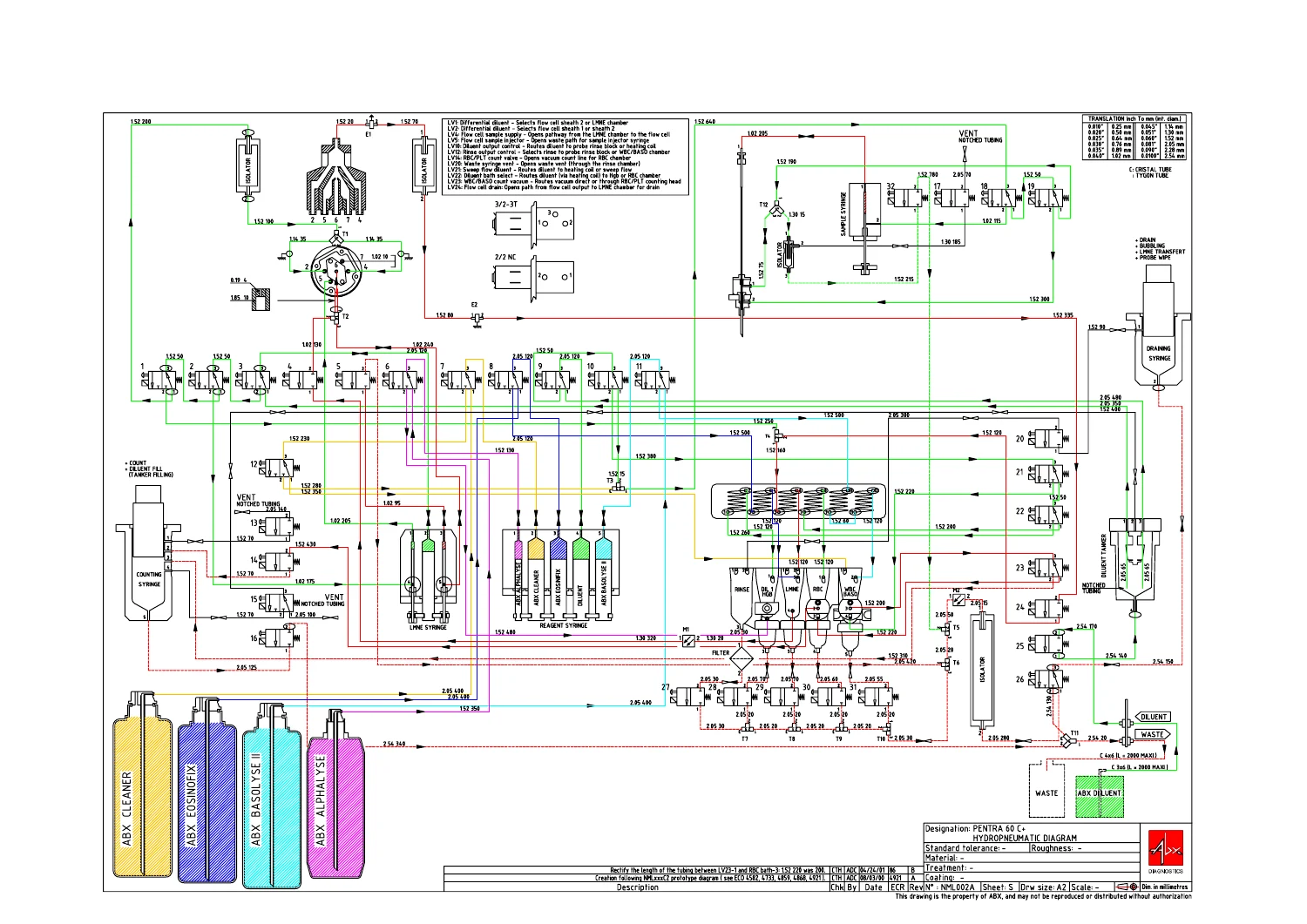
Hydropneumatic tables trace every line from ABX CLEANER, EOSINOFIX, BASOLYSE II, ALPHALYSE and diluent bottles through diluter, injector, sampling, counting and draining syringes to the Baso/WBC, LMNE, RBC and DIL1/HGB chambers, isolators, photocells and waste. Length and diameter columns let a tech cut replacement tubing to the printed sizes instead of guessing.
Thirty-two valves are identified by subject (DIL LMNE, LYSE, CLEANER, EOSINOFIX, BASOLYSE II, counting syringe, tank, needle, chamber-group drain, diluent tank). Five physical blocks are photographed: valves 1–11 above the reagent and injection syringes; 12–16 beside the counting syringe; 17–19 and 32 on the sampling carriage; 20–26 beside the draining syringe; 27–31 on top of the blending and count chambers. The facing hydropneumatic diagram labels reagent bottles, syringes, chambers, vents and waste in one sheet.
Electronics, Test Points and Boards
The electric section of this ABX Pentra 60C+ Technical Manual RAA021B Hematology Analyzer Service Guide is built around main board XAA 425 C. Test-point tables give targets such as Hgb blank 4.7 V ± 0.05 V (TP1/R248), PLT / RBC / BASO thresholds at 300 mV ± 5 mV, LMNE CIS 650 mV and OD 350 mV, syringe-motor voltages from 2 V to 4.8 V, supplies at +5 V / +12 V / +24 V / −12 V, LMNE lamp 6 V, and factory-adjusted pulse-reject windows in microseconds. Companion potentiometer tables map each trimmer to its test point.
Satellite boards are described with layout drawings: optical preamplifier XAA 423 B (photodiode intensity-to-voltage for absorbance), motor-relay XAA 427 B, carriage XAA 428 C, and front-panel LED board XAA 429 A (red busy / green ready). Connector drawings cover chamber heating XBA 386 A, reagent heating coil XBA 387 A, horizontal carriage motor, upper fan, IR sensors, RBC/WBC and LMNE flowcell coaxials, barcode-reader cable and diluent level sensor. The electrical synoptic ties power module, master board, motors, sensors, barcode reader and workstation together on one sheet.
Analysis Cycle, MDSS and LMNE Matrix
Cycle photos walk the sampling carriage from cap pierce through rinse, DIL1, WBC/BASO and LMNE chambers. CBC + 5DIFF aspiration is 53 µl. Tangential-flow distribution (ABX MDSS patent) splits unused leading/trailing segments from a 10 µl RBC/Hgb aliquot, a 10 µl BASO/WBC aliquot (1/200 in 2 ml BASOLYSE II) and a 25 µl LMNE aliquot (final 1/80 in Eosinofix plus diluent). Secondary RBC/Plt dilution reaches 1/10 000 through a 50 µm aperture at 200 mb for two 5-second counts at 35 °C. Hgb uses 400 µl ALPHALYSE at 550 nm. WBC/BASO uses an 80 µm ruby for two 6-second counts. LMNE uses DHSS hydrofocus through a 60 µm ruby and 42 µm flow for a 12-second, 72 µl injection, plotting volume versus absorbance so neutrophils, eosinophils, lymphocytes, monocytes, ALY and LIC separate on the matrix.
Service Software, Alarms and RAS Procedures
Service menus cover motor and valve checks, sampling-needle and carriage-position adjustment, drain/rinse/prime cycles, vacuum and heating-coil adjustment, gain / LMNE calibration / pulse work, burn-in, and RS232 service mode. Workstation alarms are grouped as RS232 transmission faults, database write and backup errors, worklist ID conflicts, calibration coefficient out of range, technical values outside limits, and printer messages.
Maintenance is scheduled from daily/weekly wipe-down up through kits keyed to cycles per day: XEA710BS (RAS307, six-month O-rings on probe, reagent syringe and vacuum/waste pump), XEA486BS (RAS308, yearly lamp DAJ007A, LMNE coaxial, counting-head joints, diluent-reservoir washer), and XEA630CS (RAS309, two-year probe/guide and pistons). Fitting kit XEA311 and screw kit XEA293 AS list the common pneumatic fittings and CHC/FHC hardware. Color-coded RAS sheets then detail probe home (about 1 mm past the percutor), installation and priming, post-work repeatability/calibration (RAS299), LMNE balance and flowcell alignment, chamber alignment, main-board thresholds and motor currents, vacuum and bubbling, optical-bench lamp alignment, barcode configuration, power-supply replacement with TP40–TP43 checks, and heater-assy tube cut lengths.
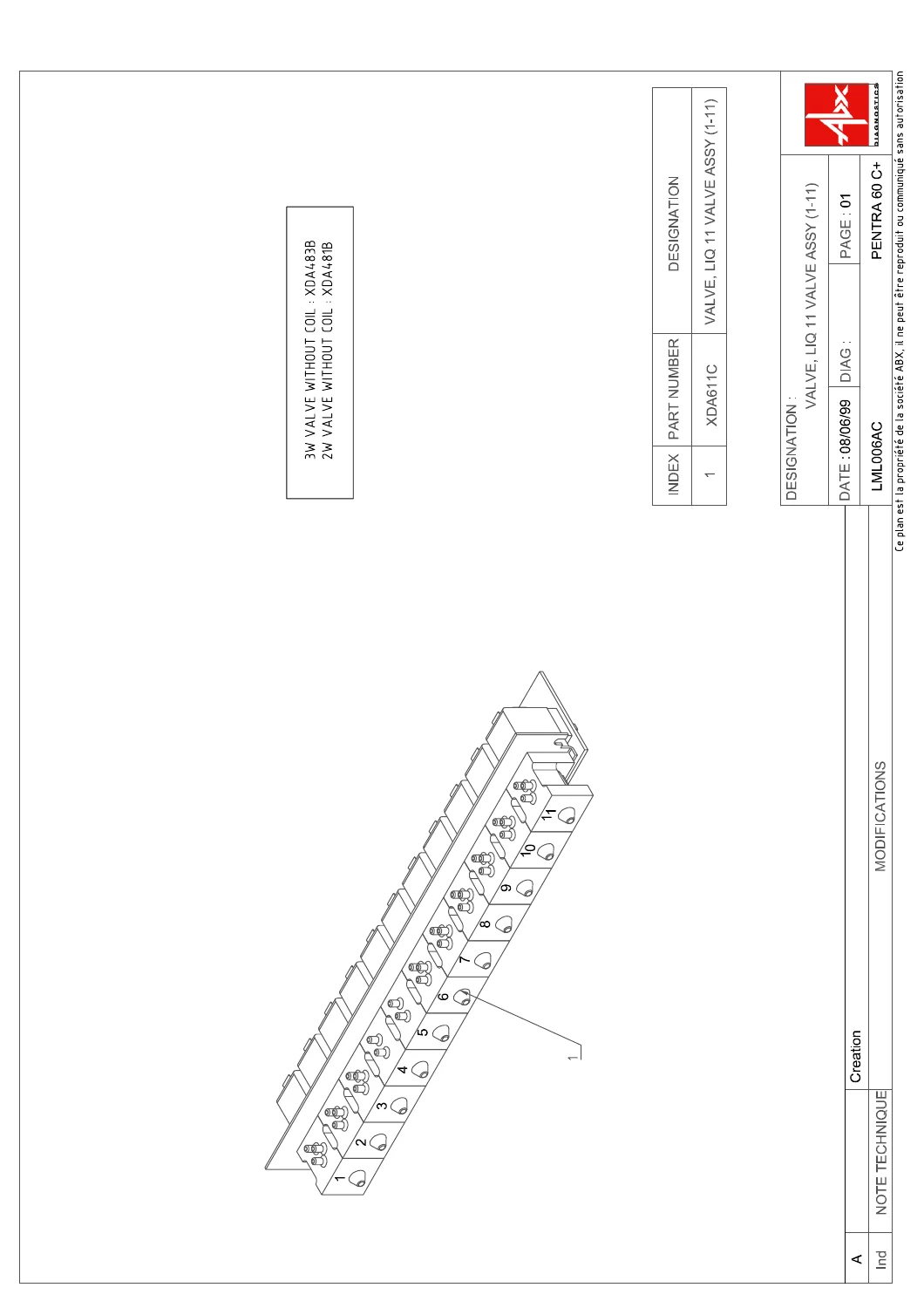
Exploded drawings at the back identify valve-block assemblies (for example LIQ 11 valve assy XDA611C and related LIQ 4 / LIQ 5 / LIQ 7 blocks) so a technician can match a physical manifold to a part number before ordering from the spare-part list.
Use This Manual On the Bench
The ABX Pentra 60C+ Technical Manual RAA021B Hematology Analyzer Service Guide supports installation and reagent priming, hydraulic leak tracing, valve and syringe rebuilds from the printed kit lists, optical-bench and LMNE matrix adjustments, main-board voltage and threshold setting, vacuum and temperature checks, decontamination before shipping, power-supply and heater replacement, and identification of exploded assemblies and spare parts. Following the printed volumes, torques (for example 400 mN·m on many M3 syringe screws and 120 mN·m on rinsing-block screws), test-point windows and RAS sequence is what keeps counts inside the linearity and CV claims listed in the specifications chapter.
Download the PDF immediately after purchase. There is no physical shipment. Open it on a workshop PC, laptop or tablet and print the RAS sheet or diagram you need for the current job.
Reviews
There are no reviews yet.