
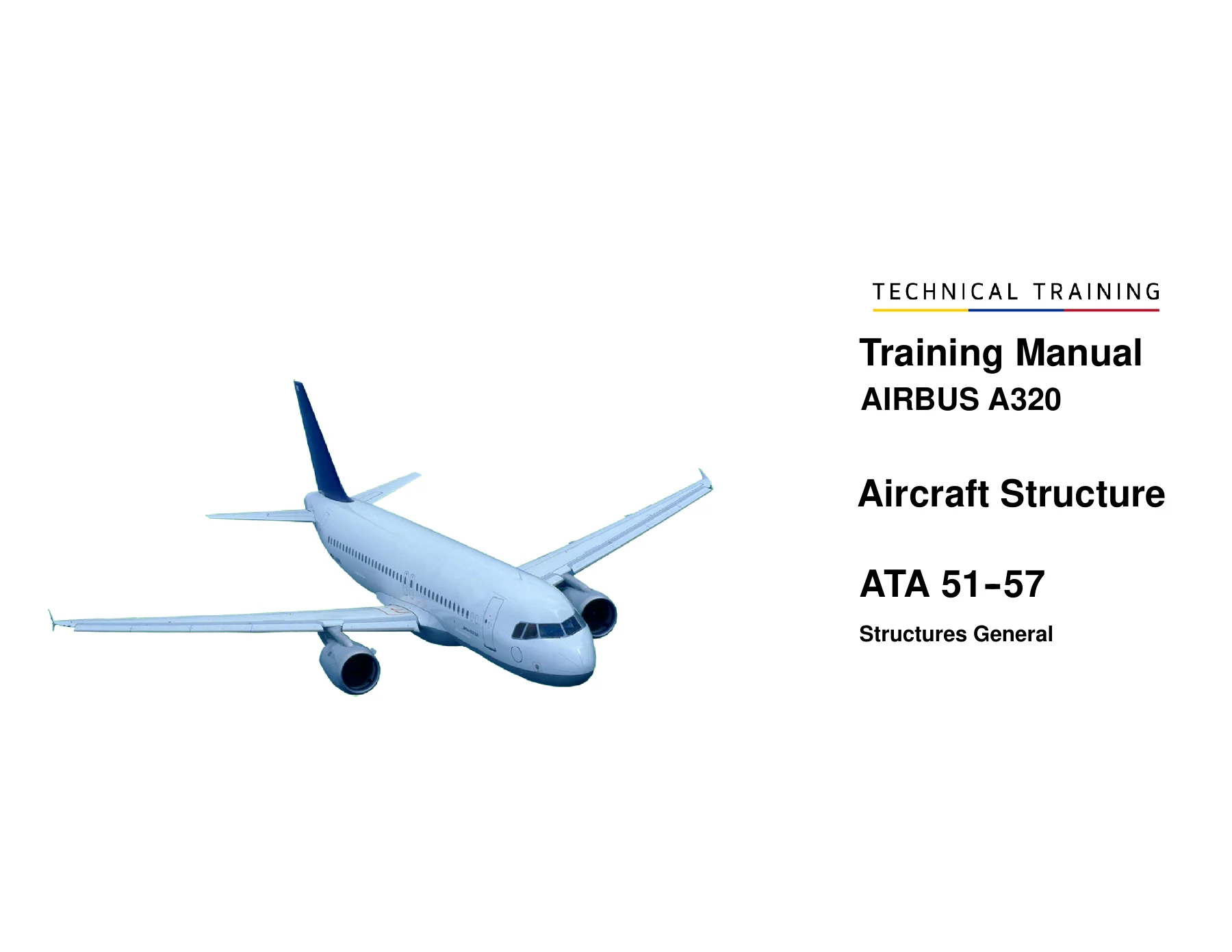
Airbus A319 A320 A321 Aircraft Structure Training Manual ATA 51-57
Original price was: $39.95.$24.95Current price is: $24.95.
Complete ATA 51-57 structure training manual for the Airbus A319, A320, and A321. Covers structural design, doors, fuselage sections, nacelles and pylons, stabilizers, windows, wings, composite and metallic materials, corrosion prevention, and full Structural Repair Manual usage.
Description
Airbus A319 A320 A321 Aircraft Structure Training Manual – ATA 51-57
This Airbus A320 family aircraft structure training manual works through ATA chapters 51 to 57, giving maintenance technicians, engineers, and aviation students a detailed picture of how the A319, A320, and A321 are built and how their structure is repaired. It opens with structural classification and design fundamentals, moves through every major airframe assembly – doors, fuselage sections, nacelles and pylons, stabilizers, windows, and wings – and closes with a thorough walkthrough of the Airbus Structural Repair Manual, including allowable damage limits, repair categories, effectivity by weight variant, and MSN-level configuration.
File Details
- Manual type: Aircraft structure training manual
- Brand / model: Airbus A319 / A320 / A321
- ATA chapters: 51-57
- Language: English
- Page count: 310
- File format: PDF
Chapters Covered
- ATA 51 – Structures General: primary and secondary structure, principal structural elements, monocoque and semi-monocoque construction, composite structure types (sandwich and solid laminate), forging and casting, extruded forms, formed sections, taper, blend-out, cut-out, frame bay and stringer bay, Alclad and Pureclad, chemical milling, dress-out, butt and lap joints, fasteners (rivets, special, blind), mechanical requirements, safe-life and fail-safe design, repair classification, repair categories, repair design patches, aerodynamic smoothness
- ATA 52 – Doors: passenger doors, emergency exits (A319, A320, A321), cargo compartment doors, bulk cargo door, main and nose landing gear doors, access and service doors
- ATA 53 – Fuselage: general description, section 11/12 nose fuselage, section 13/14 forward fuselage, section 14A (A321 only), section 15 center fuselage, keel beam, section 16A (A321 only), section 16/17 aft fuselage, section 18 rear fuselage, section 19 tailcone, radome (Isovolta Evolution 3), fin and tailplane attachment structure
- ATA 54 – Nacelles/Pylons: pylon primary structure, pylon secondary structure, engine-to-pylon attachment, nacelles, pylon-to-wing attachment
- ATA 55 – Stabilizers: horizontal stabilizer main box, leading edge, trailing edge and tip; elevator; vertical stabilizer main box, removable leading edge, rear shroud and tip; rudder
- ATA 56 – Windows: cabin windows (frames, panes, vent hole), flight deck windshields (frames, panes)
- ATA 57 – Wings: center wing box, wing root joint (upper cruciform fitting, lower T and fail-safe butt strap), external wing box, spars, skins, wing skin joints, ribs, main landing gear attachment structure, fixed leading edge, fixed trailing edge, wing tip and tip fence, sharklets (structural configuration), slats, spoilers/airbrakes, aileron, flaps (A319/A320 and A321)
- Corrosion Prevention: general principles, protective treatment areas (Zone A, B, C), temporary protections
- SRM Usage: manual front matter, regular revisions, alphanumerical index, airplane effectivity designations, effectivity by weight variant, numbering system, page block allocation, identification page block (metallic and composite), allowable damage page block, repair page block, recordable concessions, damage assessment and evaluation examples
Across roughly 310 pages, the manual builds from structure theory into component-level detail for the entire A319/A320/A321 airframe. The ATA 51 chapter alone covers everything from how a semi-monocoque fuselage breathes under pressurization to how a blend-out removes stress risers after damage. From there, each subsequent chapter drills into a specific structural assembly – the seven door stops that transfer cabin pressure on a passenger door, the chemical milling that thins fuselage skin panels, the cruciform fitting that joins the upper wing skin to the center box, the composite construction of the fin main box and rudder. The SRM section at the end ties it all together, showing how an operator identifies damage, checks it against allowable limits, determines whether a repair task exists, and reports back to Airbus when it does not.
What the structure manual covers in practice
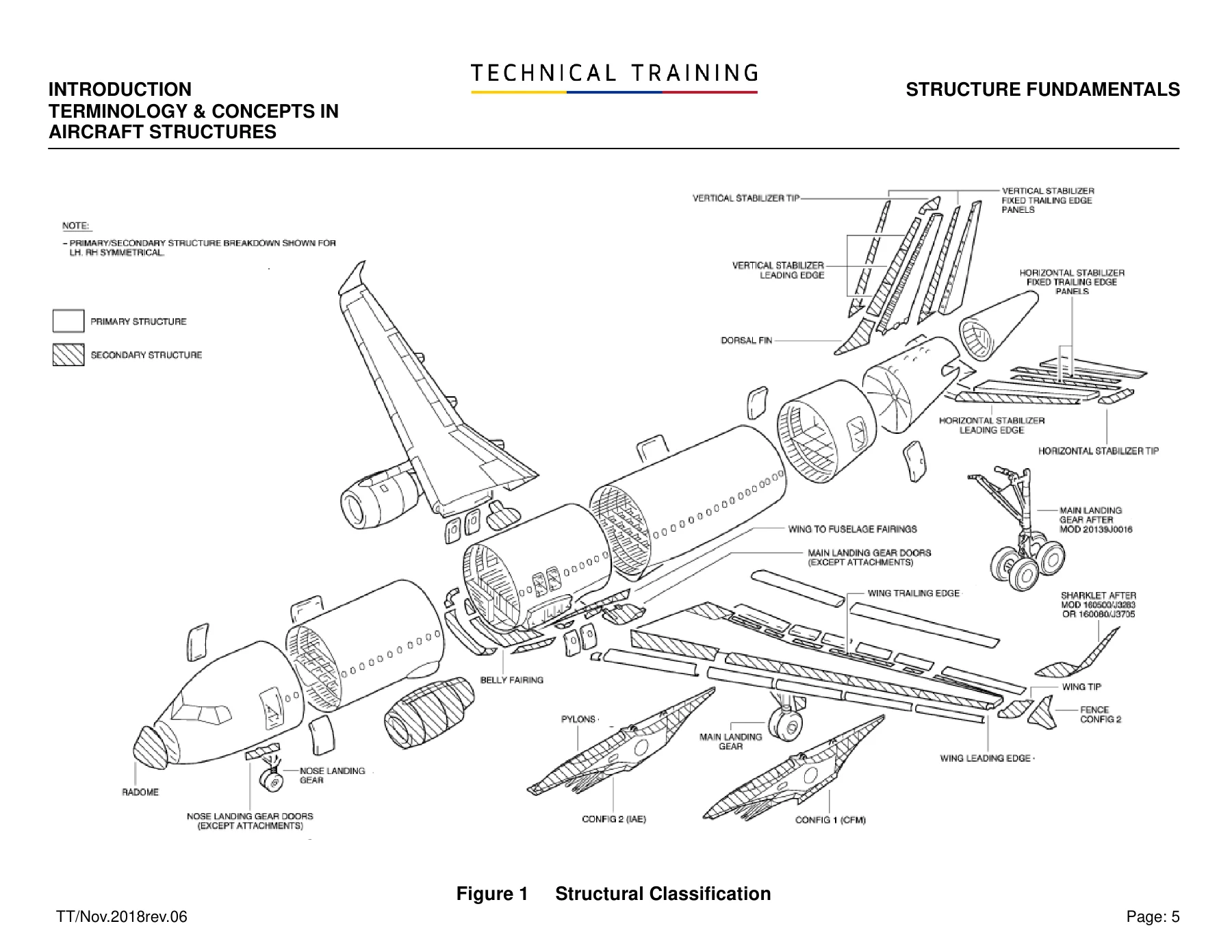
The early chapters establish the vocabulary and design logic a technician needs before touching a repair. Structural classification separates primary structure – anything essential to airworthiness, including the pressurized fuselage cavity, door and window frames, wing interspar area, stabilizer interspar structure, flight control support structure, and engine strut – from secondary structure that carries aerodynamic loads but is designed to separate without endangering primary structure. Principal Structural Elements (PSEs) are identified as those contributing significantly to flight, ground, and pressurization loads, with a reference to SRM chapter 51-11-12.
From there, the manual explains how the airframe is actually built. Monocoque and semi-monocoque construction are compared, with the semi-monocoque approach using shear ties and stringer clips so the fuselage can flex under pressurization and extend fatigue life. Composite structures are introduced – matrix, reinforcing material, core, sandwich versus solid laminate – alongside the manufacturing methods that shape metal components: forging, casting, extrusion, forming, and chemical milling. Taper, blend-out, cut-out, dress-out, and frame/stringer bay terminology are all defined with diagrams, giving a shared language for damage assessment.
Door, fuselage, nacelle, stabilizer, window, and wing detail
ATA 52 covers the four passenger doors (0.81 m wide, 1.85 m high clear opening), their fail-safe plug-type construction, the seven stops per side that transfer cabin pressure loads, and the slide/slide-raft arming mechanism. Emergency exits vary by model – A319 has two type III exits, A320 has four type III, A321 has four type C. Cargo doors, bulk cargo door, landing gear doors, and access/service doors each get their own description.
ATA 53 divides the fuselage into manufacturing sections: 11/12 (nose, frames 1-24), 13/14 (forward, frames 24-35), 14A (A321 only, frames 35-35.8), 15 (center, frames 35-47), 16A (A321 only, frames 47-47.5), 16/17 (aft, frames 47-64), 18 (rear, frames 64-70), and 19 (tailcone, aft of frame 70). The keel beam, radome (Glass fiber S2 Isovolta, 28 kg), fin attachment fittings on frames 70, 72, and 74, and the tailplane attachment structure around frame 77 are all detailed.
ATA 54 covers the pylon that supports the CFM56 or V2500 engine, its primary structure (upper and lower spars, side panels, strengthening ribs), secondary structure (forward, center, and aft sections), and the attachment to the wing. ATA 55 details the horizontal stabilizer main box (CFRP, two spars at 23% and 52% chord, 13 solid laminate ribs), elevator, vertical stabilizer main box (CFRP, front and rear spar, attachment at frames 70, 72, 74), and rudder (single unit, seven hinges, three hydraulic servos, 30 degrees deflection each side). ATA 56 covers cabin windows (230 mm x 330 mm, two panes, 9.5 mm outer and 4 mm inner, vent hole) and flight deck windshields.
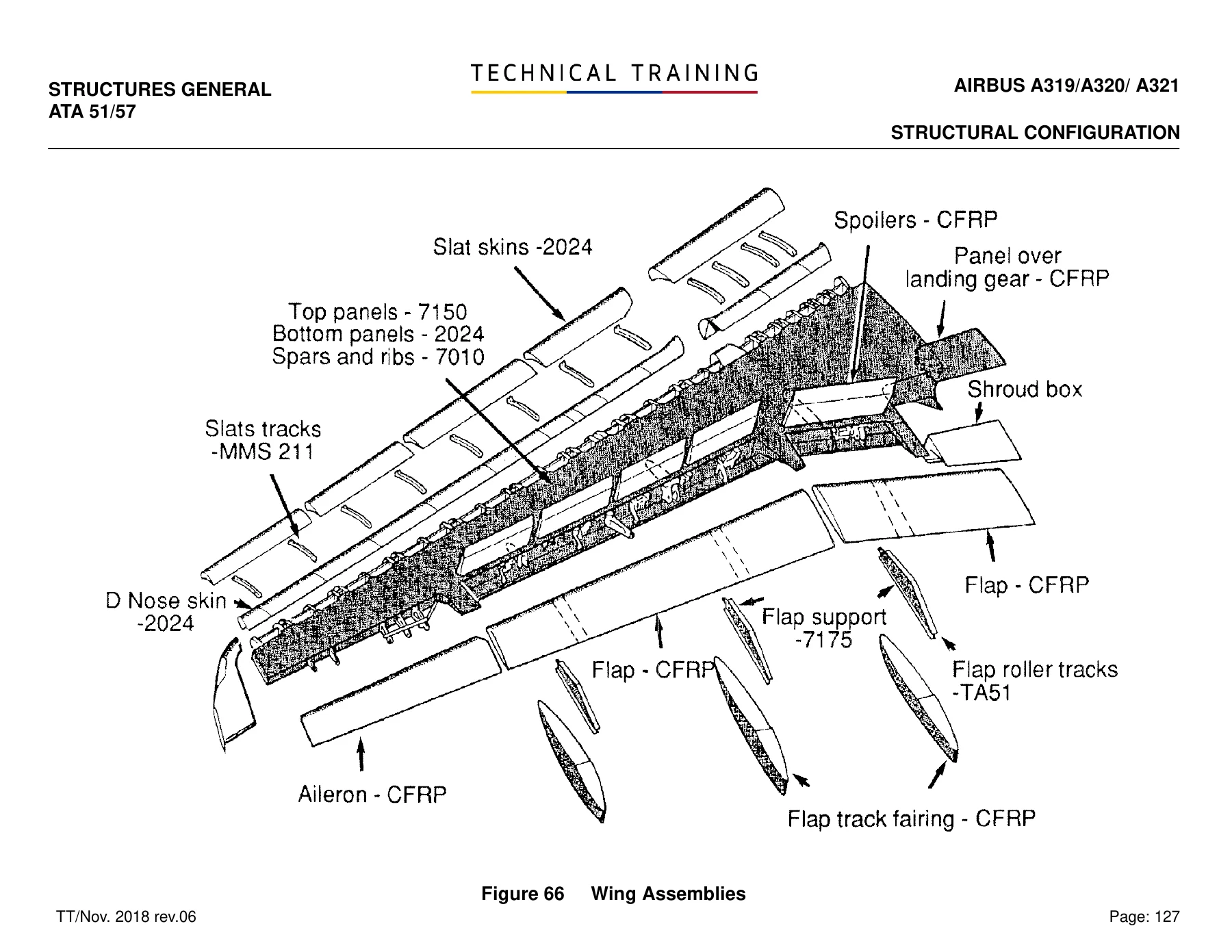
ATA 57 is the largest chapter, covering the center wing box (integral fuel tank, front and rear spars combined with frames 36 and 42), the wing root joint (cruciform fitting for upper skin, T-fitting and fail-safe strap for lower skin), the external wing box (front and rear spars, two upper and three lower skin panels, 27 ribs), wing skin joints at stringers 8 and 11, main landing gear attachment structure, leading and trailing edge structure, wing tip and tip fence, sharklets (2.4 m tall, CFRP laminated spars and honeycomb panels, expanded copper foil for lightning protection), and all movable surfaces – five slats, two flaps (A319/A320) or two double-slotted flaps with tabs (A321), five spoilers/airbrakes, and one aileron.
Working with the Structural Repair Manual
The final portion of the manual teaches SRM usage from the ground up. It explains the seven-chapter structure (51 through 57), the page block allocation (1-99 for identification, 101-199 for allowable damage, 201-999 for repairs), the task numbering system (chapter/section/subject/function code/sequence), and how effectivity is filtered by aircraft type, weight variant, modification, and MSN. A worked example walks through checking a weight variant against the cockpit data plate (MTLW, MLW, MZFW) and the SRM tables.
Damage assessment is covered in detail: damage categories (mechanical, chemical/electrochemical, thermal, metallurgical), terminology (scratch, gouge, mark, crack, dent, crease, abrasion, debonding, delamination, fretting, indentation, burn mark, penetration), logic chart for when a defect is found, reporting methods, and illustration guidance. The manual defines allowable damage categories – permanent allowable damage, permanent allowable damage with operating limits, and temporary allowable damage – and explains negligible damage limits under chapter 51-73-11, including dent criteria (depth less than or equal to 0.1 mm, skin thickness less than or equal to 4 mm, A/D ratio greater than or equal to 25) and blending rules for clad and unclad material.
Get the Airbus A320 structure training manual
IMAGES PREVIEW
This PDF gives you the full ATA 51-57 structure curriculum in one place – the design logic, the materials, the component breakdowns, and the SRM usage rules that govern how repairs are assessed and classified. Whether you are studying for type training, preparing to work on an A319/A320/A321 airframe, or need a reference for structural damage assessment, the manual’s step-by-step explanations and diagrams make the airframe’s construction clear. Because it is delivered as an instant PDF download, there is no shipping wait and no physical book to lose – open it on a laptop, tablet, or phone, print the pages you need for the hangar, and keep the rest as a digital reference.
Reviews
There are no reviews yet.