
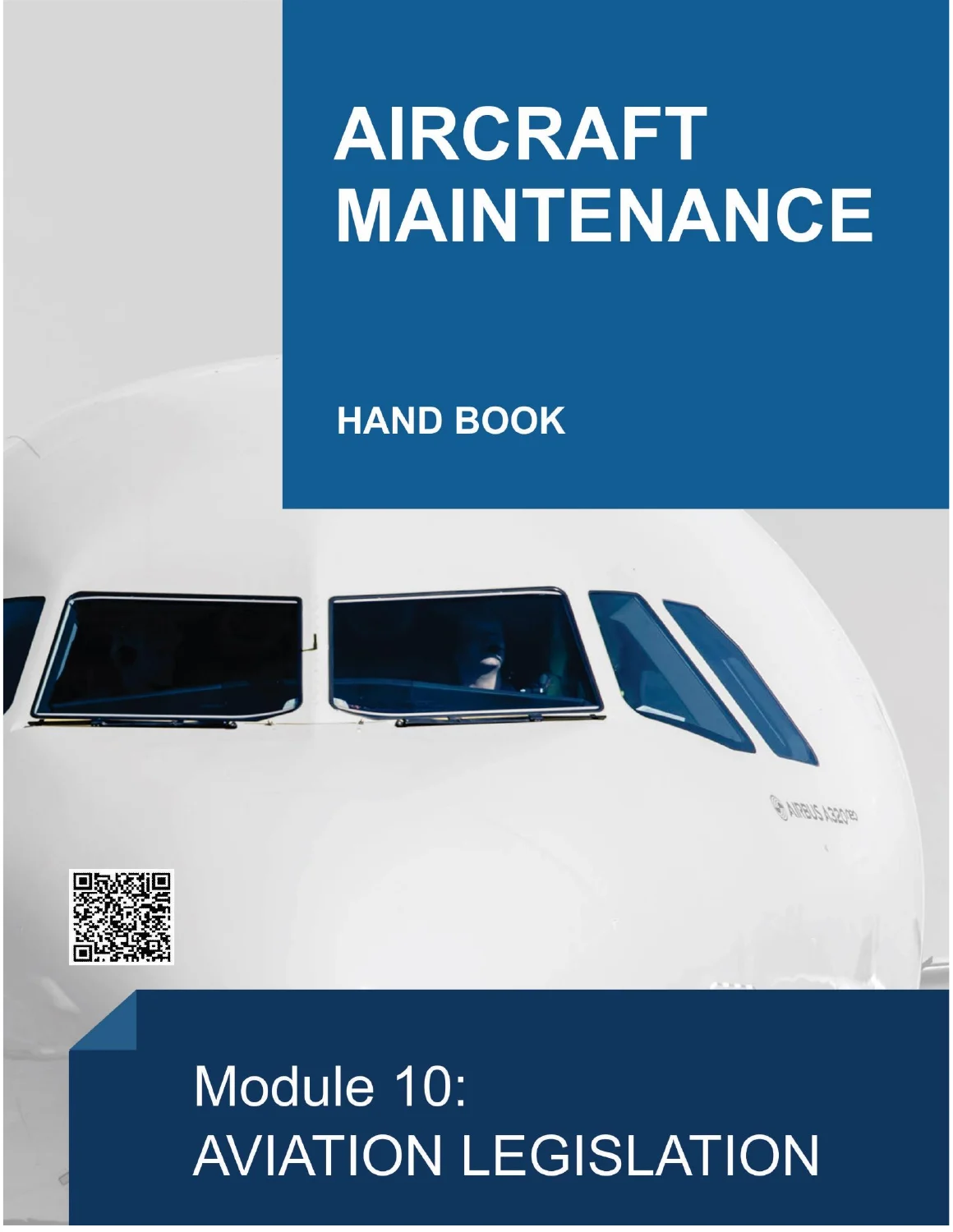
Airbus A320 Aircraft Maintenance Handbook Module 10 Aviation Legislation Training Manual
Original price was: $34.95.$21.95Current price is: $21.95.
Comprehensive training manual and reference guide covering EASA Module 10 Aviation Legislation for the Airbus A320, including Part 66, Part 145, Part M, Part 21, and EU Air Operations.
Description
Airbus A320 Aircraft Maintenance Handbook Module 10 Aviation Legislation Training Manual
The Airbus A320 Aircraft Maintenance Handbook Module 10 Aviation Legislation Training Manual provides an exhaustive, highly structured educational and practical regulatory foundation designed for aircraft maintenance engineers, technicians, and certifying staff. Prepared to align directly with the European Aviation Safety Agency (EASA) and international civil aviation standards, this handbook outlines the complete statutory environment governing commercial air transport operations, maintenance organisation approvals, design and production certification, and certifying personnel privileges. Specifically referencing the Airbus A320 aircraft series within modern air transport frameworks, this module prepares candidates and active maintenance personnel for the rigorous technical and legal responsibilities mandated across EASA Part 66 Category A, B1, B2, and C certifications.
File Details
- Manual Type: Aircraft Maintenance Handbook / Module 10 Training Manual
- Document Subject: Module 10: Aviation Legislation
- Target Aircraft Platform: Airbus A320
- Issue / Revision Status: Issue-1, Rev. 01
- Language: English
- Page Count: 187 pages
- File Format: PDF Download
Comprehensive EASA Regulatory Framework & International Standards
Understanding the legal architecture of commercial aviation requires a thorough analysis of international treaties and regional implementing rules. The Airbus A320 Aircraft Maintenance Handbook Module 10 Aviation Legislation Training Manual details the origins of global safety regulation originating from the 1944 Chicago Convention (Convention on International Civil Aviation) and the establishment of the International Civil Aviation Organization (ICAO). Technicians explore the division between sovereign member states, the ICAO Assembly, Council, and Secretariat, alongside standard-setting mechanisms including Standards and Recommended Practices (SARPs) and Annexes.
At the European regional level, the handbook thoroughly delineates the legislative machinery of the European Union, including the distinct roles executed by the European Parliament, the Council of the European Union, and the European Commission. It breaks down the foundational Basic Regulation (Regulation (EC) No 216/2008 and subsequent updates) and explains the operational divide between binding Hard Law (European Regulations) and non-binding Soft Law, such as Acceptable Means of Compliance (AMC), Guidance Material (GM), and Certification Specifications (CS). Learners gain essential clarity on how EASA coordinates with National Aviation Authorities (NAAs) acting as competent authorities across member states to enforce unified continuing airworthiness and maintenance protocols.
Certifying Staff Qualifications & EASA Part 66 Licensing
A core element of the A320 Module 10 legislation manual centers on Annex III to Commission Regulation (EU) No 1321/2014, known universally as EASA Part 66. This section guides the technician through every phase of obtaining, exercising, and maintaining an Aircraft Maintenance License (AML). The text methodically explains license categories and sub-categories, providing specific requirements and scope of work for:
- Category A: Line maintenance minor scheduled tasks and simple defect rectification (subdivided into A1 Turbine Aeroplanes, A2 Piston Aeroplanes, A3 Turbine Helicopters, and A4 Piston Helicopters).
- Category B1: Mechanical maintenance privileges covering airframe structure, powerplants, mechanical systems, and electrical installations, as well as operational testing of avionic line replaceable units (B1.1 Turbine Aeroplanes, B1.2 Piston Aeroplanes, B1.3 Turbine Helicopters, and B1.4 Piston Helicopters).
- Category B2: Avionic certifying privileges across electrical power generation, communication, navigation, radar, autoflight, and instrument systems.
- Category B3 & Category L: Light non-pressurized piston aircraft maintenance structures and specialized light aircraft limitations.
- Category C: Base maintenance certification privileges for large aircraft following the completion of comprehensive scheduled base maintenance checks.
The manual provides explicit breakdowns of examination structures, modular syllabi (Modules 1 through 17), question quantities, allotted exam times, practical maintenance experience requirements (ranging from 1 to 5 years depending on previous technical training and Part 147 approved courses), license extension matrices, type rating endorsements, recent experience criteria (6 months within the preceding 24 months), and the five-year validity and renewal process on EASA Form 19 and Form 26.
Part 145 Approved Maintenance Organisations & Quality Management
Maintenance facilities supporting large commercial transports such as the Airbus A320 must operate strictly within the bounds of EASA Part 145. This module dissects organizational obligations from upper management to shop-floor technicians. It details the required functions of the Accountable Manager, Base Maintenance Manager, Line Maintenance Manager, Workshop Manager, and Quality Manager, while analyzing the pivotal role of the Maintenance Organisation Exposition (MOE). Facility requirements are explored in depth, including climatic working environments, contamination controls, tool calibration tracking registers, segregated aeronautical component stores, and human factors continuation training scheduled at two-year intervals.
Key procedural responsibilities examined include the fabrication of parts within an approved facility, maintenance data currency (AMM, SRM, IPC, CMM, and WDM), shift handover documentation, Critical Design Configuration Control Limitations (CDCCL), Mandatory Occurrence Reporting (MOR) within 72 hours, and the formal issuance of the Certificate of Release to Service (CRS) and EASA Form 1 release certificates.
Continuing Airworthiness (Part M), Air Operations (Part-OPS), & Aircraft Documentation
The manual provides comprehensive instructions regarding the interface between aircraft operators, Continuing Airworthiness Management Organisations (CAMO under Part M Subpart G), and maintenance contractors. It clarifies the legal responsibilities defined under M.A.201, pre-flight servicing duties, maintenance program (AMP) management, aircraft technical log systems (M.A.306), and airworthiness record archiving intervals (ranging from 12 to 36 months). Critical operational certifications are covered in full, including the Airworthiness Review Certificate (ARC under M.A.901), non-expiring Certificates of Airworthiness, Permits to Fly under Part 21 Subpart P, Noise Certificates, and Radio Station Licenses.
Operational regulations under Regulation (EU) No 965/2012 (IR-OPS) are likewise explored, examining Air Operator Certificates (AOC), Flight Data Monitoring (FDM), Minimum Equipment Lists (MEL rectification intervals A, B, C, and D), Configuration Deviation Lists (CDL), aircraft weighing intervals (4-year individual and 9-year fleet evaluations), center-of-gravity scheduling, and cockpit instrumentation mandates (TAWS, ACAS II, CVR, and FDR).
Chapters Covered
- Chapter 01: 10.1 – Regulatory Framework — ICAO Chicago Convention, SARPs, European Union structure, EASA role and acts, Competent Authorities, Basic Regulation (EC) No 216/2008, Initial Airworthiness (EU) No 748/2012, Continuing Airworthiness (EU) No 1321/2014, Hard Law and Soft Law (AMC/GM/CS).
- Chapter 02: 10.2 – Certifying Staff – Maintenance — Part 66 licensing requirements, Categories A, B1, B2, B2L, B3, and C privileges, age limitations, knowledge module requirements, exam formats and question allocations, practical experience guidelines, type rating endorsements, Part 147 training approvals, Form 19 application, and Form 26 issuance.
- Chapter 03: 10.3 – Approved Maintenance Organisations — Part 145 and Part M Subpart F organization approvals, MOE development, facility requirements, Accountable Manager duties, maintenance man-hour planning, human factors training syllabus, tool calibration, component acceptance, local parts fabrication, CDCCL, CRS execution, EASA Form 1, occurrence reporting, quality audits, and finding classifications (Level 1 and Level 2).
- Chapter 04: 10.4 – Air Operations — Regulation (EU) No 965/2012 (IR-OPS), Part-ARO, Part-ORO, Part-CAT, Part-SPA, AOC application and validity, Flight Data Monitoring (FDM), flight deck taxiing qualifications, required onboard flight documentation, cockpit voice recorders (CVR) and flight data recorders (FDR), refueling safety, ground de-icing procedures, mass and balance determination, weighing tolerances, and MEL / CDL operational usage.
- Chapter 05: 10.5 – Certification of Aircraft, Parts and Appliances — Part 21 structural divisions, Certification Specifications (CS-23, CS-25, CS-27, CS-29), Design Organisation Approval (DOA / Subpart J), Production Organisation Approval (POA / Subpart G), Subpart F production without POA, Type Certificates (Subpart B), Certificate of Design, restricted type certificates, and ETSO authorisations.
- Chapter 06: 10.6 – Continuing Airworthiness — Part 21 instructions for continued airworthiness (ICA), minor and major changes in type design, Supplemental Type Certificates (STC / Subpart E), Certificate of Registration, Certificate of Airworthiness transfer and import, Permit to Fly (Subpart P), Noise Certification (CS-36), Weight and Balance schedules, Radio Station licensing, Airworthiness Directives (AD), CAMO responsibilities under Part M Subpart G, Maintenance Programs (AMP), technical logbook management, independent inspections, and Airworthiness Review Certificates (ARC).
- Chapter 07: 10.7 – Applicable National and International Requirements — Non-EASA state aircraft distinctions, maintenance check intervals (Pre-flight, Daily, Weekly, A, C, and D checks), light aircraft scheduled maintenance packages, safety-critical multi-system maintenance procedures, Service Bulletins (SB/ASB/SIL), ATA Specification 100 / 2200 numbering system, technical publication structures (AMM, IPC, CMM, SRM, WDM), and temporary revision (TR) / alert tracking.
IMAGES PREVIEW
Together, these chapters equip the aircraft technician and aviation maintenance engineer with complete statutory mastery over civil aviation legislation. This document synthesizes dense regulatory texts into clear, practical guidelines, demonstrating exactly how legislative articles translate into daily hangar, ramp, and workshop compliance.
Professional Capability, Compliance Assurance, & Instant PDF Delivery
Working on transport category commercial aircraft like the Airbus A320 requires flawless adherence to statutory mandates. Possessing the Airbus A320 Aircraft Maintenance Handbook Module 10 Aviation Legislation Training Manual empowers engineers, mechanics, and quality managers to carry out compliant defect rectifications, sign off work orders with full regulatory confidence, and successfully prepare for Part 66 basic and type examination modules. Retaining exact knowledge of maintenance data limits, CDCCL restrictions, independent inspection protocols, and CRS release statements protects airworthiness and ensures complete alignment with EASA audits.
This manual is delivered as an instant digital PDF download immediately upon checkout. With zero shipping delays, you can access this comprehensive regulatory reference across any desktop computer, laptop, tablet, or smartphone. The entire document is fully printable, allowing you to produce durable binder sections for the classroom, study desk, or maintenance station whenever needed.
Reviews
There are no reviews yet.