
Automotive Steel Design Manual Revision 6.1 – AISI Sheet Steel Engineering Reference
Original price was: $39.95.$24.95Current price is: $24.95.
The complete AISI Automotive Steel Design Manual Revision 6.1 — 773 pages of materials data, structural design methods, fatigue analysis, crash energy management, corrosion protection, and manufacturing processes for automotive sheet steel components.
Description
Automotive Steel Design Manual Revision 6.1 – AISI Sheet Steel Engineering Reference
The Automotive Steel Design Manual Revision 6.1 is the August 2002 edition of the American Iron and Steel Institute’s comprehensive engineering guide for designing automotive body components and assemblies in sheet steel. Prepared in cooperation with the Auto/Steel Partnership, this reference brings together materials properties, product design information, and manufacturing data into a single resource for product designers, design engineers, and the simultaneous engineering team. This is the ninth update in a series that began with the first edition in October 1986.
File Details
- Manual Type: Engineering Design Reference
- Publisher: American Iron and Steel Institute (AISI)
- Edition: Revision 6.1, August 2002
- Language: English
- Page Count: 773 pages
- File Format: PDF
- First Edition: October 1986
- Prepared With: Auto/Steel Partnership
Chapters Covered
- 1. Introduction
- 2. Materials — Steel Making, Classification and Properties, Hot Rolled and Cold Rolled Steels, Dent Resistant / High Strength / Advanced High Strength Steels, Steel Company Provided Stress Strain Curves, Weldability of High Strength Steels, Tolerances, Coated Steel Sheets, Laminated Vibration Damping Steels, Stainless Steels, Comparative Cost and Mass, Mechanical Testing, Influence of Strain Rate on Yield Strength, Strength Increase from Cold Work of Forming
- 3. Design — Straight Linear Members, Curved Members, Surface Elements, Connections, Designing Against Fatigue Failures, Crash Energy Management, Designing Against Corrosion, Design for Roll Forming, Special Design Considerations, Design Guidelines for Sheet Steel, AISI/CARS Geometric Analysis of Sections (GAS) Theory, Designing for Stamping Operations
- 4. Manufacturing — Stamping Operations, Roll Forming, Welding Processes, Adhesive Bonding, Finishing Systems, Thin-Walled Welded Steel Tube Forming, Hydroforming Sheet Steel
- 5. Procedures
- 6. Applications — Case Studies and Examples
- 7. AISI/CARS — User’s Manual and Tutorials
- Appendix A: Symbols and Definitions
- Appendix B: Steel Constants and Conversion Factors
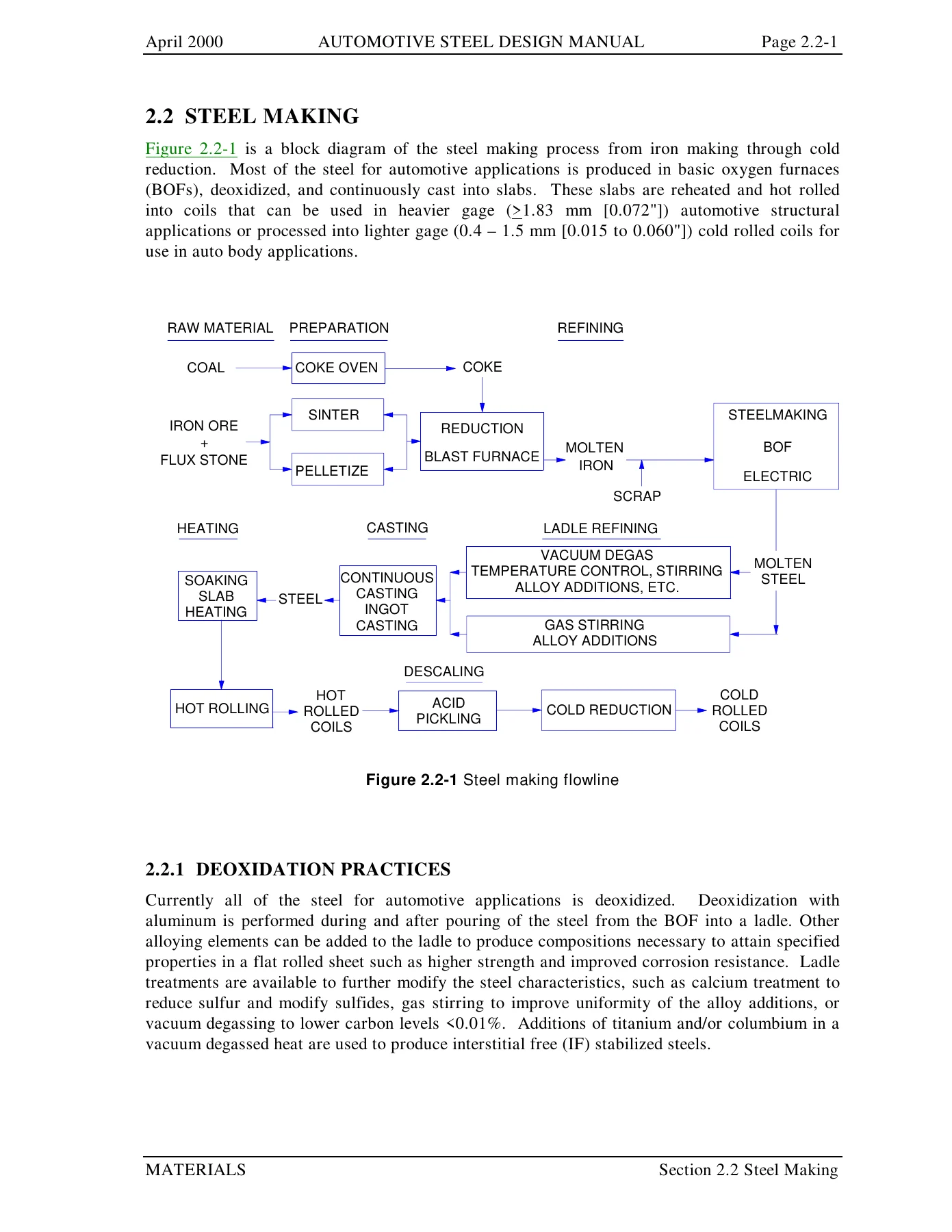
This is a deep technical reference. Section 2 alone covers everything from basic oxygen furnace steelmaking through advanced high strength steels (dual phase, TRIP, complex phase, martensitic), coating types, and mechanical testing procedures. Section 3 is the design core — straight members, curved members, surface elements, fatigue, crash energy management, corrosion, roll forming, and the AISI/CARS GAS theory. Section 4 covers how parts are actually made: stamping, roll forming, welding processes, adhesive bonding, finishing, tube forming, and hydroforming.
What This Manual Enables
The Automotive Steel Design Manual Revision 6.1 is built around the simultaneous engineering concept — the idea that material, design, and manufacturing engineers work together from the concept stage. It gives the design engineer the fundamental characteristics of sheet steels, shows how material properties influence design and manufacturing, and provides the first-order analysis methods needed before finite element analysis is applied.
For the body designer working on body-in-white, attached frame members, and attached assemblies such as hoods, deck lids, doors, and fenders, this manual delivers quantified design data. Section 3.1 alone contains the complete treatment of tension, compression, flexure, torsion, local instability, overall stability, and combined loading for thin-wall sheet steel members. Section 3.2 covers curved members, Section 3.3 covers surface elements including dent resistance and oil canning, and Section 3.4 covers connections from spot welds through adhesives and weldbonding.
Advanced High Strength Steel Coverage
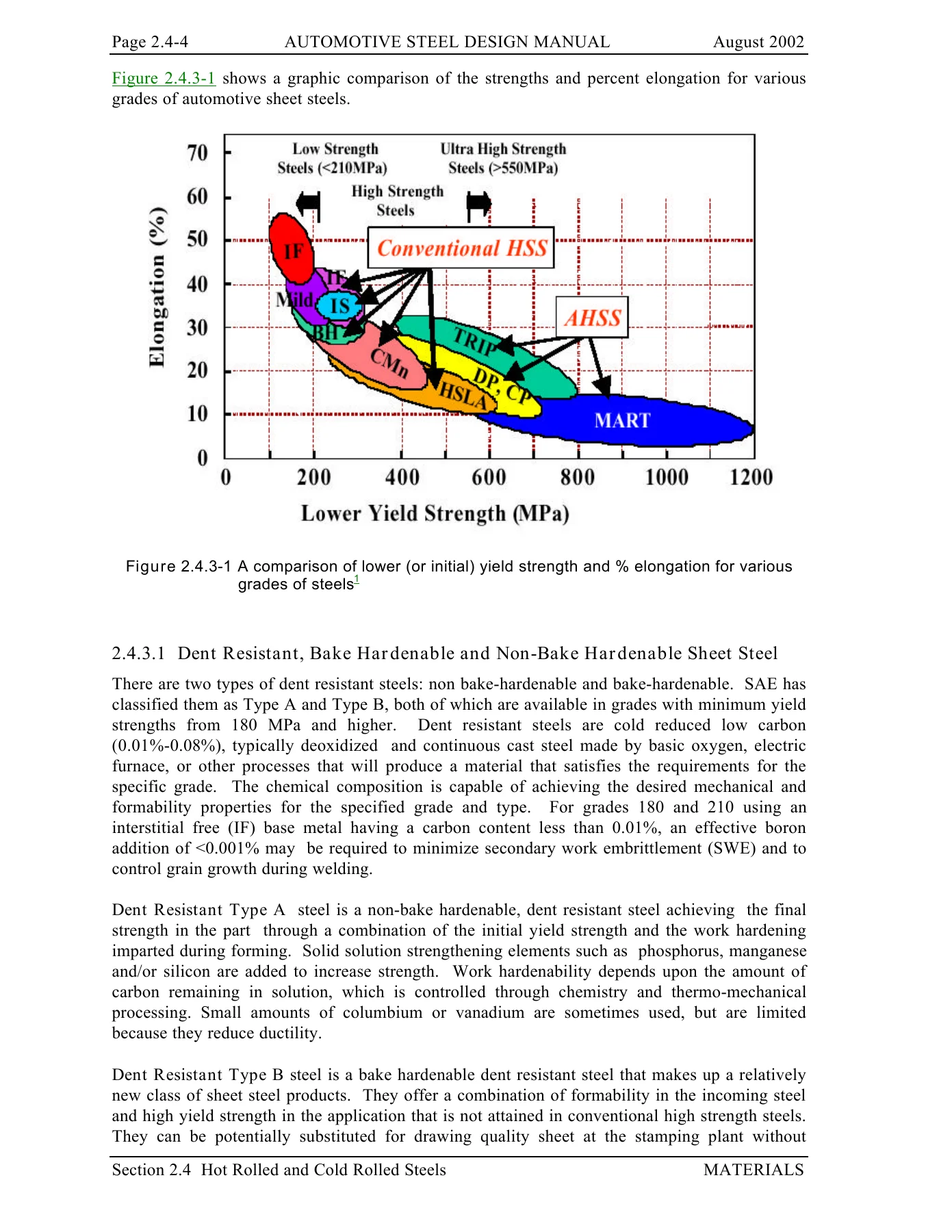
Revision 6.1 reflects significant updates in the high strength and advanced high strength steel area. Section 2.4.3 covers dent resistant, bake hardenable, high strength low alloy, dual phase, TRIP, complex phase, and martensitic steels. The manual includes strength vs. elongation comparisons, work hardening behavior, strain rate sensitivity data, and guidance on formability of these grades. The new Section 2.5 provides sample stress-strain curves from steel companies for materials including HR 80 ksi, DP 590 HR, BH210, DP600/590 HDGA, and DDS-CR. The new Section 2.14 provides a numerical procedure for evaluating increased yield strength due to cold work of forming.
Fatigue and Crash Energy Management
Section 3.5 is a comprehensive fatigue design reference covering monotonic properties, load-controlled cyclic properties, strain-controlled cyclic properties, fatigue life prediction methods, variability of fatigue properties, and fatigue behavior of sharply notched and welded components. It includes S-N curves, strain-life curves, cyclic stress-strain curves, and statistical analysis methods. Section 3.6 covers crash energy management — rail crush modes, parameters affecting average crush force, static and dynamic crush force design considerations, analytical tools, and the crush behavior of hybrid stub columns.
Corrosion and Manufacturing
Section 3.7 addresses corrosion design — types and forms of corrosion, corrosion of painted steel, precoatings, assembly coatings, phosphate pretreatment, and paint systems. Section 4 covers manufacturing processes in depth: stamping operations including circle grid analysis and forming limit diagrams, roll forming, welding processes (resistance spot, seam, projection, butt, high frequency, arc, laser), adhesive bonding, finishing systems, tube forming, and hydroforming.
Case Studies and AISI/CARS
Section 6 provides real-world applications: uniside construction, front shock tower construction, hood inner panel, door anti-flutter bar using engineered scrap, modular seat support, design of an anti-intrusion door beam, and design of a front rail. Section 7 covers the AISI/CARS software including the Design Key, GAS (Geometric Analysis of Sections), MAP (Material Archive Program), and step-by-step tutorials.
Why This Reference Matters
Steel remains the material of choice for automotive body structures, and using it correctly means understanding how material properties interact with design geometry and manufacturing processes. This manual bridges those disciplines. It provides the equations, the material data, the design procedures, and the manufacturing constraints that let an engineering team optimize for strength, stiffness, fatigue, crash performance, corrosion resistance, mass, and cost. The appendices include recommended steel constants and conversion factors for both SI and U.S. customary units.
IMAGES PREVIEW
Instant PDF Delivery
The Automotive Steel Design Manual Revision 6.1 is delivered as an instant PDF download after payment. No shipping, no waiting. The file can be viewed on any device — desktop, laptop, tablet, or smartphone — and individual pages or sections can be printed for use at the bench or in the design office. Whether you are evaluating a material substitution, checking a local buckling calculation, designing a spot weld pattern, or reviewing crash energy management data, this reference is built to be used.
Reviews
There are no reviews yet.