
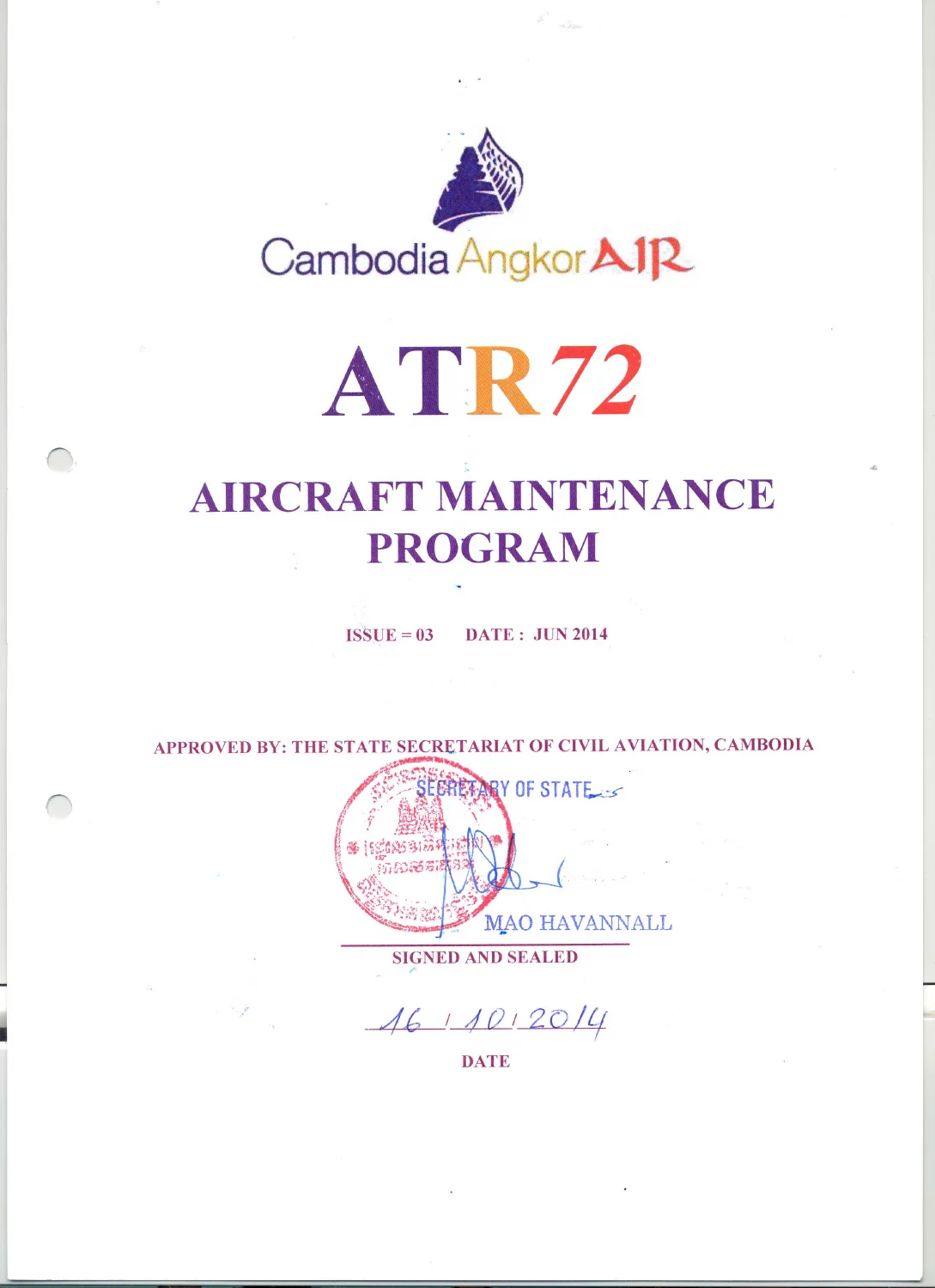
Cambodia Angkor Air ATR72-500 Aircraft Maintenance Program Issue 03 June 2014
Original price was: $36.95.$21.95Current price is: $21.95.
SSCA-approved Issue 03 Amendment 00 Aircraft Maintenance Program for Cambodia Angkor Air ATR 72-500 / ATR72-212A aircraft MSN 899 (XU-235) and MSN 906 (XU-236), aligned to ATR MPD Rev 20 and MRBR Rev 19, covering line checks, life-limited parts, ATA task cards, CMR, AWL, CPC and abnormal-flight inspections.
Description
Cambodia Angkor Air ATR72-500 Aircraft Maintenance Program Issue 03 June 2014
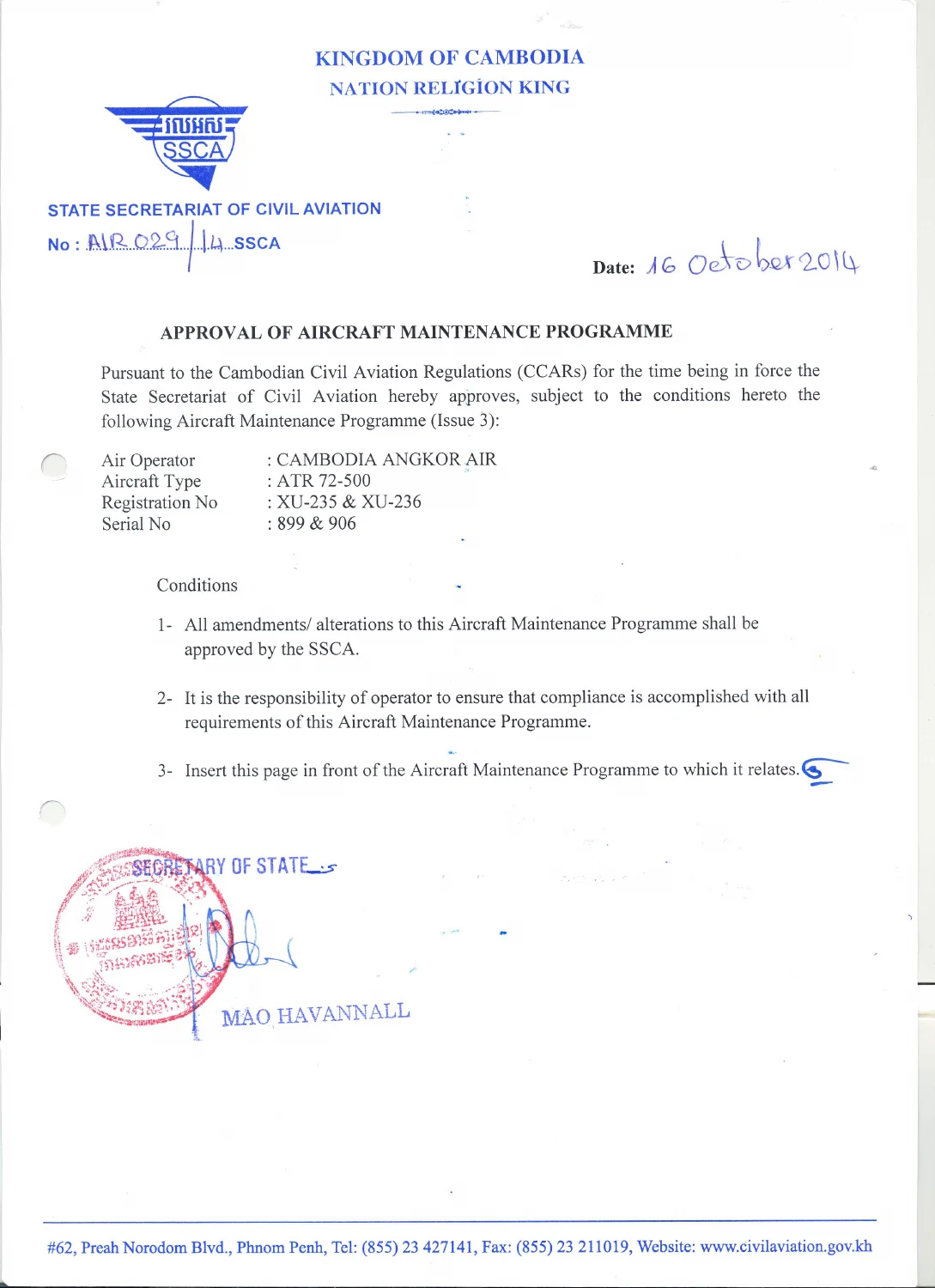
This download is the Cambodia Angkor Air ATR72-500 Aircraft Maintenance Program Issue 03 June 2014 used to control scheduled maintenance on the airline’s ATR 72-500 fleet. Issue 03 Amendment 00 is dated 15 June 2014 and was approved by the State Secretariat of Civil Aviation of Cambodia (document AIR.029.1.1.a.SSCA / AIR.029/14 SSCA, signed 16 October 2014). The program applies only to manufacturer serial numbers 899 and 906, registered XU-235 and XU-236. It was built from the ATR72 Maintenance Planning Document Revision 20 (April 2014) and Maintenance Review Board Report revision 19 (March 2014), then customised for Cambodian national requirements, vendor recommendations and the two aircraft’s modification status.
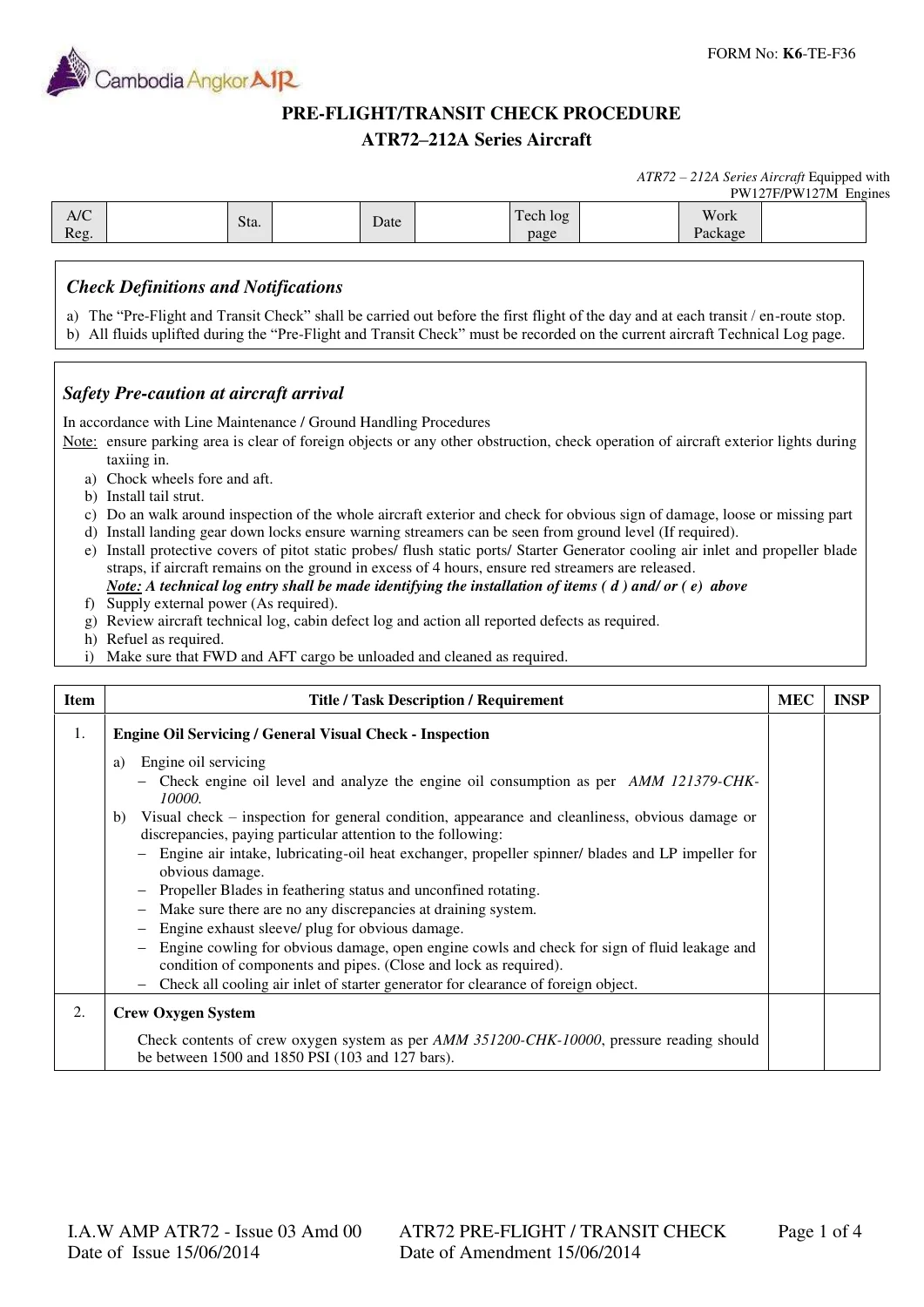
Line-check forms identify the airframes as ATR72-212A Series aircraft equipped with PW127E/PW127M engines on the pre-flight/transit list and PW127F/PW127M engines on the daily and weekly lists. The document is an operator Aircraft Maintenance Programme (AMP), not a full Aircraft Maintenance Manual. Task cards quote AMM, JIC, CMM, NTM, EMM, SIL and service-bulletin references for the actual work steps.
File Details
- Manual type: Aircraft Maintenance Program (AMP)
- Brand / operator: Cambodia Angkor Air / ATR
- Models: ATR 72-500, ATR72-212A Series
- Aircraft: MSN 899 (XU-235), MSN 906 (XU-236)
- Engines shown on check forms: PW127E, PW127F, PW127M
- Language: English
- Page count: 416
- File format: PDF
- Issue / amendment: Issue 03, Amendment 00
- Program date: 15 June 2014
- SSCA approval date: 16 October 2014
- Source documents: ATR72 MPD Revision 20 (April 2014), MRBR revision 19 (March 2014)
Who This Program Covers
The Cambodia Angkor Air ATR72-500 Aircraft Maintenance Program Issue 03 June 2014 is written around two specific airframes. Effectivity columns on most task cards read ALL, meaning both MSN 899 and MSN 906. Copy holders listed in Section 0 include SSCA, the Engineering Division, Safety-Quality & Security, VAECO and line stations. Amendments require SSCA consent before they enter the master program.
Anticipated annual utilisation is 2000 flight hours. If utilisation on an individual aircraft moves more than 25 percent from that figure, the operator must review task periods. Next-due calculation is defined: when the certificate of release to service falls after the due date, next due equals due date plus interval; when CRS falls before the due date, next due equals CRS date plus interval.
Chapters Covered
- Section 0 Summary of Changes: list of effective pages, table of contents, reason for Issue 03 Amendment 00, record of amendments, distribution list, summary of added, revised and deleted task cards
- Section 1 General Introduction: applicability, operational units (FH, FL, LD, HR, DY, MO, YE), check codes (DY, LC, WY, A through 4A, C through 4C), structure-program thresholds, general rules, CMR policy, permitted variations, glossary and abbreviations, revision responsibility, assistance contacts
- Section 2 Line Maintenance Checks: Pre-Flight / Transit Check, Daily Check, Weekly Check for ATR72-212A Series
- Section 3 Scheduled Components Maintenance: landing-gear life-limited parts, engine life-limited parts (Pratt & Whitney Time Limit Manual Chapter 05 takes precedence), time-controlled items list
- Section 4 Scheduled Aircraft Maintenance: Special Task Cards (4.1), Maintenance Task Cards (4.2), Certification Maintenance Requirements (4.3), Airworthiness Limitation Tasks (4.4), Corrosion Prevention and Control Tasks (4.5), Time Control Item Task Cards (4.6), SSCA Airline Inspection Requirements (4.7)
- Section 4 ATA task chapters include: zonal inspections plus ATA 08 Leveling/Weighing, 12 Servicing, 21 Air Conditioning/Pressurization, 25 Equipment & Furnishing, 26 Fire Protection, 28 Fuel, 29 Hydraulic Power, 30 Ice and Rain Protection, 32 Landing Gear, 35 Oxygen, 52 Doors, 53 Fuselage, 54 Nacelles/Pylons, 57 Wings, 61 Propellers, 71 Power Plant, 72 Engine, 73 Engine Fuel Control, 74 Engine Ignition, 76 Engine Control, 77 Engine Indicating, 79 Engine Oil and related systems through ATA 80
- Section 5 Special Procedures: reference table after an abnormal flight, storage and destorage JICs
Taken together, the Cambodia Angkor Air ATR72-500 Aircraft Maintenance Program Issue 03 June 2014 gives planning and airworthiness staff the interval framework, task identities, zone numbers, man-hour estimates, access-panel lists and source references needed to build work packages from transit through 4C and calendar structural inspections. It does not reprint the AMM job steps themselves.
Check Intervals and Usage Units
Flight hours are elapsed time between lift-off and touchdown. Flight cycles are a complete take-off and landing. Calendar units run from hours through years. Line checks are DY (one calendar day), LC (two calendar days) and WY (seven calendar days). Base checks map as A = 500 FH, 2A = 1000 FH, 3A = 1500 FH, 4A = 2000 FH, C = 5000 FH, 2C = 10000 FH, 3C = 15000 FH and 4C = 20000 FH.
Structure-program guidance in Section 1 lists fatigue-related thresholds at 18000, 24000 or 36000 cycles, environmental-damage thresholds at 4 or 8 years with repeats at 2, 4 or 8 years, and accidental-damage repeats at 2, 4 or 8 years. When two units are assigned to one task, the first to expire applies unless a note says otherwise.
Line Maintenance Content
The Pre-Flight / Transit Check is done before first departure or at each transit, not earlier than two hours before the flight. Arrival precautions cover chocking, tail-strut fitment, walk-around, landing-gear down locks, pitot/static and starter-generator covers if the aircraft sits more than four hours, technical-log review, refuel and cargo unload. Task items include engine-oil level and consumption per AMM 121379-CHK-10000, crew-oxygen contents with a printed band of 1500 to 1850 PSI (103 to 127 bar), toilet and potable-water servicing, flight-deck and cabin inspection, air-conditioning inlets, hydraulic reservoir sight-glass check per AMM 290000-CHK-10000, pitot/static and ice-detector condition, antennas, cargo compartments, wings and landing gear. An appendix sets fuel-uplift discrepancy limits between the aircraft indicator and the bowser, from ≤5.8 percent / 58 kg on uplifts of 0–1000 kg down to ≤1.6 percent on uplifts above 20000 kg.
The Daily Check adds tire-pressure and wear recording (AMP 324100-CHK-10010-1), cargo-door actuator/crank alignment, security-box condition, and fuel-tank and surge-tank water drain per AMM 122428-DRN-10000 before first daily flight or after more than six hours on the ground. The Weekly Check adds turbo-machine and reduction-gearbox magnetic chip-detector checks, main-oil-filter and scavenge-filter impending-bypass indicators, emergency and cabin lighting tests, and a weekly nacelle DVI for cracks on the engine oil-cooler flaps (AMP 541201-DVI-10000-1).
Life Limits and Time-Controlled Items
Section 3.1 lists landing-gear life limits in cycles: leg assemblies at 48700, 60000 or 70000 CYC depending on part number; drag-brace assemblies at 60000 or 70000 CYC; side-brace assemblies at 57800 CYC; free-fall assister, shock absorbers, truss shear members, fittings and strut joints commonly at 70000 CYC.
Section 3.2 is the Pratt & Whitney engine life-limited-parts table. In any conflict the PW Engine Time Limit Manual Chapter 05 is the controlling reference. Printed cycle limits include torque-tube assembly 42000, LP and HP impellers 15000, HPT and LPT disks 15000, PT first- and second-stage disks 30000, HPT covers and inter-stage airseal 15000, HPT and LPT blades 15000, and aft isolators 42000 cycles.
Section 3.3 time-controlled items include CVR/FDR ULB batteries (DK120 / ELP-362D) discarded at 6 years, CVR bench test at 2000 FH, AC generator bearing discard at 4000 FH, DC starter-generator brush change at 800 FH, bearing discard at 1200 FH and restoration at 2400 FH, emergency battery check/restoration at 800 FH / 12 months, main battery check at 400 FH and restoration at 2000 FH / 12 months, ELT battery discard at 4 or 5 years, life-vest restoration at 4 or 5 years, portable and engine fire-extinguisher weighing and hydrostatic intervals, crew-oxygen cylinder hydrostatic test at 5 years and discard at 15 years, propeller-blade overhaul at 10500 FH or 7 years, hub major inspection at 10500 FH or 7 years, and fuel-nozzle restoration at 1000 FH.
IMAGES PREVIEW
Scheduled Task Cards, CMR, AWL and CPC
Section 4 is the bulk of the Cambodia Angkor Air ATR72-500 Aircraft Maintenance Program Issue 03 June 2014. Special cards cover aircraft weighing every 4 years, aircraft wash every 30 days, engine wash every 15 days, pack-valve filter and water-spray nozzle work, first-aid-kit seal/expiry check at A check, FDR download and analysis at 5000 FH, fuel-tank microorganism sampling, hydraulic-fluid drain and replenish at 12 years, and MLG side-brace fitting GVI tied to SB ATR72-53-1042.
Maintenance task cards (sub-section 4.2) run zonal GVI/DVI/SDI work from nose to tail and through both nacelles, plus system tasks for fire detection, fuel feed, ice protection, propeller control (ATPCS, NP overspeed, PEC), engine borescope of HP turbine vanes, blades, combustion chamber and exit duct, ignition relight, control-cable tension and oil-system warnings. Engine notes distinguish on-condition monitoring from hard time: hot-section removal on hard time at 4000 FH, turbomachine and RGB overhaul on hard time at 8000 FH, turbine-containment DVI not to exceed 40000 FH at refurbishment, and borescope intervals of 3000/1500 FH on-condition versus the hard-time schedule.
CMR tasks cannot be deleted. AWL, CPC and TCI sub-sections isolate airworthiness-limitation, corrosion-prevention and time-control cards so planners can protect those intervals. Permitted variations are 10 percent (max 500 FH above 5000 FH) on flight-hour items, calendar bands of 10 percent/1 month, 2 months or 3 months, and 5 percent on cycles with caps of 25 or 250 cycles. Variations do not apply to LLP, CMR, AWL or SSCA-mandatory periods. ECO tasks may use a 20 percent variation at SQS inspector discretion.
Abnormal Flight and Storage References
Section 5 points technicians to JICs for hard landing and VLE/VLO exceedance, turbulence and VFO/VFE exceedance, hail in flight or on ground, lightning strike, limitation exceedance, wing overpressure, runway excursion, carbon outer-wing-box lightning protection, bird strike, tail-bumper hard landing, engine and propeller overtorque, mercury spillage, fuselage pressurization leak test, airframe demagnetisation, and short- and long-term storage plus destorage of systems and external equipment.
How to Use This AMP With Other Manuals
Each task card carries a 12-digit-plus-letter identity (ATA or zonal prefix, task code such as GVI/DVI/SDI/OPT/FUT/CHK/LUB/RAI, sequence and modification index), zone list, threshold and interval, control-inspection flag, JIC/AMM/MRB references and effectivity. Man-hours exclude stand positioning, defect rectification and efficiency loss. NDT substitutions must detect the same damage size at least as confidently as the prescribed visual method. Life-limited items follow the Type Certificate Data Sheet or the manufacturer’s time-limit publications. Manufacturer ISB, SIL, AOL and AOT documents still apply even when they have not yet been absorbed into a later AMP revision.
Get the Program and Start Planning
With the Cambodia Angkor Air ATR72-500 Aircraft Maintenance Program Issue 03 June 2014 you can build Pre-Flight, Daily, Weekly, A-check and C-check packages, track landing-gear and PW engine life limits, schedule CMR/AWL/CPC/TCI cards, apply the printed variation rules, and call the correct JIC after a hard landing, lightning strike or storage period on XU-235 and XU-236. Using the approved intervals and source references keeps the two ATR 72-500 airframes inside the SSCA-accepted program instead of informal or outdated task lists. After payment you receive an instant PDF download — no shipping, readable on any device and printable for the hangar or technical library.
Reviews
There are no reviews yet.