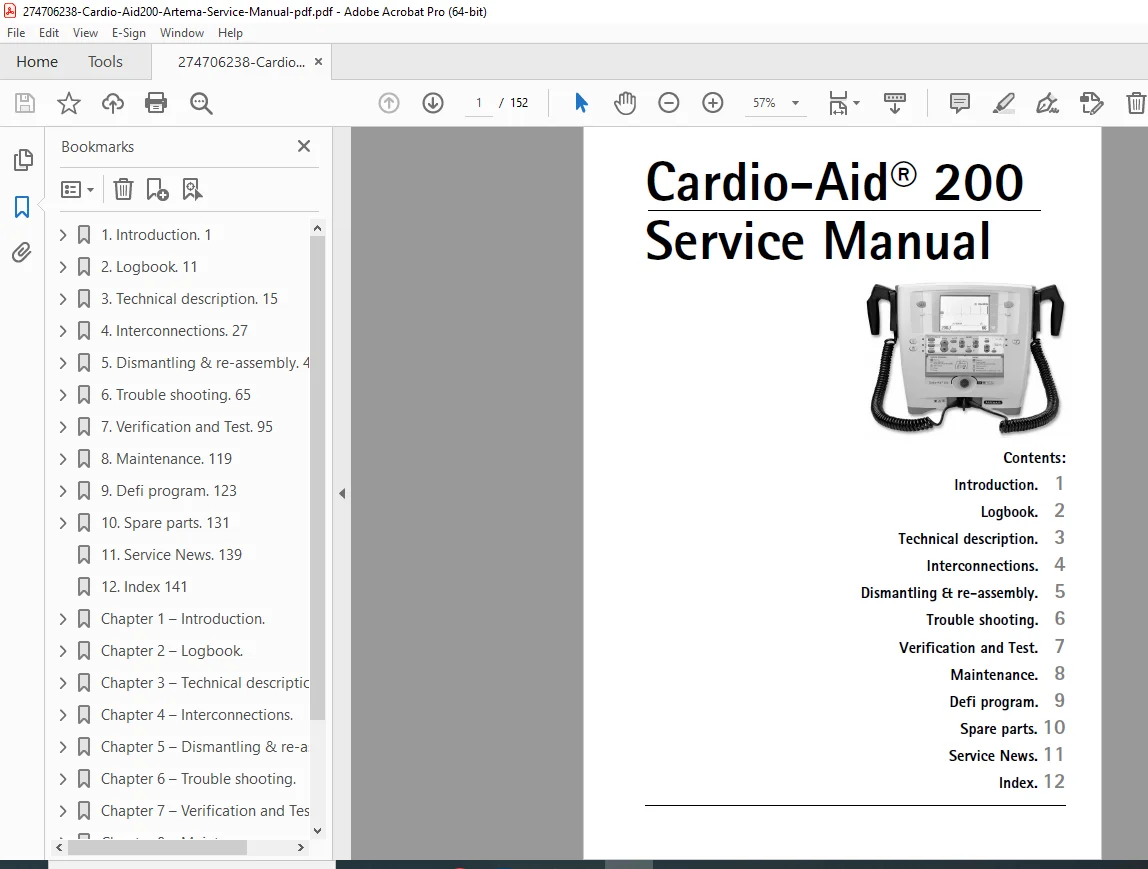
Cardio-Aid 200 Artema Defibrillator Service Manual Repair PDF
Original price was: $85.00.$16.95Current price is: $16.95.
Official Artema Cardio-Aid 200 defibrillator service manual for biomedical technicians and authorized service personnel. This comprehensive 152-page PDF covers complete technical description, troubleshooting, circuit board replacement, verification testing, and calibration procedures for this professional medical defibrillator. Includes detailed interconnections, dismantling instructions, self-test procedures, error code diagnostics, and spare parts catalog. Essential manual for hospital biomedical departments and certified service centers.
Description
Cardio-Aid 200 Artema Defibrillator Service Manual Repair PDF DOWNLOAD
DESCRIPTION
Cardio-Aid® 200 Defibrillator Service Manual – Complete Professional Medical Device Service Reference
This is the official factory service manual for the Artema Cardio-Aid® 200 defibrillator, manufactured by Artema MEC A/S (Artema Monitoring & Emergency Care). Published in November 2001 (Manual No. 95900-B), this professional-grade technical documentation is essential for biomedical technicians, hospital clinical engineering departments, and authorized service centers who maintain and repair this life-saving cardiac emergency equipment.
📋 FILE DETAILS
- Manual Name: Cardio-Aid® 200 Service Manual
- Device Covered: Artema Cardio-Aid 200 Defibrillator/Monitor
- Manufacturer: Artema MEC A/S (Artema Monitoring & Emergency Care)
- Publication Date: November 2001
- Manual Number: 95900-B
- Total Pages: 152 pages
- File Format: PDF
- PDF Quality: High-quality official manual
- Language: English
- Page Size: A4 format
🔧 COMPREHENSIVE COVERAGE INCLUDES:
Chapter 1: Introduction (Detailed Product Overview)
Service Policy:
- Three-tier service strategy
- Field service procedures (hospital biomedical departments)
- Authorized distributor service
- Factory service options
- Remote troubleshooting capabilities
- PC-based service kit information
The Cardio-Aid® 200 Product:
- Philosophy of Design:
- First responder mode
- Experienced user mode
- Operating Modes:
- Semi-automatic mode (AED functionality)
- Manual mode (advanced defibrillation)
- Pacer mode (optional cardiac pacing)
- Test mode (built-in diagnostics)
- Service and Configuration Menus access
- General User Interface principles
- Design Architecture overview
- Memory Card system for software updates
- Printer (optional feature)
- Pads (adhesive electrode system)
- External Paddles (adult/pediatric)
- Internal Paddles (surgical applications)
Installation Options:
- Trolley mount configuration
- Wall mount installation
- Bed mount setup
- Carrying bag portability
Chapter 2: Logbook (Service Documentation)
Service Record Keeping:
- Logbook templates
- Goods to repair documentation
- Complaint form templates
- Service history tracking
- Warranty documentation
- Maintenance record forms
Chapter 3: Technical Description (Complete System Architecture)
Block Description – Major Subsystems:
Power Management:
- Power Supply Board architecture
- Battery-pack system
- Multi-output converter
- Battery fast-charge circuitry
- Energy monitoring system
- Battery capacity management
Defi Board (Main Control):
- Defi Controller and safety logic
- Shock gate circuitry
- High Voltage Generator
- Energy delivery system
- Safety interlocks
ECG Interface:
- ECG signal conditioning
- Artifact rejection
- Arrhythmia detection algorithms
- VF/VT detection
Processor Board:
- Main microprocessor system
- Flash PROM and RAM
- LCD Display Controller
- Real Time Clock
- Voice and sound generator
- Watchdog circuit
- Defi controller interface
- ECG and Printer interface
- PCMCIA interface (memory card)
- Keyboard interface
Defi Test Board:
- Internal defibrillator testing
- Energy measurement
- Waveform verification
ECG Amplifiers:
- Cable ECG board
- Paddle ECG board
- Signal amplification
- Baseline stabilization
- Noise filtering
Printer (Optional):
- Thermal printer mechanism
- ECG waveform recording
- Event documentation
Pacer (Optional):
- Boost regulator
- Pace generator
- Pace security system
- Rate control
- Output adjustment
Chapter 4: Interconnections (Complete Connectivity Reference)
External Connectors:
- Signal type definitions
- Front panel connectors:
- ECG connector pinout
- HV socket specifications
- PCMCIA connector interface
- RS-232 card for PC communication
- System requirements
Internal Connectors (Detailed):
- Defi Board Connectors (19+ connections):
- J4001: Power input from mains supply
- J4002: High voltage output to HV relay
- J4003: High voltage relay coil
- J4005: VSYS RTN
- J4006: HV shield
- J4100: Communication and supply for Processor board
- J4101: Paddles control
- J4102: Defi HV-test and supply
- J4103: Communication for Cable ECG board
- J4104: Communication and supply for Pacer board
- J4107-J4114: ECG amplifier connections
- J4405: Battery power input and printer supply
- EMC shield connections
- ECG Connector Board:
- J801: ECG Input
- J802: ECG signal routing
- Printer Board Connectors:
- J701: Printer data bus and supply
- Processor Board Connectors:
- J3004: LCD data connections
- J3005: LCD CCFL backlight power
- J3006: Keyboard interface
- J3008: Printer communication
- J3010: EMC shield
Chapter 5: Dismantling & Re-assembly (Step-by-Step Procedures)
Component Replacement Procedures:
- Replacing Paddles or Pads holder
- Replacing the battery pack
- Replacing the printer module
- Removing front and rear covers
- Replacing the keyboard PCB and keypad panel
- Service position (open and closed procedures)
- Replacing the Processor board
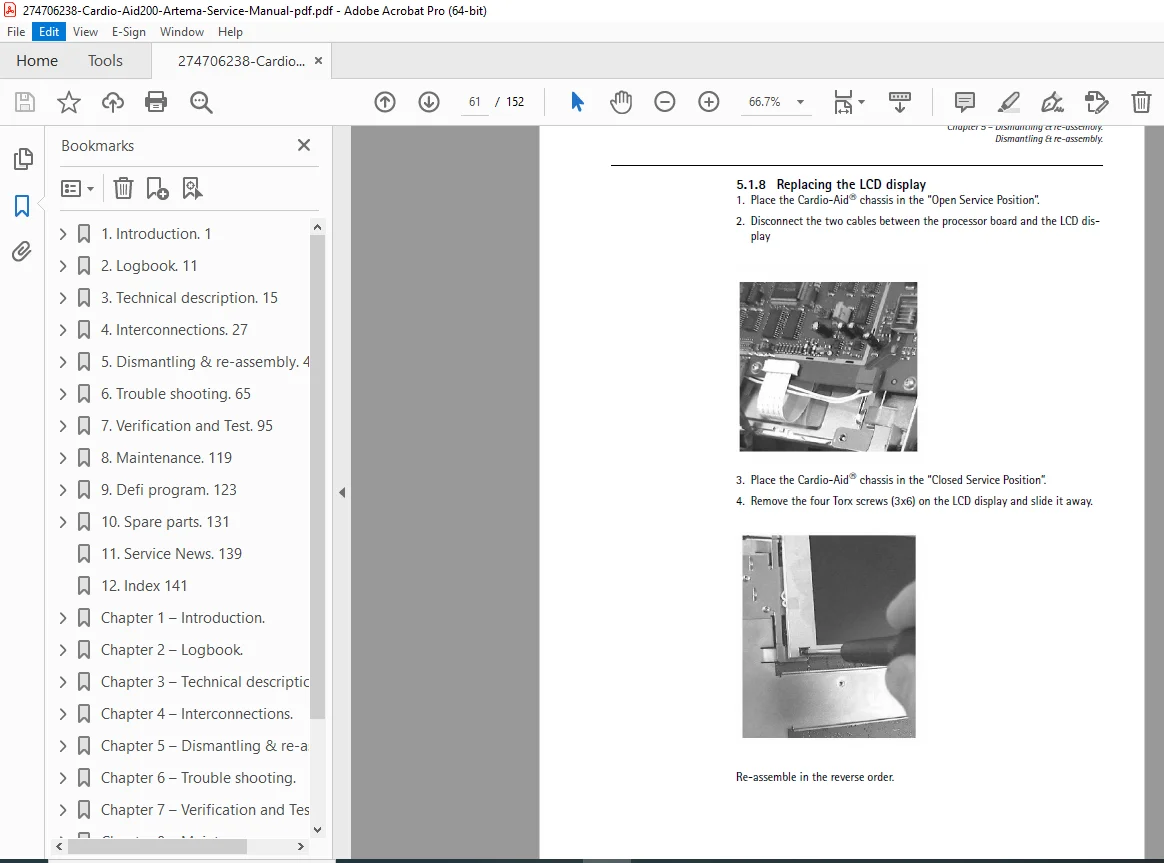
- Replacing the LCD display
- Replacing the Power supply board
- Replacing the ECG connector board
- Replacing the ECG paddle amplifier board
- Replacing the ECG cable amplifier board
- Replacing the Printer connection board
- Replacing the Defi board
- Replacing the optional Pacer board
- Replacing the Defi test board
- Replacing the HV Capacitor (high voltage)
- Replacing keyboard cover (flap)
- Replacing the handle
Safety Precautions:
- High voltage discharge procedures
- ESD protection requirements
- Proper tool usage
- Reassembly verification
Chapter 6: Troubleshooting (Comprehensive Diagnostic Guide)
Self-Test Systems:
- Power-ON self-test
- Wake-up self-test procedures
- Status indicator interpretation
- Error log access and interpretation
Error Log Table:
- Complete error code listing
- Error descriptions
- Impact assessment
- Resolution procedures
Error Messages:
- Error messages and their system impact
- User-visible errors
- Internal diagnostic errors
- Critical failure modes
Fault Finding Procedures (11 Detailed Flowcharts):
- Flowchart A1-A3: Power systems faults
- Flowchart B: High voltage defibrillator faults
- Flowchart C: Display faults
- Flowchart D: Cable ECG faults
- Flowchart E: Printer faults
- Flowchart F: Memory card faults
- Flowchart G: Paddles ECG faults
- Flowchart H: Pacer faults
- Flowchart I: Internal defi-test unit faults
Measurement Details:
- Test point identification on all boards
- Voltage limits for critical test points
- Defi board test points (TP2, TP5, J107, J108)
- Processor board test points
- Power supply board test points
- Defi test board test points
Chapter 7: Verification and Test (Complete Calibration Procedures)
Configuration and Setup:
- Jumper and DIL switch settings
- Configuration menu access
- Service menu functions
- Self-test menu procedures
Battery System:
- Battery system verification
- Resetting the battery monitor
- Battery capacity testing
- Charge system calibration
Test Procedures:
- Calibrating the Pacer board
- Adjusting and testing the LCD display
- Testing the Battery charge system
- Adjusting and testing the defi processor board
- Adjusting and testing the ECG amplifiers
- Retrofitting printer option
Final Testing:
- Safety Test procedures
- Battery Test protocols
- ECG Cable Amplifier Test:
- Noise zero line verification
- ECG gain calibration
- Heart rate readout at 60 bpm
- QRS beep functionality
- Volume adjustment
- Inop (inoperative) detection
- VF detector sensitivity
- Lead placement verification
- External ECG input
- ECG Paddle Amplifier Test:
- Noise zero line
- ECG gain verification
- Heart rate readout
- QRS beep
- Electrode “short” detection
- Electrodes “open” detection
- Paddle ECG signal quality
- Defibrillator Part Test:
- Sync mode operation
- Sync-delay timing
- External Paddles Test:
- Discharge in open air
- Defi tester verification
- Sound check
- Defibrillator safety verification
- Accuracy of delivered energy
- Defi Ready time-out
- Disarm functionality
- Max charge time on mains supply
- Max charge time on battery (@25°C)
- Internal Paddles Test
- Semi-Automatic Function Test
- Printer Test (optional):
- Printer offset calibration
- Printer gain adjustment
- Serial number verification
- Memory Card Functions:
- Format procedures
- Delete data procedures
Final Check Sheet:
- Complete verification checklist
- Sign-off documentation
- Quality assurance procedures
Chapter 8: Maintenance (Preventive Maintenance)
Operator’s Inspection After Use:
- Cleaning procedures
- Visual checks
- Functional test (paddle version)
- Functional test (pads version)
- Pacer test procedures
Routine Inspection Schedules:
- Daily inspection checklist
- Every two weeks inspection
- Complete annual inspection requirements
Updates and Modifications:
- Software update procedures
- Hardware change documentation
- Field modification instructions
Chapter 9: Defi Program (PC-Based Service Software)
PC Service Kit:
- Introduction to remote servicing
- Equipment needed
- Installation procedures
- Setting up the equipment
- Defitest Help program
- Reporting failures
- Verification procedures
- Remote calibration capabilities
Chapter 10: Spare Parts (Complete Parts Catalog)
Parts Lists:
- Printed Circuit Boards catalog
- Cables and interconnections
- Electrical components
- Mechanical items
- Labels (front and rear)
- Complete label kit listings
Accessories:
- Accessory information
- Reorder information
- Part numbers
- Service kit contents
Chapter 11: Service News
- Reserved for service bulletins
- Field modifications
- Product updates
Chapter 12: Index
- Comprehensive alphabetical index
- Quick reference guide
🎯 DEVICE FEATURES & CAPABILITIES:
Defibrillation Modes: ✅ Semi-Automatic (AED mode with automated rhythm analysis)
✅ Manual Mode (operator-controlled energy selection)
✅ Synchronized Cardioversion
✅ Energy range configurable (typical 2-360 Joules)
Monitoring Capabilities: ✅ 3-lead ECG cable monitoring
✅ Paddles ECG “Quick-Look”
✅ Heart rate display
✅ VF/VT detection algorithms
✅ Arrhythmia detection
Optional Features: ✅ Thermal printer for ECG strips
✅ External cardiac pacing (transcutaneous)
✅ PCMCIA memory card for data storage
✅ Internal paddles for surgical applications
Power Systems: ✅ AC mains operation
✅ Rechargeable battery pack
✅ Battery capacity monitoring
✅ Fast-charge capability
💡 IDEAL FOR:
✅ Hospital biomedical engineering departments
✅ Authorized Artema service centers
✅ Clinical engineering technicians
✅ Medical device repair specialists
✅ Emergency medical equipment servicers
✅ Healthcare technology management (HTM) professionals
✅ Military medical maintenance personnel
✅ Ambulance service technical staff
✅ Anyone servicing cardiac emergency equipment
🌟 KEY BENEFITS:
- Life-Critical Equipment Service: Factory procedures for cardiac emergency devices
- Comprehensive Module-Level Repair: Board replacement and troubleshooting
- Built-in Diagnostics: Utilize self-test and error logging systems
- Remote Service Capable: PC-based calibration and troubleshooting
- Minimize Equipment Downtime: Quick diagnostic flowcharts reduce repair time
- Ensure Patient Safety: Factory-approved test and calibration procedures
- Complete Technical Reference: From basic maintenance to complex repairs
- Regulatory Compliance: Maintain medical device standards
- Cost-Effective Service: In-house repairs reduce service costs
- Three-Level Service Strategy: Flexible service model for different capabilities
📊 TECHNICAL SERVICE CONTENT:
System Architecture:
- Complete block diagrams
- Signal flow analysis
- Power distribution
- Communication protocols
- Safety systems
Circuit-Level Information:
- Test point locations
- Voltage specifications
- Component values
- Signal characteristics
- Timing diagrams
Calibration Procedures:
- ECG amplifier calibration
- Energy delivery calibration
- Display adjustments
- Battery monitor reset
- Pacer output calibration
- Printer alignment
Safety Testing:
- Electrical safety verification
- Leakage current testing
- Ground integrity
- Energy accuracy verification
- Synchronization timing
- Safety interlock testing
⚙️ SERVICE EQUIPMENT REQUIRED:
- Digital Multimeter
- Oscilloscope
- Defibrillator Analyzer (for energy measurement)
- ECG Simulator
- PC with RS-232 interface (for remote service)
- Defitest software (available from manufacturer)
- Standard electronic tools
- ESD protection equipment
- High voltage discharge tools
📥 DOWNLOAD INFORMATION:
- Instant Download: Immediate access after purchase
- Format: PDF (viewable on all devices)
- Compatibility: Works on PC, Mac, tablet, smartphone
- Searchable: Full-text search for quick reference
- Printable: Print entire manual or specific sections
- Bookmarked: Navigate easily to any chapter
- High Quality: Clear diagrams, schematics, and photographs
⚠️ IMPORTANT NOTES:
- This is a professional service manual for qualified biomedical technicians
- Contains high-voltage safety warnings (defibrillator circuitry)
- Requires understanding of medical device regulations
- Official Artema MEC A/S documentation
- Essential for maintaining device safety and effectiveness
- Service must comply with local medical device regulations
- Some procedures require manufacturer-specific test equipment
- Biomedical technician certification may be required
🔧 SAFETY WARNINGS INCLUDED:
- High Voltage Hazards: Defibrillator contains lethal voltages
- Capacitor Discharge: Proper discharge procedures before service
- Patient Safety: Verification of proper operation before clinical use
- Electrical Safety: Leakage current and grounding requirements
- Component Handling: ESD-sensitive medical electronics
- Regulatory Compliance: Medical device service requirements
- Sterilization: Cleaning and disinfection procedures
- Calibration Verification: Energy delivery accuracy requirements
🌟 WHY CHOOSE THIS MANUAL?
This is the authentic Artema factory service manual, not third-party documentation. It contains proprietary diagnostic procedures, calibration methods, error code interpretations, and safety test procedures developed by Artema’s medical device engineers. The Cardio-Aid 200 is life-critical emergency equipment requiring factory-level service procedures to ensure patient safety and regulatory compliance.
The manual’s three-tier service strategy supports flexible service models, from basic field maintenance to complete board-level repair, making it valuable for both hospital biomedical departments and specialized service centers.
Order now for immediate download access to complete Cardio-Aid 200 defibrillator service documentation!