
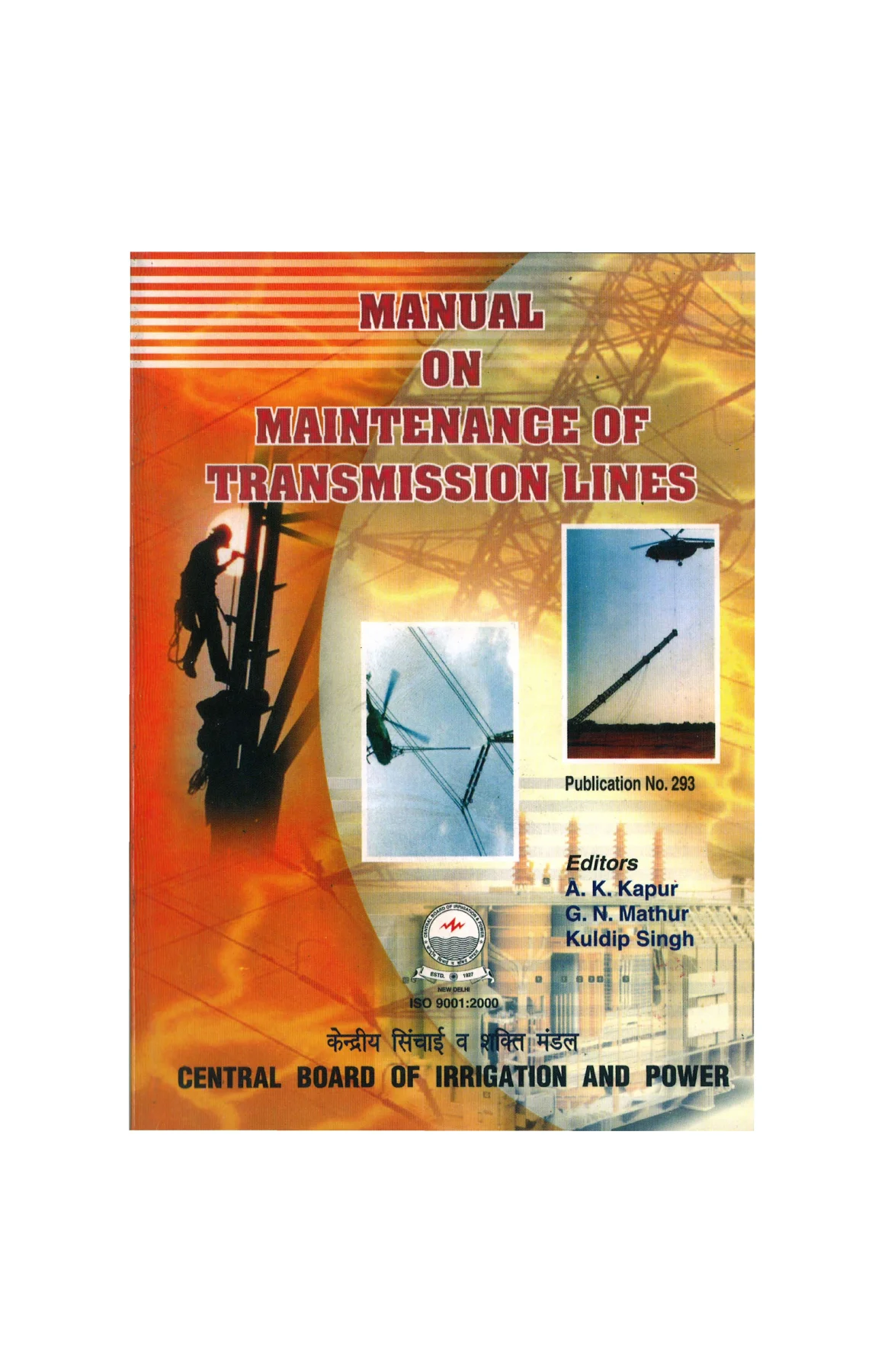
CBIP Manual on Maintenance of Transmission Lines – EHV 66kV-800kV PDF
Original price was: $29.95.$17.95Current price is: $17.95.
The complete CBIP maintenance manual for EHV AC and HVDC transmission lines, covering design parameters, inspection formats, failure diagnosis, condition monitoring, field maintenance procedures, hot line maintenance, insulator washing and emergency restoration.
Description
File Details
- Manual type: Technical maintenance manual, CBIP Publication No. 293
- Publisher: Central Board of Irrigation and Power (CBIP), New Delhi
- Equipment covered: EHV AC transmission lines (66 kV, 110 kV, 132 kV, 220 kV, 400 kV, 800 kV) and 500 kV HVDC transmission lines
- Language: English
- Page count: 236 pages
- File format: PDF
- Publication No.: 293
- ISBN: 81-7336-300-5
- Year: 2005
- Editors: A. K. Kapur, G. N. Mathur, Kuldip Singh
Chapters Covered
- Design Parameters for Transmission Lines — wind zones and basic wind speeds, maximum conductor and earth wire temperatures, design span and weight span tables, tower steel sections, permissible bolt stresses, zinc coating weights, sag templates, electrical clearances, ground clearances, clearances above rivers and lakes, conductor-to-groundwire clearances at tower and midspan, clearances at power line, communication line and railway crossings, insulators and string configurations, right of way requirements, PTCC limits, conductor and earth wire property data
- Inspection and Maintenance Formats of Transmission Lines — ground patrolling, tower climbing inspection, schedules of inspection and maintenance activities, fault inspection of lines, inspection reports for major maintenance work, plus eight standard reporting formats covering ground patrolling, tower climbing for critical lines, live line punctured insulator detection, maintenance schedules, faulty line inspection, major maintenance and breakdown work, insulator IR values under shutdown, and contact resistance of joints
- Probable Causes of Failure of the Transmission Line Components — insulators and hardware fittings, conductor and conductor accessories, adverse effects of vibration, earthwire and its accessories, towers, bolts and nuts, rusting, tower foundations, erosion at the base of foundation and tower legs, damage to earthing electrodes and strips
- Condition Monitoring of EHV Transmission Lines — philosophy and advantages, corrosion measurement of steel in foundations, tower footing resistance measurement, conductor corrosion detection, contact resistance measurement of conductor joints, clearance checking, insulator condition monitoring including IR measurement at ground and in situ, live line punctured insulator detection, contamination measurement, ESDD and NSDD, coronography, line signature analyzer, thermovision scanning, monitoring of spacers and hardware fittings, advanced real-time condition monitoring techniques
- Maintenance Procedures of EHV Transmission Lines — locating faults, patrolling and scheduling, general safety precautions, attending to tower collapse, stub repair procedures with required tools and materials, insulator replacement for twin and quad bundle conductor lines including suspension and tension strings and V-strings, catching off and holding twin and quad conductors, raising and lowering conductors and insulators to the ground, repairing twin conductor at ground on tension and suspension towers, jointing procedures, repair of twin or quad conductor in situ with mid span compression joint or repair sleeve, temporary repair, repair of failed jumpers and earthwire, replacement of nuts and bolts, replacement and repair of spacer and spacer dampers, anti-corrosive measures, preventive maintenance of tower foundations, earthing maintenance, tree cutting and trimming
- Hot Line Maintenance — history and development of hot line tools, training, methods including hot stick, bare hand and combination, hot line operations, safety rules, safe electrical clearances, effect of leakage current on the body, ropes and hot line knots, safe practices for live line barehand maintenance, hot stick design considerations, epoxy glass stick advantages, types and loading capacities of epoxy and metallic tools, care and maintenance of tools, replacing ferrules on epoxiglass poles, protecting and inspecting tools, live line barehand maintenance principle and history, equipment, bonding procedure, important tools, detailed procedures for hot line work on 66 kV, 132 kV, 220 kV and 400 kV lines using hot stick, trolley pole and barehand techniques, tightening of nut bolts and replacement of spares and jumpers in substations up to 800 kV
- Insulator Washing/Cleaning — types of contaminants such as salt, cement or lime, dust, bird defecation, chemical, smog, cooling tower effluents and smoke, pollution management, methods of cleaning under energized conditions including high pressure water washing with hand held, remote control, fixed spray and helicopter mounted nozzles, medium pressure washing, low pressure washing, compressed air dry cleaning and hot wiping, cleaning under de-energized conditions and hand cleaning, cleaning of polymer insulators, safety procedures and technical considerations for live-line cleaning with water, resistivity measurement and monitoring, water pressure, nozzle orifice, safety, frequency and results of cleaning, general guidelines, training, equipment and public considerations, limitations, practical experience in hot line washing in India, and other pollution cleaning methods including cleaning of greased insulators, silicone protective coatings and silicone RTV coatings
- Emergency Restoration of Damaged Transmission Lines — advantages of ERS, components of ERS including foundation plate, gimbal joint, column section, guy plate, insulators and hardware, anchoring system and gin pole, deployment of ERS including route alignment, computerized calculations, erecting structure by gin pole, light duty crane, winch line or helicopter, anchoring systems, stringing and clipping, general precautions, safety aspects and training
This CBIP Manual on Maintenance of Transmission Lines is a complete maintenance reference for the extra-high-voltage transmission network, bringing together design parameters, inspection formats, failure diagnostics, condition monitoring and detailed step-by-step maintenance procedures for lines operating from 66 kV up to 800 kV AC and 500 kV HVDC. Prepared by an expert group under the Central Board of Irrigation and Power, it collects in one place the design data, field procedures, safety rules, tool lists and standard reporting formats that transmission line engineers, supervisors and maintenance crews need to keep EHV lines in reliable service.
What This Manual Provides
The document goes well beyond general advice. The design parameter chapter gives the wind zone table, maximum conductor and earth wire temperatures, design and weight span tables for each voltage class, minimum zinc coating specifications, and the sag template construction that determines tower positioning and statutory clearances. The electrical design section reproduces the air clearance, ground clearance, midspan clearance, railway and communication line crossing, and right-of-way tables used in Indian practice. Later chapters translate these figures into field action: how to inspect a line from ground and from the tower, how to fill the standard patrolling and maintenance formats, how to diagnose the probable cause of a failed insulator, conductor, earthwire, tower or foundation, and how to carry out the repair under live or de-energized conditions.
Condition monitoring is treated as a full subject, with methods for measuring stub and anchor bolt corrosion, tower footing resistance, conductor corrosion, contact resistance of joints, and conductor clearances, plus insulator IR measurement, live-line punctured insulator detection, ESDD and NSDD contamination measurement, coronography, line signature analysis, thermovision scanning, and spacer damper monitoring. Advanced real-time monitoring of transmission line parameters is also described.
The maintenance procedures chapter is the operational core of the manual and works through specific jobs: attending to a tower collapse, repairing a damaged stub with joint cleats and cover plates, replacing suspension and tension insulator strings on twin and quad bundle lines, catching off and holding conductors, raising and lowering conductor and insulator assemblies to the ground, repairing twin conductor at ground on tension and suspension towers, making mid span compression joints and repair sleeves, repairing failed jumpers and earthwire at dead end, suspension clamp or midspan, replacing nuts and bolts, replacing spacers and spacer dampers, applying anti-corrosive measures, preventive maintenance of tower foundations, earthing maintenance, and tree cutting to maintain the right of way.
Hot line maintenance is covered in depth, from the history and development of hot line tools through training, safe electrical clearances, rope types and hot line knots, and the safe practices required for barehand work. The tool chapters list the epoxy glass and metallic tools with their loading capacities and describe how to care for, inspect and repair them. Detailed step-by-step procedures are given for hot line work on 66 kV, 132 kV, 220 kV and 400 kV lines using the hot stick method, trolley pole method and barehand technique, including work in double circuit suspension towers and tension towers.
Insulator washing and cleaning is treated as its own chapter because pollution flashover is a major cause of transmission line trips. The manual explains the eight main contaminant types, how to manage pollution, and the methods available for cleaning energized and de-energized insulators, including high pressure water washing with hand held, remote control, fixed spray or helicopter mounted nozzles, medium and low pressure washing, compressed air dry cleaning, hot wiping and hand cleaning. Safety procedures, water resistivity limits, safe nozzle-to-conductor distances, frequency of cleaning, and the practical experience of Indian utilities with live line washing are all included, along with silicone grease and RTV coating methods. The final chapter covers emergency restoration of damaged transmission lines using Emergency Restoration Systems, describing the advantages of ERS, the major components, and deployment by gin pole, light duty crane, winch line or helicopter, with anchoring options for normal, marshy and rocky soils.
Who This Manual Is For
This transmission line maintenance manual is written for transmission line O&M engineers, supervisors, junior engineers, linemen, hot line crews, and utility training centres working on EHV AC and HVDC transmission systems. It is also useful for manufacturers of transmission line hardware who need to understand field maintenance requirements, and for engineering students and consultants who want a single reference on Indian EHV transmission line maintenance practice.
Get the CBIP Manual on Maintenance of Transmission Lines PDF Today
IMAGES PREVIEW
With the CBIP Manual on Maintenance of Transmission Lines you can plan and execute preventive maintenance, diagnose the likely cause of a failed component, carry out insulator replacement and conductor repair on twin and quad bundle lines, perform condition monitoring measurements, follow safe hot line maintenance procedures, manage insulator pollution, and restore damaged lines quickly with an Emergency Restoration System. Using the correct procedures, clearances, torque values and safety rules is what keeps EHV lines reliable and keeps maintenance crews safe. This PDF downloads instantly after payment, with no shipping and no waiting, and can be stored, searched and printed from any device so the procedures you need are always available on site or in the office.
Reviews
There are no reviews yet.