
Chevrolet Spark 1.0 Engine Repair Manual Spanish Translation – M-Car Service Training Guide PDF
Original price was: $37.95.$24.95Current price is: $24.95.
Bilingual English/Spanish service training manual for the Chevrolet Spark 1.0L SOHC M-Car platform, covering engine repair, Sirius D4 engine management, manual transaxle, suspension, steering and brakes.
Description
Chevrolet Spark 1.0 Engine Repair Manual — Spanish Translation
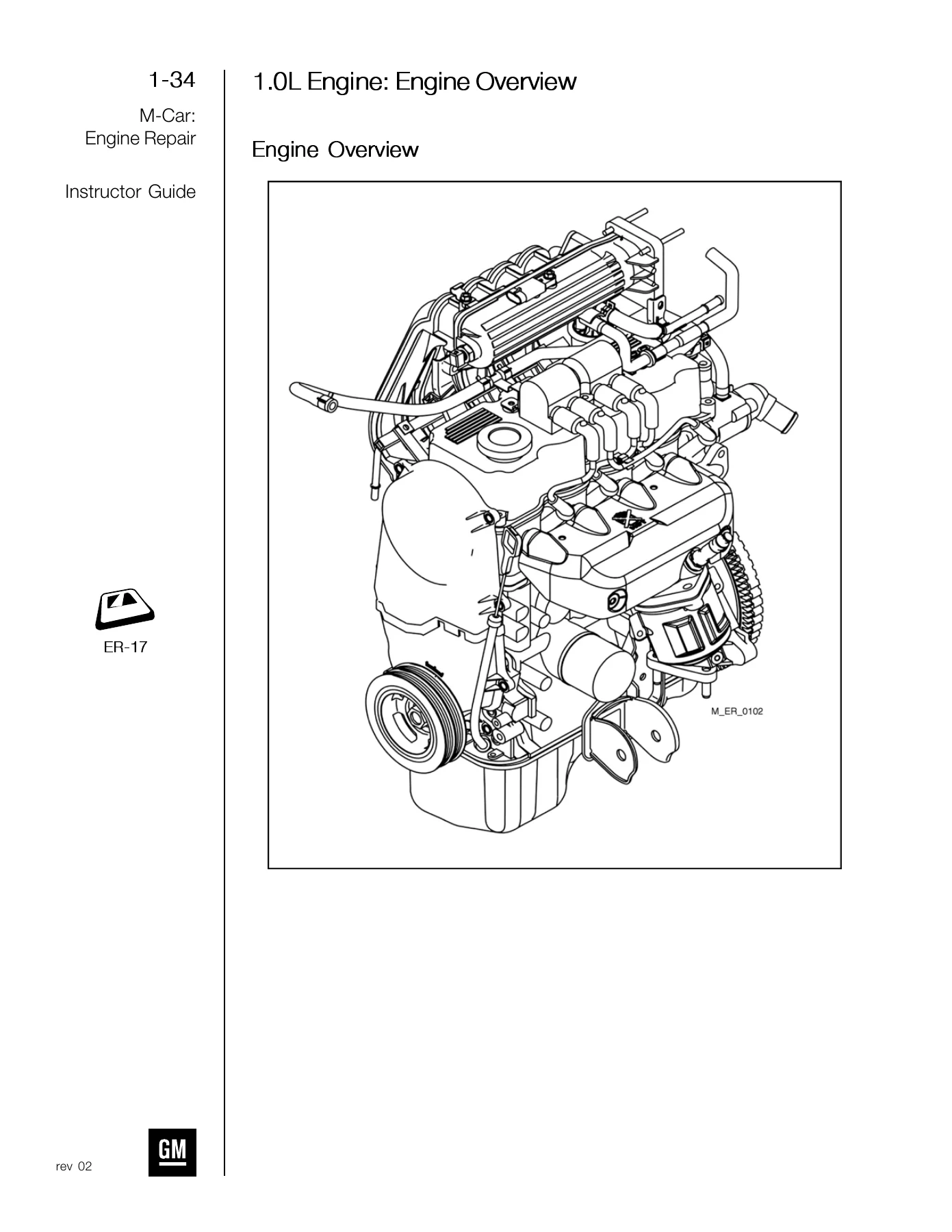
This Chevrolet Spark 1.0 engine repair manual is the Spanish-translated service training guide used for the M-Car platform. It pairs the original English instructor material with a full Spanish translation, making it a practical reference for technicians who work on the 1.0L SOHC four-cylinder engine and its supporting systems. The document walks through engine mechanical repair, Sirius D4 engine management, the manual transaxle, suspension and steering, and the brake system — with exploded views, wiring schematics, hydraulic circuits, specification tables and step-by-step adjustment procedures.
File Details
- Manual type: Service Training / Instructor Guide (Spanish translation)
- Brand: Chevrolet
- Model: Spark / M-Car (Matiz 1.0L)
- Language: English and Spanish (bilingual)
- File format: PDF
- Page count: 226 pages
- Engine covered: 1.0L SOHC (B10S1, in-line 4-cylinder); reference data also given for 0.8L SOHC
Chapters Covered
- 1.0L Engine: Specifications, Overview, Timing Belt, Valve Clearance, Belts
- 1.0L Engine: Lubrication, Intake, Exhaust, Cooling, Fuel, EVAP
- Sirius D4 Engine Performance (Sensors, ECM, EEGR, CCCP, DTCs)
- Manual Transaxle (Clutch, Shift Control, Gear Train, Differential)
- Suspension and Steering (Front, Rear, Power Steering)
- Brakes (Front, Rear, Master Cylinder, ABS)
1.0L Engine — Mechanical Repair
The engine section opens with a full specification table for the 1.0L SOHC: maximum speed 152 km/h, maximum power 46.5 kW (63.2 ps) at 5400 rpm, maximum torque 8.9 kg.m (64.4 lb.ft) at 4200 rpm, bore × stroke 68.5 × 67.5 mm, total displacement 995 cc and compression ratio 9.3:1. Valve timing, idle speed (850 rpm warm, 900 rpm with A/C on), ignition type, ignition timing and spark plug data are all laid out for both unleaded and leaded fuel variants. The engine generation code is decoded (B10S1: B = In-Line 4 Cylinder, 10 = 1.0L, S = SOHC 2V, I = Engine Generation Code) along with the full engine number format (assembly line, plant location K: Korea, sequential number).
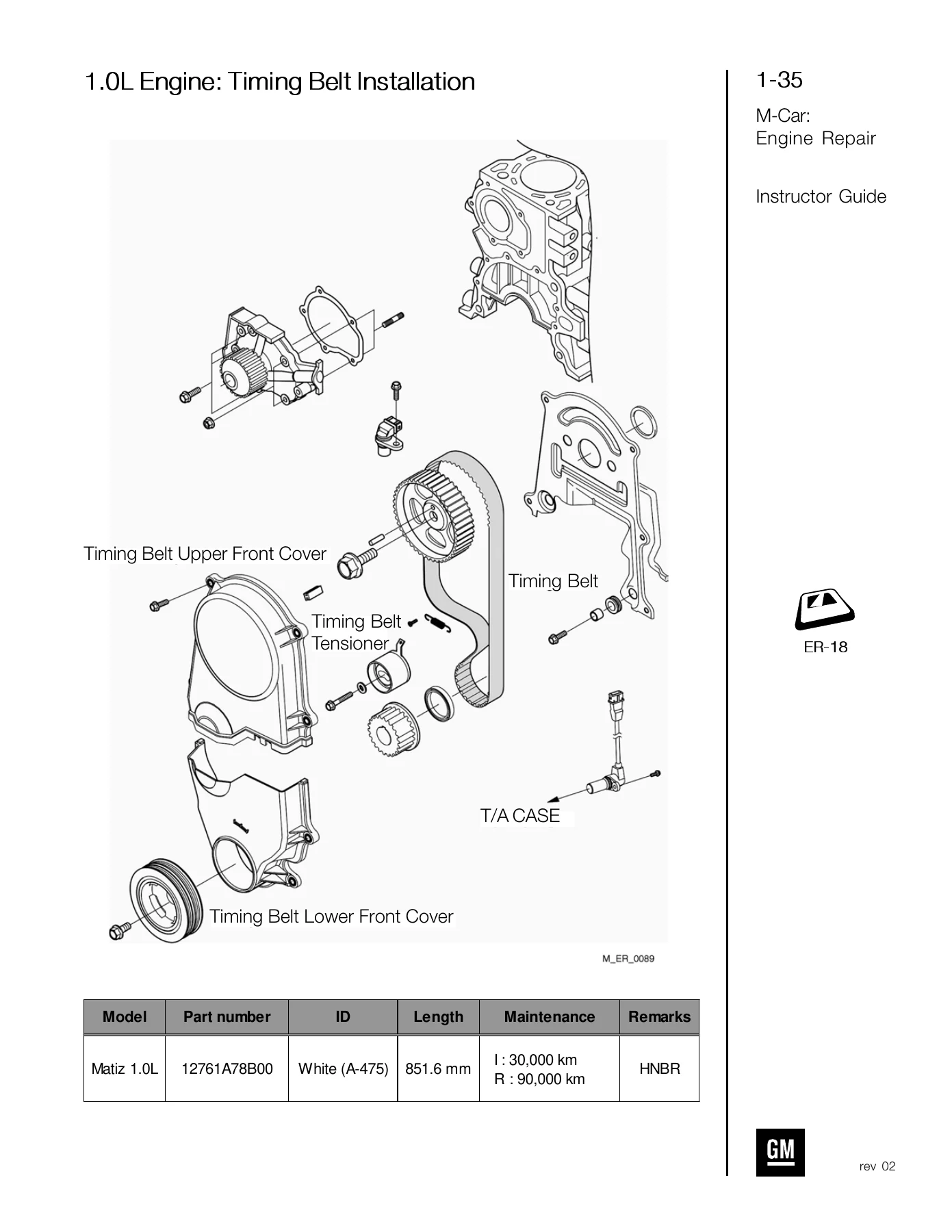
Timing belt installation is shown with a detailed exploded view: upper and lower front covers, tensioner, idler, and the Matiz 1.0L belt (part number 12761A78B00, 851.6 mm, HNBR, inspection at 30,000 km / replacement at 90,000 km). Timing belt adjustment is covered with the cam sprocket and crankshaft sprocket alignment marks, followed by valve clearance checking and adjustment — including the cold and hot clearance values for both 0.8L and 1.0L engines and the procedure for rotating the crankshaft 360° to check the exhaust top dead centre.
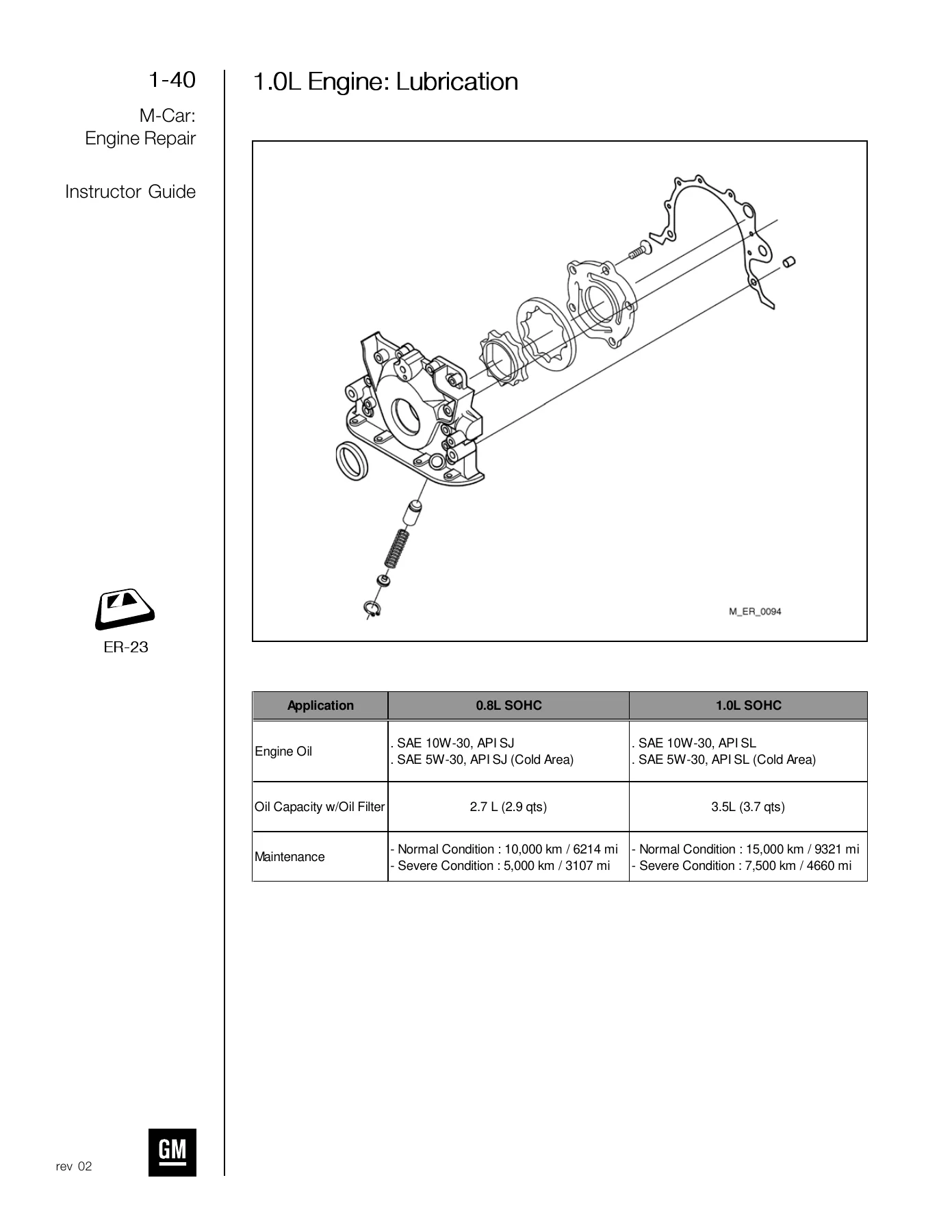
The accessory belt section maps the alternator (635 mm), power steering (665 mm) and A/C (735 mm) rib belts, plus the combined A/C + power steering belt (910 mm). Lubrication coverage includes the oil pump (idle 1.73 kg/cm², 2000 rpm 3.0–3.5 kg/cm²), oil pressure switch torque (1.22–1.63 kgm), oil capacity with filter (3.5 L) and maintenance intervals (normal 15,000 km, severe 7,500 km for the 1.0L).
Intake, Exhaust, Cooling and Fuel
The intake section identifies the intake manifold, EGR pipe, EGR valve, throttle body, air filter assembly (non-woven fabric, 6.0 L), main resonator (1.9 L, 87 Hz), auxiliary resonator (450 Hz) and snorkel, with the plastic intake manifold volume of 1732 cm³. The exhaust chapter details the pup-up catalytic converter, front exhaust pipe/catalytic converter assembly, front muffler pipe and rear muffler pipe, along with front catalyst (0.34 L), main catalyst (1.54 L), front muffler (3.4 L) and rear muffler (9.0 L) volumes.
Cooling system coverage includes the thermostat (starts to open at 82°C ± 1.5, fully open at 95°C, closes at 80°C), cooling fan (300 mm, 14 A, 70–90 Ω at 23°C, 95–125 Ω at 125°C) and radiator dimensions (458 × 295 × 27 mm). The fuel system chapter explains the in-tank fuel pump, ECM fuel pump cut-off logic (2 seconds after ignition ON with no reference pulse or engine stop), the fuel pressure regulator (3.88 kg/cm² / 55 psi), the fuel quantity gauge angle/resistance table, and the fuel filter maintenance interval (every 3 years or 45,000 km).
Sirius D4 Engine Performance
This section is the electronic heart of the manual. It opens with the ECM type by market (FENIX 5MR / SIRIUS D3 / SIRIUS D4, SASCO and SIEMENS families, 55-pin and 90-pin connectors) and a full ECM input/output block diagram covering power supply, MAP, TPS, ECT, O2 sensors, IAT, evaporator thermistor, VSS, CKP, CMP, knock sensor, EEGR position, power steering pressure, headlamp ON signal, A/C request, octane select, fuel level, VR sensor, rough road, diagnostic request and ground.
Each sensor gets its own sub-chapter with operation, location, connector pinout, inspection procedure and reference values: upstream and post oxygen sensors (zirconia, heated, 6.0 Ω heater, 150 ms lean-to-rich, 250 ms rich-to-lean), engine coolant temperature sensor (NTC curve and resistance table), intake air temperature sensor (resistance/voltage table from −10°C to 35°C), Main Throttle Idle Actuator (MTIA — idle switch, two potentiometers, limp-home at 5.1%, 0–24° throttle angle control), vehicle speed sensor for A/T, MAP sensor (piezo, 4.7–5.0 V signal, vacuum pump pressure table), crankshaft position sensor (inductive, 460–620 Ω, 0.3–1.7 mm clearance), camshaft position sensor (Hall effect, 5 V/12 V reference), knock sensor (piezo, 18–34 mV/g at 5 kHz, 15–25 Nm torque), A/C evaporator thermistor, power steering pressure switch and rough road detection (G sensor and ABS-based).
The fuel injector chapter gives static flow (1.35 ± 4% g/sec), dynamic flow (2.565 ± 4% g/sec), 14.5 Ω resistance, cut-off at 6500 rpm and re-wetting at 6000 rpm. The electronic ignition (EI) system section covers the coil-driver-in-ECM design, primary coil 0.5 ± 0.05 Ω, secondary 5.1 ± 0.3 kΩ and high-tension cable resistance 1.8–8 kΩ. The EEGR chapter lists enable conditions (VSS ≥ 3 kph, RPM < 4768, TPS not closed/WOT, ECT ≥ 40°C, IAT ≥ 20°C, battery ≥ 11.5 V, MAP between 28 and 82.2 kPa, A/F ≥ 13.4) and the CCCP solenoid specifications (24–28 Ω at 20°C, 10 Hz, 0–100% duty).
The DTC chapter is a comprehensive diagnostic trouble code table for the Sirius D4 ECM, listing fault codes from P0107 through P1661 with function, type and MIL status — MAP, IAT, ECT, TPS, O2 sensors, fuel trim, MTIA, fuel pump relay, injectors, misfire, CKP, CMP, knock sensor, rough road, EGR, EVAP purge, cooling fan, VSS, idle charge actuator, A/C compressor relay, system voltage, ECM checksum/RAM/write errors, immobilizer and MIL circuits.
Manual Transaxle
The manual transaxle chapter covers the clutch (single dry plate, 170 mm outside diameter, 110 mm inside diameter, 7.15 mm thickness for 0.8L; 184 mm / 127 mm / 7.65 mm for 1.0L), pedal travel (100–110 mm) and clutch engagement clearance (30–40 mm). Special tools are listed with part numbers. The drive shaft parts are exploded (outer Rzeppa joint, boots, clamps, drive axle shaft, inner Tripot joint and housing). The five-speed transaxle (Y3S for 0.8L, Y4M for 1.0L, DWM) uses synchronized mesh for 5 forward speeds and sliding idle gear for reverse. Gear ratios, final drive ratio, oil capacity (2.1 L SAE 75W-85 GL-4) and maintenance intervals are tabulated. The reverse gear miss-shift preventing mechanism is explained with a shift pattern illustration.
Shift control, gear train (input shaft, counter shaft, synchronizers, bearings, circlips), differential (case, ring gear, bearings, oil seals, pinion gears, side gears, shims) and maintenance (fluid level check, drain plug, oil level plug, changing fluid) are all documented. A noise diagnosis section distinguishes differential side bearing noise from wheel bearing noise.
Suspension and Steering
Front suspension is a McPherson strut type with stabilizer bar (24 mm outside diameter) and coil spring (374 mm no-load height). Rear suspension is an isolated trailing link with shock absorber (max 394.5 mm, min 257.5 mm, stroke 137 mm) and coil spring (291 mm no-load). Front toe adjustment, rear wheel bearing end play (0 mm) and pre-load (0.137–0.422 Nm) are covered with illustrations. Special tools are listed with part numbers. Power steering is a hydraulic rack and pinion system (15.7:1 ratio) with vane-type pump, control valve unit, power cylinder, fluid reservoir and cooler. Control valve operation is explained for neutral and turning conditions. Pressure testing (pump relief valve 5,197.7–5,688.1 kPa / 754–825 psi, pre-load 294.1–490.3 kPa / 43–71 psi), bleeding procedure, pre-loading the steering gear and straight-ahead check with inside/outside angle values are all included.
Brakes
The brake chapter covers front disc brakes (solid rotor, 236 mm diameter, 20.64 mm bore, 0.25:1 pressure ratio), rear drum brakes (180 mm inside diameter, 17.46 mm wheel cylinder), tandem master cylinder, proportioning valve (cut-in 2,451.6 kPa / 356 psi), power booster and DOT-3/DOT-4 fluid (0.45 L). Parking brake, fluid lines, lining inspection and rotor inspection are documented. The ABS section explains the need for ABS, the EBC 430 system, the hydraulic control unit, ECBM, isolation valve/dump valve operation (normal, isolation, dump, reapply modes), electronic brake distribution, proportioning function, wheel speed sensors, warning light and a full DTC table for the ABS system.
Why This Manual Matters
Working on a Chevrolet Spark 1.0 without the correct procedures and specifications is a gamble. This manual gives you the exact torque values, clearances, pressures, resistances and diagnostic thresholds the factory training programme uses. The exploded views show you how components fit together before you remove a single bolt, and the wiring and hydraulic schematics let you trace faults logically instead of replacing parts by guesswork. The bilingual English/Spanish format is particularly useful for technicians who work in Spanish-speaking markets or who need to cross-reference the original English terminology with the Spanish translation.
Whether you are replacing a timing belt, adjusting valve clearance, diagnosing a P0300 misfire, rebuilding a manual transaxle, tracing a power steering leak or troubleshooting an ABS fault, this Chevrolet Spark 1.0 engine repair manual provides the reference material you need in one organised PDF.
IMAGES PREVIEW
Instant PDF Delivery
The manual is delivered as an instant PDF download after payment — no shipping, no waiting. Read it on any device: laptop, tablet or smartphone. Print the pages you need for the workshop and keep the digital copy for quick searches on screen. This is the complete 226-page document, not a sample or excerpt, and it is the same material used in the M-Car service training programme.
Reviews
There are no reviews yet.