
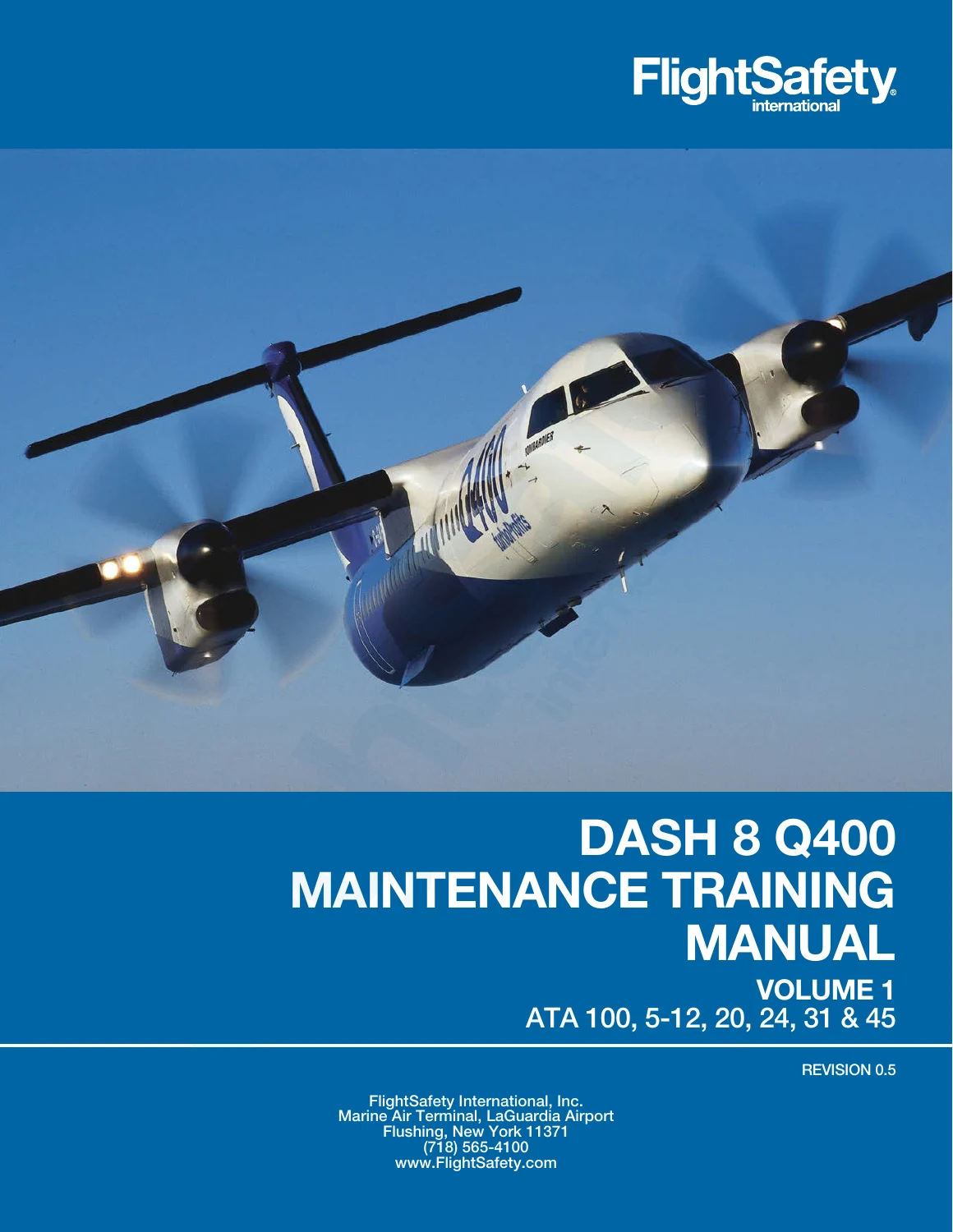
FlightSafety Dash 8 Q400 Maintenance Training Manual Volume 1 Rev 0.5 (2015)
Original price was: $34.95.$19.95Current price is: $19.95.
FlightSafety International Volume 1 maintenance training manual for the Dash 8 Q400 / Q400 NextGen, Revision 0.5 (November 2015). Covers ATA 100, 5-12, 20, 24, 31 and 45 with aircraft general handling, airframe standard practices, electrical power, indicating and recording, and the central diagnostic system.
Description
FlightSafety Dash 8 Q400 Maintenance Training Manual Volume 1 Rev 0.5 (2015)
The FlightSafety Dash 8 Q400 Maintenance Training Manual Volume 1 Rev 0.5 (2015) is the first volume of the FlightSafety International Maintenance Training Manual (MTM) used with Bombardier Q400 maintenance initial courses. Volume 1 is arranged in ATA-100 chapter order and covers ATA 100, 5-12, 20, 24, 31 and 45. It describes the Q400 / Q400 NextGen airframe, systems layout, ramp handling and selected system operation so technicians can learn terminology, safety precautions, component locations and condensed maintenance practices. The MTM is for familiarization and training only. Condensed tasks in this book do not replace the Aircraft Maintenance Manual, Structural Repair Manual, Component Maintenance Manual or Maintenance Requirements Manual. If data here conflicts with the manufacturer or the FAA, the manufacturer or FAA publication takes precedence.
File Details
- Manual type: Maintenance Training Manual (MTM), Volume 1
- Brand / model: FlightSafety International — Dash 8 Q400 / Q400 NextGen (DHC-8-400)
- Language: English
- Page count: 529
- File format: PDF
- Revision: 0.5, November 2015
- Edition history: Second Edition 0 (August 2013); Revisions 0.1 (April 2014), 0.2 (August 2014), 0.3 (April 2015), 0.4 (October 2015), 0.5 (November 2015)
- Cover ATA scope: 100, 5-12, 20, 24, 31 and 45
Aircraft and Powerplant Described in This Volume
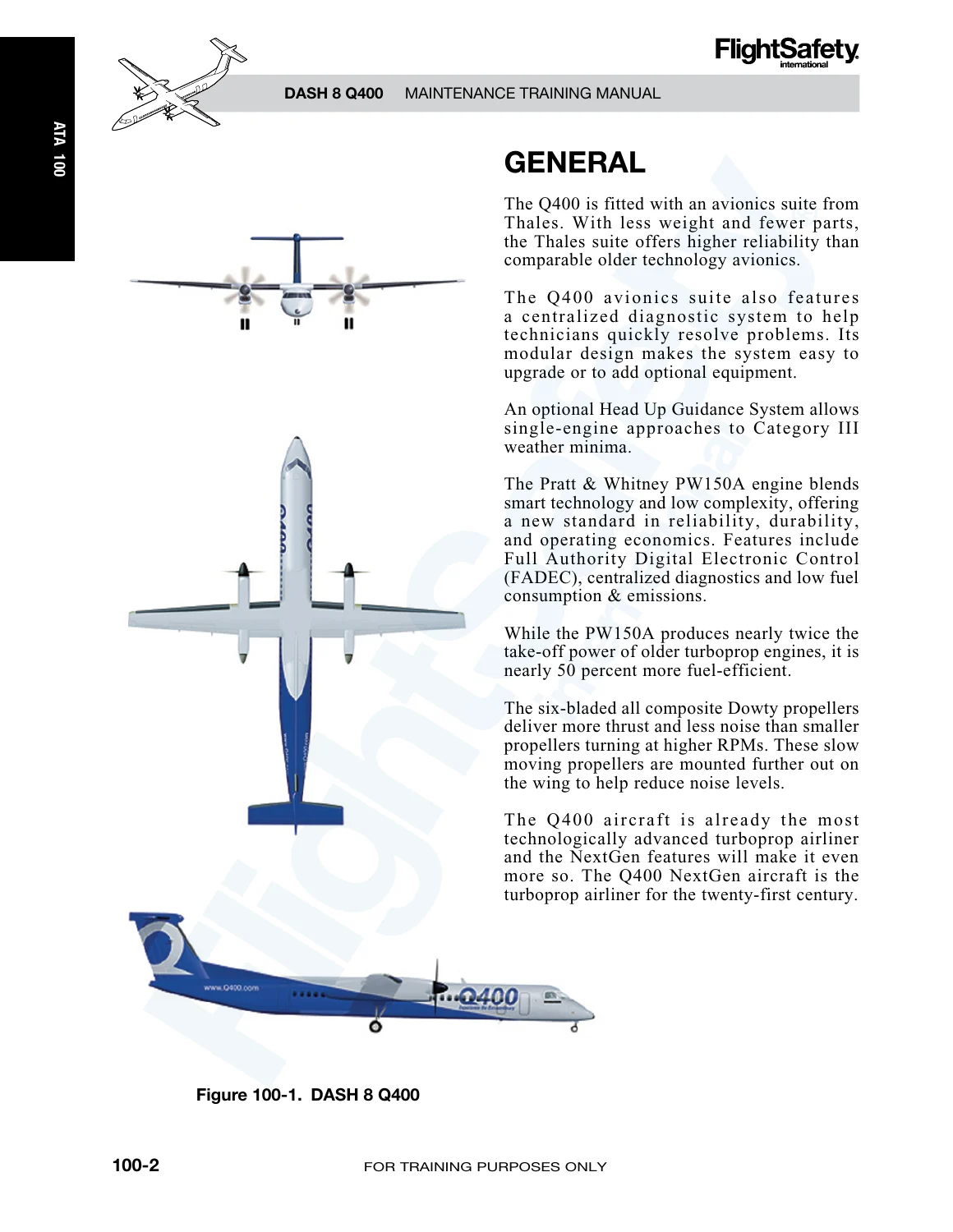
The introduction presents the Dash 8 Q400 as a twin turboprop with a Thales avionics suite, optional Head Up Guidance System for Category III approaches, Pratt & Whitney Canada PW150A engines with FADEC, and Dowty R408 six-bladed composite reversible-pitch propellers of 13 ft 6 in (4.11 m) diameter. Crew is two plus two or three flight attendants; passenger capacity is listed as 68 to 78 at 30–34 in (76–86 cm) seat pitch.
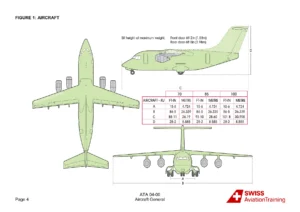
Engine ratings printed in the general data tables are normal takeoff 4,580 shp, maximum 5,071 shp, maximum cruise 3,947 shp and maximum climb 4,058 shp. External dimensions include overall length 107 ft 9 in (32.84 m), wingspan 93 ft 3 in (28.42 m), overall height 27 ft 5 in (8.34 m) and fuselage maximum diameter 8 ft 10 in (2.69 m). Cabin length excluding the cockpit is 61 ft 8 in (18.80 m) with maximum height 6 ft 5 in (1.95 m) and cabin pressurization 5.5 psi (37.9 kPa). Fuel capacity is given as 1,724 U.S. gal (6,526 L); oil capacity is 8.0 U.S. gal (30 liters) per engine. Weights include maximum takeoff 64,500 lb (29,257 kg), maximum landing 61,750 lb (28,009 kg), maximum zero fuel 57,000 lb (25,855 kg), operating weight empty 37,888 lb (17,185 kg) and maximum payload 19,112 lb (8,670 kg). Maximum cruise speed is 360 kts; maximum operating altitude is 25,000 ft (7,620 m), with an optional ceiling of 27,000 ft (8,230 m). Structural figures assume a 50-minute flight: crack-free life 40,000 flights / 32,670 flight hours and design life 80,000 flights / 65,340 flight hours. Line checks are listed every 50 flight hours and structural inspection every 40,000 flights.
IMAGES PREVIEW
Chapters Covered
- ATA 100 Introduction — Q400 NextGen overview; engines, propellers, Thales avionics, navigation and communication equipment; dimensions, doors, weights, fuel and oil, performance; maintenance program and structural integrity; Bombardier Q400 MI course objectives; MTM purpose; Aircraft Maintenance Manual organization, ATA numbering, page blocks, AMTOSS task numbers, warnings/cautions/notes
- ATA 05 Time Limits / Maintenance Checks — Maintenance Requirements Manual parts; MRB report and revision process; systems/powerplant, structural, zonal, EWIS, CPCP and L/HIRF programs; Airworthiness Limitation Items (CMR, structural ALI, safe-life discard, fuel system limitations, CDCCL); unscheduled checks after non-normal operations
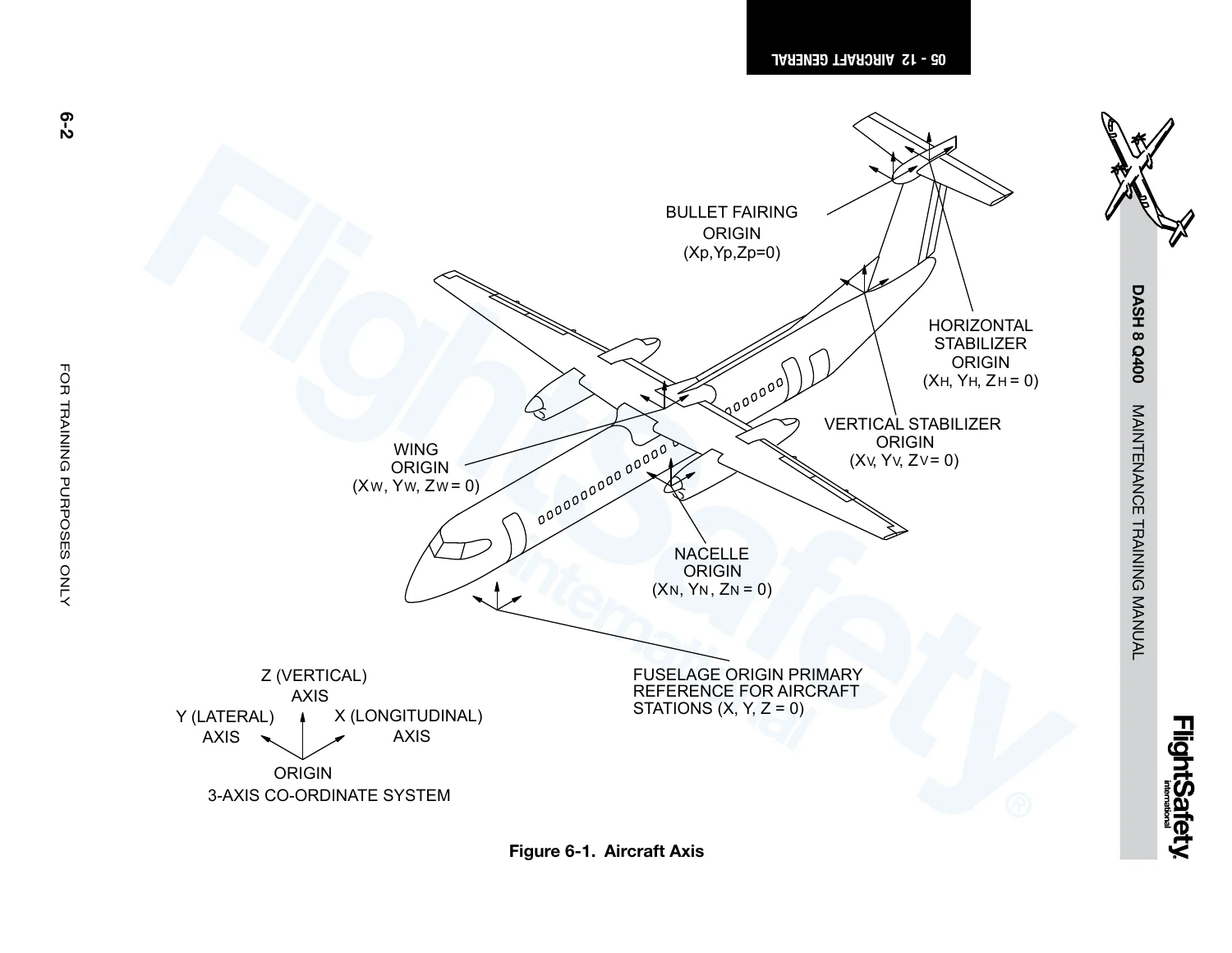
- ATA 06 Dimensions and Areas — overall dimensions; aircraft stations and axis origins; major zones and sub-zones (100 lower fuselage, 200 upper fuselage, 300 empennage, 400 nacelles); external and internal access panels and doors
- ATA 07 Lifting and Shoring — complete-aircraft jacking; NLG and MLG axle jacking; special tools; cautions and warnings
- ATA 08 Leveling and Weighing — weighing on jacks; centerline of main wheels; leveling; special tools; cautions and warnings
- ATA 09 Towing and Taxiing — towbar and towbar-less towing; moving with flat tires; taxiing and turning radii; propeller/engine exhaust danger areas; special tools; cautions and warnings
- ATA 10 Parking, Mooring and Return to Service — parking; aircraft storage; humidity indicators; engine preservation and depreservation; mooring at NLG and MLG; wind limitations; special tools; cautions and warnings
- ATA 11 Placards and Markings — left-fuselage example configuration and related markings
- ATA 20 Standard Practices — Airframe — marking parts and materials; pitot-static probe drain-hole cleaning; 7×19 and 7×7 control-cable inspection; rigid-line permanent repairs (Permaswage, Harrison, Aeroquip Rynglok, CryoFit/Cryolive, Deutsch DME, flexible-hose temporary repairs); ESDS device handling; connector and engine harness cleaning; demagnetization; lens-cap and switch-light bulb replacement; wiring electrical test; antenna sealant; instrument-panel integral lamps; vacuum anchor system; special tools; cautions and warnings
- ATA 24 Electrical Power — battery system (main, auxiliary, standby, sump jar); main 28 VDC generation; DC starter-generators, QAD housing, GCUs, EPCU fault-code retrieval; DC control panel, TRUs, DCCB and SBCB contactors, current transformers; APU 28 VDC generation; DC external power; DC load distribution and relay junction boxes; AC variable-frequency system (AC generators, adapter plates, AC GCUs, AC control panel, ACCB contactors); external AC power and protection unit; 115 VAC load distribution; operational checks; special tools; maintenance practices; cautions and warnings
- ATA 31 Indicating and Recording — Electronic Instrument System (display units, lighting modules, EFIS and ESID control panels, index control panels, PFD/MFD/ED pages); Flight Data Processing System (IFC, IOP, PPSM, ACM, mismatch and essential monitoring, warning tone generator); clocks; Flight Data Recorder, FSCU, impact switch and underwater locating device; EQAR and MQAR; caution and warning lights system; take-off warning; touched runway / tail-strike switch; landing-gear configuration warning; special tools; maintenance practices
- ATA 45 Central Diagnostic System — CDS architecture and interfaces with Type 1/2/3 avionics, EIS, non-avionics systems and clocks; CDS maintenance switch and maintenance panel; ARCDU pages (avionics status, last-leg and previous-legs reports, system report/test, LRU ident, avionics configuration, NVM reset); modes of operation; operational checks after switch or panel replacement; special tools; maintenance practices
Taken together, Volume 1 of the FlightSafety Dash 8 Q400 Maintenance Training Manual Volume 1 Rev 0.5 (2015) gives a technician the ground-handling picture of the airplane, the ATA document structure used on the Q400, airframe standard practices that appear across systems, a full walk-through of DC and AC electrical generation and distribution with EPCU fault codes, the flight-deck indicating and recording suite, and the Central Diagnostic System used to pull reports and run system tests from the ARCDU and maintenance panel.
How the MTM Relates to OEM Manuals
Chapter 100 explains that the Aircraft Maintenance Manual is written to ATA-100 Revision 34 and is split into a System Description Section and Practices and Procedures. Page blocks follow the familiar 1–99 description, 201–299 maintenance practices, 301–399 servicing, 401–499 removal/installation, 501–599 adjustment/test, 601–699 inspection/check, 701–799 cleaning/painting and 801–899 repairs pattern. AMTOSS seven-element task numbers, equivalent-tool rules, consumable-material references to PSM 1-84-18, and the definitions of WARNING, CAUTION and NOTE are all introduced here so course students can navigate Bombardier publications after class. The MTM itself states that any maintenance performed on the aircraft must use approved OEM documentation.
Electrical Generation, Fault Codes and CDS Diagnostics
ATA 24 is the longest chapter in this volume. It walks through battery contactors and emergency isolation by the EPCU, main 28 VDC starter-generators and TRUs, APU 28 VDC generation, DC and AC external power receptacles, and variable-frequency 115 VAC generation from the propeller reduction gearboxes. Block diagrams show source-fault and bus-fault logic, including dual-generator and dual-TRU loss cases and MMEL dispatch with a failed generator. Fault-code tables are tied to the battery system, DC generation and distribution, APU DC generation, DC external power, AC generation and distribution, and AC external power. Operational checks are written for batteries, DC generation, GCUs, EPCU, SBCB, APU 28 VDC generation, AC contactors and external power connect/remove sequences.
ATA 45 then shows how the Central Diagnostic System talks to the Integrated Flight Cabinets, EIS, air-data units, radios and selected non-avionics computers. Students see the ARCDU last-leg report, previous-legs report, system report/test pages, LRU identification pages and avionics configuration sheets, plus how to set CDS maintenance mode from the wardrobe-compartment switch and how to reset NVM messages for other systems from the maintenance panel.
Ground Handling, Zoning and Standard Practices
Aircraft general chapters cover jacking at fuselage and axle points, weighing and leveling, towbar and towbar-less towing including flat-tire movement, taxi turning radii, propeller and exhaust danger areas, nose-gear and main-gear lock pins, static grounding, storage with humidity indicators and engine preservation, and mooring with published wind-speed and direction limits. Zone maps divide the airplane into major zones 100 through 400 with sub-zones for underfloor, cabin, empennage and nacelle work. ATA 20 collects the everyday airframe practices that appear on many job cards: approved markers, pitot drain-hole cleaning limits (do not insert more than 0.118 in / 3 mm of nylon wire), control-cable inspection, approved permanent fittings for rigid lines, ESDS wrist-strap and conductive-bag handling, connector lubricants and Geltek tape, degaussing, and the vacuum anchor system used as person-rated fall-arrest anchorage.
Use This Manual for Training and System Familiarization
The FlightSafety Dash 8 Q400 Maintenance Training Manual Volume 1 Rev 0.5 (2015) supports identification of safety precautions, ramp and transit servicing, system layout and nomenclature, special tooling awareness, normal and abnormal system function, and use of MEL/CDL-style airworthiness thinking as listed in the Bombardier Q400 MI course objectives. Correct electrical isolation, ESDS handling, jacking and towing limits, and CDS report interpretation matter because condensed classroom procedures still point at real contactors, generators, recorders and diagnostic menus on the airplane. After payment you receive an instant PDF download with no shipping. Open it on any device and print the pages you need for study or shop reference. Always confirm live maintenance against the current manufacturer AMM and related Bombardier manuals before work on the aircraft.
Reviews
There are no reviews yet.