
GTCP36-150 and GTCP36-150-2 APU Aviation Unit Intermediate Maintenance Manual TM 1-2835-209-23&P 2008
Original price was: $36.95.$21.95Current price is: $21.95.
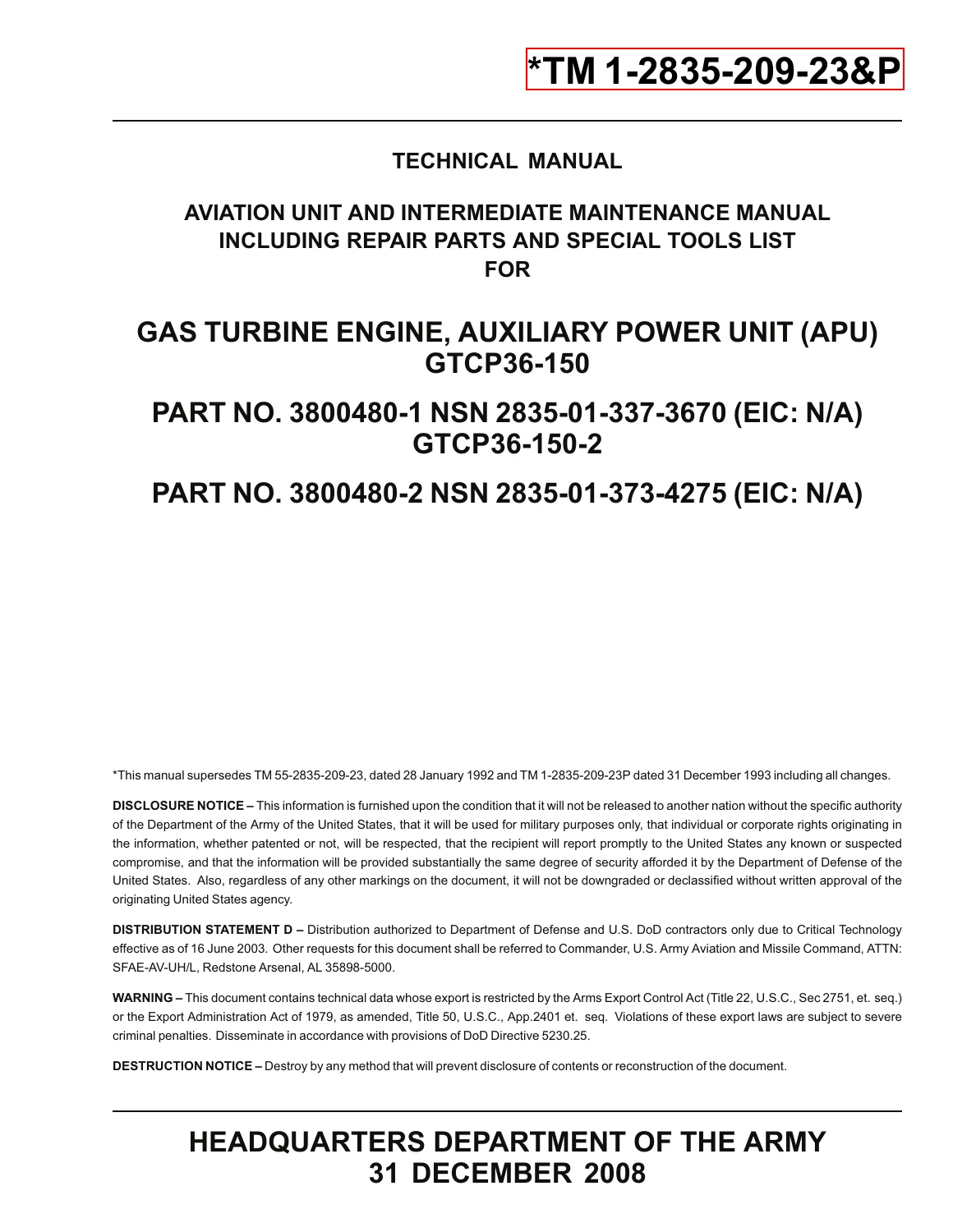
U.S. Army TM 1-2835-209-23&P aviation unit and intermediate maintenance manual with repair parts and special tools list for the GTCP36-150 and GTCP36-150-2 gas turbine APU, dated 31 December 2008.
Description
GTCP36-150 and GTCP36-150-2 APU Aviation Unit Intermediate Maintenance Manual TM 1-2835-209-23&P 2008
This download is the Headquarters, Department of the Army technical manual TM 1-2835-209-23&P for the GTCP36-150 (part number 3800480-1, NSN 2835-01-337-3670) and GTCP36-150-2 (part number 3800480-2, NSN 2835-01-373-4275) gas turbine auxiliary power unit. Current as of 31 December 2008, it supersedes TM 55-2835-209-23 dated 28 January 1992 and TM 1-2835-209-23P dated 31 December 1993. The book is written for aviation unit (AVUM) and aviation intermediate (AVIM) maintainers who service the pneumatic and shaft-power APU used to start the main engines and drive a gearbox-mounted generator.
File Details
- Manual type: Aviation unit and intermediate maintenance manual including repair parts and special tools list (RPSTL)
- Document number: TM 1-2835-209-23&P
- Date: 31 December 2008
- Equipment: GTCP36-150 P/N 3800480-1 and GTCP36-150-2 P/N 3800480-2
- Language: English
- Page count: 556
- File format: PDF
- Work packages: 162 plus glossary
What This APU Is and What the Manual Expects You to Do
The GTCP36-150 family is a compact gas turbine that supplies bleed air for main-engine start and shaft power at the accessory pads. At 100 percent speed the rotor turns 58,759 rpm; the generator pad is geared to 12,000 rpm and the starter pad to 8,190 rpm. Dry weight is given as 96.3 lb (43.7 kg), with overall length 30.49 in., height 16.9 in., and width 17.45 in. Shaft power is listed as 90.0 hp with zero bleed flow, falling through 60.0 hp, 40.0 hp, and 20.0 hp as bleed flow rises. Steady-state exhaust gas temperature limits are 1265°F (684.9°C) under load and 1287°F (697.2°C) in operation.
Approved fuels in the data tables include MIL-T-5624 JP-4 and JP-5, MIL-T-83133 JP-8, automotive gasoline per ASTM D439, and diesel grades DF-A, DF-1, and DF-2 within the printed temperature windows. Lubrication oils are MIL-L-23699 for general use and MIL-L-7808 for arctic use. Speed, start sequencing, fuel scheduling, and overspeed protection are handled by a separately mounted electronic sequence unit (ESU) commanding the fuel-control torque motor. The GTCP36-150 and GTCP36-150-2 APU Aviation Unit Intermediate Maintenance Manual TM 1-2835-209-23&P 2008 stays at unit and intermediate level: shipping and stand work, visual and hot-section inspection, combustor and fuel-system component replacement, lube-pump service, wiring and ignition work, insert and stud repair on the gearbox, cleaning processes, torque tables, the maintenance allocation chart, and the full RPSTL.
Chapters Covered
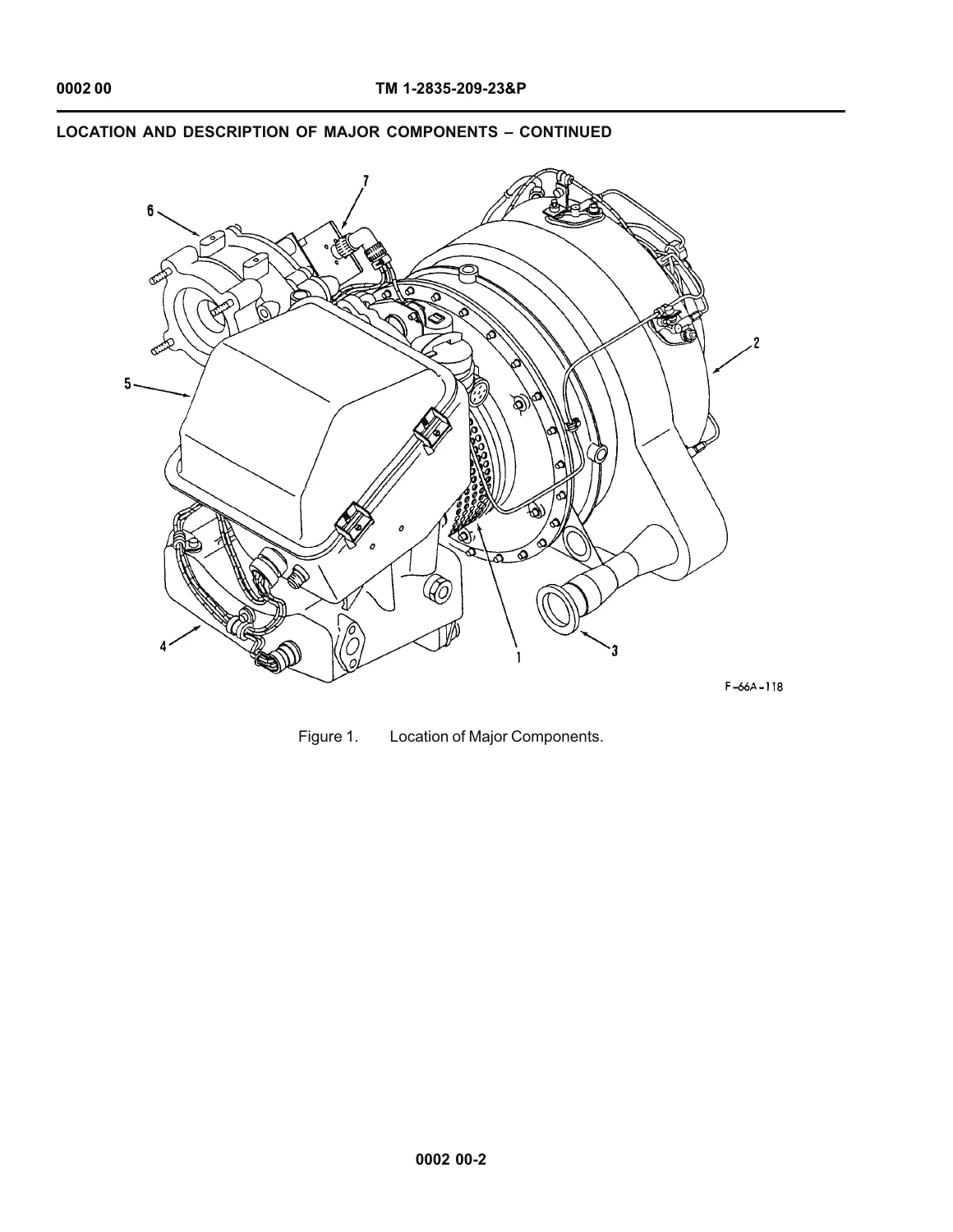
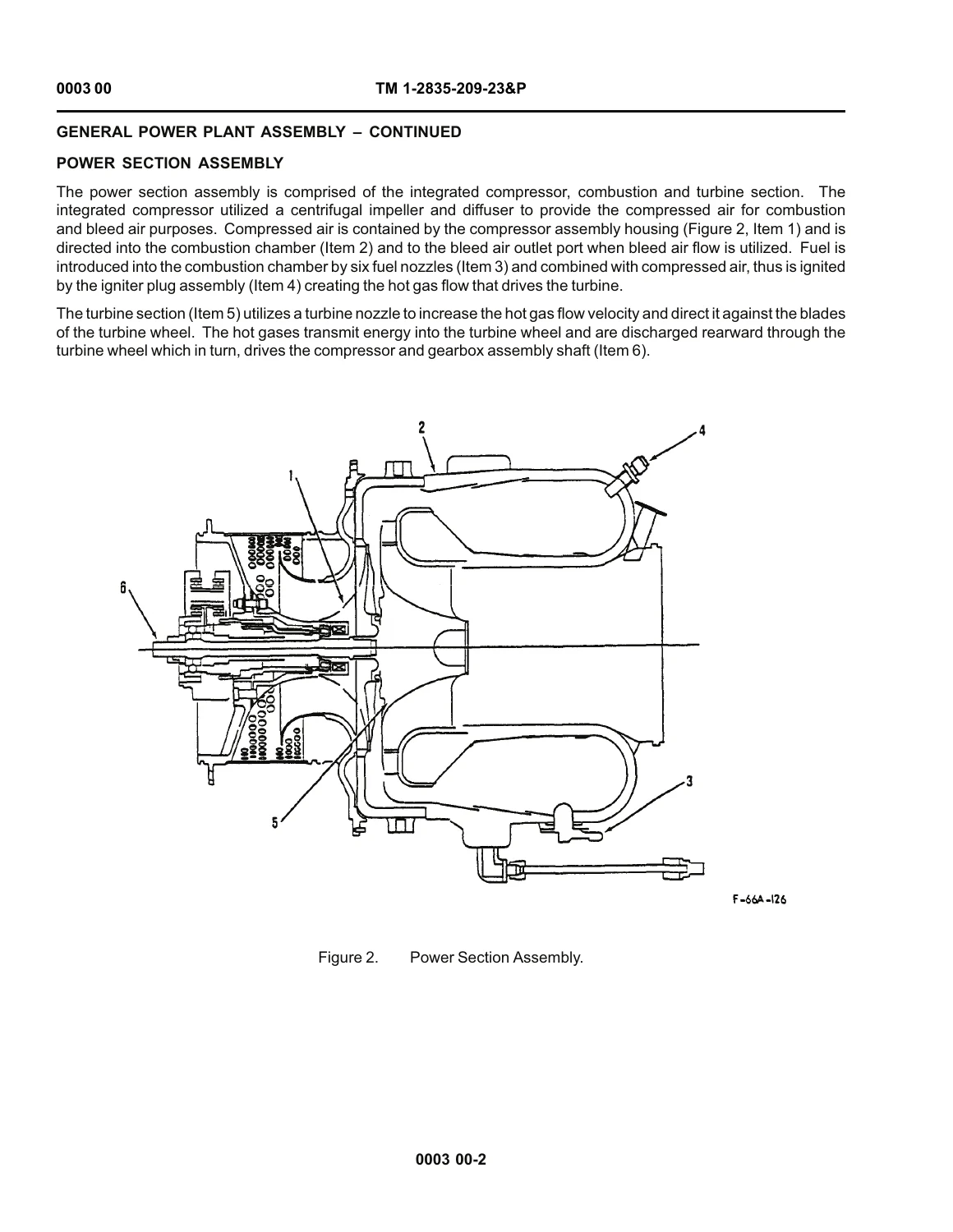
- Chapter 1 — General information, equipment description, and theory of operation: scope, forms and records, EIR, corrosion control, warranty (Garrett Auxiliary Power, 1000 operating hours or 3000 starts), nomenclature cross-reference, characteristics, major-component locations, power-section and gearbox theory
- Chapter 2 — Troubleshooting; service upon receipt; remove/install shipping container and maintenance stand; visual inspection; PMCS; combustor case and chamber remove/inspect/repair/install; igniter-plug ferrule; weld combustor-case cracks; nut plates, inserts, and rivets; 1000-hour hot-section inspection; inspect hot-section components; hand-finish turbine nozzle vanes and shroud
- Chapter 3 — Fuel-control upper and lower covers (remove, weld cracks, anodize touch-up, nut plates, seals, install); fuel filter; fuel-control assembly; fuel solenoid valve; fuel drain tube; orifice fitting; fuel manifold; primary and secondary fuel nozzles; fuel check valve
- Chapter 4 — APU wiring harness; immersion thermocouple; motional pickup transducer; hour-meter and meter bracket (including weld and nut-plate repair); ignition unit, igniter-plug lead, and igniter-plug assembly; fuel-control wiring harness
- Chapter 5 — Oil sample and drain; lube-pump cover and rotor housing; dimensional inspection of housing and matched rotor set; relief valve; anodize touch-up; pin; oil temperature bulb; oil filter element; low oil pressure switch; oil fill cap and gasket; magnetic drain plug; oil-pressure-plug packing; service lubrication system
- Chapter 6 — Power-section remove/install; replace specified inserts and studs; repair damaged gearbox stud threads; gearbox-housing anodize; lifting lug; inspect and replace spline adapter; replace seal assembly; preparation for storage or shipment
- Chapter 7 — Cleaning processes 1 through 7 (solvent, vapor degrease, carbon/rust, soap/water, glass bead, abrasive blast, electrical components); standard torque limits
- Chapter 8 — References; maintenance allocation chart introduction and MAC; RPSTL introduction and group lists 0400 through 0408 and 8100 through 8118; national stock number index; part number index; expendable/durable supplies and materials list; glossary
Taken together, the work packages walk a 15B powerplant repairer from crate to stand, through combustor and hot-section work, fuel and oil system component swaps, ignition and harness service, and gearbox hardware repair, then into the MAC so the shop knows which tasks stay at AVUM versus AVIM. The RPSTL groups give figure-keyed parts with NSNs and CAGE data so requisitioning matches the hardware called out in the procedures.
Hot Section, Fuel, Lube, and Electrical Work
The 1000-hour hot-section inspection (WP 0025) is an AVIM task performed with the APU on the maintenance stand. It requires draining oil, replacing the fuel filter and oil-filter element, removing the combustion chamber, match-marking the airflow deflector, turbine nozzle, and compressor airflow deflector to the compressor housing, then continuing into component inspection and authorized hand finishing of nozzle vanes and shroud. Combustor-case work includes crack welding, nut-plate and insert replacement, and rivet replacement before the case goes back on.
IMAGES PREVIEW
Fuel-system packages cover the filter assembly, control body, solenoid valve, manifold, check valve, orifice fitting, drain tube, and the three primary plus three secondary nozzle assemblies, with inspection criteria for the nozzles and anodize touch-up on the control covers. Special torques appear throughout rather than only in the general table: igniter plug 95 to 105 inch-pounds, igniter-plug lead 33 to 37 inch-pounds, many manifold and cover fasteners in the 33–53 inch-pound band, fuel tubes in the 66–120 inch-pound range, and selected inlet fittings as high as 190 to 210 inch-pounds where printed.
Lubrication work packages take the technician through sampling, drain, lube-pump cover and rotor-housing removal, dimensional checks of the housing and matched rotor set, relief-valve service, oil-temperature bulb (57 to 63 inch-pounds), filter element, low-oil-pressure switch (61 to 68 inch-pounds), magnetic drain plug (80 to 90 inch-pounds), and fill-to-spill servicing. Electrical packages replace the immersion thermocouple, motional pickup transducer, hour-meter, ignition unit, igniter lead and plug, and both the APU and fuel-control branched wiring harnesses, including clamp and lock-wire practice.
Torque, Tools, Parts, and Shop Limits
WP 0109 publishes the standard torque tables used when a procedure does not give a special value: fasteners from 3-48 (5–7 inch-pounds) through 9/16-18 (480–600 inch-pounds), minimum drag torque for self-locking nuts, plug/union/elbow values, and flared and flareless tube-nut values. The MAC and special-tools list call out the engine repairman’s kit, inspection kit, maintenance stand, lifting sling, 0–30 / 30–150 / 150–750 inch-pound torque wrenches, fuel-nozzle tester, torque-motor controller, monopole shim gauge, and numerous Garrett/Honeywell-coded fixtures (CAGE 99193) such as planet-shaft fixtures and torque adapters. Cleaning is split into seven defined processes so solvent, vapor degrease, carbon/rust, soap/water, glass-bead, abrasive-blast, and electrical-component methods are not mixed. Warranty language in the general-information package cites Garrett Auxiliary Power coverage of 1000 operating hours or 3000 starts, whichever occurs first, starting from the date on DA Form 2410 or DA Form 2408-16.
Use This Manual on the Job
The GTCP36-150 and GTCP36-150-2 APU Aviation Unit Intermediate Maintenance Manual TM 1-2835-209-23&P 2008 supports receiving inspection, container and stand handling, PMCS, combustor and 1000-hour hot-section work, fuel-control and nozzle service, lube-pump and oil-system component replacement, ignition and harness replacement, gearbox insert/stud/seal work, authorized welding and anodize touch-up, and parts identification through the RPSTL. Following the printed torque, lock-wire, packing, and inspection limits keeps a small high-speed turbine from being assembled to the wrong clamp load or returned to service with an unserviceable hot section. After payment you receive the PDF immediately—no shipping—so it can be opened on a shop computer, tablet, or phone and printed for the stand. This TM 1-2835-209-23&P GTCP36-150 workshop download is the unit-and-intermediate reference for both 3800480-1 and 3800480-2 configurations.
Reviews
There are no reviews yet.