
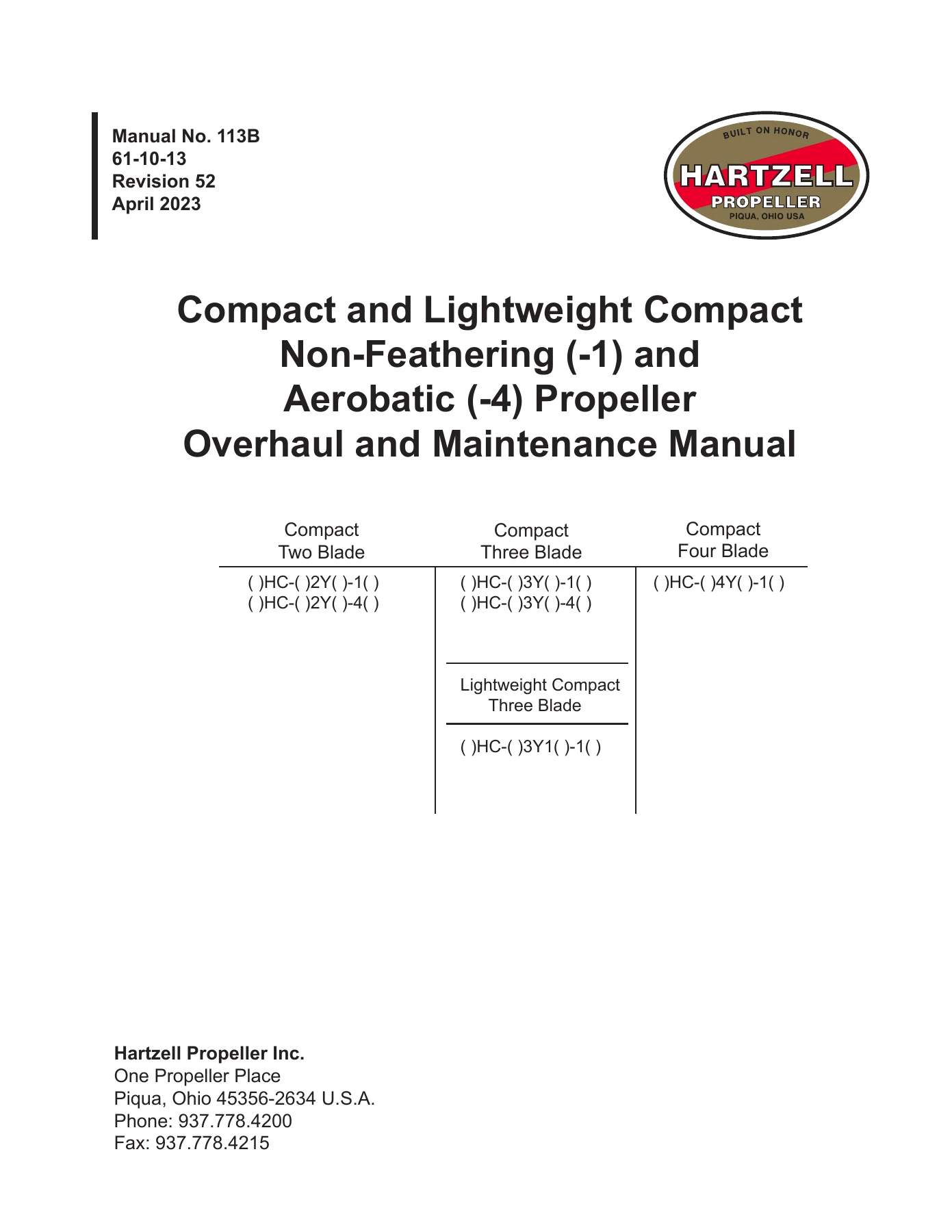
Hartzell 113B Rev 52 Compact Lightweight Compact Non-Feathering (-1) Aerobatic (-4) Propeller Overhaul Manual
Original price was: $39.95.$23.95Current price is: $23.95.
Hartzell Propeller Inc. Manual 113B (ATA 61-10-13) Revision 52, April 2023. Shop-level overhaul and maintenance procedures for compact and lightweight compact non-feathering (-1) and aerobatic (-4) propellers, including check criteria, assembly, torque data, and illustrated parts lists.
Description
Hartzell 113B Rev 52 Compact Lightweight Compact Non-Feathering (-1) Aerobatic (-4) Propeller Overhaul Manual
This Hartzell 113B Rev 52 Compact Lightweight Compact Non-Feathering (-1) Aerobatic (-4) Propeller Overhaul Manual is Manual No. 113B, ATA 61-10-13, Revision 52 dated April 2023 from Hartzell Propeller Inc., One Propeller Place, Piqua, Ohio 45356-2634 U.S.A. The publication has been reviewed and accepted by the FAA and contains data approved in a manner acceptable to the FAA administrator. It is written for propeller repair stations and for personnel already trained and experienced with Hartzell products. It is the primary shop source for maintenance and overhaul of the compact and lightweight compact families listed on the cover, and it does not by itself give an inexperienced technician enough information to overhaul a propeller without supervision.
File Details
- Manual type: Propeller overhaul and maintenance manual (component maintenance manual format, ATA iSpec 2200 where possible)
- Brand / manufacturer: Hartzell Propeller Inc.
- Coverage: Compact two-, three-, and four-blade and lightweight compact three-blade non-feathering (-1) and aerobatic (-4) propellers
- Document number: Manual 113B (61-10-13)
- Revision / date: Revision 52, April 2023 (includes prior revisions through TR-033)
- Language: English
- Page count: 625
- File format: PDF
Propeller Families and How They Work
The cover of the Hartzell 113B Rev 52 Compact Lightweight Compact Non-Feathering (-1) Aerobatic (-4) Propeller Overhaul Manual groups the hardware as compact two-blade ( )HC-( )2Y( )-1( ) and ( )HC-( )2Y( )-4( ), compact three-blade ( )HC-( )3Y( )-1( ) and ( )HC-( )3Y( )-4( ), compact four-blade ( )HC-( )4Y( )-1( ), and lightweight compact three-blade ( )HC-( )3Y1( )-1( ). A typical full designation printed in the text is HC-C3YR-1RF/F8468A-6R, with the slash separating hub/propeller identity from the blade model. The propeller model is impression stamped on the hub; the blade model is stamped on the blade butt and also identified on the cylinder or camber side.
Compact constant-speed non-feathering (-1) propellers use engine-governor oil pressure to drive the blades toward high pitch (reduced RPM). A spring plus blade centrifugal twisting moment returns them toward low pitch if governor oil is lost. Constant-speed aerobatic (-4) propellers reverse that hydraulic sense: governor oil drives the blades toward low pitch to raise RPM, while shank counterweights drive them toward high pitch if oil pressure disappears, which is the intended fail-safe against overspeed during inverted flight or other low-oil maneuvers. The text also describes aerobatic installations that use an accumulator, citing HC-C3YR-1A: those units behave like the non-feathering family when the governor is supplied, and a check valve feeds accumulator oil to the governor when engine oil pressure falls below accumulator pressure.
A lightweight compact three-blade hub is a different structure from a standard compact hub and is compatible only with certain blade models. One printed distinction is nine hub clamping bolts on the lightweight compact three-blade versus fifteen bolts on a compact hub. Two similar Lycoming mounting flanges appear in the model string: K-flange and R-flange. An improved R-flange hub fits both K-flange and R-flange engines; original-design K-flange hubs will not fit R-flange engines. Overhaul shops may restamp an R-flange hub as a K-flange hub when the aircraft type certificate requires the K designation. Converting an original K-flange hub into an R-flange hub is not permitted.
Two-blade production improvements are called out as the move from -1 / -1A (example HC-C2YK-1) to -1B (example HC-C2YK-1B) with a later cylinder, pitch change rod, fork, and spring, and as the F-knob blade suffix (example HC-C2YK-1BF) that uses a larger fork for the strengthened pitch-change knob. Three-blade improved hubs carry a B suffix on the hub and propeller serial numbers and extra forging material in the blade retention area. Current production supplies hub units for -1R( ) three-blade models; installing a new hub on an older -1( ) three-blade also requires the matching hydraulic parts and reidentifies the propeller as -1R( ).
IMAGES PREVIEW
Chapters Covered
- Revision Highlights, Record of Revisions, Record of Temporary Revisions, Service Document List, Airworthiness Limitations, List of Effective Pages
- Introduction — statement of purpose and FAA acceptance; item-number and effectivity-code conventions; companion Hartzell publications; personnel and regulatory requirements; special tooling (TE prefix) and consumable materials (CM prefix); calendar limits and long-term storage; component life (TSN/TSO) and overhaul definition; airworthy vs unairworthy damage and minor vs major repair; Propeller Critical Parts; warranty and contact information; definitions and abbreviations
- Description and Operation — propeller/blade model designation; compact constant-speed non-feathering (-1) operation; constant-speed aerobatic (-4) operation including accumulator installations; R-flange substitution for K-flange; lightweight compact propeller description
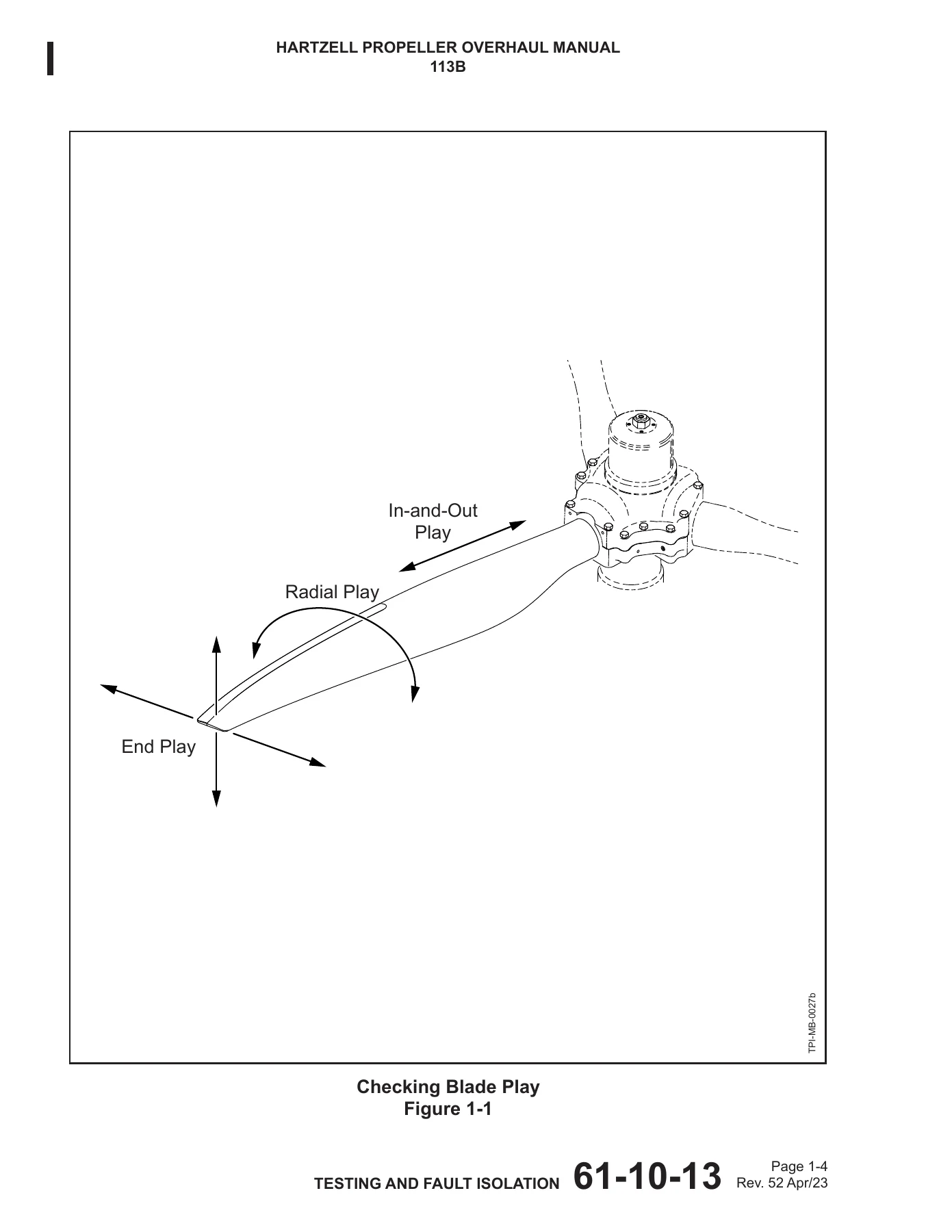
- Testing and Fault Isolation — pitch control difficulty; friction; abnormal vibration; blades not tracking; end play, in-and-out play, and radial play; oil leakage; external grease leakage; lightning strike on hub or blade (Figure 1-1 Checking Blade Play)
- Automatic Test Requirements
- Disassembly — propeller removal and serial/blade-location records; ice protection system notes; pitch-change parts teardown for -1 and -4 configurations; hub, pitch-change fork, pitch-change block, and split-hub disassembly; C-1576 damper disassembly (Figure 3-1); blade bearing system, blade-plug removal on ( )HC-( )( )Y( )-1N models, and preload-plate teardown
- Cleaning — general cleaning; steel parts for magnetic particle inspection and cadmium replating; aluminum parts for penetrant inspection and chromic acid anodizing; titanium parts for penetrant inspection; cylinder threads
- Check — inspection intervals and dimensional practice; criteria for components, hubs, blades, ice protection, spinners, and special inspections; detailed checks of cylinder, fork, stop sleeve/collar, hub unit, hex-head bolt, low-pitch-stop set screw, piston, pitch-change block and rod, preload plates, bearing retaining rings, blade seal and plug, bearing race, spring seats/guides/spacers/springs, hub plug, pitch-change knob bracket, brass and steel counterweight slugs, F-flange spacer, damper parts, balance weight, and wire-harness bracket
- Repair — shot peening and aluminum/steel repair rules; cylinder wrench-hole repair; A-3253-( ) pitch-change block modification; C-1862-( ) pitch-change knob plating; preload-plate threaded-insert replacement; spring zinc chromate primer; pitch-change rod modification; brass counterweight slug hole repair; B-2457-3 fork modification for hub/fork interference; preload-plate modification for set-screw/fork interference; inner bearing race replacement on the preload plate
- Assembly — O-rings, blade-bore plug/bearing, and blade-angle notes; composite pitch-change knob and bushing; blade seal and bearing race/balls; preload-plate assembly including -1N variants; two-, three-, and four-blade compact hub blade installation; optional blade-angle reference tape; hydraulic pitch-change unit assembly and leak test; counterweight and slug installation; lubrication; static balance; labels; packing for shipping and later reassembly; C-1576 damper assembly and spring-gap check
- Fits and Clearances — torque values (Table 8-1) and blade tolerances (Table 8-2), plus the torque-wrench adaptor calculation (Figure 8-1)
- Special Tools, Fixtures, and Equipment — standard shop tooling, TE-prefixed special tools referenced to Manual 165A, and facility/segregation notes
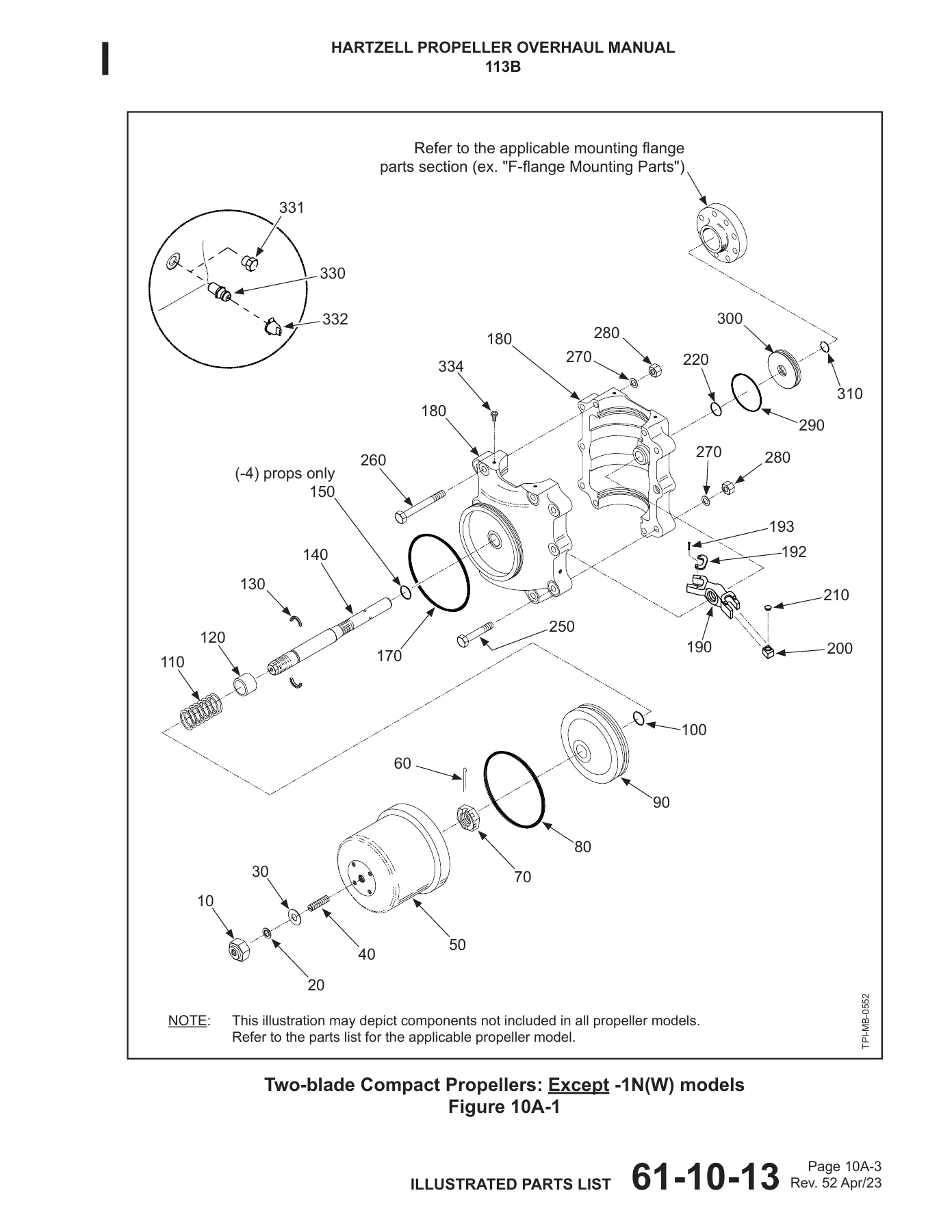
- Illustrated Parts List — column definitions (Fig/Item, part number, description, effectivity, UPA, O/H, PCP); alternate / supersedure / replacement / obsolete terms; vendor hardware; F and N-flange studs; two- and three-blade improvement notes and Table 10-1; A-3204 / A-3204-2 set-screw color coding; exploded views and effectivity-coded parts lists for 2-blade (10A), 3-blade (10B), 4-blade (10C), mounting-flange (10D), and blade-retention (10E) hardware plus hub and damper appendices
Taken together, those chapters give a repair station the shop sequence for a compact or lightweight compact -1 or -4 propeller: record identity, tear the hydraulic unit and hub down without exceeding 175 PSI (12.06 bar) actuation pressure, clean to the inspection method that follows, apply the check limits and figures, perform only the repairs this manual authorizes, rebuild blade bearings and preload, assemble two-, three-, or four-blade hubs, leak-test the hydraulic unit, set damper spring gap to 0.280-0.290 inch (7.12-7.36 mm) where the C-1576 damper is used, torque fasteners from Table 8-1, and pick the correct parts from the effectivity-coded IPL. Blade airfoil overhaul itself is not duplicated here; aluminum blades go to Manual 133C (61-13-33) and composite blades to Manual 135F (61-13-35).
What This Manual Expects You to Use With It
The Hartzell 113B Rev 52 Compact Lightweight Compact Non-Feathering (-1) Aerobatic (-4) Propeller Overhaul Manual repeatedly points to other Hartzell books rather than reprinting them. Life limits live in Owner’s Manual 115N (61-00-15) for metal blades and Owner’s Manual 145 (61-00-45) for composite blades. Overhaul interval—hours or calendar—is specified in Service Letter HC-SL-61-61Y; the calendar clock starts at first engine installation and is not paused by later removal or storage. Application-specific counterweights, slugs, spinners, and ice-protection hardware are selected from Application Guide Manual 159 (61-02-59). Special tools are catalogued in Illustrated Tool and Equipment Manual 165A (61-00-65). Consumable materials, anodizing, penetrant and magnetic-particle inspection, hub overhaul, packaging, and static/dynamic balance are in Standard Practices Manual 202A (61-01-02). Metal and composite spinner work is in Manuals 127 and 148. Hartzell-supplied ice protection is in Manual 180 (30-61-80). Active service bulletins, letters, advisories, and instructions can supersede pages in this revision; the service-document list in the front matter records the bulletins and letters already incorporated through Revision 52.
Propeller Critical Parts are flagged PCP in the Illustrated Parts List. Procedures that touch those parts were substantiated on the assumption that the Instructions for Continued Airworthiness in this manual and the companion books will be followed. Experimental or non-aviation parts—even if they still carry a TC or PC stamp—must not be built into a type-certificated propeller. Installation eligibility always comes from the aircraft TC or STC, not from this overhaul book alone.
Shop Limits and Typical Work the Text Supports
Troubleshooting isolates pitch-control trouble to friction, leaking piston or rod O-rings (underspeed on a -4, overspeed and a hub full of oil on a -1), excessive blade preload, damaged blade-retention balls, or tight pitch-change clearances. Blade play is checked in three axes against Figure 1-1. Vibration and tracking problems are referred out to the blade manuals or to Manual 202A for hub cracks, balance, and foreign-object-strike inspection. Lightning-strike action is in the same testing chapter.
Disassembly records hub, blade, and other serial numbers against the logbook, numbers blades counterclockwise from the hub stamp with a non-graphite marker, and then strips the cylinder, piston, springs or counterweight path, pitch-change rod, fork, and blocks. Separate paths are written for aerobatic (-4) hardware and for non-feathering (-1) hardware that uses the 101322 / 101330 springs versus the A-2213-( ) spring. Hub halves themselves are opened per the compact and lightweight compact hub chapter of Manual 202A. The C-1576 damper comes apart as eight screws, spacer tubes, springs, bushings, grommets, and friction disk.
The Check chapter is the longest inspection block: serviceable limits and figures for the cylinder, fork, piston, pitch-change rod and block, preload plates (inner-race and threaded-insert styles), several bearing-retaining-ring part numbers, blade seals and -1N blade plugs, spring hardware, hub plugs, F-flange spacers, damper weight and plate, and both brass C-7249 and steel A-890-( ) counterweight slugs. Repair work that is authorized here is specific—cylinder wrench-hole repair, pitch-change block and rod modifications, knob plating, preload-plate insert and inner-race work, fork clearance cuts on B-2457-3, and brass slug hole repair—not open-ended field machining. Shot-peen marks on fatigue-critical parts are not to be dressed off as tool marks.
Assembly rebuilds the blade bearing stack, sets preload, installs blades into two-, three-, or four-blade compact hubs, builds the hydraulic unit, leak-tests it, lubricates, statically balances, and labels the unit. Damper screws on the C-1576 assembly are torqued to 96-120 in-lb (10.9-13.5 N·m) after the spring gap is set. Fits and Clearances supplies the torque table used throughout assembly and a blade-play tolerance table. The Illustrated Parts List then maps every configuration the shop is likely to see: two-blade lists from families such as HC-C2YF-1B, HC-C2YK-1B, HC-C2YL-1B, HC-C2YR-1B / -1BF, HC-E2YR-1, HC-F2YR-1, HC-G2YR-1BF, and the corresponding -4 lists such as HC-C2YK-4, HC-C2YL-4, and HC-C2YR-4, plus three-blade, four-blade, flange, and blade-retention sections. Effectivity codes, O/H replacement flags, and PCP marks tell the assembler which dash number belongs on which model and which parts must be renewed at overhaul.
Get the Procedures and Parts Data on the Bench
With the Hartzell 113B Rev 52 Compact Lightweight Compact Non-Feathering (-1) Aerobatic (-4) Propeller Overhaul Manual a certificated shop can diagnose pitch, leakage, play, and vibration complaints; tear down and inspect compact and lightweight compact -1 and -4 hubs and hydraulic units; apply the printed check limits; complete the repairs this revision authorizes; reassemble, leak-test, torque, and identify the correct IPL configuration—including PCP and overhaul-replacement parts. Using the current check figures, torque table, and effectivity-coded parts list matters because these propellers rely on correct blade preload, spring or counterweight sense, and governor oil sealing; the wrong dash-number piston, fork, spring, or hub unit, or a missed O/H replacement part, puts the assembly outside its type design. After payment the file is delivered as an instant PDF download—no shipping wait—so it can be opened on a shop computer, tablet, or phone and printed for the work order.
Reviews
There are no reviews yet.