
Hartzell Propeller Aluminum Hub Overhaul Manual 202A Volume 3 Revision 37 2016 – PDF Download
Original price was: $39.95.$24.95Current price is: $24.95.
Complete Hartzell Propeller Standard Practices Manual 202A Volume 3 covering aluminum hub overhaul for Compact, Lightweight Compact, Lightweight Turbine, and Raptor turbine hubs – Revision 37, March 2016. Disassembly, inspection, repair, shot peening, anodizing, masking, assembly, and leak testing procedures with illustrated inspection criteria.
Description
Hartzell Propeller Aluminum Hub Overhaul Manual – 202A Volume 3, Revision 37
The Hartzell Propeller Aluminum Hub Overhaul Manual 202A Volume 3 Revision 37 is the dedicated Standard Practices Manual chapter used by propeller repair stations to inspect, repair, refinish, and reassemble Hartzell aluminum propeller hubs. Issued March 2016 as document 61-01-02, this revision consolidates the complete aluminum hub overhaul workflow – from initial disassembly and cleaning through penetrant and eddy current inspection, dimensional checks against published serviceable limits, corrective repairs, shot peening, chromic acid anodizing, painting, masking, final assembly, and pressure leak testing of installed bushings.
This is the aluminum hub overhaul reference for the full range of Hartzell aluminum hub designs: the Compact hub family, the lighter Lightweight Compact hub, the turbine-oriented Lightweight Turbine hub (LWT), and the five-blade Raptor turbine hub. Rather than a model-specific propeller overhaul manual, it functions as the standard-practices backbone that sits alongside the applicable propeller overhaul manual, service bulletins, service letters, and airworthiness directives for a given propeller assembly.
File Details
- Manual type: Standard Practices Manual – Aluminum Hub Overhaul chapter
- Brand / publisher: Hartzell Propeller Inc.
- Document number: 202A (61-01-02), Volume 3
- Revision: 37
- Issue date: March 2016
- Language: English
- File format: PDF
- Page count: 476 pages
Chapters and Sections Covered
The manual is organized into numbered top-level chapters that follow the overhaul workflow in order. Each is written for technicians already trained on Hartzell products, with step-by-step procedures, caution and warning blocks, illustrated inspection areas, and serviceable/corrective action limits.
- Introduction, Statement of Purpose, Required Publications, Personnel Requirements, Safe Handling of Paints and Chemicals, Component Life, Propeller Critical Parts, Definitions, Abbreviations
- General – Aluminum Hub Types (Compact, Lightweight Compact, Five-blade Raptor Turbine, Lightweight Turbine), Inspection Interval Requirements, Inspection Requirements, Replacement Requirements, Repair, Specific Inspection Procedures
- Disassembly – General, Pitch Change Rod Bore Bushing Removal, Pitch Change Rod Delrin Bushing Removal, D-/F-/N-/W-Flange Stud Removal, Threaded Staked Insert Removal, HeliCoil Removal, Slimsert Removal, Beta Rod Bushing B-6045-6-6 Removal, Hub Sleeve 104488 Removal
- Cleaning – General, Stripping of Anodized Coating
- Measuring Depth of Damage with Replication Material
- Check – Hub Visual Inspection, Lightning Strike / Foreign Object / Ground Strike / Overspeed / Heat Damage, Flange Fretting Inspection, Hub Inspections, Hub Penetrant Inspection, Hub Eddy Current Inspection
- Repair – Removal of Corrosion or Mechanical Damage, Shot Peening, D-/F-/N-Flange Stud Mounting Threads, Stripped Lubrication Fitting Holes, Stripped Cylinder Attachment Screw Holes, Anti-Rotation Rod Threaded Holes, Chamfering Lubrication Fitting Holes, Balance Weight Attachment Holes, Pitch Change Rod Bore Repairs for 2/3/4-Blade Hubs, Four-Blade Lightweight Turbine Hub Modification, F and N Dowel Pin Hole Repairs, K and R Counterbored Drive Hole Repairs, Mounting Bolt Through Hole Repairs, Five-Blade LWT Beta Rod Hole Modification, Two-Blade Fork-to-Hub Interference Modification, F-Flange Hub Mounting Bore Repair to Use Hub Sleeve 104488
- Shot Peening Aluminum Hubs
- Chromic Acid Anodizing
- Chemical Conversion Coating Application
- Painting
- Masking for Painting, Shot Peening, and Anodizing
- Assembly – Hub Substitutions, Hub Extension Bolts, Mounting Flange Dowel Pins, D-/F-/N-/W-Flange Studs, K-/L-/R-Flange Studs, Mounting Bolt Ring Installation, Pitch Change Rod Hub Bushings for Four-Blade Lightweight Turbine and Five-Blade Raptor Turbine Hubs, Pitch Change Rod Hub Bushings for Compact and Lightweight Compact Hubs, A-2249 Guide Bushing, B-1243 Threaded Staked Insert, Non-Staked Insert, Beta Rod Bushing B-6045-6-6, HeliCoil Insert Installation, Hub Sleeve 104488 Installation, Five-Blade Lightweight Turbine Pitch Change Rod Hub Bushing Installation
- Leak Inspection of a Compact Hub Pitch Change Rod Bore Bushing
- Leak Inspection of Bushings in Four-Blade Lightweight Turbine and Five-Blade Raptor Turbine Hubs
- Leak Inspection of the Bushing in the Engine-Side Half of Five-Blade Lightweight Turbine Series Hubs
What this adds up to in practical terms is a single reference that lets a qualified technician take an aluminum Hartzell hub from a used, in-service state through a complete overhaul to a tested, re-anodized, painted, and reassembled unit ready to return to service. The workflow inside the Hartzell Propeller Aluminum Hub Overhaul Manual follows how work actually happens in the shop – inspect first, decide replace vs. repair, machine only within published limits, restore protective coatings, and leak-test the finished bushing installations before signing off. Inspection criteria are tied to specific hub bore configurations, blade-retention zones, flange styles, and pitch change rod bushing part numbers so a technician is working from the numbers that apply to the hub on the bench instead of a generic chart.
Coverage Highlights
- Aluminum hub designs covered: Compact (2, 3, 4 blade), Lightweight Compact (3 blade), Five-blade Raptor Turbine, and Lightweight Turbine (3, 4, 5, 6 blade)
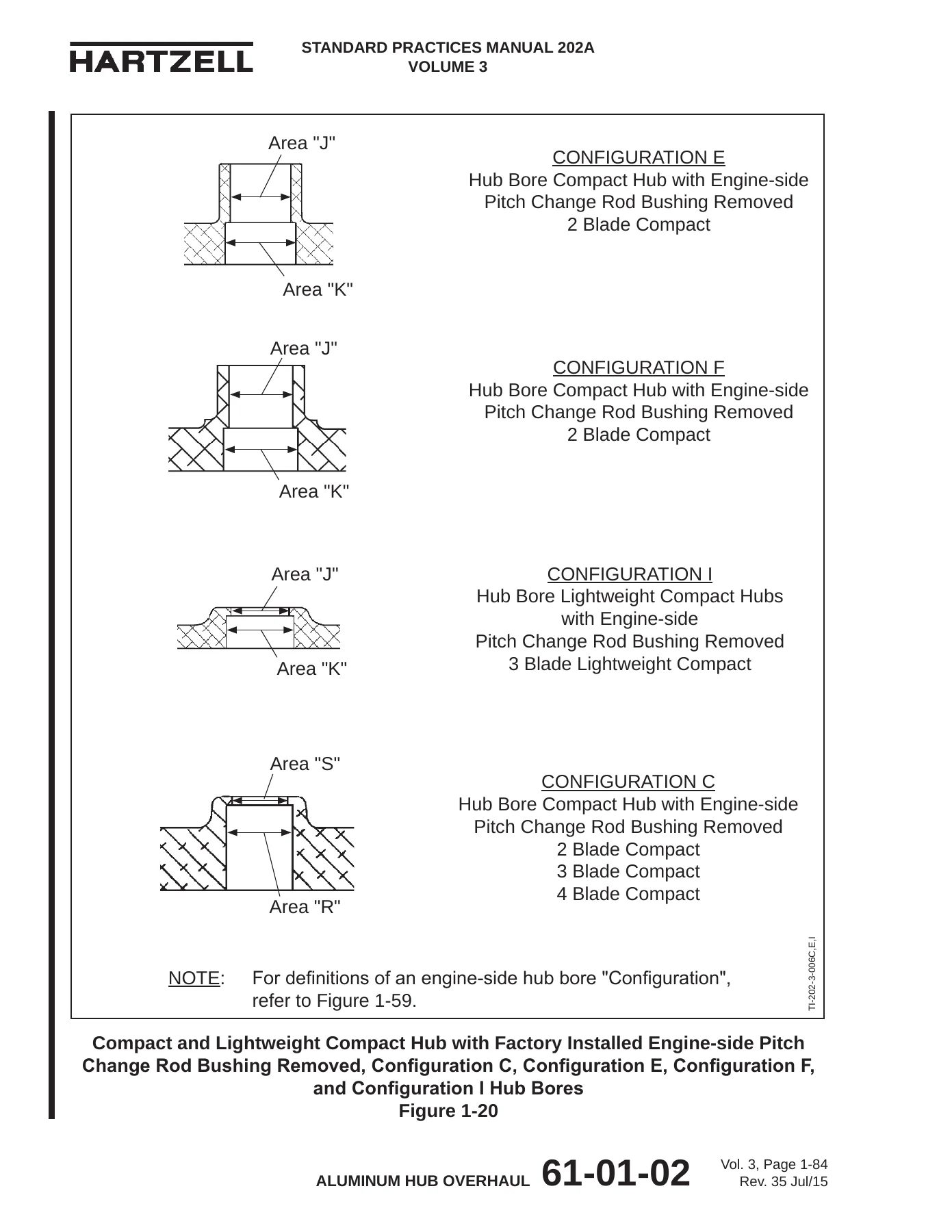
- Hub configurations defined as engine-side and cylinder-side bore configurations (A, B, C, D, E, F, G, H, I, J, S, T, U, V, W, X, Y, Z)
- Specific hub part numbers addressed across figures and tables include D-389, D-489, D-499, D-1066, D-3251, D-3372, D-3398, D-5126, D-5108-5, E-393, E-2819, E-6468, E-6771, E-6826, E-6866, E-7154, E-7167, E-7369, 102339, 103433, 103434-1/-2/-3, 104904, 104488, 104903, 105880, 105916, 103559
- Bushing part numbers with their own inspection criteria: B-5952, B-5952-1, B-6108, B-6108-1, 102778, 102779, 102580-1, 102580-2, 103433, 103434-1/-2/-3
- Propeller model series referenced: HC-()2Y, HC-()3Y, HC-()3Y1, HC-(D,E)4, HC-E5, HC-A6A, 5D3-(N,P), HD-E6C-3, PHC-C3YF
- Engine applications referenced in the hub substitution and stud height tables include Continental (including GTSIO-520-D, IO-550-B, IO-550-C, ()-346, ()-360), Lycoming, Franklin 6A-350-C1, Porsche, Rolls-Royce 250B17, Walter 601/GE H, and Honeywell (Garrett) TPE 331-11U
Inspection, Repair, and Overhaul Workflow
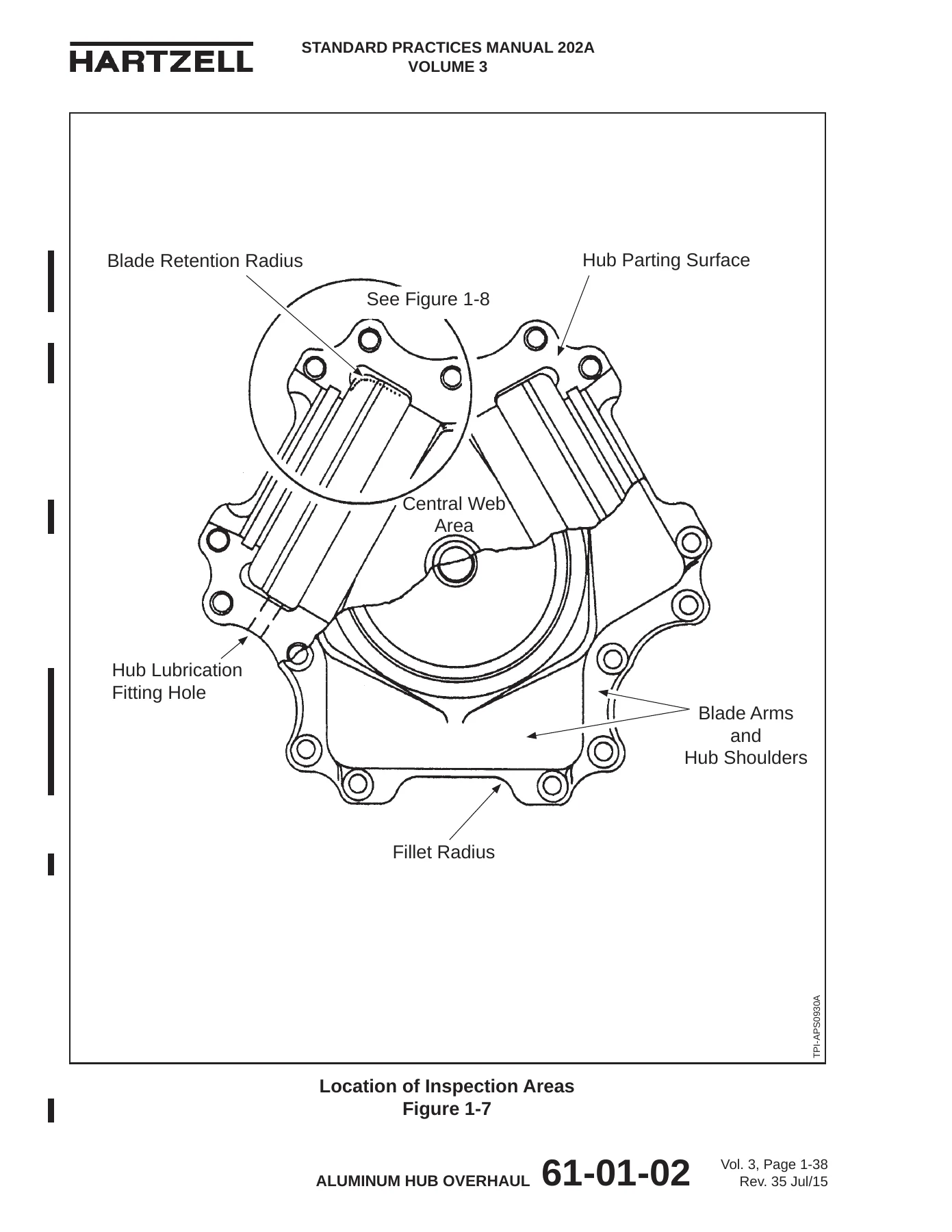
The inspection chapters are organized around a Table 1-1 “Inspection and Repair Requirements” grid that pairs each inspectable feature with a serviceable limit and a corrective action limit. Features and areas covered include the blade retention radius (Zones A1, A2, Zone B, Preload Plate Shelf), blade O-ring groove and sidewalls, hub threaded holes including lubrication fitting holes, central web area, hub parting surface, fillet radius, blade arms and hub shoulders, hydraulic unit / cylinder mounting area, pitch change rod bore with and without pitch change rod bushings, engine-side and cylinder-side O-ring grooves, beta rod hole IDs (including 5-blade LWT, 6-blade D-1066, and N/P flange Raptor variants), mounting flange surfaces, dowel pin holes, K/L/R bolt holes, A/N/P mounting bolt through holes, and threaded staked insert bores. Inspection methods called out include visual examination, penetrant inspection with pre-penetrant etch, eddy current inspection on defined areas, and dimensional verification with pin gauges, plug gauges, bore micrometers, and flatness gauge TE321.
On the repair side, the Hartzell Propeller Aluminum Hub Overhaul Manual documents six numbered pitch change rod bore repair procedures (Repair 1 through Repair 6) tied to specific hub configurations, plus hub-specific modifications for four-blade Lightweight Turbine hubs, five-blade Lightweight Turbine hubs, and two-blade Compact hubs. It also covers thread repair of D-, F-, N-, and W-flange stud mounting threads using Slimsert inserts, repair of stripped lubrication fitting holes, repair of stripped cylinder attachment screw holes, repair of anti-rotation rod threaded holes, chamfering of lubrication fitting holes on original-design “Y” shank hubs, repair of balance weight attachment holes, mounting flange dowel pin hole repairs on F and N flanges, K and R counterbored drive hole repairs, A/N/P mounting bolt through hole paint and adhesive repairs, and the F-flange hub sleeve 104488 repair that converts the mounting bore for a pressed-in sleeve.
Shot Peening, Anodizing, Painting, and Masking
The protective-finish portion of the manual is built around specific hub part numbers. Shot peening requirements are given per hub type – 2-blade compact, 3-blade compact and lightweight compact, 4-blade compact and lightweight turbine, 5-blade lightweight turbine (general and E-7369-specific), D-5108-5 six-blade, and D-1066 six-blade – with shot size, Almen type, and intensity for each pass, and dedicated Almen strip location figures for each hub family. Chromic acid anodizing and chemical conversion coating are covered with references to the Chromic Acid Anodizing chapter of Volume 10 for the actual bath procedures, while masking figures and tables for D-5108-5, E-6468, E-6826, E-393-(), E-6771, 103559, E-7369, and 105880 hubs define exactly what is shot peened, painted, anodized, or chromate conversion coated and what is masked for each operation.
Assembly and Leak Inspection
The assembly chapter provides hub substitution rules, hub extension bolt installation, dowel pin installation, D-/F-/N-/W-flange stud installation with a stud usage and overall height table, K-/L-/R-flange stud installation, mounting bolt ring installation, pitch change rod hub bushing installation for four-blade Lightweight Turbine and five-blade Raptor turbine hubs, pitch change rod hub bushing installation for Compact and Lightweight Compact hubs (Procedures 1 through 5), A-2249 guide bushing installation, B-1243 threaded staked insert installation, W-flange non-staked insert installation, beta rod bushing B-6045-6-6 installation, HeliCoil insert installation, hub sleeve 104488 installation, and installation of the pitch change rod hub bushing 104903 in five-blade Lightweight Turbine series hubs. The manual closes with dedicated leak-inspection chapters for the compact hub pitch change rod bore, for bushings in four-blade Lightweight Turbine and five-blade Raptor turbine hubs, and for the engine-side bushing of five-blade Lightweight Turbine series hubs, including locally manufactured test pins and pressure-test fixtures.
Who This Manual Is For
This manual is written for propeller repair stations with personnel trained and experienced on Hartzell products. It assumes the reader is working under the applicable regulatory requirements for the FAA (or international equivalent) and is using it alongside the propeller model’s specific overhaul manual, illustrated parts list, service bulletins, service letters, service instructions, service advisories, and airworthiness directives. It also references Hartzell Standard Practices Manual companion volumes – Volume 1 for cleaning and paint and finish, Volume 2 for penetrant and eddy current inspection, Volume 6 for parts identification and part retirement, Volume 7 for consumable materials, Volume 9 for shot peening, and Volume 10 for chromic acid anodizing and chemical conversion coating – so the reader needs access to the full 202A set to complete every step.
Why This Revision Matters
Revision 37 (March 2016) incorporated specific updates across the aluminum hub overhaul workflow – new inspection criteria for the five-blade lightweight turbine engine-side pitch change rod bore with bushing removed, revised serviceable limits for B-5952 and B-6108 pitch change rod bushings, revised guidance for repair of stripped cylinder attachment screw holes and anti-rotation rod threaded holes, new masking figures and tables for the 105880 lightweight turbine aluminum hub, added assembly instructions for installing pitch change rod hub bushing 104903, and revised leak inspection procedures for cylinder-side hub halves and the five-blade LWT engine-side bushing. Working from an earlier revision means missing those updates.
What You Can Do With This Manual
With the Hartzell Propeller Aluminum Hub Overhaul Manual 202A Volume 3 Revision 37 on hand, a qualified technician can walk an aluminum Hartzell hub through a full overhaul: identify the hub design and bore configuration, disassemble it correctly, remove pitch change rod bushings and threaded inserts without damaging the parent metal, clean and strip coatings, measure and evaluate corrosion and mechanical damage against the published serviceable and corrective action limits, perform the correct numbered repair or modification for that specific bore configuration or hub part number, re-shoot peen as required, re-anodize or apply chemical conversion coating, apply the correct masking, paint the hub, reassemble the hub halves and mounting hardware to the correct heights and torques, install new bushings and retaining rings, and pressure-test every bushing-to-hub and pitch change rod-to-bushing seal before returning the propeller to service.
The value here is in getting the numbers right. Aluminum hub overhaul is unforgiving: a hub that is repaired past its published corrective action limit has to be retired, and a bushing installed to the wrong clearance or orientation will leak or come loose in service. This manual gives the technician the correct serviceable limits, corrective action limits, bore diameters, retaining ring groove dimensions, bushing orientations, and test pressures for the hub and bushings on the bench, so repairs stay inside the design envelope and the finished hub is safe to fly.
IMAGES PREVIEW
Instant PDF Delivery
This is a downloadable PDF. After payment is confirmed the file is available immediately – no shipping, no waiting for a physical book. The PDF can be opened on any device that reads PDFs (desktop, laptop, tablet, smartphone) and the pages you need can be printed for use at the bench while the master copy stays safe. Keep it in the shop, load it on a tablet, or print the specific figures and tables for the hub you are working on.
Reviews
There are no reviews yet.