
Hitachi EX5600-6 Hydraulic Excavator Troubleshooting Manual – PDF Download
Original price was: $39.95.$24.95Current price is: $24.95.
Complete Hitachi EX5600-6 troubleshooting manual covering operational performance tests, fault code diagnosis, component layouts and full electrical system inspection for the EX5600-6 hydraulic excavator.
Description
Hitachi EX5600-6 Hydraulic Excavator Troubleshooting Manual
This Hitachi EX5600-6 Hydraulic Excavator Troubleshooting Manual is the diagnostic companion for the EX5600-6 mining-class excavator. It is built around two working sections: Section 4 Operational Performance Test, which tells you how to measure and judge the machine against published standards, and Section 5 Troubleshooting, which walks you through fault finding from the monitor display down to individual harness pins. Everything is written for the technician who already knows the machine and now needs the numbers, the procedures and the acceptance limits to prove whether a system is good or bad.
File Details
- Manual type: Troubleshooting Manual (Technical Manual)
- Brand: Hitachi
- Model: EX5600-6 hydraulic excavator
- Language: English
- Page count: 442 pages
- File format: PDF
- Publisher: Hitachi Construction Machinery Co., Ltd.
- Contents reference: KCAT-5-1
Chapters Covered
- Section 4 — Operational Performance Test
- Group 1 Introduction — purpose of testing, performance standards, test area and measuring equipment, precautions
- Group 2 Standard — operational performance standard table, main pump P-Q and Pi-Q diagrams, oil cooler fan motor drive pump diagrams, electric lever characteristics
- Group 3 Engine Test — engine speed measurement and pulse counter method
- Group 4 Excavator Test — travel speed, track revolution speed, mistrack, travel parking leakage, swing speed, swing function drift, swing motor leakage, maximum swingable slant angle, swing bearing play, hydraulic cylinder cycle time, dig function drift, control lever operating force and stroke
- Group 5 Component Test — primary pilot pressure, secondary pilot pressure (EHC valve and DQR valve), main relief valve set pressure, overload relief valve set pressure, main pump flow rate, oil cooler fan motor drive pump flow rate, swing motor drainage, travel motor drainage
- Section 5 — Troubleshooting
- Group 1 Diagnosing Procedure — six-step diagnosis routine, monitor display layout, alarm indication, automatic snapshot, monitor and manual snapshot, monitoring list, maintenance history, life data, machine information, setting menu, starting screen, keypad operation, fault diagnosis indication
- Group 2 Cross Reference Table — circuit diagram and component layout cross reference
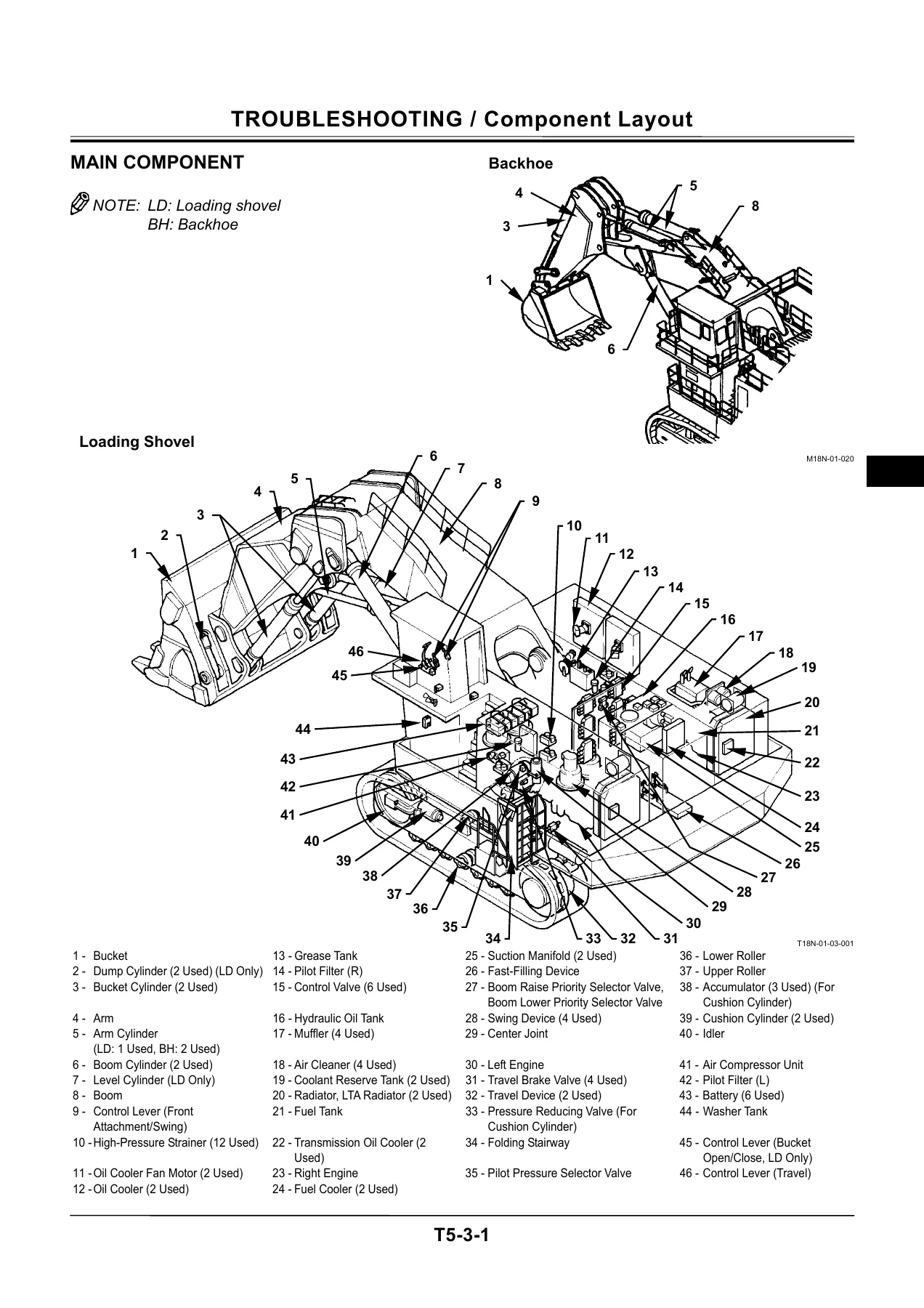
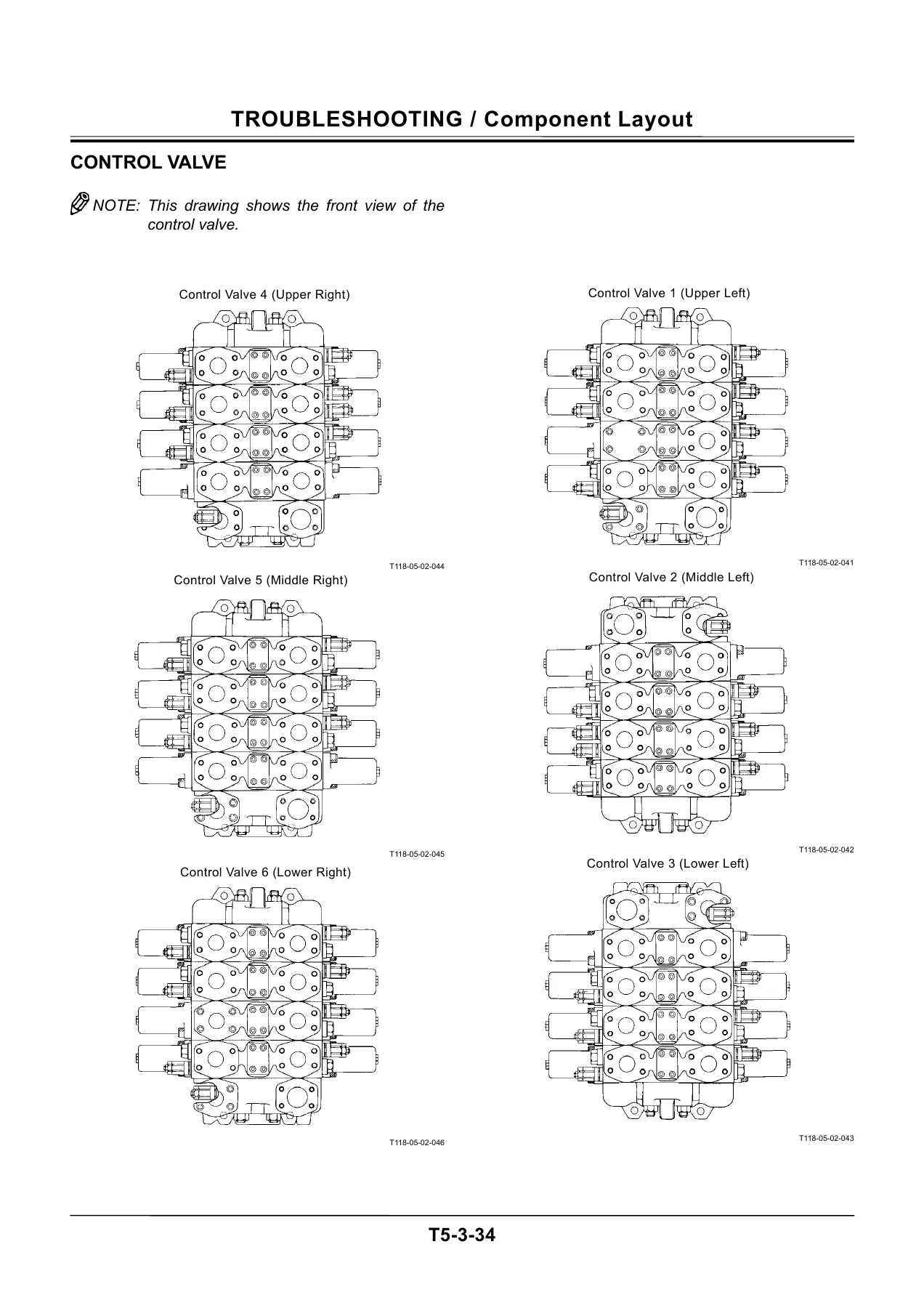
- Group 3 Component Layout — main component, frames, cab, relay panel, control box, relay box, pilot piping, pump rooms, engine rooms, folding stairway, center frame, control valve panels, hydraulic oil tank, fuel tank, travel alarm, fast-filling device, oil cooler room, auto-lubrication device, undercarriage, swing and travel devices, manifolds and pilot hose routing
- Group 4 Troubleshooting A — base machine diagnosis through monitor display fault codes, full fault code list and alarm code list with related controllers
- Group 5 Troubleshooting B — engine diagnosis by flashing pattern of indicator lamps, how to read fault codes, engine fault code tables with effect on engine and recommended action
- Group 6 Troubleshooting C — air conditioner diagnosis, cooling circuit, electrical circuit, electronic thermo, compressor, and diagnosis by blinking of indicator
- Group 7 Electrical System Inspection — precautions, disconnecting connectors, battery voltage check, fusible link and fuse inspection, alternator check, voltage check, false signal check, continuity check, circuit check by lamp harness
What this manual actually gives a technician
What separates this Hitachi EX5600-6 troubleshooting manual from a general service book is the way the two sections feed each other. The performance test section defines what “correct” looks like — fast idle and slow idle engine speeds, auto-idle speed, fast and slow travel speed over a 20 m track, track revolution time over three turns, permitted mistrack, swing speed over three turns, swing drift, cylinder cycle times for boom, arm, bucket and bucket open/close, dig function drift limits, and control lever operating forces and strokes. The component test section then takes you inside the hydraulic and pilot systems with primary and secondary pilot pressures at fast and slow idle, main relief and overload relief set pressures, and pump flow rate checks against the published P-Q and Pi-Q curves. When a machine feels weak, slow or unstable, this is the data that decides whether the pump, the valve or the operator is at fault.
Section 5 is the diagnostic half. The diagnosing procedure explains how the controller self-diagnosis works through the monitor display, how to read the alarm and fault list screens, how to step into the detailed screen and the schematic circuit diagram from the keypad, and how to use the automatic snapshot, manual snapshot, monitoring list, maintenance history, life data and machine information screens. Troubleshooting A lists base machine fault codes and alarm codes with the description, warning and buzzer status and the related controller, so you can jump straight to the right system. Troubleshooting B covers the engine side, where fault codes are read from the flashing pattern of the engine stop, engine warning and engine maintenance lamps inside the control box, with a full engine fault code table, the effect on the engine and the recommended first and second actions. Troubleshooting C is dedicated to the air conditioning system, and Group 7 closes the loop with electrical inspection practice: battery voltage checks, fusible link and fuse continuity, alternator generating voltage checks, voltage drop testing, false signal testing, continuity and short-circuit checks, and the lamp harness method.
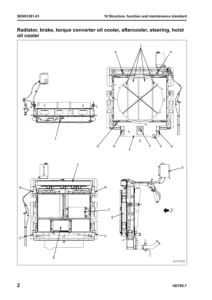
The component layout group is worth calling out on its own. Each major area of the EX5600-6 — both frames, cab, relay panel, control box, relay box, pilot panels, both pump rooms, both engine rooms, radiators, oil cooler, fuel tank, folding stairway, undercarriage, swing and travel devices and the various manifolds — is drawn and numbered so you can locate a sensor, solenoid valve, pressure switch, relay or harness connector without guessing. Where a manifold is involved, the connecting ports are tabulated with what each port feeds, which makes pressure testing and pilot circuit work far faster.
Why this Hitachi EX5600-6 troubleshooting manual matters
Large mining excavators live on condition monitoring and fast diagnosis. A wrong call on a pump, a relief valve or a pilot circuit costs a machine day, not an hour. The performance test values and the fault code tables in this manual let you replace guesswork with measurement — confirm the fault, isolate the circuit, test against the published figure, then repair. The electrical inspection group goes further and gives you the actual test technique, so you can prove a harness or a connector instead of replacing parts on suspicion.
IMAGES PREVIEW
Instant delivery
The Hitachi EX5600-6 Hydraulic Excavator Troubleshooting Manual is delivered as an instant PDF download after payment — no shipping, no waiting. Open it on a laptop or tablet in the cab, print only the pages you need for the job, and keep the full manual on any device for the next diagnosis. Whether you are running performance tests, chasing a fault code, locating a pressure sensor or inspecting the electrical system, this manual is the reference you want within reach.
Reviews
There are no reviews yet.