
Hitachi EX8000-6 Hydraulic Excavator Operator’s Manual – Loading Shovel PDF
Original price was: $39.95.$23.95Current price is: $23.95.
Complete operator’s manual for the Hitachi EX8000-6 hydraulic excavator with loading shovel front attachment. Covers safety, operation, maintenance, troubleshooting, and specifications for the Cummins QSKTA60-CE powered EX8000-6. Instant PDF download.
Description
Hitachi EX8000-6 Hydraulic Excavator Operator’s Manual
This is the complete operator’s manual for the Hitachi EX8000-6 hydraulic excavator equipped with the loading shovel front attachment. Produced by Hitachi Construction Machinery Co., Ltd., this manual (document number EM18P-1-2) provides the essential operating, safety, and maintenance information needed to run and service the EX8000-6 correctly. Whether you are an operator running the machine daily, a maintenance technician performing scheduled service, or a site supervisor responsible for safe operation, this manual delivers the procedures and specifications that keep the EX8000-6 working productively and safely.
File Details
- Manual Type: Operator’s Manual
- Brand: Hitachi Construction Machinery Co., Ltd.
- Model: EX8000-6 Hydraulic Excavator
- Front Attachment: Loading Shovel
- Language: English
- Page Count: 312
- File Format: PDF
- Document Number: EM18P-1-2
Chapters Covered
The EX8000-6 operator’s manual is organised into the following main sections:
- Safety — Safety alert symbols, signal words (DANGER, WARNING, CAUTION, IMPORTANT, NOTE), general precautions for the cab, handholds and steps, seat adjustment, seat belt usage, safe machine movement, jump starting, keeping riders off, job site investigation, protection against falling stones and debris, signals for multiple machines, safe driving practices, rollaway prevention, back-over and swing accident prevention, digging precautions, power line safety, lightning precautions, object handling, flying debris protection, parking procedures, fluid handling and fire safety, safe maintenance practices, high-pressure fluid hazards, fire prevention, exhaust fume warnings, welding and grinding precautions, asbestos dust awareness, battery explosion prevention, air conditioning service safety, chemical product handling, and waste disposal.
- Safety Signs — Locations and content of all safety decals affixed to the machine, including electrical hazard warnings, battery danger notices, track adjuster warnings, swing area warnings, boom crush warnings, stairway warnings, and high-pressure gas cautions.
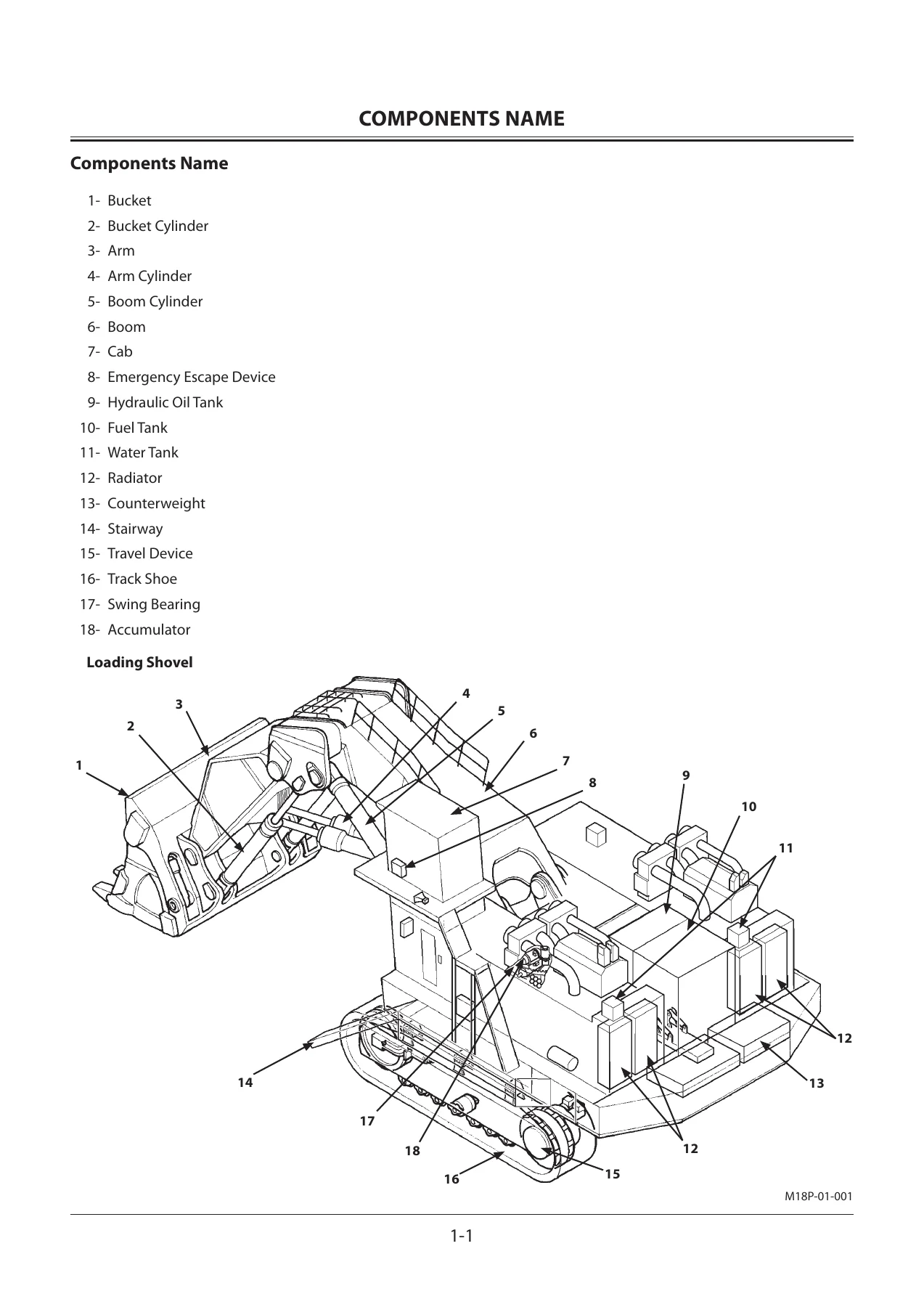
- Components Name — Illustrations and identification of major components including bucket, bucket cylinder, arm, arm cylinder, boom cylinder, boom, cab, emergency escape device, hydraulic oil tank, fuel tank, water tank, radiator, counterweight, stairway, travel device, track shoe, swing bearing, and accumulator.
- Handling Stairway / Emergency Escape Device — Procedures for using the stairway, extending and retracting the stairway, manual operation of the stairway, emergency escape device operation, emergency exit procedures, and evacuation in case of fire.
- Operator’s Station — Cab features, monitor display including starting check screen and meter check screen, tachometer, coolant temperature gauge, hydraulic oil temperature gauge, fuel gauge, engine oil pressure gauge, engine oil temperature gauge, hour meter, all warning indicators, caution indicators, status indicators, travel mode indicator, prelub indicator, warning lamp, caution lamp, key pad, monitor contrast switch, wiper and washer controls, air conditioner operation, FM/AM radio operation, right console controls, left console controls, rear console, horn switch, seat adjustment, seat belt, cab door release, and window operation.
- Break-In — Break-in procedures for the first 50 hours and first 200 hours, every 10 hours or each shift service, and after the first 50 hours service.
- Operating Engine — Before starting checks, starting check screen, meter check screen, fault and alarm message review, starting the engine, starting in cold weather using ether, checking instruments after starting, stopping the engine, emergency engine stop switch, engine stop switches, and using booster batteries for jump starting.
- Driving Machine — Steering using pedals, steering using levers, travel mode switch, travel alarm, operating on soft ground, raising one track using boom and arm, towing the machine a short distance, operating ground conditions, parking on slopes, parking procedures, and overnight storage instructions.
- Operating Machine — Control lever patterns (Hitachi and ISO), bucket open/close pedals, pilot control shut-off lever, engine speed control, auto-idle function, warming-up operation, warming-up cylinders and motors, operating machine safely, prohibited operations, loading shovel operation, object handling, and overnight storage.
- Maintenance — Correct maintenance and inspection procedures, checking hour meter, using correct fuels and lubricants, preparing machine for maintenance, access doors, inspection/maintenance lights, using a chain to prevent falling accidents, electric pump operation, periodic replacement of parts, maintenance interval guide, greasing procedures (front joint pins, swing bearing, swing internal gear, center joint, lubricator operation), engine maintenance (oil level checks, oil changes, filter replacement), transmission maintenance (pump transmission, swing reduction gear, travel reduction gear), hydraulic system maintenance (oil level, filter replacement, oil changes, suction filter, high-pressure filter, oil cooler cleaning, hose inspection), fuel system maintenance (fuel tank sump, filter sediment, filter element replacement, hose inspection, cooler cleaning, breather cleaning), air cleaner maintenance, cooling system maintenance (coolant level, DCA4 concentration, coolant filter, coolant change, radiator cleaning), air conditioner maintenance (recirculation filter, ventilation filter, refrigerant check, compressor belt, condenser cleaning), electrical system maintenance (batteries, fuses, high current fuses, electrical cables, emergency engine stop switch), and miscellaneous maintenance (bucket teeth, emergency escape device, auto-lubrication system, seat belt, windshield washer fluid, air horn compressor filter, track sag, accumulator, side frame cleaning, tightening torque of bolts and nuts with full torque specification tables).
- Maintenance Under Special Environmental Conditions — Muddy soil, rainy or snowy weather, near the ocean, dusty atmosphere, rocky ground, freezing weather, and falling stones.
- Storage — Storing the machine, removing from storage, and transporting the machine.
- Troubleshooting — Cummins fault code lamps and diagnostic switches, engine troubleshooting (cranks but will not start, knocks or runs irregularly, not developing full power, overheating, low oil pressure, excessive oil or fuel consumption, exhaust smoke diagnosis, turbocharger issues), electrical system troubleshooting (nothing works, undercharged batteries, starting motor issues, charging indicator, alternator noise, monitor panel indicators), mode selection issues, hydraulic system troubleshooting (slow functions, overheating, foaming, low pressure, no functions, cylinder issues, travel issues, swing issues), and auto-idle troubleshooting.
- Specifications — Complete machine specifications and working range for the loading shovel configuration.
- Index — Comprehensive alphabetical index.
What This Manual Provides
The Hitachi EX8000-6 operator’s manual is the fundamental reference for anyone responsible for the safe operation and routine maintenance of this 811-tonne class hydraulic excavator. The EX8000-6 is powered by twin Cummins QSKTA60-CE engines, each rated at 1450 kW (1970 PS) at 1800 rpm, and carries a PCSA-rated 40.0 m³ (52.3 yd³) loading shovel bucket. This manual addresses the specific systems, controls, and service requirements of that machine in detail.
From the operator’s perspective, the manual explains every gauge, indicator, and control on the monitor panel and consoles. It covers starting and stopping procedures for the twin-engine installation, including the prelub system and cold-weather starting with ether. The driving and operating sections describe correct techniques for steering with pedals or levers, selecting travel speed modes, working on slopes and soft ground, and using the loading shovel front attachment productively. Safety is woven throughout — not just in the dedicated safety chapter but also in the operating procedures that warn against unsafe practices like undercutting high banks, swinging loads over personnel, or working too close to power lines.
For maintenance personnel, the manual provides structured service intervals from daily checks through 12,000-hour component replacements. The greasing section covers both manual and auto-lubrication systems, with specific grease types, quantities, and procedures for the front joint pins, swing bearing, swing internal gear, and center joint. Engine service includes oil level checks on both the oil pan and reserve tank, oil and filter change procedures for the twin Cummins engines, and the automatic oil fill system. Hydraulic system maintenance covers the full-flow filters, drain filters, bypass filters, pilot oil filters, suction filters, and high-pressure filters, along with hydraulic oil change procedures and the electric pump used to draw oil from the lines. Cooling system service explains DCA4 concentration testing and adjustment, coolant filter replacement, and the correct coolant change procedure using Genuine Hitachi Long-Life Coolant.
The troubleshooting chapter helps diagnose common problems across the engine, electrical system, hydraulic system, and auto-idle function. Engine symptoms like hard starting, knocking, overheating, low oil pressure, and exhaust smoke colour are addressed with probable causes and corrective actions. Electrical troubleshooting covers battery issues, starting motor problems, charging system faults, and monitor panel failures. Hydraulic troubleshooting addresses slow functions, overheating, foaming, pressure loss, and specific component failures. The Cummins fault code reading procedure using the diagnostic switches and lamps in the electrical equipment box is explained, allowing fault codes to be retrieved without external tools.
Specification tables at the end of the manual provide the machine’s working dimensions, engine output, bucket capacity, operating weight, ground pressure, swing speed, travel speed, and gradeability. The tightening torque tables in the maintenance section list the correct torque values for critical fasteners throughout the machine, from engine cushion rubber mounting bolts to swing bearing bolts and track pin retaining bolts. These specifications are essential for any repair work that involves disassembly and reassembly of major components.
Why This Manual Matters
The EX8000-6 is a significant capital investment, and correct operation and maintenance directly affect its service life, availability, and safety. Using the wrong oil, skipping greasing intervals, ignoring warning indicators, or performing repairs without the correct torque values can lead to premature component failure, unplanned downtime, and potentially dangerous situations. This manual provides the specific procedures and specifications that Hitachi intended for the machine, helping owners and operators avoid costly mistakes.
For maintenance planning, the maintenance interval guide provides a clear schedule of what needs to be checked, cleaned, lubricated, or replaced at each interval from 10 hours to 12,000 hours. The periodic replacement parts table identifies the hoses that should be replaced every two years or 8000 hours regardless of appearance, covering pump delivery hoses, front hoses, travel hoses, and fan motor hoses. Following these schedules helps prevent failures before they occur.
Delivery
IMAGES PREVIEW
This Hitachi EX8000-6 operator’s manual is delivered as an instant PDF download after payment. There is no waiting for shipping and no physical product to handle. The PDF can be viewed on any device — computer, tablet, or smartphone — and relevant pages can be printed for use in the cab, workshop, or field. The file remains accessible for future reference, making it a practical resource for the entire working life of the machine.



Reviews
There are no reviews yet.