
Honda Motorcycle, Scooter & ATV Common Service Manual – Theory, Troubleshooting & Repair Guide
Original price was: $29.95.$17.95Current price is: $17.95.
The Honda Common Service Manual covers the theory of operation, troubleshooting, inspection and repair of systems shared across Honda motorcycles, scooters and ATVs. 442 pages spanning engine, drivetrain, chassis and electrical systems in 26 sections.
Description
Honda Motorcycle, Scooter & ATV Common Service Manual
The Honda Motorcycle, Scooter & ATV Common Service Manual is a cross-model technical reference published by the Honda Motor Co., Ltd. Service Publications Office. Rather than documenting one machine, it explains the theory of operation behind the systems common to Honda motorcycles, motor scooters and ATVs, and provides the basic inspection, troubleshooting and repair information that applies across those platforms. Where a specific model requires its own adjustment, maintenance or repair procedure, the manual directs you to the Model Specific Service Manual for that machine.
File Details
- Manual type: Common / cross-model service manual
- Publisher: Honda Motor Co., Ltd. — Service Publications Office
- Language: English
- Page count: 442 pages
- File format: PDF
- Coverage: Honda motorcycles, motor scooters and ATVs
Chapters Covered
- General Information — General Safety, Fasteners, Service Rules, Ball Bearing Replacement
- Maintenance — Fuel Line, Throttle Operation, Air Cleaner, Spark Plug, Valve Clearance, Engine Oil and Filter, Carburetor Synchronization and Idle Speed, Radiator Coolant, Cooling System, PAIR and Evaporative Emission, Drive Chain, Drive Belt, Final Drive Oil, Battery, Brake Fluid, Brake Shoe and Pad Wear, Brake System, Clutch System, Side Stand, Suspension, Wheels and Tires, Steering Head Bearings, Wheel Alignment
- Engine Testing — Service Information, Troubleshooting, Compression Testing, Leak-Down Testing
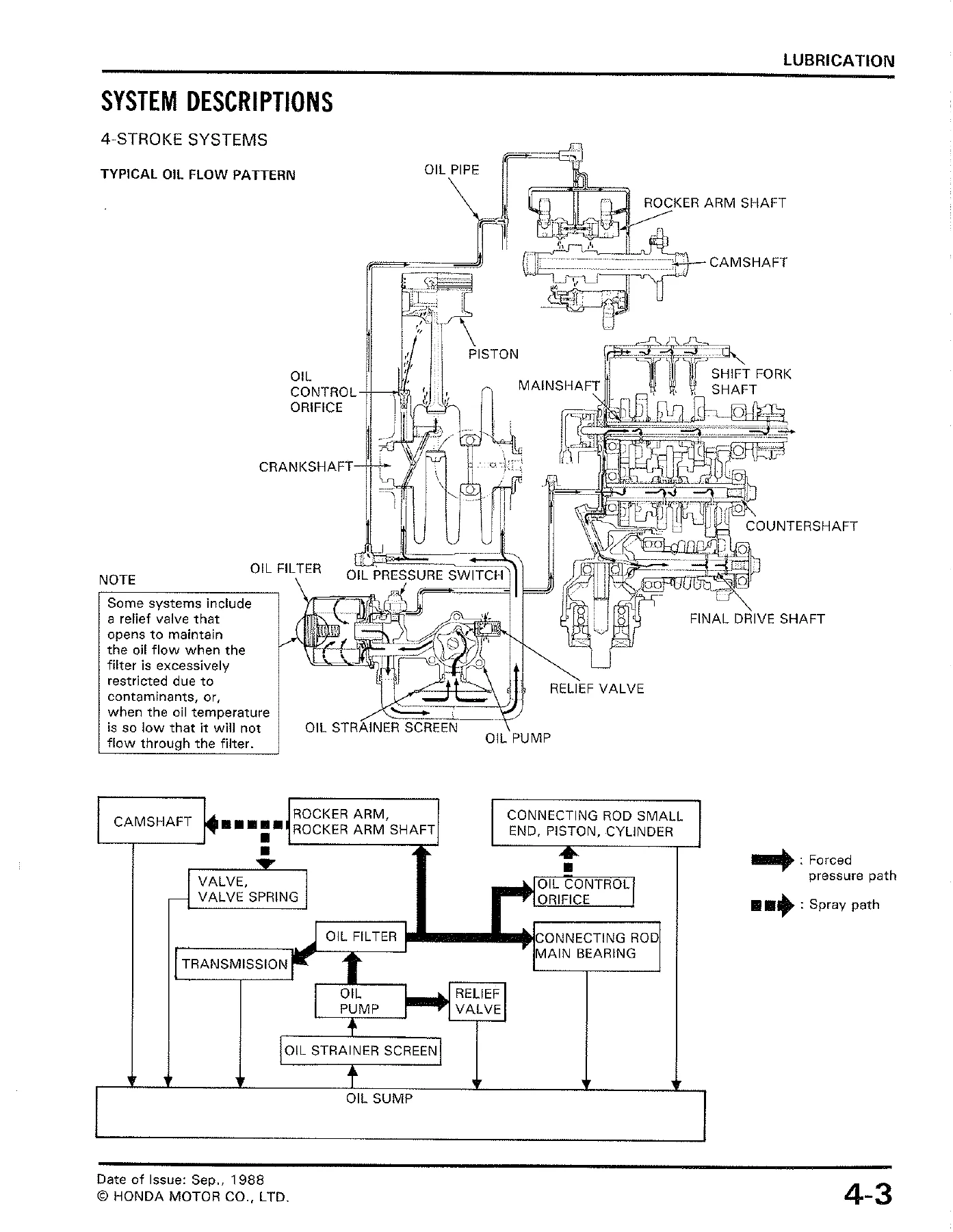
- Lubrication — Service Data, System Descriptions, Oil Pump Descriptions, Oil Pressure Check, Oil Pump Inspection, Pressure Relief Valve, Oil Pump and Oil Line Bleeding, Oil Cooler Inspection
- Cooling System — System Descriptions, Coolant, System Testing, Thermostat, Water Pump
- Exhaust System — System Description, Exhaust Pulse Scavenge Effect, Common Exhaust Pipe
- Emission Control Systems — System Descriptions, System Inspections, Emission Control Information Labels
- Fuel System — Accelerator Pump, Air Cut-Off Valve, Reed Valve, Fuel Line, Fuel Auto Valve, Carburetor Disassembly and Assembly, Pilot Screw Adjustment, High Altitude Adjustment
- Cylinder Head — Hydraulic Tappets, Decompressor System, Camshaft, Rocker Arm, Cylinder Head Disassembly and Assembly, Valve Springs, Valves, Valve Guides, Valve Seats
- Cylinder/Piston — Cylinder Inspection, Piston and Piston Ring, Cylinder Installation
- Clutch — Wet Multiplate Manual Clutch, One-Way Clutch System, Centrifugal Clutch, Clutch Inspection, Hydraulic Clutch System Service
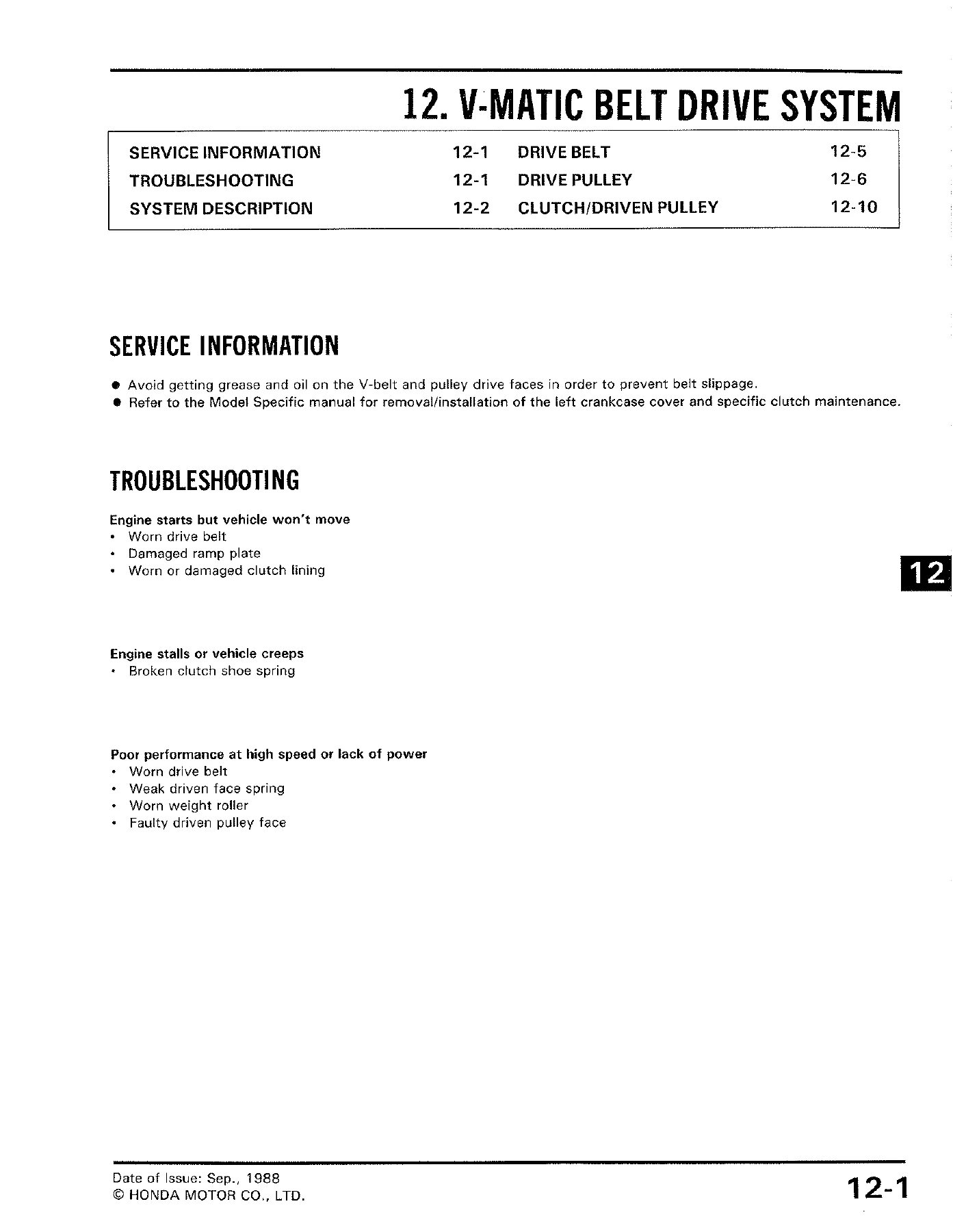
- V-Matic Belt Drive System — System Description, Drive Belt, Drive Pulley, Clutch and Driven Pulley
- Transmission — Gearshift Mechanism, Planetary Gear Type, Constant Mesh Transmission, Transmission Disassembly and Assembly
- Crankcase/Crankshaft — System Descriptions, Crankshaft Inspection, Main Bearing, Connecting Rod Bearings
- Final Drive/Output Shaft — Output Shaft, Final Drive, Universal Joint, Backlash Inspection
- Wheels/Tires — Wheel Removal and Installation, Wheel Bearing Replacement, Basic Tire Information, Tire Removal and Installation, Wheel Balancing, ATV Wheel and Tire
- Brakes — Hydraulic Disc Brakes, Mechanical Drum Brakes, Master Cylinder, Caliper, Brake Disc Inspection
- Front Suspension — Fork, Handlebar(s), Steering Stem
- Rear Suspension — Shock Absorber, Swingarm, Pro-Link Suspension Linkage
- Frame/Body Panels — Frame Types, Inspection
- Electrical Fundamentals — Basic Electronic Knowledge, Electrical Symbols, Basic Electrical Diagnostic Methods
- Battery/Charging/Lighting System — Battery Descriptions, Battery Testing and Charging, Charging System Descriptions, Charging System Inspection, Regulator/Rectifier Inspection, Alternator
- Ignition Systems — Spark Test, Ignition Timing, Ignition System Inspection (Peak Voltage Measurement Method), Ignition Coil, Side Stand Ignition Cut-Off Switch
- Electric Starter/Starter Clutch — Starter Motor, Starter Relay Switch, Clutch Switch Diode Inspection, Starter Clutch Inspection, Starter Pinion Inspection
- Lights/Meters/Switches — Oil Pressure Warning Light, Oil Level Indicator, Fan Motor Switch, Coolant Temperature Gauge, Fuel Gauge, Low Fuel Indicator, Fuel Pump, Headlight Bulb, Switches, Turn Signal Lights, Horn, Side Stand Switch, Side Stand Indicator
- Index
Across the 26 sections, the Honda Common Service Manual builds a complete working picture of how a Honda motorcycle, scooter or ATV is put together and how its systems behave. It starts with safety and service rules, then moves through engine and drivetrain theory — lubrication, cooling, fuel and emission control, valve train, crankshaft and transmission — before covering chassis systems: wheels, tires, brakes, suspension, steering and frame. The final block of sections is a self-contained electrical course, from electron flow and Ohm’s law through battery and charging theory, ignition types (CDI, DC-CDI, transistorized), starter circuits, and switch and indicator diagnosis. Diagrams, exploded views and cross-sections accompany the theory so the reader can see the relationship between components before attempting a repair.
What You Can Do With This Manual
The Honda Common Service Manual gives a technician the background knowledge needed to diagnose and repair systems that repeat across many Honda machines, so you are not starting from zero each time you open a model-specific book. Concrete tasks it supports include:
- Running a compression test or leak-down test to establish engine condition before tune-up or rebuild.
- Reading oil flow circuits and checking oil pressure on wet-sump, dry-sump and two-stroke lubrication systems.
- Servicing cooling systems: coolant mixture, air bleeding, thermostat testing, water pump mechanical seal inspection, radiator cap pressure testing.
- Diagnosing fuel and emission control faults: float system, slow and main jet circuits, accelerator pump, air cut-off valve, reed valve, PAIR system, evaporative emission control.
- Inspecting and adjusting valve clearance, cylinder heads, valves, valve guides and seats, camshafts and rocker arms.
- Servicing clutches: wet multiplate, one-way sprag, centrifugal, and hydraulic clutch master and slave cylinders.
- Working on the V-Matic belt drive — drive belt, drive pulley, clutch and driven pulley — used on Honda scooters.
- Transmission, gearshift linkage, crankshaft and main bearing inspection.
- Wheel and tire work: removal and installation, bearing replacement, wheel balancing, tubed and tubeless tire servicing.
- Brake system service: hydraulic disc brakes, mechanical drum brakes, master cylinder, caliper and brake disc inspection.
- Front and rear suspension work: fork disassembly and assembly, shock absorber, swingarm, Pro-Link linkage.
- Electrical diagnosis: voltage, resistance and current measurement, battery testing and charging, regulator/rectifier inspection, alternator testing, ignition system peak voltage measurement, starter and starter clutch service, switch and indicator continuity testing.
Having the correct theory and specification behind each procedure matters. A connecting rod bearing cap torqued past its specification can deform the cap and close up the oil clearance until the bearing seizes; a snap ring installed with the chamfer facing the wrong way can walk out of its groove; a float level set high will run the mixture rich. The Honda Common Service Manual is written precisely to prevent that class of mistake by explaining why the specification exists before telling you what it is.
IMAGES PREVIEW
Instant PDF Delivery
This Honda Common Service Manual is delivered as an instant-download PDF. There is no shipping, no waiting, and no physical book to store. Once payment is confirmed you can open the file immediately on a phone, tablet, laptop or desktop, print the pages you need for the workshop bench, or keep the whole manual on a shop computer for quick reference. Buyers working on Honda motorcycles, scooters and ATVs get a durable reference that stays available whenever a system needs to be understood, tested, adjusted or repaired.

Reviews
There are no reviews yet.