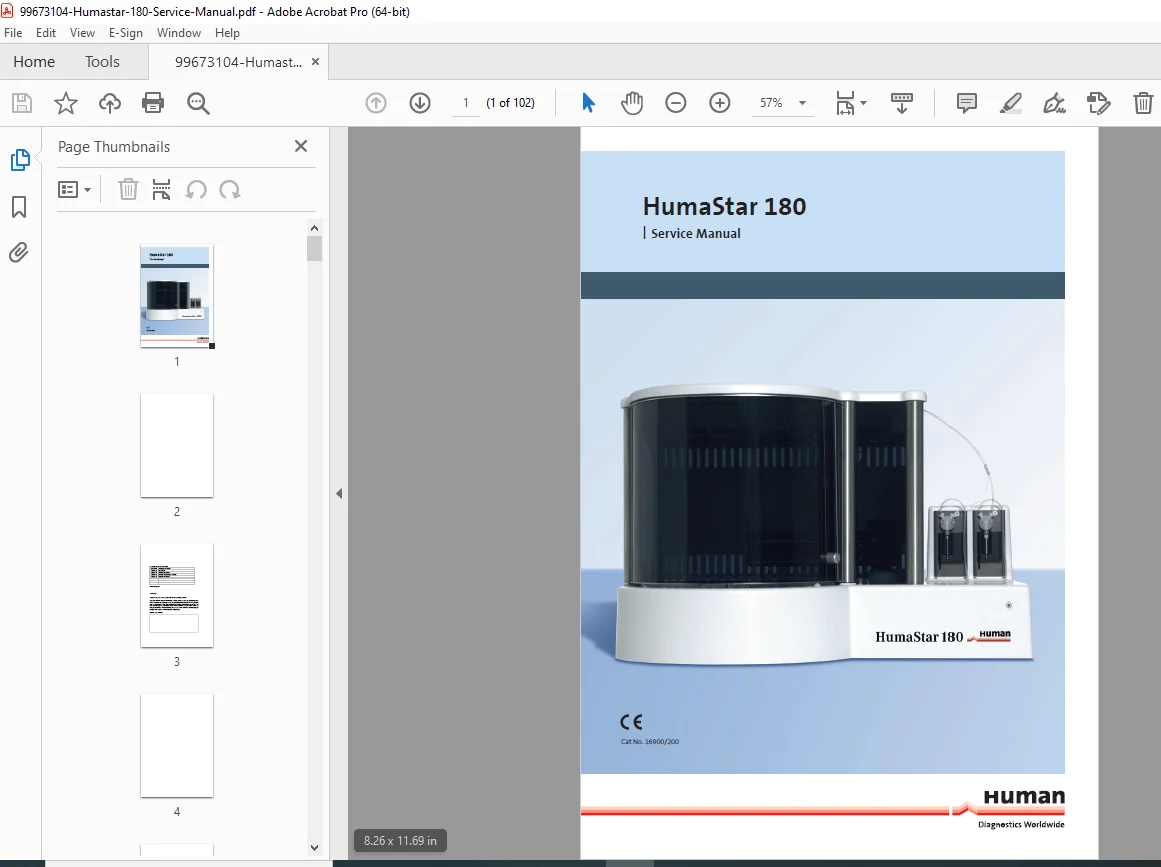
Human HumaStar 180 Clinical Chemistry Analyzer Service Manual PDF Download
Original price was: $65.00.$15.95Current price is: $15.95.
Complete Human HumaStar 180 clinical chemistry analyzer service manual with system introduction, electronics schematics, Euly Service software instructions, calibration procedures, troubleshooting guides, spare parts list, maintenance procedures, photometer adjustment, and technical specifications.
Description
Human HumaStar 180 Clinical Chemistry Analyzer Service Manual PDF Download
DESCRIPTION:
This comprehensive Human HumaStar 180 service manual (Catalog No. 16900/200, Revision 04/2011-01) provides complete factory technical documentation for servicing and repairing the HumaStar 180 automated clinical chemistry analyzer. Essential for biomedical equipment technicians, clinical laboratory engineers, and authorized service professionals.
Analyzer Overview:
The Human HumaStar 180 is a fully automated clinical chemistry analyzer designed for small to medium-sized laboratories, featuring reliable performance and ease of use for routine chemistry testing.
Key Analyzer Features:
- Automated Clinical Chemistry: Fully automated sample and reagent handling
- Throughput: Up to 180 photometric tests per hour
- Test Menu: Comprehensive clinical chemistry parameters
- Sample Capacity: Multiple sample positions
- Reagent Management: Refrigerated reagent carousel
- Measurement System: High-precision photometer
- Cuvette System: Permanent cuvette rotor with automated washing
- Temperature Control: Precise temperature management
- Liquid Handling: Automated pipetting system
- Process Management: Computerized workflow control
- Data Management: Integrated software system
TABLE OF CONTENTS
REVISION LIST (Page 2)
- Manual revision history:
- 01/2004-07: First edition
- 02/2005-07: Addition of Chapter 8
- 03/2010-11: Adaptation to new Corporate Design
- 04/2011-01: Addition of Chapter 5
COPYRIGHT NOTICE (Page 2)
- Copyright 2010, Human GmbH, Wiesbaden, Germany
- Documentation usage rights
- Technical development disclaimer
CHAPTER 1 – SAFETY INSTRUCTIONS (Pages 5-10)
- 1.1 Introduction (Page 5)
- Safety information overview
- Warning symbol definitions
- Precautionary measures
- 1.2 User Warranty (Page 5)
- Warranty conditions
- Authorized service requirements
- Liability limitations
- 1.3 Intended Use of the Instrument (Page 5)
- Clinical chemistry analysis applications
- In vitro diagnostic use
- Qualified operator requirements
- Laboratory environment specifications
- 1.4 General Safety Warnings (Pages 6-7)
- Electrical safety precautions
- Moving parts hazards
- High-temperature components
- Chemical handling safety
- Installation requirements
- Power supply specifications
- Grounding requirements
- Environmental conditions
- 1.5 Disposal Management Concept (Page 6-7)
- Waste disposal procedures
- Environmental protection
- Recycling guidelines
- Hazardous material handling
- Local regulation compliance
- 1.6 Biohazard Warning (Page 7-8)
- Biological safety precautions
- Bloodborne pathogen exposure
- Personal protective equipment (PPE)
- Sample handling procedures
- Contamination prevention
- Universal precautions
- 1.7 Instrument Disinfection (Pages 7-10)
- Disinfection procedures:
- Surface disinfection methods
- Approved disinfectants
- Decontamination protocols
- Fluid path disinfection
- Cuvette rotor cleaning
- Needle cleaning procedures
- Safety precautions during disinfection
- Reagent compatibility
- Disinfection procedures:
CHAPTER 2 – SYSTEM INTRODUCTION (Pages 11-22)
- 2.1 Introduction (Page 11)
- HumaStar 180 overview
- System architecture
- Design philosophy
- 2.2 Characteristics (Page 11-12)
- Key features and capabilities
- Performance specifications
- Operational advantages
- Technology highlights
- 2.3 Specifications (Page 12-13)
- Technical Specifications:
- Throughput: 180 tests per hour
- Sample positions
- Reagent positions
- Reaction volume
- Wavelengths available
- Temperature specifications
- Sample volume range
- Reagent volume range
- Reaction time
- Measurement range
- Physical Specifications:
- Dimensions (W x D x H)
- Weight
- Power requirements
- Environmental conditions
- Performance Specifications:
- Precision
- Accuracy
- Linearity
- Carryover specifications
- Technical Specifications:
- 2.4 Functional Description (Pages 13-22) 2.4.1 Process Management (Pages 13-14)
- System control architecture
- Workflow automation
- Software integration
- Test scheduling
- Result processing
- Quality control management
2.4.2 Liquid Handling (Pages 14-17)
- Pipetting System:
- Sample pipettor mechanism
- Reagent pipettor design
- Needle washing system
- Clot detection
- Liquid level detection
- Volume accuracy
- Pipetting sequence
- Precision specifications
- Maintenance requirements
2.4.3 Carousels, Temperature Control and Cooling (Pages 17-20)
- Reagent Carousel:
- Refrigerated compartment
- Temperature control (2-10°C)
- Position sensing
- Barcode reading capability
- Sample Carousel:
- Sample tray design
- Position identification
- Sample tracking
- Cuvette Rotor:
- Permanent cuvette design
- Thermal regulation (37°C)
- Washing stations
- Optical path configuration
- Temperature Management:
- Peltier cooling system
- Heating elements
- Temperature sensors
- Control algorithms
2.4.4 Measurement System (Pages 20-22)
- Photometer Design:
- Halogen lamp light source
- Filter wheel mechanism
- Wavelength selection
- Optical path description
- Photodetector specifications
- Measurement Process:
- Absorbance measurement
- Multi-wavelength capability
- Blank measurement
- Kinetic measurements
- Endpoint measurements
- Optical Components:
- Interference filters
- Light guide system
- Cuvette positioning
- Signal processing
CHAPTER 3 – ELECTRONICS (Pages 23-24)
- 3.1 Introduction (Page 23)
- Electronic system overview
- Control architecture
- Component integration
- 3.2 Schematic Diagram of Electronics (Pages 23-24)
- System Electronics:
- Main controller board
- Motor control circuits
- Temperature control electronics
- Photometer electronics
- Power supply distribution
- Communication interfaces
- Sensor interfaces
- Electronic component locations
- Signal flow diagrams
- Power distribution schematic
- System Electronics:
CHAPTER 4 – SERVICE SOFTWARE “EULY SERVICE” (Pages 25-40)
- 4.1 Introduction (Page 25)
- Euly Service software overview
- Purpose and capabilities
- System requirements
- 4.2 Installation of Euly Service (Page 25)
- Software installation procedure
- System requirements
- Driver installation
- Configuration setup
- 4.3 Serial Settings (Page 25)
- COM port configuration
- Baud rate settings
- Communication parameters
- Connection verification
- 4.4 Script (Pages 25-31)
- Script functionality:
- Automated test sequences
- Diagnostic routines
- Maintenance procedures
- Data logging
- Script programming
- Command syntax
- Error handling
4.4.1 Example for Reading through Euly Service Script (Page 31)
- Practical script examples
- Data retrieval procedures
- Log file interpretation
- Script functionality:
- 4.5 Reagent Rotor (Page 31)
- Reagent rotor diagnostics
- Position verification
- Temperature monitoring
- Motor control testing
- 4.6 Cuvette Rotor (Page 31)
- Cuvette rotor diagnostics
- Position sensing
- Washing verification
- Temperature control testing
- 4.7 Belt (Page 31)
- Belt drive diagnostics
- Speed verification
- Position accuracy testing
- 4.8 Pipettor (Page 32)
- Pipettor diagnostics
- Volume verification
- Movement testing
- Washing cycle verification
- 4.9 Eulytest (Page 32)
- Automated system test
- Component verification
- Performance assessment
- 4.10 Endurance Test (Page 32)
- Long-term reliability testing
- Stress testing procedures
- Component wear assessment
- 4.11 Device Data (Page 32)
- System configuration data
- Calibration parameters
- Service history
- Component information
- 4.12 FW Update (Page 32)
- Firmware update procedures
- Version management
- Update verification
- 4.13 Photo (Page 32)
- Photometer diagnostics
- Light source verification
- Detector testing
- Calibration procedures
CHAPTER 5 – CALIBRATION (Pages 33-60)
- Calibration Procedures:
- Photometer Calibration:
- Wavelength calibration
- Absorbance calibration
- Blank measurement setup
- Multi-point calibration
- Linearity verification
- Temperature Calibration:
- Reagent cooler calibration
- Reaction chamber calibration
- Temperature sensor verification
- Control loop adjustment
- Volume Calibration:
- Sample pipettor calibration
- Reagent pipettor calibration
- Volume accuracy verification
- Precision testing
- Mechanical Calibration:
- Carousel positioning
- Belt alignment
- Needle positioning
- Home position setup
- System Performance Verification:
- Accuracy testing
- Precision studies
- Carryover testing
- Linearity verification
- Photometer Calibration:
CHAPTER 6 – TROUBLESHOOTING (Pages 61-80)
- Troubleshooting Methodology:
- Systematic diagnostic approach
- Error code interpretation
- Symptom analysis
- Common Problems and Solutions:
- System Startup Issues:
- Power supply problems
- Initialization failures
- Communication errors
- Sample/Reagent Handling Problems:
- Pipetting errors
- Clot detection failures
- Volume inaccuracies
- Needle blockage
- Washing problems
- Measurement Problems:
- Photometer errors
- Wavelength drift
- Baseline instability
- Absorbance out of range
- Temperature Control Issues:
- Cooler malfunction
- Heater problems
- Temperature deviation
- Sensor failures
- Mechanical Problems:
- Carousel movement errors
- Belt drive issues
- Position detection failures
- Motor problems
- Electronic Failures:
- Board communication errors
- Sensor malfunctions
- Control system faults
- System Startup Issues:
CHAPTER 7 – MAINTENANCE (Pages 81-90)
- Preventive Maintenance Schedule:
- Daily maintenance tasks
- Weekly maintenance
- Monthly service intervals
- Quarterly inspections
- Annual calibration
- Maintenance Procedures:
- Daily Maintenance:
- System checks
- Waste disposal
- Consumables check
- Weekly Maintenance:
- Cuvette rotor cleaning
- Needle cleaning
- Reagent cooler check
- System performance verification
- Monthly Maintenance:
- Deep cleaning procedures
- Filter replacement
- Lubrication
- Calibration verification
- Periodic Maintenance:
- Lamp replacement
- Belt replacement
- Seal replacement
- Major component inspection
- Daily Maintenance:
CHAPTER 8 – SPARE PARTS (Pages 91-102)
- Complete Spare Parts List:
- Consumable Parts:
- Filters
- Seals and O-rings
- Tubing
- Needles
- Lamps
- Mechanical Components:
- Motors
- Belts and pulleys
- Gears
- Bearings
- Structural parts
- Electronic Components:
- Control boards
- Power supplies
- Sensors
- Cables and connectors
- Optical Components:
- Photometer parts
- Filters
- Light guides
- Cuvette rotor components
- Part Numbers and Ordering Information:
- Human part numbers
- Component descriptions
- Quantities
- Ordering procedures
- Consumable Parts:
KEY FEATURES OF THIS SERVICE MANUAL:
✓ Official Human GmbH factory service documentation ✓ Complete system introduction with functional descriptions ✓ Electronics schematics and diagrams ✓ Euly Service software installation and operation guide ✓ Comprehensive calibration procedures (photometer, temperature, volume) ✓ Troubleshooting guides with error code reference ✓ Maintenance schedules and procedures ✓ Spare parts list with part numbers ✓ Liquid handling system detailed description ✓ Temperature control calibration procedures ✓ Photometer adjustment and verification ✓ Disinfection and cleaning protocols ✓ Professional clinical laboratory service standards
Applications:
This HumaStar 180 service manual is essential for:
- Hospital clinical laboratory biomedical departments
- Independent laboratory service companies
- Authorized Human service centers
- Clinical laboratory equipment technicians
- Biomedical engineering departments
- Laboratory equipment distributors
Ideal For:
- Certified biomedical equipment technicians (CBET)
- Clinical laboratory technologists
- Laboratory equipment service engineers
- Biomedical technology students
- Hospital technical services staff
- Laboratory managers with technical responsibility
This comprehensive factory service manual provides the complete technical knowledge required to properly diagnose, calibrate, repair, and maintain the Human HumaStar 180 Clinical Chemistry Analyzer, ensuring accurate test results and optimal analyzer performance in clinical laboratory environments.
FILE DETAILS:
| Specification | Details |
|---|---|
| Manual Title | HumaStar 180 Service Manual |
| Catalog Number | 16900/200 |
| Model Covered | Human HumaStar 180 Clinical Chemistry Analyzer |
| Manufacturer | Human GmbH, Wiesbaden, Germany |
| Revision | 04/2011-01 (January 2011) |
| First Edition | July 2004 |
| Throughput | 180 photometric tests per hour |
| Application | Automated clinical chemistry analysis |
| Temperature Control | Reagent cooling (2-10°C), Reaction chamber (37°C) |
| Measurement System | Multi-wavelength photometer |
| Service Software | Euly Service (included) |
| Total Pages | 102 pages |
| File Size | 8.7 MB |
| PDF Quality | High-quality factory documentation with diagrams and photos |
| Language | English |
| File Format | Searchable PDF (A4 size, optimized) |