
Hydraulic Handbook Fairbanks Morse Pump – 16th Edition Engineering Reference PDF
Original price was: $34.95.$21.95Current price is: $21.95.
The complete 16th Edition Fairbanks Morse Pump Hydraulic Handbook – 252 pages of hydraulic fundamentals, friction tables, conversion factors, viscous liquid data, NPSH, cavitation, pump testing methods and pump selection reference material for engineers, plant managers and pump operators.
Description
Hydraulic Handbook Fairbanks Morse Pump – 16th Edition
This is the complete Hydraulic Handbook published by Fairbanks Morse Pump, A Member of Pentair Pump Group, in its Sixteenth Edition. Compiled as an aid to engineers who plan the installation of pumping machinery, and to plant managers and operators responsible for efficient functioning of that machinery, it gathers fundamental hydraulic principles together with the tables, charts and general data needed to solve pump application problems across public works, industry and agriculture.
The Hydraulic Handbook Fairbanks Morse Pump 16th Edition PDF is a working reference, not a promotional brochure. It opens with hydraulics fundamentals and moves through water hammer, specific speed, net positive suction head, cavitation, siphons, affinity laws and parallel/series pump operation before delivering page after page of friction tables and conversion factors that field engineers actually use.
File Details
- Manual Type: Engineering reference handbook
- Brand: Fairbanks Morse Pump (A Member of Pentair Pump Group)
- Edition: Sixteenth Edition
- Language: English
- Page Count: 252 pages
- File Format: PDF
- Copyright Years Referenced: 1954, 1956, 1959, 1965, 1969, 1971, 1973, 1974, 1975, 1977, 1979, 1988
Chapters and Sections Covered
- Section I – Hydraulic Fundamentals: Hydraulics, Liquids in Motion, Total Head, Fluid Flow, Water Hammer, Specific Gravity and Head, Power/Efficiency/Energy, Specific Speed, Net Positive Suction Head, Cavitation, Siphons, Affinity Laws, Centrifugal Pumps in Parallel and Series, Hydro-Pneumatic Tanks, Corrosion, Galvanic Corrosion, Non-Metallic Construction Materials, Graphitization
- Section II – Pipe Friction (Water): Friction of Water – General, Friction Tables for Schedule 40 Steel Pipe, Friction Tables for Asphalt-Dipped Cast Iron Pipe, Friction Loss in Pipe Fittings, Roughness Factors, Aging of Pipe, Flexible Plastic Pipe
- Section III – Conversion Factors: Length, Area, Pressure, Volume, Flow, Mgd and Cu. Ft./Sec. to Gpm, In. Water / Ft. Water / In. Mercury / PSI, Work / Power / Torque, Power Consumed per 1000 Gal., Centigrade-Fahrenheit, Baume, API, Brix, Water Analysis, Lbs./Cu. Ft. Specific Gravity, Decimal Equivalents, Hardness Numbers
- Section IV – Water Data: Viscosity, Vapor Pressure, Specific Weight, Specific Gravity, Altitude and Barometric Pressure, Boiler Feed Water Requirements, Industrial Plant Requirements, Public Buildings, Swimming Pools, Hot Water Service, Rural and Domestic Requirements, Irrigation Requirements, Land Drainage Pumped Outlets
- Section V – Viscous Liquids: Properties of Viscous Liquids, Kinematic Viscosity of Common Liquids, Viscosity-Temperature Charts, Fuel Oil Viscosity Limits, Viscosity Blending, Viscosity Conversion, Friction of Viscous Liquids in Pipes and Fittings, Reynolds Number, Centrifugal Pump Performance on Viscous Liquids, Reciprocating Pump Correction
- Section VI – Volatile Liquids: Pumping Volatile Liquids, Reid Vapor Pressure, NPSH for Hydrocarbon Liquids, Vapor Pressure-Temperature-Specific Gravity Tables, Propane-Butane Mixtures, Hydrocarbon Liquids, Gasolines, Petroleum Oils, Expansion-Temperature Chart
- Section VII – Solids in Suspension: Sewage, Sand, Slurries, Paper Stock, Foods – General Principles, Sewage and Trash Pumps, Sludge, Fall Velocities, Digested Sludge Friction, Paper Stock Friction and Pump Correction, Food Handling Pumps
- Section VIII – Chemical Liquids: Materials of Construction, Material Selection Chart, Packing Recommendations, Mechanical Seals, pH Values, Calcium Chloride, Sodium Chloride, Caustic Soda Physical Properties
- Section IX – Mechanical Data: Cast Iron Pipe Dimensions, Cast Iron Flanged Fittings, Cast Iron Pipe Flanges, Steel and Wrought Iron Pipe Properties, Copper and Brass Pipe, Vertical and Horizontal Cylindrical Tank Capacities, V-Belt Drive Horsepower, Functions of Numbers
- Section X – Electrical Data: Electric Motor Service Conditions, Motor Characteristics, Synchronous Speeds, Electric Circuit Formulas, Full Load Currents, Watt-Hour Meter Disk Constants, Wire and Fuse Sizes
- Section XI – Pump Testing: Measurement of Pressure, Pressure Gauges, Determination of Total Head, Manometers, Determining Water Level in a Well, Measurement of Capacity, Venturi Meter, Nozzles, Orifices, Discharge Tables, Pipe Cap Orifices, Weirs, Flow Over Suppressed Weir, Weir Formulas, Pitot Tubes, Fire Hose Nozzle Flow, Parshall Measuring Flume, Approximating Water Flow from Pipes
- Section XII – Fairbanks Morse Pumps: Turbine and Propeller Pumps, Fire Pumps, Non-Clog Pumps, End Suction and Submersible Pumps, Angleflow and Split Case Pumps, Peripheral Pumps, Water Systems, Utility Pumps, Vertical Turbine Solids Handling Pumps
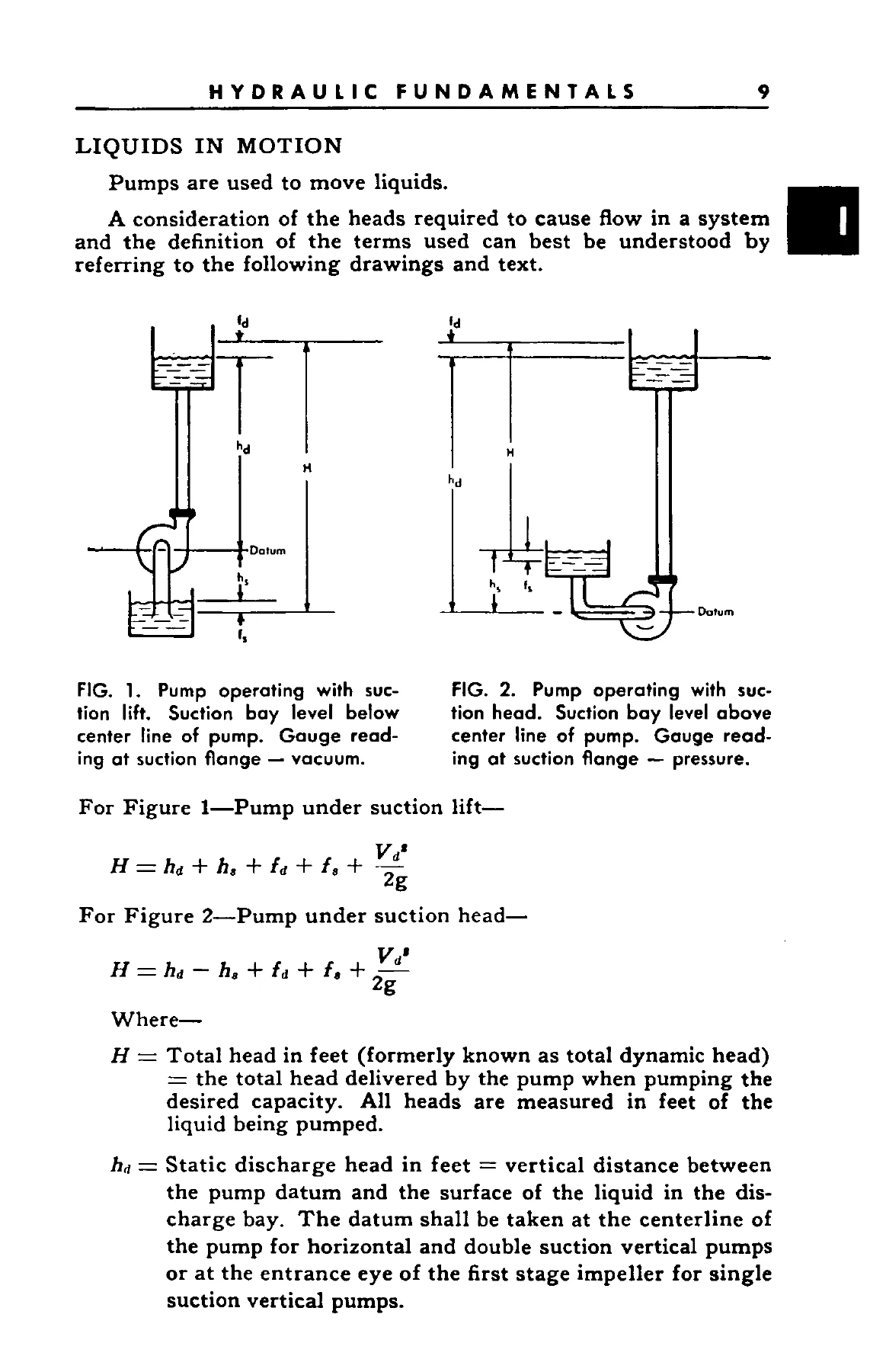
For the engineer or technician, this handbook is a single-volume working library. It explains how total head is calculated for suction lift and suction head installations, how specific speed classifies an impeller and predicts suction limitations, how NPSH available must exceed NPSH required, how cavitation develops in centrifugal and propeller pumps, and how the affinity laws approximate performance when pump speed or impeller diameter changes. It then supports those principles with thousands of friction-loss figures, conversion factors and physical property tables that would otherwise require a shelf of separate references.
Coverage of Fairbanks Morse Pump Models
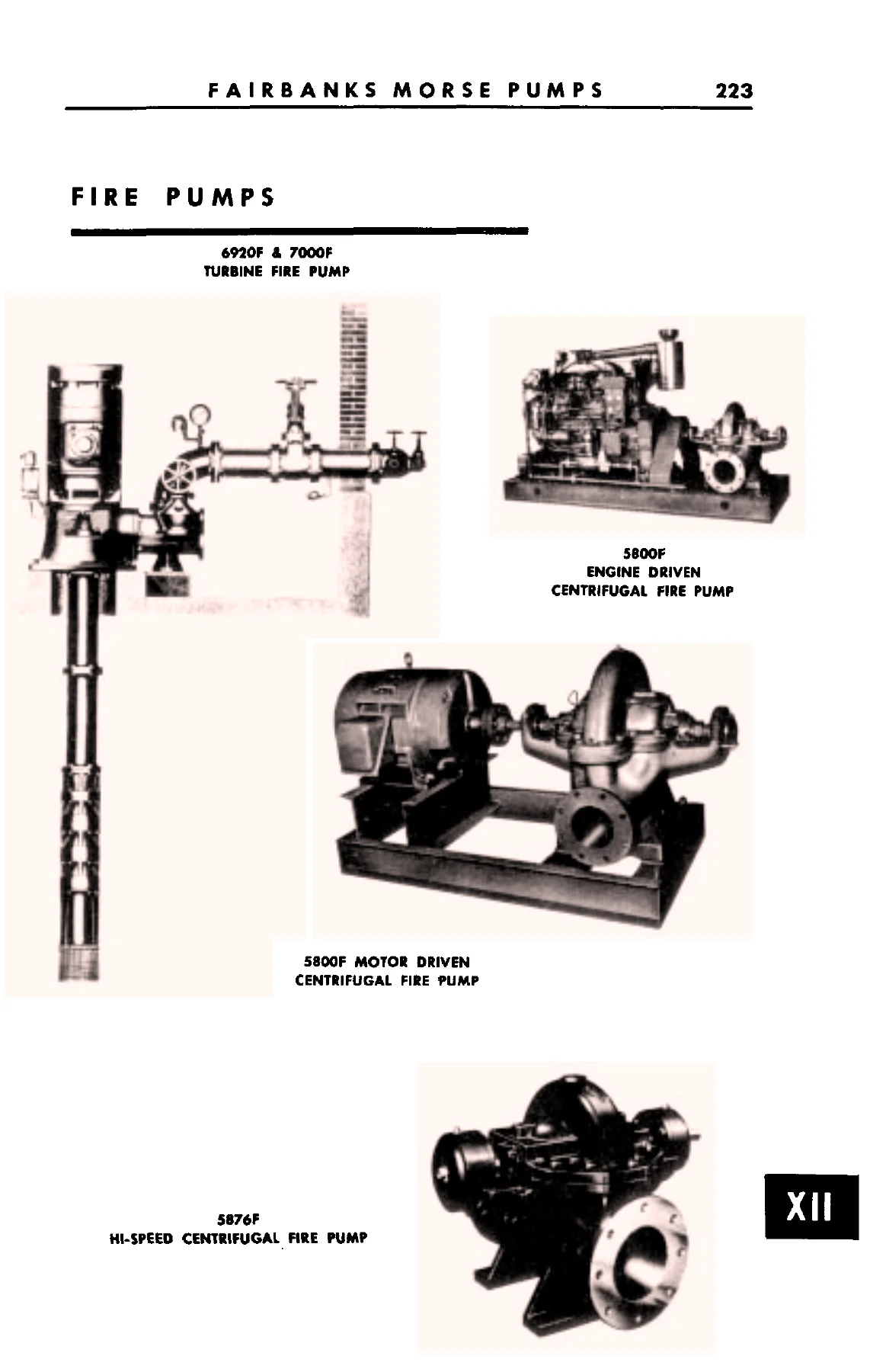
The final section illustrates the Fairbanks Morse Pump product line as it stood in the Sixteenth Edition, including the 6920, 6970 and 7000 oil and water lubricated deep well and sump turbine pumps, the 6930 pot pump, the 8211 and 8312 propeller pumps, the 6900F and 7000F skid mounted offshore units, the 6920F and 7000F turbine fire pumps, the 5876F hi-speed centrifugal fire pump, the 5400 bladed impeller and 5400K bladeless impeller non-clog pumps, the 5420P horizontal self-primer, the 5410, 5410K, 5430, 54301 and 5440 vertical and submersible non-clog configurations, the 5520R frame mounted end suction pump, the 5430AW submersible non-clog, the 5553ER end suction horizontal biltogether, the 5553F radial vane diffuser, the 5426 hi-head non-clog, the 5720, 5710 and 5740 angleflow pumps, the 5800 split case, the 5900 multistage split case, the peripheral pump line, and the patented VTSH Vertical Turbine Solids Handling pump.
Why This Handbook Matters in the Field
Pump selection errors are expensive. A pump chosen without accounting for viscosity correction factors, suction limitations or friction loss in aged pipe will run off its curve, cavitate, or fail to deliver rated capacity. This handbook gives the underlying method and the numeric data to get those decisions right. The friction tables alone, covering sizes from 1/4 inch through 72 inch nominal, convert directly into pipe sizing and total head calculations. The water data section provides boiler feed, industrial, public building, swimming pool, domestic hot water, rural, irrigation and drainage water requirement figures so system demand can be established before a pump is ever specified.
The conversion factor sections, Baume and API gravity tables, viscosity conversion tables, and hardness number comparisons remove the arithmetic ambiguity that creeps into pump engineering when different reference systems meet. The pump testing section explains how to measure pressure accurately, how to determine total head from gauge readings, how to calculate capacity with venturi meters, nozzles, orifices, weirs, pitot tubes and Parshall flumes, and how to determine water level in a deep well with an air line and pressure gauge. These are the procedures that let a field test be compared honestly against factory performance.
The chemical liquids section, galvanic corrosion discussion and material selection chart help protect a pump from the fluid it is meant to move. The galvanic series shows which metal combinations can be safely joined and which will accelerate corrosion on the less noble member. The material and packing recommendation tables list iron, bronze, stainless steel and other constructions against a long alphabet of acids, brines, oils, foods and industrial chemicals, with the corresponding packing recommendations noted.
The Complete 16th Edition in PDF Form
Whether the task is sizing a deep well turbine, working out the head loss through an aging cast iron main, correcting a centrifugal pump curve for a viscous oil, checking NPSH margin on a volatile liquid, or verifying the flow from a horizontal pipe in the field, this Hydraulic Handbook Fairbanks Morse Pump 16th Edition PDF places the answer within reach. The handbook is written to be worked from: tables are indexed, charts are labeled, and the formulas are shown in the notation the industry uses.
Every page of the original Sixteenth Edition is included. Section II alone runs through friction loss per 100 feet for water in new wrought iron or Schedule 40 steel pipe from 1/4 inch through 72 inch, with matching tables for new asphalt-dipped cast iron pipe. Section V carries kinematic viscosity data for a long list of common liquids, from acetic acid and acetone through molasses and road tar to turbine lubricating oil, along with the correction curves for centrifugal pump performance on viscous liquids.
This is reference material for the working engineer, the pump station operator, the plant maintenance planner and the consultant preparing a pumping installation study. It is not tied to a single pump model or a single process line – the principles and tables apply wherever liquid is being moved and head must be accounted for.
IMAGES PREVIEW
Instant PDF Delivery – No Shipping, No Wait
This Hydraulic Handbook Fairbanks Morse Pump is delivered as a PDF file immediately after purchase. There is no physical shipment and nothing to wait for. The file opens on any device that reads PDFs, and individual pages or tables can be printed for use at the pump or in the field. Search, bookmark and annotation tools available in any PDF reader can be used with the file. Keep it on the office workstation, the tablet in the truck, or the laptop in the pump house.
Reviews
There are no reviews yet.