
Hyundai R220LC-9S Excavator Operation and Maintenance Manual – PDF Download
Original price was: $48.95.$34.95Current price is: $34.95.
Complete 293-page operation and maintenance manual for the Hyundai R220LC-9S crawler excavator series, covering the standard, Long Reach, High Walker, and Amphibious models. Includes full specifications, maintenance schedules, troubleshooting, hydraulic breaker setup, and safety procedures. Instant PDF download.
Description
Hyundai R220LC-9S Excavator Operation and Maintenance Manual – Complete PDF
The Hyundai R220LC-9S is a 21.9-tonne class crawler excavator powered by a Cummins 6BTAA / Hyundai HM 5.9 six-cylinder turbocharged diesel engine rated at 150 Hp. This operation and maintenance manual is the complete factory document set covering the standard R220LC-9S, the R220LC-9S LONG REACH, the R220LC-9S HIGH WALKER, and the R220LC-9S AMPHIBIOUS. At approximately 293 pages, it gives you the operating procedures, service intervals, adjustment values, hydraulic and electrical system explanations, and troubleshooting guidance for the whole machine.
File Details
- Manual Type: Operation and Maintenance Manual
- Brand: Hyundai Construction Equipment
- Models: R220LC-9S, R220LC-9S LONG REACH, R220LC-9S HIGH WALKER, R220LC-9S AMPHIBIOUS
- Language: English
- Page Count: Approximately 293 pages
- File Format: PDF
Chapters Covered
- Safety Hints
- Specifications
- Control Devices
- Operation
- Transportation
- Maintenance
- Troubleshooting Guide
- Hydraulic Breaker and Quick Clamp
- Amphibious Excavator Series
Safety Hints
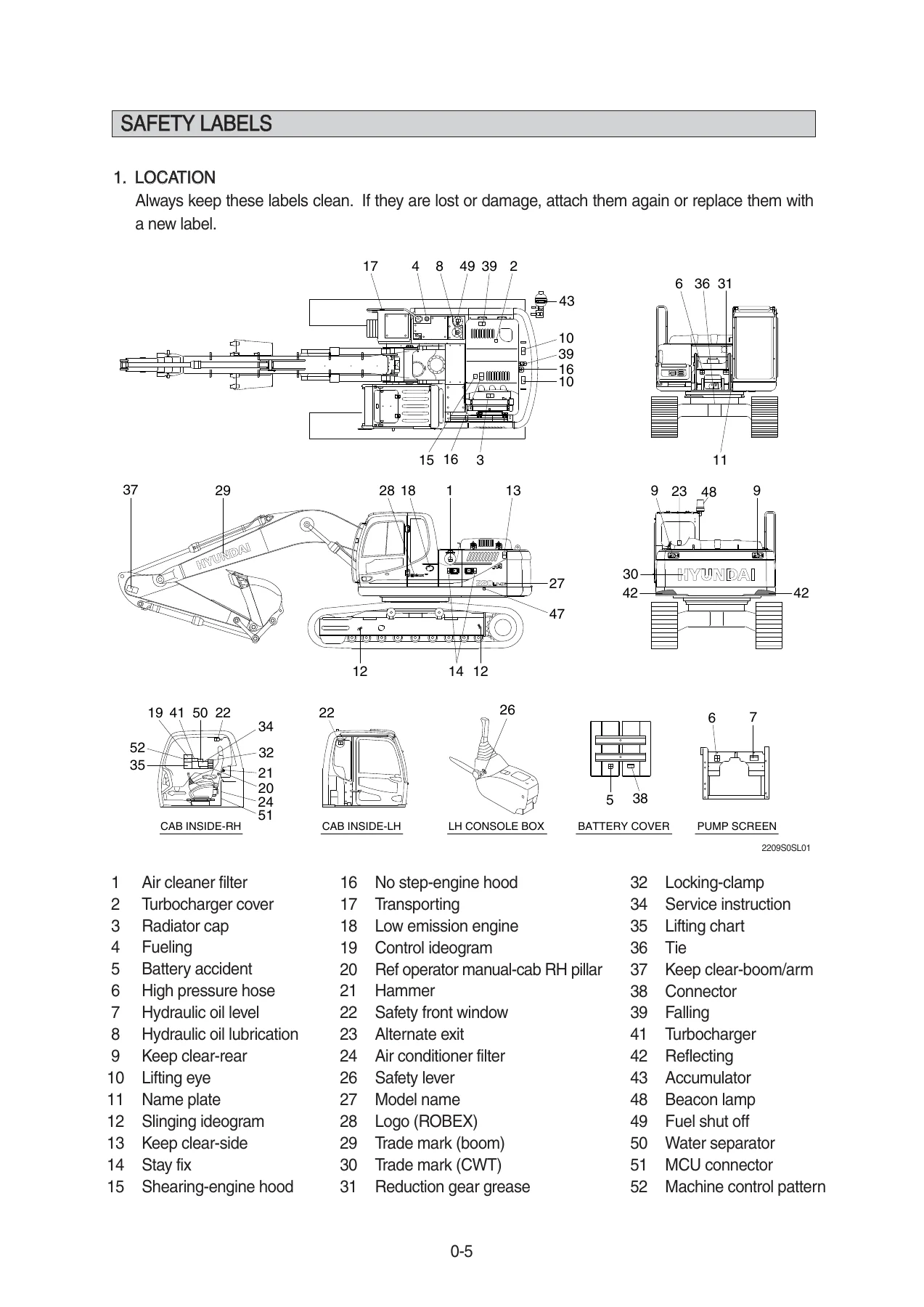
The opening chapter lays out the safety rules for before operating the machine, during operation, during maintenance, and parking. It covers protective clothing requirements, working near electrical lines with minimum safe separation distances for voltages from 6.6 kV to 275 kV, operating on slopes and soft ground, fire prevention and fire extinguisher use, battery and battery cable hazards, high-pressure line and hose safety, and the European Union vibration directive data for earthmoving machines. Warning labels on the machine are described with their locations and the hazards they address.
Specifications
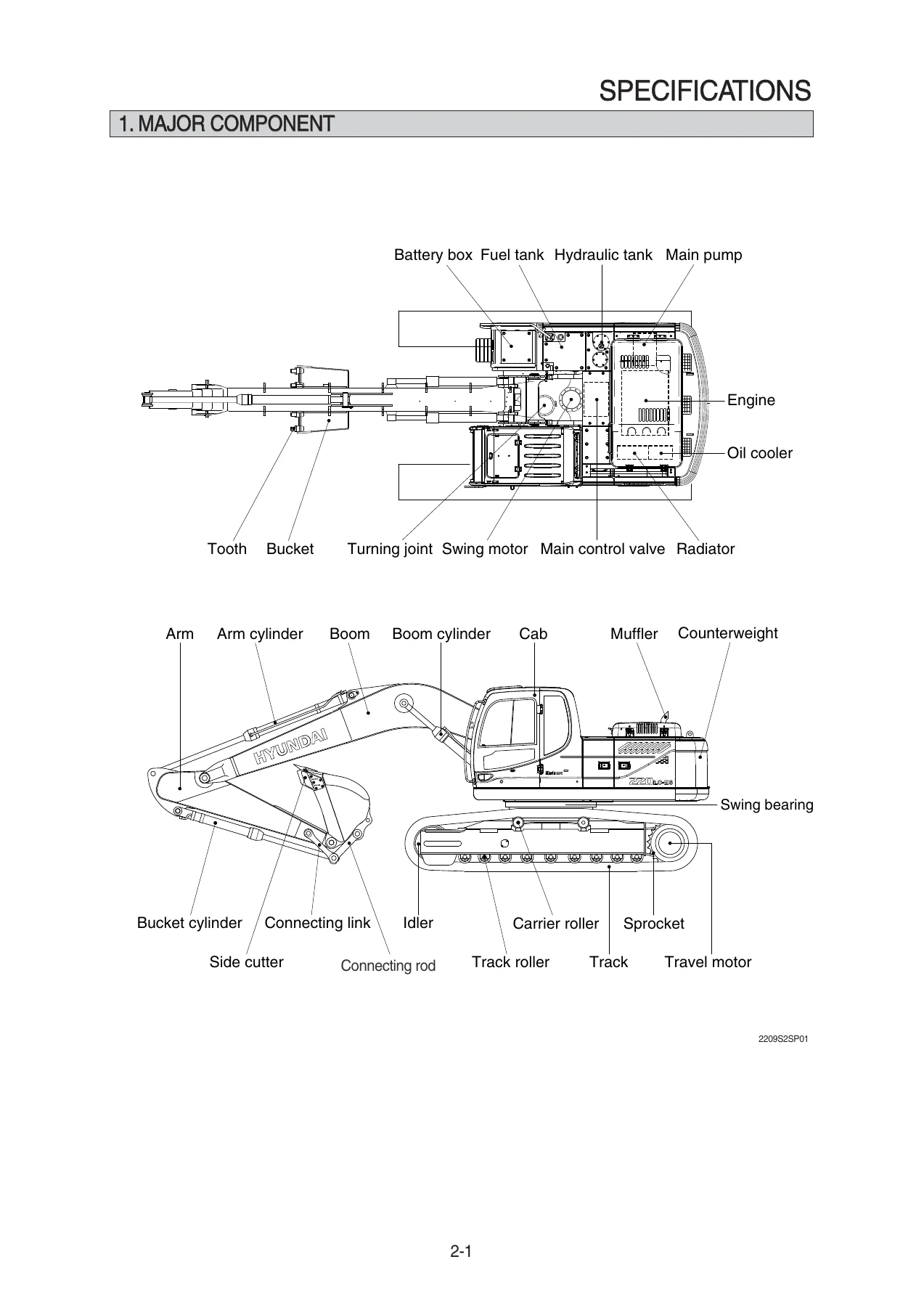
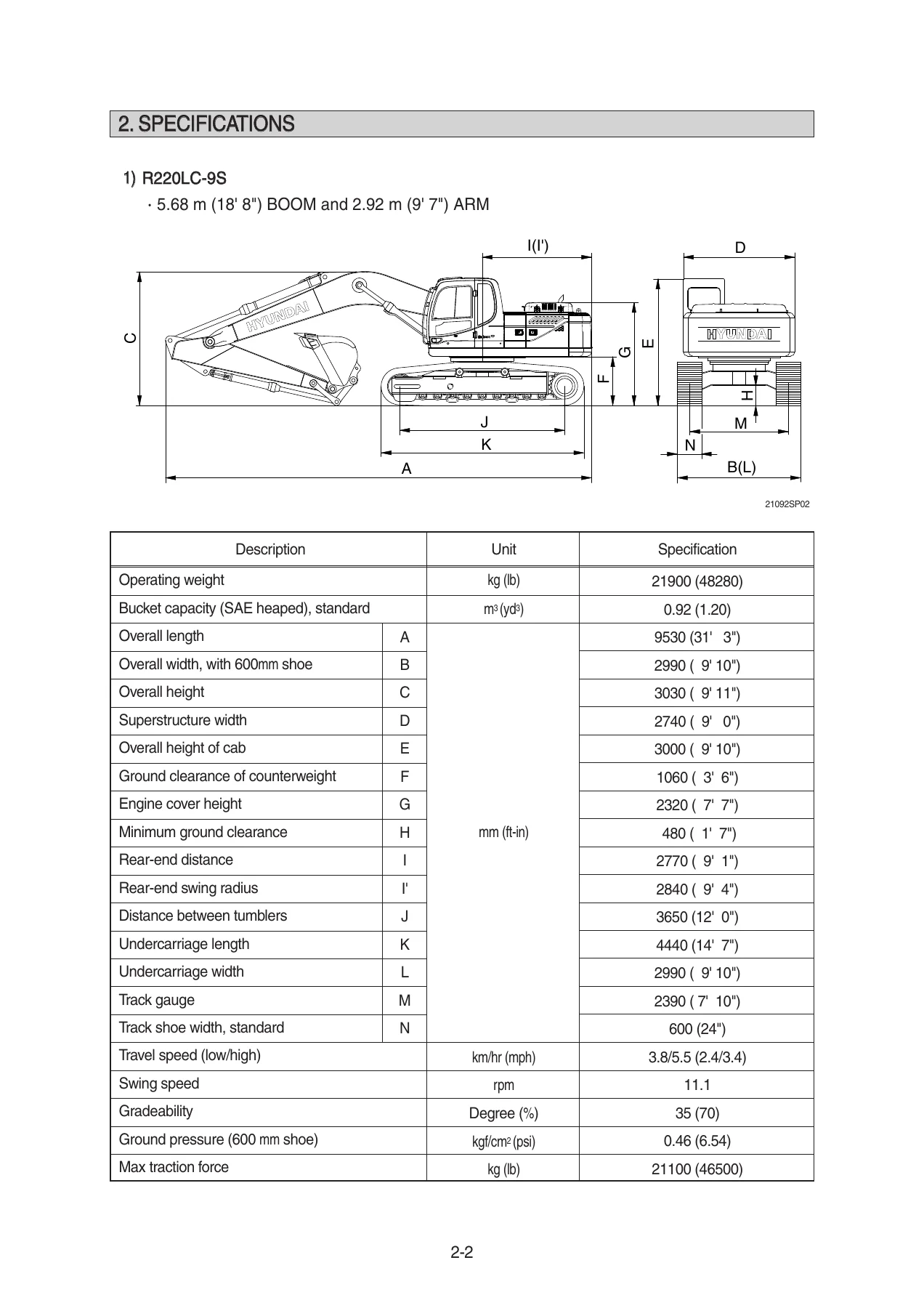
This chapter provides the technical data for every R220LC-9S variant. It covers major components with a labelled diagram, dimensions and operating weights, bucket capacities, travel and swing speeds, gradeability, ground pressure, and maximum traction force. Working range charts give maximum digging reach, digging depth, digging height, and dumping height for the different boom and arm combinations. Lifting capacity tables show rated loads at various radii and load point heights for the standard, Long Reach, High Walker, and Amphibious configurations. Bucket selection guidance covers general purpose, heavy duty, rock-heavy duty, and slope finishing buckets with recommended applications. The undercarriage section details track shoe options, ground pressure for each shoe width, and roller and shoe quantities. Specifications for major components cover the engine, main pump, gear pump, main control valve, swing motor, travel motor, remote control valve, cylinders, shoes, and buckets. The chapter closes with recommended oils and lubricants for all service points across the ambient temperature range.
Control Devices
The control devices chapter explains the cab layout, including the console box, suspension seat, and electronic monitor system. The cluster section details the LCD display, gauges for engine coolant temperature, hydraulic oil temperature, and fuel level, the RPM and tripmeter display, warning lamps for engine coolant temperature, hydraulic oil temperature, fuel level, engine oil pressure, battery charging, air cleaner restriction, and overload. Pilot lamps cover power mode, work mode, user mode, travel speed, auto idle, preheat, warming up, decel, fuel warmer, and maintenance indicators. Switch functions are described for power mode, work mode, user mode, select, auto idle/buzzer stop, travel speed, and escape/camera. The main menu structure covers mode, monitoring, management, display, and utilities screens, with instructions on user mode power settings, boom and arm speed control, auto power boost, initial mode, cluster switch backup, active and logged fault monitoring, maintenance information, machine security, display settings, language selection, tripmeter, DMB, entertainment, camera settings, and message box. Levers and pedals include the left and right control levers, safety lever, travel lever, travel pedal, and seat and console box adjustment. The air conditioner and heater section covers both full auto and semi auto systems with switch functions, self-diagnosis, and error codes. Other cab features include the cigar lighter, 12V socket, radio and USB player operation, seat adjustment, fuse and relay box, MCU, service meter, RS232 service socket, and upper windshield operation.
Operation
The operation chapter starts with suggestions for running a new machine through its first 100 hours, followed by pre-start checks. Engine starting and stopping procedures cover normal temperature and cold weather conditions, including the preheat and fuel warmer systems. The mode selection system explains power modes (P, S, E), work modes (general, breaker, crusher), user mode settings for engine speed, power shift, and idle speed, travel modes, and auto idle. Working device operation covers the left control lever for arm and swing, and the right control lever for boom and bucket. Traveling instructions include basic travel, travel on slopes, travel on soft ground, and towing the machine. Efficient working methods cover digging technique, truck loading, swing operation, and ditch digging. Operation in special work sites covers cold weather, sandy or dusty conditions, sea shore operation, mud and water, and rocky sites. The chapter also explains normal excavator phenomena such as arm roll-in speed variation, boom lowering sound, relief valve noise, and swing motor brake noise. Attachment lowering procedures with the accumulator are described, along with machine storage for periods over one month. RCV lever operating patterns are shown for ISO, A, B, and C types, with pattern change valve installation instructions. Switching the hydraulic attachment circuit between one-way flow for breakers and two-way flow for clamshells or shears is covered.
Transportation
The transportation chapter covers preparation for moving the machine, including route checks and trailer selection. Dimension and weight data are given for the base machine, boom assembly, arm assembly, bucket assembly, boom cylinder, cab assembly, and counterweight for the standard, Long Reach, and High Walker models. Loading the machine onto a trailer is described with safety lever positioning, swing procedures, and stay bracket fixing. Fixing the machine covers switch positions, lock security, and chain tie-down. Loading and unloading by crane covers wire rope and stay installation with proper hookup points.
Maintenance
The maintenance chapter is the largest section, covering maintenance intervals, proper maintenance practices, relieving hydraulic system pressure, precautions when installing hydraulic hoses and pipes, and periodical replacement of safety parts. Tightening torque tables cover coarse and fine thread bolts, pipe and hose fittings for flare and ORFS types, and major component torque values for engine, hydraulic system, power train, undercarriage, and other mountings. Fuel, coolant, and lubricant specifications are given along with a recommended oils chart by ambient temperature. The maintenance check list covers daily service before starting, every 50 hours, initial 50 hours, every 200 hours, initial 250 hours, every 250 hours, every 500 hours, every 1000 hours, every 2000 hours, every 5000 hours, and when required services. The maintenance chart provides a visual reference of all lubrication points. Service instructions cover checking and changing engine oil and filter, coolant level, radiator flushing and refilling, cleaning the radiator and oil cooler, checking the charge air cooler, inspecting the cooling fan and fan belt, cleaning or replacing the air cleaner elements, servicing the oil bath air cleaner, prefuel filter, fuel tank, fuel filter replacement, bleeding the fuel system, checking and changing hydraulic oil, cleaning the suction strainer, replacing the return filter, hydraulic tank breather element, drain filter cartridge, pilot line filter, checking and changing swing reduction gear oil, lubricating the swing bearing, lubricating the output shaft bearing, swing gear and pinion grease, checking and changing travel reduction gear oil, adjusting track tension, lubricating the RCV lever, bucket replacement, bucket tooth replacement, bucket clearance adjustment, and pin and bushing lubrication. Electrical system coverage includes battery maintenance, starting with a booster cable, and welding repair precautions. Air conditioner and heater maintenance covers fresh air and recirculation filter cleaning and replacement, seasonal checks, and refrigerant and compressor oil specifications.
Troubleshooting Guide
The troubleshooting guide is organised by system. Engine troubleshooting covers oil pressure lamp illumination, starting failure, white or blue exhaust, steam from the radiator, coolant level warnings, black exhaust, combustion noise changes, and unusual mechanical noise. Electrical system troubleshooting covers lamp brightness, flickering, battery charging lamp issues, alternator noise, starting motor problems, warming up lamp failure, oil pressure lamp failure, and battery charging lamp failure. Other troubleshooting covers track misalignment, sprocket wear, slow or non-responsive bucket, slow travel and swing speeds, pump noise, and high hydraulic oil temperature.
Hydraulic Breaker and Quick Clamp
This chapter explains how to select a hydraulic breaker for the machine, the circuit configuration including oil quantity setting for cluster type 1 and cluster type 2, maintenance of hydraulic oil and filters with a hydraulic oil change guide for breaker operation, and precautions while operating the breaker such as not breaking rock while lowering, not using the breaker to carry broken stone by swing, operating with a gap from the stroke tip, and avoiding continuous work over one minute at the same boom and arm position. Quick clamp coverage includes fixing a bucket with the quick clamp, removing a bucket, and precautions for safe use.
Amphibious Excavator Series
The amphibious excavator chapter covers safety operation including protective clothing, machine operation understanding, safety equipment, machine inspection, inspection and maintenance, parking safely, examining water depth and bed contour, avoiding digging during floated position, avoiding water travelling in bad weather, and power line awareness. Basic machine operation covers operating with wider undercarriage, careful boom stick and bucket operation, safe machine operation, avoiding abusive operation, and avoiding hammering. Travelling the machine covers general travel, land travel, launching, travelling in water, and landing. Undercarriage maintenance covers track tension, track roller lubrication, greasing of axle bearings and pin and bushings, hydraulic cylinder care, travel reduction gear oil, wearing plates, track parts including track shoes and pins and rollers, and pontoon leak testing. The assembly manual covers installation precautions, undercarriage and base machine installation, front attachment mounting preparation and procedures, additional pontoons installation, and spud piles installation with testing.
What This Manual Does For You
If you run or service an R220LC-9S, this manual puts the machine’s own reference data in your hands. You can set the correct engine speed and power shift values for the job, adjust the boom and arm speeds to suit the operator, set up breaker or crusher mode with the right flow, and understand what each warning lamp is telling you before a small issue becomes a major repair. The maintenance schedules tell you what to check daily, what to change at each interval, and the exact lubricants and capacities to use. When something does go wrong, the troubleshooting guide gives you a structured way to identify the cause instead of guessing.
The value of having the correct procedures and specifications is hard to overstate on a machine that weighs over 21 tonnes and works with hydraulic pressures up to 350 kgf/cm2. Torque values matter. Oil types and capacities matter. Track tension matters. The R220LC-9S operation and maintenance manual gives you those values in one document instead of scattered notes and second-hand advice. The lifting capacity tables let you plan safe lifts. The working range charts let you set up the machine for the dig. The electrical and hydraulic system explanations help you trace faults logically.
IMAGES PREVIEW
This manual is delivered as an instant PDF download. There is no shipping, no waiting for a physical book, and no risk of a lost parcel. You can open it on a laptop in the workshop, a tablet in the cab, or a phone on site. If you prefer a paper copy, print the pages you need and keep them with the machine. Whether you are a seasoned excavator technician, a fleet owner maintaining several R220LC-9S units, or an operator who wants to understand the machine better, this PDF gives you the full factory documentation in a format you can use immediately.


Reviews
There are no reviews yet.