
Indian Railways 140T Cranes ARTs ARMEs Maintenance & Operation Manual 2015 – PDF Download
Original price was: $59.95.$39.95Current price is: $39.95.
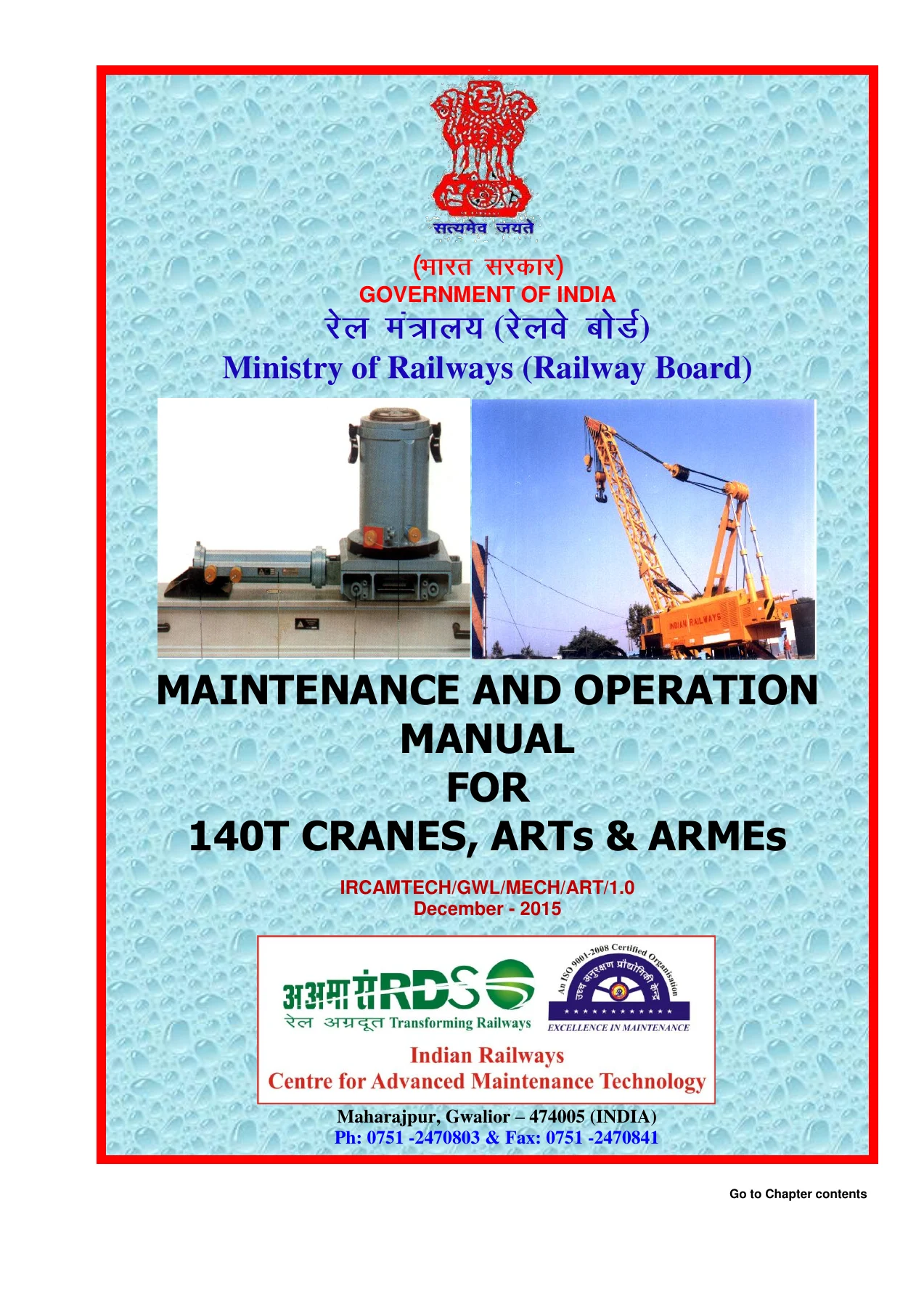
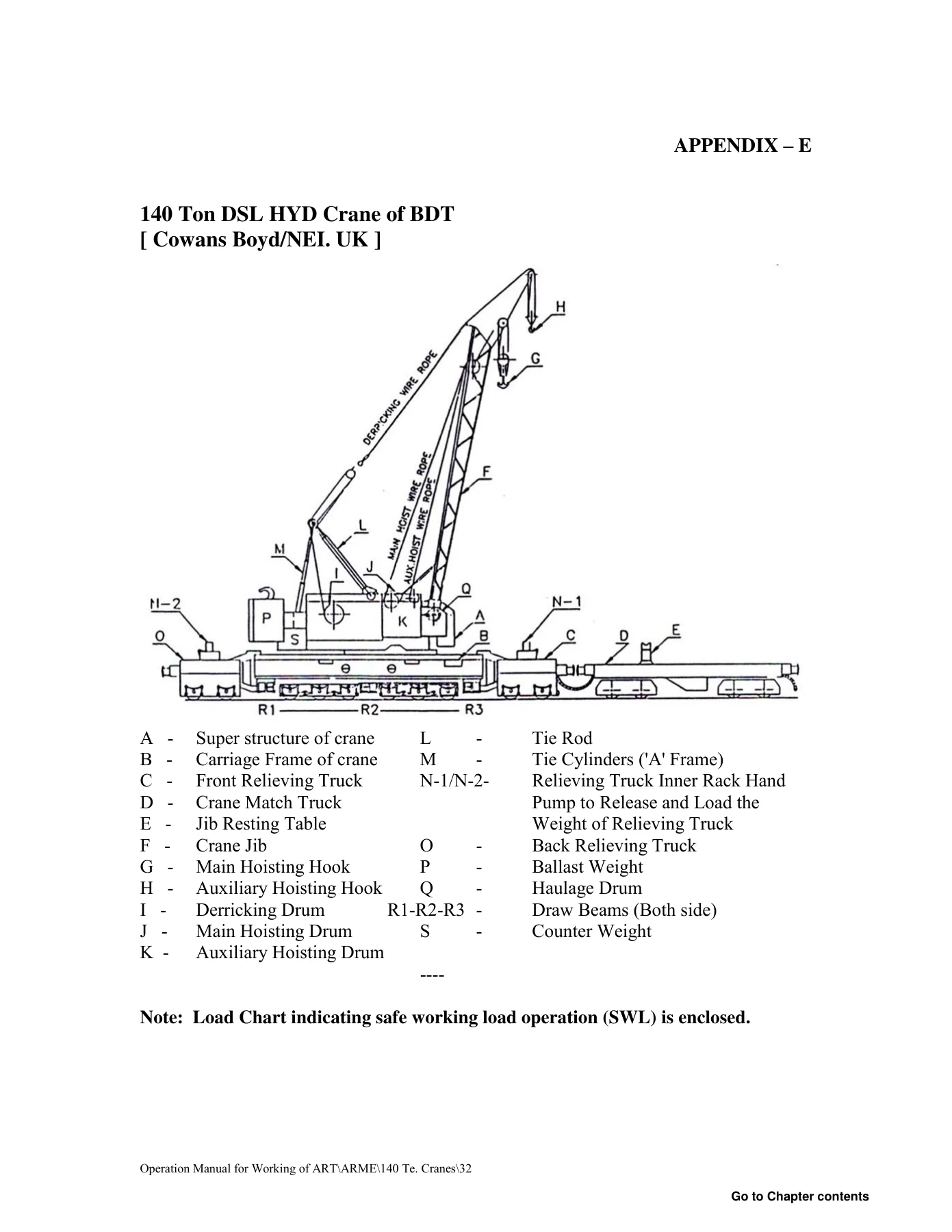
The complete Indian Railways maintenance and operation manual for 140T diesel hydraulic breakdown cranes, ARTs, ARMEs, SPARTs and SPARMVs. Published by CAMTECH, Gwalior in December 2015. Covers Cowans Sheldon and Gottwald cranes, hydraulic re-railing equipment, rescue procedures, load charts, safety protocols and standard equipment lists across 900+ pages.
Description
Indian Railways 140T Cranes, ARTs & ARMEs Maintenance and Operation Manual (2015)
This is the comprehensive Indian Railways maintenance and operation manual for 140-tonne diesel hydraulic breakdown cranes, Accident Relief Trains (ARTs), Accident Relief Medical Equipment (ARMEs), Self-Propelled Accident Relief Trains (SPARTs) and Self-Propelled Accident Relief Medical Vans (SPARMVs). Published in December 2015 by the Centre for Advanced Maintenance Technology (CAMTECH), Gwalior under the Ministry of Railways (Railway Board), this extensive document serves as the definitive reference for railway staff engaged in disaster management, relief and rescue operations. It covers the operation, maintenance, inspection and certification of the 140T Cowans Sheldon and Gottwald breakdown cranes along with the complete ART/ARME/SPART rolling stock and associated rescue equipment.
Written for breakdown supervisors, crane operators, mechanical officers and maintenance staff responsible for accident relief operations across Indian Railways, every chapter delivers practical procedures, safety protocols, load charts, inspection schedules and equipment specifications needed to keep relief trains and cranes in a state of readiness and to conduct safe, efficient restoration at accident sites.
File Details
- Manual Type: Maintenance and Operation Manual
- Document Number: IRCAMTECH/GWL/MECH/ART/1.0
- Publisher: Indian Railways, Centre for Advanced Maintenance Technology (CAMTECH), Maharajpur, Gwalior
- Issuing Authority: Ministry of Railways (Railway Board), Government of India
- Date: December 2015
- Language: English (with some Hindi terminology and section headings)
- Page Count: Approximately 903 pages
- File Format: PDF
Chapters Covered
- Chapter 1: Rules for the Working of Cranes
- Chapter 2: Operation of 140T Break Down Crane & Important Instructions
- Chapter 3: Deployment of Break Down Staff and Composition of ARTs
- Chapter 4: Important Rules for ARTs/ARMEs & SPARTs
- Chapter 5: Important Letters from Railway Board & RDSO
- Chapter 6: Record Keeping and Certification
- Chapter 7: Technical Description of GOTTWALD 140T Break Down Crane
- Chapter 8: DO’s and DON’Ts for COWANS SHELDON 140T New Design Crane and GOTTWALD 140T New Design Crane
- Chapter 9: Operation of Hydraulic Re-railing Equipments (HREs) MFD & LUKAS
- Chapter 10: Standard Lists for ART, ARME, SPARMV & SPART
- Chapter 11: Dealing with LPG & Ammonia Gas
- Chapter 12: Drawings and Layouts for Composition of ART/SPART/ARME on IR
- Chapter 13: Relief and Rescue Operation on Passenger Train
- Chapter 14: Infrastructural Facilities for Maintenance of 140T Cranes
- Chapter 15: High Speed SPART
- Appendix I: Chains & Chain Slings
Chapter 1 – Rules for the Working of Cranes
Establishes the regulatory framework for operating breakdown cranes on Indian Railways. Covers classification of cranes into main line travelling, yard travelling and fixed/special categories, hire and haulage charges, expenditure responsibilities, and the roles of Divisional Railway Managers and SSEs in maintenance. Includes G.R.4.27 rules on attaching cranes to trains, jib trailing requirements, and speed limits for 140T cranes running as trailing loads.
Chapter 2 – Operation of 140T Break Down Crane & Important Instructions
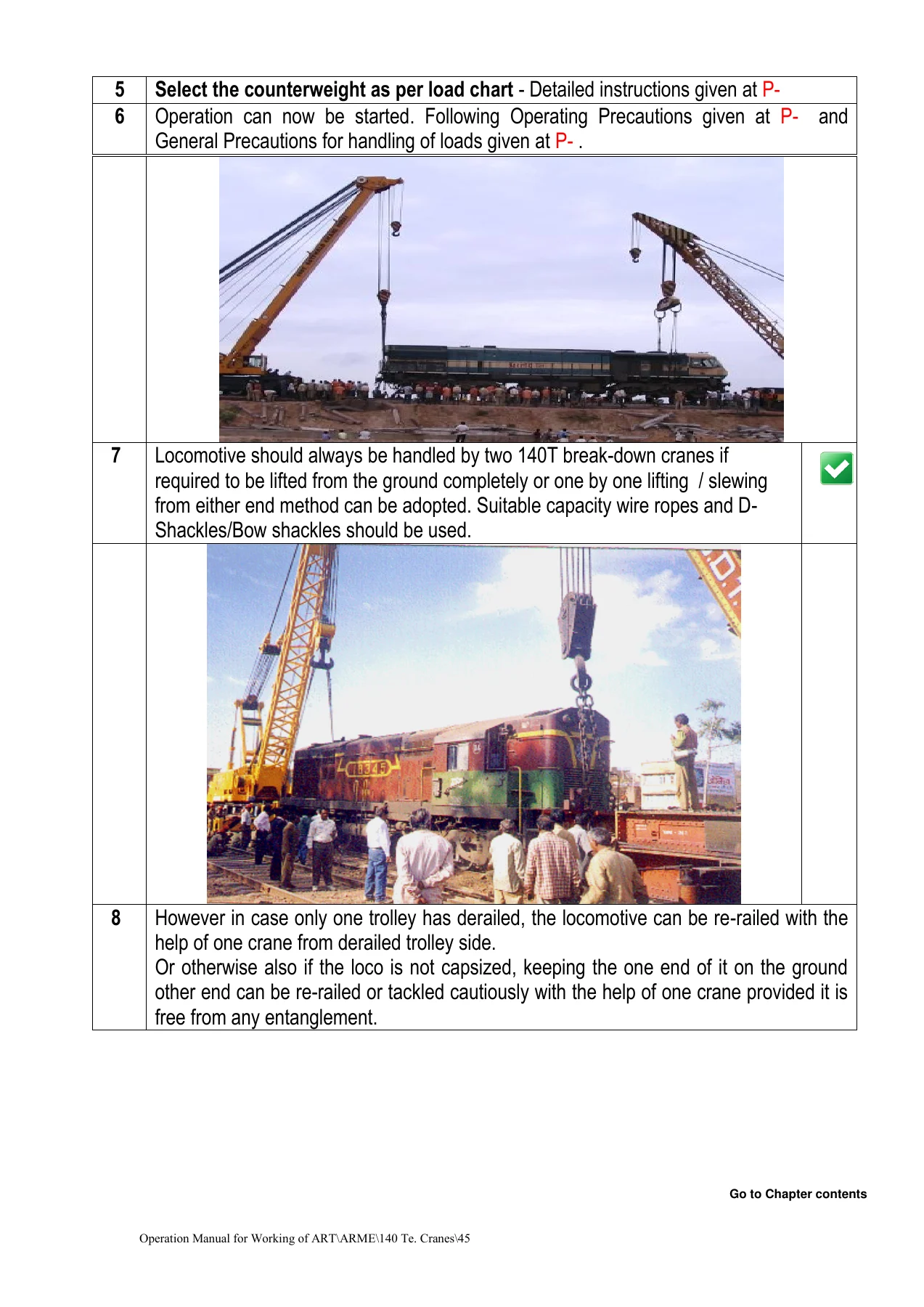
The operational core of the manual. Provides comparative technical data for Cowans Sheldon and Gottwald cranes (old and new designs), safety precautions for operators, preparation for in-train formation and running, propping and rigging procedures, counterweight selection, axle blocking, boom erection and derigging sequences. Includes 140T crane specifications, load charts, propping arrangements, and step-by-step restoration procedures for derailed locomotives, coaches, EMU/MEMU/DEMU stocks, BCN/BOXN wagons, oil tank wagons on fire, guard brake vans, FOB erection, girder launching, and operations on super-elevated track, tunnels and bridges.
Chapter 3 – Deployment of Break Down Staff and Composition of ARTs
Details organizational structure, staffing yardsticks, selection criteria, physical fitness requirements, accident proneness assessment and team composition for ART and ARME staff. Provides deployment charts and work distribution for break down operations using 140T cranes and MFD/LUKAS systems, kitchen management procedures, duties of railway officials during accidents, crack team formation, and qualification requirements for crane operators and supervisors.
Chapter 4 – Important Rules for ARTs/ARMEs & SPARTs
Covers ordering procedures for break down trains and medical vans, hooter codes and target turn-out times, break down allowance rules including revised rates per the Sixth Central Pay Commission, travelling allowance and daily allowance provisions, overtime calculation methods, and delegation of powers for procurement of ART/SPART/ARME items. Includes syllabus outlines for foundation, refresher and specialized courses for ART staff and crane drivers.
Chapter 5 – Important Letters from Railway Board & RDSO
A compilation of official circulars and directives covering cash imprest amendments, CUG connections for break down staff, stainless steel cutting facilities on ARTs, HLC recommendations on disaster management, IOH/POH periodicity for ART coaches, fire fighting equipment requirements, movement of 140T cranes for non-breakdown work, crane operator policy, and maintenance group meeting minutes from Jamalpur and Parel workshops.
Chapter 6 – Record Keeping and Certification
Provides more than 50 standard proformas for maintaining registers, inspection records, competency certificates and operational logs. Includes forms for overdue inspections, break down site reports, competency certificates for crane drivers and supervisors, equipment testing registers, chain and wire rope sling testing, MFD/LUKAS maintenance records, 140T crane master defect cards, and schedule/unschedule repair statements.
Chapter 7 – Technical Description of GOTTWALD 140T Break Down Crane
Detailed technical data for the Gottwald 140T breakdown crane, including track gauge, wheel dimensions, bogie pivot distances, towing speeds, axle loads, brake systems, outrigger specifications, travel gear, diesel engine ratings (Cummins NTA-855), auxiliary engine details (Kirloskar HA-294), main and auxiliary hoist specifications, slewing and derricking gear data, counterweight options, boom dimensions and match truck specifications. Also covers duties of the crane operator and load charts.
Chapter 8 – DO’s and DON’Ts for 140T Cranes
Essential operating guidance organized as DO’s and DON’Ts for both Gottwald and Cowans Sheldon 140T break down cranes. Covers bringing the crane in train order, rigging and derigging, axle blocking, boom erection, propping, counterweight attachment, operating precautions, air brake operation, hydraulic operation, electrical operation, safe load indicator (SLI) operation, maintenance checks for engine, hydraulic system, wire ropes and safety devices. Each entry includes the repercussion of failing to follow the guidance.
Chapter 9 – Operation of Hydraulic Re-railing Equipments (HREs) MFD & LUKAS
Comprehensive operating instructions for MFD and LUKAS hydraulic re-railing equipment. Covers MFD system components including power packs, small pump sets, hand pumps, control units, lifting jacks (series 400, 600, 900, 1200), single piston jacks, tilting jacks, lateral displacement equipment, re-railing bridges, roller carriages, axle pusher units, high-pressure hoses, distribution valves, bogie suspensions, rescue devices and air bags. Also covers LUKAS 530 bar double-acting HRE with telescopic jacks, DUO traversing units, control desks, power packs, hand pumps, hydraulic hoses, pulling devices, up-righting systems and emergency pneumatic air bags.
Chapter 10 – Standard Lists for ART, ARME, SPARMV & SPART
The definitive equipment reference. Lists all tools and equipment required for A and B class ARTs, ARMEs, SPARMVs and SPARTs. Covers generators and electrical equipment, illumination, cutting equipment, hydraulic re-railing equipment, wire rope slings and shackles, chains, mechanical items, fitter tools, measuring instruments, wooden packings, oils and greases, C&W items, general stores, kitchen equipment, fire fighting equipment, engineering items, medical equipment, signalling and telecommunication equipment, OHE items, and books and manuals. Each item is listed with recommended quantities for A and B class ARTs along with HLC recommendations.
Chapter 11 – Dealing with LPG & Ammonia Gas
Critical safety information for handling hazardous gas emergencies. Covers properties of LPG and ammonia, leakage detection and precautions, do’s and don’ts for tackling leakages from tank wagons, procedures for derailments and accidents involving LPG and ammonia tank wagons, emergency contact numbers for IOC, BPC and HPC officials, and important tools for handling gas emergencies including spark-proof tool sets, breathing apparatus and explosive meters.
Chapter 12 – Drawings and Layouts for Composition of ART/SPART/ARME
Contains detailed layout drawings for the composition and marshalling of ART, SPART and ARME coaches and wagons. Covers newly developed standard layouts for tool and equipment vans, C&W/electrical/telecom vans, re-railing equipment vans, staff and kitchen vans, crane packing and OHE material vans, engineering and OHE material vans, medical vans and auxiliary vans. Includes benefits of revised marshalling, space utilization details, and storage arrangements for critical equipment.
Chapter 13 – Relief and Rescue Operation on Passenger Train
Focuses on rescue and relief operations during the Golden Hour. Covers types of railway disasters, characteristics of accidents, rescue planning and organizing, safety in rescue operations, search and extraction methodologies, ropes/chains/slings, various rescue equipment including electrical hand tools, hydraulic rescue devices (HRD) and pneumatic rescue devices, operating instructions for generators, power saws, tre-panners, angle grinders, panel shears and nibblers, plus the new design stretcher developed by WCR for rescuing trapped passengers from coaches. Also includes detailed team formation, duties of ARME/SPART incharge, work distribution among A through F teams, duties of guard, conductor, loco pilot, DRM, AC attendant and RPF staff at accident sites.
Chapter 14 – Infrastructural Facilities for Maintenance of 140T Cranes
Specifies the infrastructure required for maintaining 140T cranes and ART/ARME/SPART depots. Covers shed layout with dimensions, lighting requirements, fuel supply arrangements, fire fighting equipment, supervisor/computer room, staff room, lifting tackle room, consumables store, compressor room, electrical room with battery charger, toilets and washing rooms, ART stabling line requirements, and detailed layout drawings for 140T crane shed with repair bay, pit dimensions, portable platforms and RDSO standard drawings.
Chapter 15 – High Speed SPART
Technical documentation for the High Speed Self Propelled Accident Relief Train (HS SPART). Covers technical specifications, environmental conditions, SPART rake details with ZF and VOITH transmissions, composition of supervisory, medical and tool vans, layout drawings, Cummins engine specifications, air intake and exhaust arrangements, water cooling system, fuel system, hydraulic transmission operation and maintenance, SAN axle drive gear box, torque arm, cardan shaft, recommended oils and lubrications, and comprehensive electrical system with control and instrumentation details. Includes complete maintenance schedules for daily, weekly, half-yearly, yearly, two-yearly, four-yearly and twelve-yearly intervals.
Appendix I – Chains & Chain Slings
Technical considerations for procurement, inspection, testing and repair of chains, chain slings and their components. Covers specifications for chains and chain slings, grades of chains (30, 40, 63), technical considerations for choosing slings, procurement guidelines, manufacture of chain slings in railway workshops, working loads, periodical inspection and repairs, procedure for identification/repairs/heat treatment, and information to be supplied during enquiry or order. Includes safety recommendations for use, care, maintenance and storage of chains and slings, plus recommendations for ramshorn hooks.
Why This Manual Matters
Operating a 140-tonne breakdown crane is not a routine task. It demands precise knowledge of load charts, propping configurations, counterweight selection and rigging procedures. A wrong duty selection, improper propping or incorrect slinging can topple the crane, damage rolling stock or endanger lives. This manual is the reference that Indian Railways relies on to train crane operators, breakdown supervisors and mechanical officers, and it remains the single most comprehensive document for anyone responsible for 140T crane operations and accident relief across the network.
For maintenance engineers and depot staff, the manual provides the complete inspection and certification framework, standard equipment lists, record-keeping proformas and maintenance schedules that keep ARTs, ARMEs, SPARTs and cranes in a constant state of operational readiness. The detailed chapters on hydraulic re-railing equipment (MFD and LUKAS), rescue tools and procedures, and hazardous gas handling make it an indispensable resource for disaster management teams.
Get Instant Access
IMAGES PREVIEW
This Indian Railways 140T Cranes, ARTs & ARMEs Maintenance and Operation Manual is delivered as an instant PDF download. There is no shipping, no waiting and no physical book to carry. The file can be stored on any computer, tablet or smartphone and printed page by page as needed for use in the field, workshop or training room. Whether you are preparing for a mock drill, conducting a periodical inspection, studying for a competency certificate or managing an actual accident site, the relevant procedures, charts and checklists are always at your fingertips.
Reviews
There are no reviews yet.