
Indian Railways Vande Bharat Express T-18 Maintenance Schedule Manual – Version 1.0 (August 2020)
Original price was: $39.95.$23.95Current price is: $23.95.
Indian Railways periodic maintenance schedule for the Vande Bharat Express T-18 (Train-18) train set. Version 1.0, first release dated 31 August 2020, covering daily, trip, monthly, quarterly, nine-monthly and SS-1 to SS-3 shop schedules for mechanical and electrical equipment, plus Annexures A to J.
Description
If you maintain, inspect or overhaul the Train-18 fleet, the Vande Bharat Express T-18 Maintenance Schedule sets out the interval logic and the activity lists that Indian Railways field units work to. This is Version 1.0 of the schedule, released 31 August 2020 as the first issue, and it was prepared with input from ICF, RDSO, NR and the OEMs. It is the reference that defines when each mechanical and electrical item is examined, and what is actually done at that point.
File Details
- Document type: Periodic maintenance schedule
- Railway: Indian Railways
- Train set: Vande Bharat Express T-18 (Train-18)
- Version: 1.0
- Release date: 31 August 2020
- Revision status: First Release
- Language: English
- Page count: 130 pages
- File format: PDF
Chapters Covered
- Assumptions for Train-18
- Maintenance Interval
- Frequencies – Periodic Work
- Schedule Activities for Mechanical Equipment
- Bogie frame, axle box CTRB, primary springs, air spring systems
- Wheels and axles, vertical and lateral dampers, stabilizer assembly
- Traction rod and traction centre, control arm, rubber metal bonded parts, center pivot bearing
- Main air compressor, MR and BP pressurised system, auxiliary compressor
- Brake system, brake control system, air horn, under frame brake components
- Brake disc and caliper assembly, air dryer unit, micromesh filter, air reservoirs
- B01 panel, ballcock, magnet valve, axle speed sensor, pressure sensor, pressure governors
- Safety valves, drain valves, driver desk control, dual gauges, B02 panel, anti-skid and levelling valves
- Underframe and car body, roof
- Gangway, seat assembly, tables, floor mat, windows, roller blinds, luggage racks
- Fire extinguisher, CBC and semi-permanent couplers, internal sliding and plug doors
- Vacuum bio-toilet, traction gearbox
- Schedule Activities for Electrical Equipment
- Daily schedule maintenance activities
- Line and traction converter, auxiliary converter unit, battery charger
- Battery, brake chopper resistor, DC link earthing switch
- Pantograph, vacuum circuit breaker, earthing switch for VCB, AC surge arrester
- Main transformer, traction motor, TM cable junction box
- Jumper couplers, power coupler junction box, inter vehicular coupler
- Isolation transformer, master controller, driver console
- Passenger information system, CCTV, saloon and reading lights
- Head lights, marker lights, flasher lights, LP and ALP seats, wiper
- Roof mounted AC package unit, driver’s cab air conditioning unit
- Earth return JB and return CT JB, primary CT, potential transformer, ERCU ground contact
- Mini pantry items, power supply socket junction box, speedometer, frequency generator unit
- HT cable, water supply system, lavatory equipment
- Annexure A – Summary of Maintenance Activities for Wheels and Axles
- Annexure B – Air Pressure Built-up Test
- Annexure C – MR Pressure Drop Test and BP Pressure Drop Test
- Annexure D – BC Pressure Test
- Annexure E – Traction Gear Box Maintenance (TSA)
- Annexure F – Traction Gear Box Maintenance (IRCAMTECH)
- Annexure G – Functional Test under Trip Schedule
- Annexure H – Functional Test under Monthly Schedule
- Annexure I – Functional Test under Quarterly Schedule
- Annexure J – Functional Test under Nine Monthly Schedule
IMAGES PREVIEW
Taken as a whole, the document is not a repair manual in the usual sense. It is the maintenance cadence document for the train set. Every activity is tagged with the interval at which it applies, so a depot planner can read straight across from an item to the schedule that owns it, and a technician can read down from a schedule to the full list of jobs on that card. The functional test annexures carry the acceptance criteria as well as the steps, which is what makes the schedule usable for sign-off rather than just for planning.
How the Maintenance Interval Structure Works
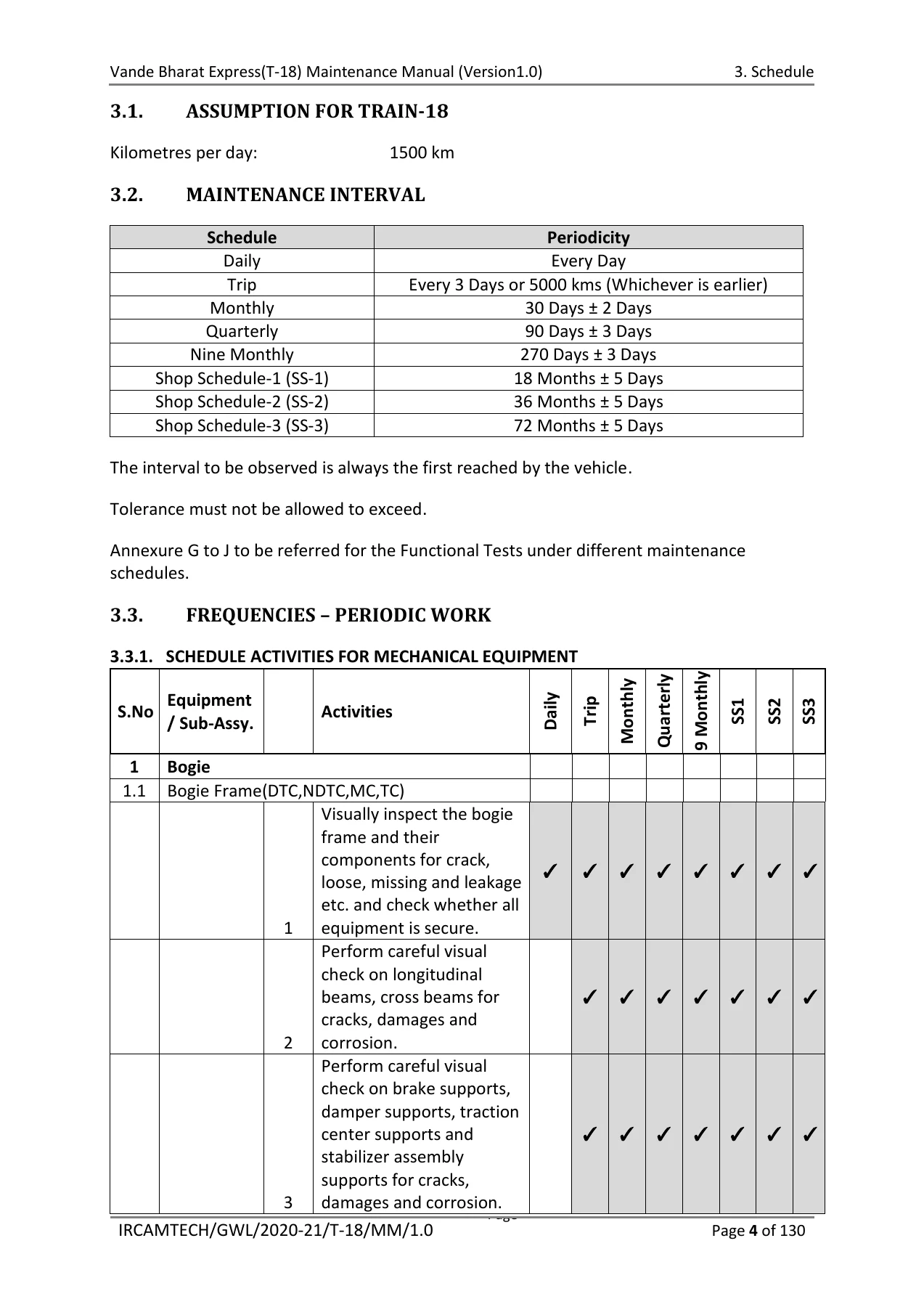
The schedule assumes 1,500 km per day and builds its intervals on that figure. Daily work is every day. Trip work falls every three days or 5,000 km, whichever is earlier. Monthly is 30 days with a tolerance of 2 days, Quarterly is 90 days with a tolerance of 3 days, and Nine Monthly is 270 days with a tolerance of 3 days. Above those sit the shop schedules: SS-1 at 18 months, SS-2 at 36 months and SS-3 at 72 months, each with a tolerance of 5 days. The Indian Railways Vande Bharat Express T-18 Maintenance Schedule is explicit that the interval to be observed is always the first one reached by the vehicle, and that tolerance must not be allowed to exceed. If you have ever needed to justify why a component came out early, that is the rule that carries the argument.
Mechanical Equipment Schedules
The mechanical half of the schedule runs from the bogie outwards. Under the bogie heading you get the frame itself, axle box CTRB, primary springs, air spring systems, wheels and axles, the primary vertical, secondary vertical, lateral and yaw dampers, the stabilizer assembly, traction rod and traction centre, control arm, all rubber-to-metal bonded parts and the center pivot bearing. Each item carries its own grid of activities against the Daily, Trip, Monthly, Quarterly, Nine Monthly, SS1, SS2 and SS3 columns, so a wheel re-profiling decision, a bearing reconditioning call or an air spring replacement sits in exactly the right slot.
Brakes and air supply take up a large block. Main air compressor, MR and BP pressurised system, auxiliary compressor, brake system, brake control system with the automatic load braking function test, air horn and tyfon, under frame brake components, brake disc and caliper assembly, air dryer unit, micromesh filter, air reservoirs, B01 panel, ballcock, magnet valve, axle speed sensor, pressure sensor, pressure governors, check and drain valves, brake control unit, safety valves, driver desk control and driver brake valve, dual gauges, B02 panel and BCU, traction cut-out panel, LB panels, anti-skid valve and levelling valve are all listed with their maintenance actions. The brake control entries include simulated tare-weight brake tests through the master controller, and the air dryer entry gives you the dew point measurement and pressure switch check as separate activities.
Shell and under-frame work, roof work, interior and furnishing, gangway, seat assembly, tables, floor mat, windows, roller blinds, luggage rack, side and roof panels, fire extinguisher checks, couplers, doors and the vacuum bio-toilet follow. The coupler section separates the tight-lock CBC from the semi-permanent coupler, and the semi-permanent entries reference the DELLNER preventive maintenance manual for lubrication and inspection of the elastomer spring package and guide cone.
Electrical Equipment Schedules
The electrical side opens with a daily schedule maintenance activities table covering general checks, cab facilities, wiper, TCMS self-tests, speedometer, IV couplers and jumper cables, isolation transformer, driver desk, pantograph, ERCU ground contacts, HV potential transformer, lightning arrester, VCB, lighting circuits, CCTV and HVAC. On-board functional tests are then given separately for DTC and for all cars, including cab occupation in key-on and RDM modes with normal and high-priority cab selector settings, panto raise and lower, VCB on and off, emergency off and emergency off bypass, saloon lighting at 100 percent and 50 percent, door proving and AC on command.
The other maintenance schedule activities section works through the traction and auxiliary converters, HS module, blower, LC and inverter modules, DC-DC modules, heat sink, battery charger, battery, brake chopper resistor, DC link earthing switch, pantograph, VCB with the vacuum switch tube and additional SS-2 and SS-3 items, earthing switch for VCB, AC surge arrester, main transformer with cooling system, Tommy Gun, PT100 sensors, air dryers, damper, oil sampling, pressure relief device, oil level indicator, windings, oil pump bearing replacement and main bushing. Traction motor entries cover air filter cleaning and replacement, guard grid servicing, bearing re-greasing with SHELL GADUS S3 V220C 2 and the periodic overhaul point at 30,00,000 km. The roster continues through jumper couplers, power coupler junction box, inter vehicular coupler, isolation transformer, master controller, driver console, CRW and GCRW equipment, PIS, CCTV, saloon, reading and gangway lights, head lights, marker lights, flasher lights, pilot seats, wiper, roof mounted AC package unit, cab air conditioning unit, earth return JB, primary CT, potential transformer, ERCU ground contact, mini pantry, power supply socket junction box, speedometer, frequency generator unit, HT cable, water supply and lavatory equipment.
Annexures and Functional Test Criteria
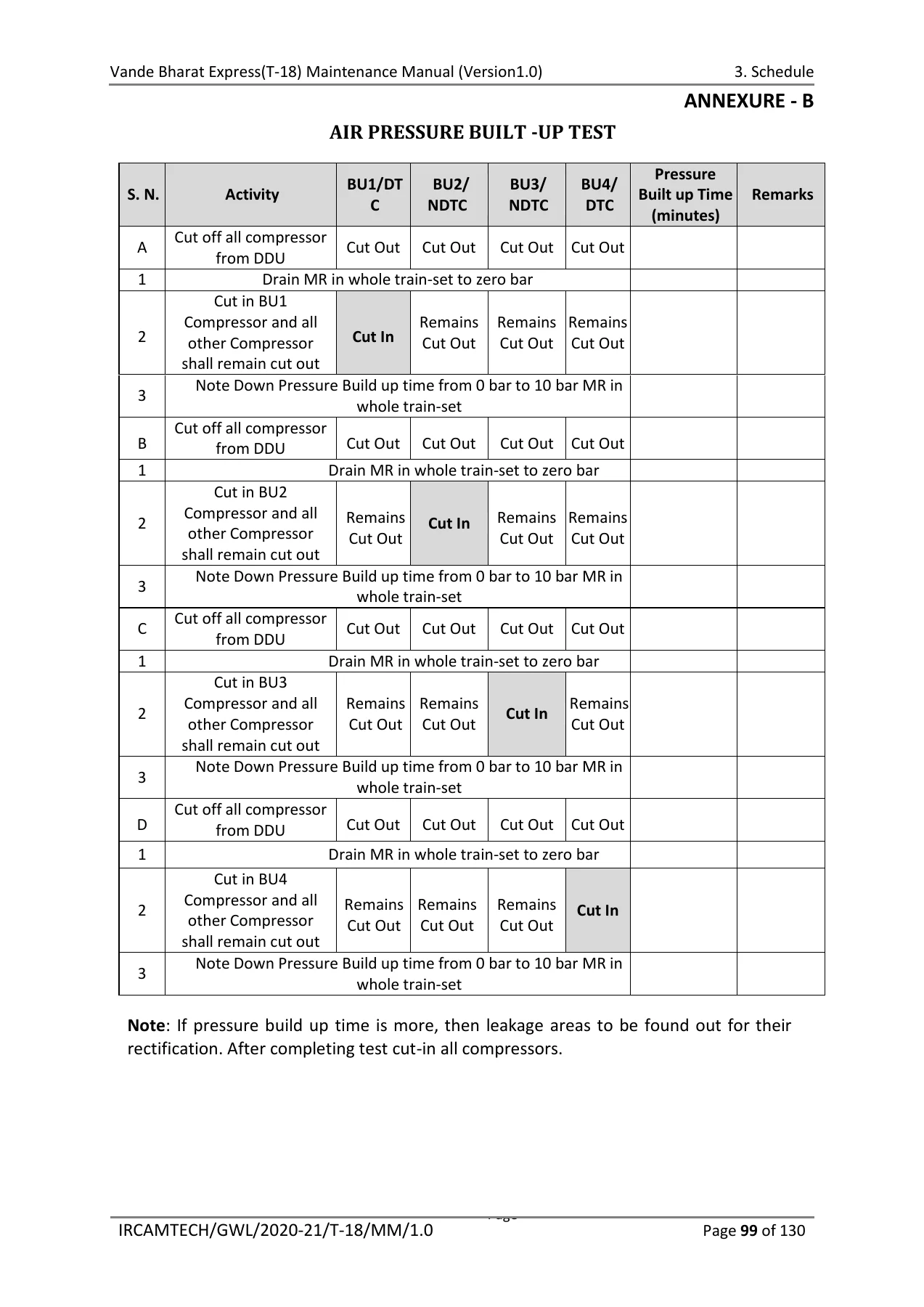
Annexures A to F carry the reference summaries. Annexure A summarises wheel and axle maintenance with inspection methods and the 2D, 2W, 3M, 1Y and 2D maintenance levels, including back-to-back dimensions, diameter difference between wheels on the same axle, defectoscopy tests and the electrical resistance limit of 0.01 ohms. Annexure B is the air pressure built-up test format with the cut-out and cut-in sequence for each compressor. Annexure C gives the MR and BP pressure drop test procedure. Annexure D is the BC pressure test matrix across the full brake handle positions. Annexures E and F summarise traction gearbox maintenance to the TSA and IRCAMTECH intervals, covering first oil change at 5,000 km, oil level checks, magnet inspection, oil change at 300,000 km, elastomer replacement on the reaction rod and general overhaul points.
Annexures G to J are the functional tests under Trip, Monthly, Quarterly and Nine Monthly schedules. They are written as work preparation plus a task table, with each system or equipment listed against the functional test to be performed. The test lists include pantograph lifting and lowering times within 6 to 10 seconds, MR pressure range checks, service brake and emergency brake application and release through the master controller, driver brake valve and emergency push buttons, parking brake release from DDU, driver display unit health checks, cab light, spot light, emergency light, fans, head light, marker light, flasher light, horn, CCTV, cab AC, wiper, saloon light, RMPU, passenger saloon doors with DPL and ADCR status, PA and PIS including display test, speaker test, intercom test, passenger announcement test and PECU test, main air compressor, brake system, emergency brake test, parking brake, leakage test and log book and data download. The nine monthly leakage test requires no air-consuming task after isolating the overhead line and checks that the MR gauge does not fall below 0.2 bar from setting pressure over five minutes.
Who This Schedule Is For
This is a working document for depot planners, maintenance supervisors, section engineers and technicians on the Vande Bharat Express T-18. It suits anyone who has to build a maintenance card, sign off a job, or work out which schedule a given activity belongs to. Because the activities are mapped to the Daily, Trip, Monthly, Quarterly, Nine Monthly, SS1, SS2 and SS3 columns directly, it also works as a training aid for new staff learning the interval structure. The amendments and revisions page records the first release, and the note in the front matter confirms that activities may be updated as field experience and input from the related agencies accumulates.
What This Manual Lets You Do
With the Indian Railways Vande Bharat Express T-18 Maintenance Schedule in hand you can run the full interval structure from daily checks through to the 72-month SS-3 shop schedule, plan and record the mechanical and electrical activities on each card, apply the functional test criteria for the Trip, Monthly, Quarterly and Nine Monthly schedules, and carry out the wheel and axle, air pressure build-up, MR and BP pressure drop, BC pressure and traction gearbox reference procedures set out in the annexures. Working from the specified intervals and the stated acceptance limits matters, because the schedule states plainly that the first-reached interval governs and that tolerance must not be exceeded. The document is supplied as an instant PDF download after payment, with no shipping and no waiting, and it opens on any device so it can be read on a depot tablet or printed for the maintenance office.
Reviews
There are no reviews yet.