
ITEMA A9500 Air Jet Weaving Machine Use and Maintenance Manual – English PDF Download
Original price was: $34.95.$19.95Current price is: $19.95.
English PDF use and maintenance manual for the ITEMA A9500 air jet weaving machine. Covers safety, installation, start-up, mechanical and textile adjustments, lubrication, maintenance, and technical characteristics. 216 pages, document code 120710009, edition 02-2012.
Description
This ITEMA A9500 Air Jet Weaving Machine Use and Maintenance Manual is the English translation of the original instructions, published under document code 120710009, edition 02-2012. It is the complete PDF workshop and operation guide for the A9500 air jet weaving machine, covering safety, installation, start-up, mechanical and textile adjustments, lubrication, and preventive maintenance. Whether you are commissioning a new loom, troubleshooting a weft or warp stop, adjusting shed geometry, or planning scheduled service, this manual gives you the procedures and specifications directly from the manufacturer.
File Details
- Manual type: Use and Maintenance Manual (Translation of the original instructions)
- Brand: ITEMA
- Model: A9500 Air Jet weaving machine
- Document code: 120710009
- Edition / date: 02-2012
- Language: English
- Page count: 216 pages
- File format: PDF
- Manufacturer: ITEMA S.p.A., Via Cav. Gianni Radici, 4, 24020 Colzate (BG), Italia
Chapters Covered
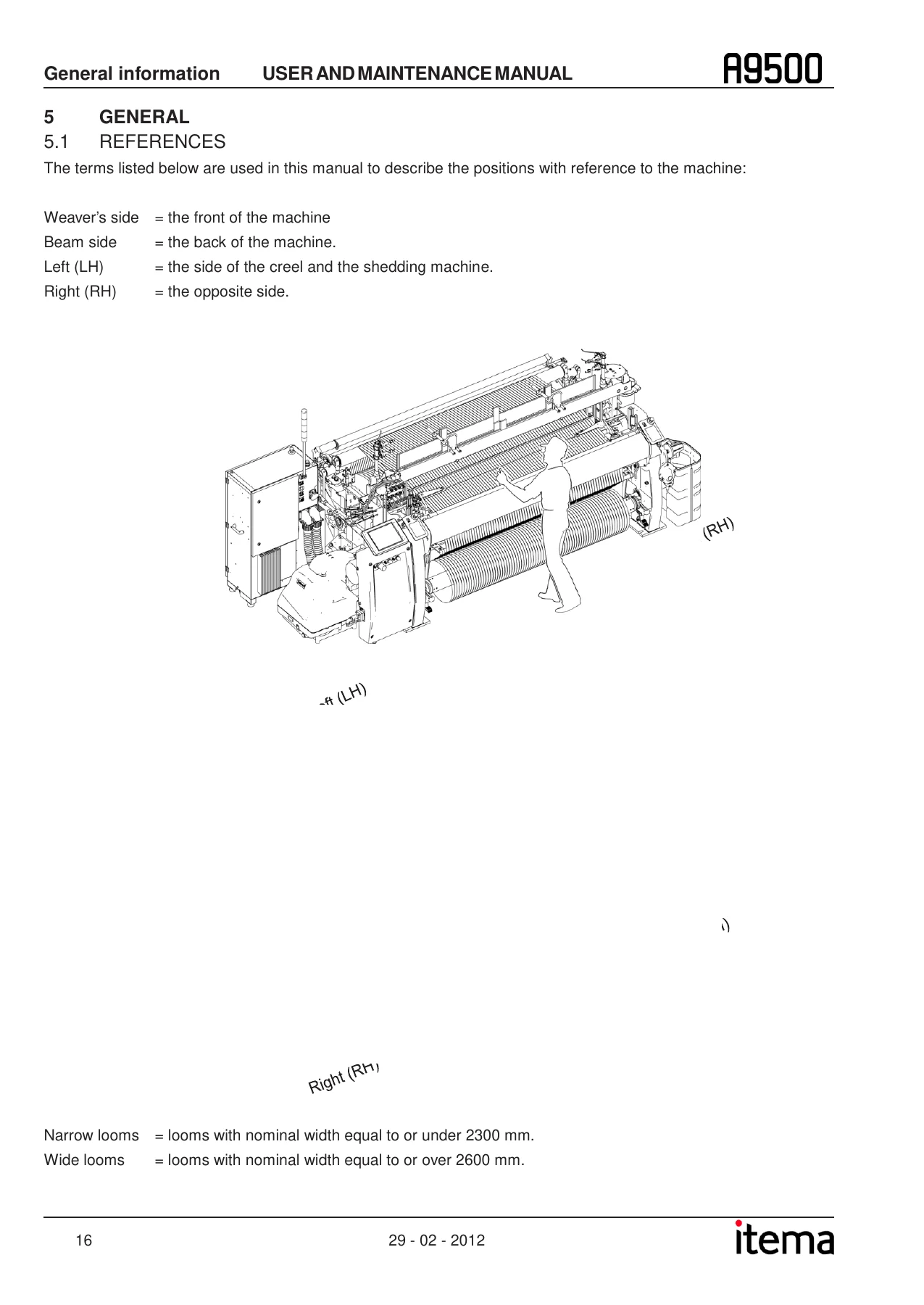
- General Information: symbols, warnings, general rules, technical assistance, references, operator position, manufacturer’s name plate, electrical data plate, disclaimer
- Safety and Accident Prevention Rules: declaration of conformity and CE marking, general safety rules, safety for installation, safety for use, operator health, fire risk, safety for maintenance, safety devices, safety checks, noise exposure rules, vibration reduction, decommissioning and scrapping
- Section 1 – General Layout and Technical Characteristics: main components, machine type, machine versions, nominal widths, motor drives, shedding machines, colour selection, beam type, overall dimensions, electrical connection position, installation layout, electrical characteristics, installed power, absorbed power, power factor, surge current, protections, auxiliary sockets, pneumatic features, air measurement, air consumption, machine air system, air system layout, air conditioning advice, optimal humidity and temperature conditions
- Section 2 – Transport and Installation: preliminary operations before starting up, sequence of operations to start up, flooring preparation, floor paving, slab floor, hoisting and transport, unloading from container, hoisting from above, hoisting and transport using trolleys, unloading the switchboard, removal of anti-rust protection, levelling, looms with beams fitted with 1000 or 1100 diameter flanges, electrical connection, manual movement of the machine, pneumatic connection, encoder and graduated disk
- Section 3 – Preparation for Start Up: warp beam, simple beams, diagram for mounting simple beams, positioning of flanges, reduction from right-hand side, symmetrical reduction from both sides, cloth roller beams, safety regulations for transporting, loading and unloading beams, simple beam assembly, SBM beam version, standard beam version, mounting beams on warping machines, heald frames and healds, dimensions of heald frames, healds, reed, features, calculating total reed width and threading up, reed cleaning, selvedges and waste selvedges, leno device selvedges, tucked-in selvedges, waste selvedges feed
- Section 4 – Mechanical and Textile Adjustments: fabric support, standard supply, cut fabric support, telescopic fabric support, fastening the reed, mounting and positioning auxiliary nozzles, temples, positioning, adjustment, lateral scissors, blade preloading adjustment, blade opening adjustment, lengthwise and depth adjustment, main nozzle and tandem nozzle group, nozzles, tandem nozzles, use of nozzles and pre-nozzles, photocells and straightener nozzle group, photocells, straightener nozzle group, working with full width reed, weft stretching nozzle, positioning bending beam photocells, ITN stretching nozzle, fastening photocell cables, air inlet, F.A.R. device, F.A.R. for full reed width, weaving with waste selvedge, selvedge conveyor, selvedges, selvedge binding, leno device ELD SPLITZ, back roller, adjusting back roller inclination, horizontal adjustment, vertical adjustment, spring position, adjusting springs, timing of driven back roller, load cell adjustment, shed size, adjusting levers for Staubli cam motions, adjusting levers for Staubli dobbies, adjusting head frame tie-rods, default setting for dobby, machines with tappet motion with levelling, machines with tappet motion without levelling, shed closing adjustment, calibrating launch nozzles and pre-nozzles, pneumatic adjustments, calibrating pressures, continuous blow, weft threading up blow, auxiliary nozzle pressure, straightener nozzle adjustment pressure, nozzle blow pressure of tuck-in devices, adjusting F.A.R. flow rate, weft density, calculating cloth speed, production speed, winding of the fabric, stretching bar, upper fabric pressing cylinder, fabric roll cylinder, warp stop motion, warp stop motion with drop wires, height of oval bars, height of warp stop motion rows
- Section 5 – Lubrication: general, supply conditions, oil lubrication systems, lubrication system and control device, minimum pressure switch, maximum pressure switch, pump motor, replacing filters, checking lubricant level, replacing lubricant, types of lubricant, symbols used, units to be filled with lubricating oil, pressure lubrication circuit tank, fabric regulator and let-off units, grease lubrication, tie-rods lubrication
- Section 6 – Maintenance: regular checks (preventive maintenance), daily checks, weekly checks, monthly checks, six-monthly checks, yearly checks
- Section 7 – Appendix: using the flowmeter, connection, reading the flowmeter, sharpener for weft cut blades, adjustment sheet, screw tightening torques
This A9500 manual is organised as a complete technical reference for the air jet weaving machine. It begins with safety and accident prevention rules, then moves through transport, installation, levelling, electrical and pneumatic connection, and encoder synchronisation. The preparation section covers warp beams, heald frames, reeds, selvedges, and waste selvedges. The mechanical and textile adjustments section is especially detailed, covering fabric support positioning, temples, lateral scissors, main and tandem nozzles, pre-nozzles, photocells, straightener nozzle groups, F.A.R. device, back roller settings, shed size, head frame tie-rods, shed closing, nozzle calibration, pneumatic pressures, weft density, fabric winding, and warp stop motion. Lubrication and preventive maintenance chapters give oil types, grease points, filter replacement, and daily through yearly check schedules. The appendix provides a flowmeter guide, blade sharpener instructions, adjustment sheets, and screw tightening torques.
Key Procedures and Systems Covered
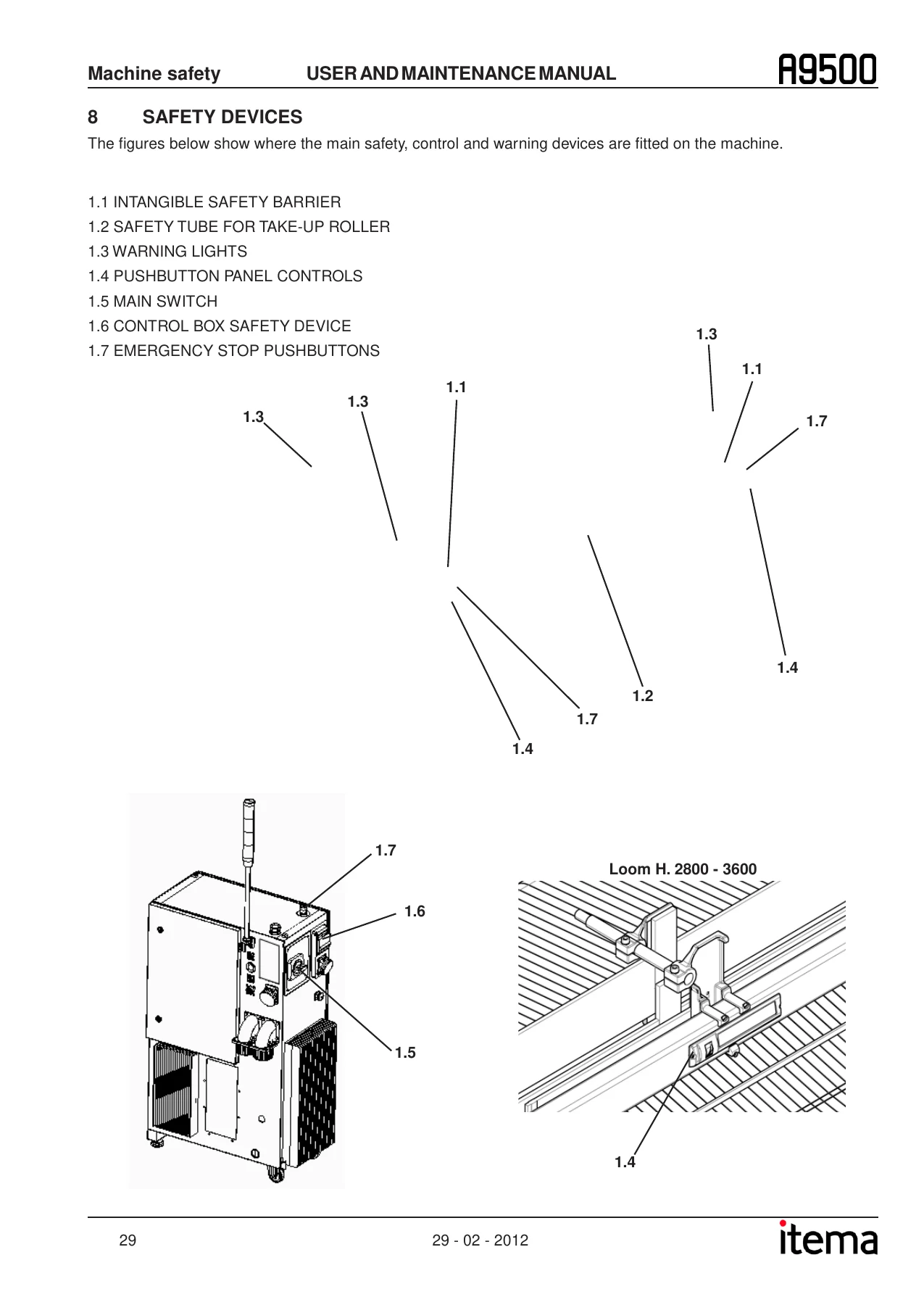
- Safety devices: intangible safety barrier, photoelectric cell device, safety tube for take-up roller, control box safety device, main switch, emergency stop pushbuttons, pushbutton panel controls, warning lights
- Machine start-up and operation: fast speed, slow motion (jogging), manual forward/backward pick-finding, light signal of starting movement, function buttons F1-F2, automatic backward repositioning and pick-finding, normal stop, emergency stop
- Mechanical adjustments: back roller inclination, horizontal and vertical adjustment, spring position and adjustment, timing of driven back roller, load cell adjustment, shed size, Staubli cam motion and dobby lever adjustment, head frame tie-rod adjustment, shed closing
- Pneumatic adjustments: calibrating launch nozzles and pre-nozzles, continuous blow, weft threading up blow, auxiliary nozzle pressure, straightener nozzle pressure, tuck-in device nozzle blow, F.A.R. flow rate
- Weft and fabric control: weft density ranges, cloth speed calculation, production speed, winding of the fabric, stretching bar, upper fabric pressing cylinder, fabric roll cylinder, warp stop motion with drop wires, oval bar height, row height
- Lubrication and maintenance: pressure circulation lubrication system, minimum and maximum pressure switches, pump motor, filter replacement, oil level checks, oil types, grease lubrication points, daily/weekly/monthly/six-monthly/yearly checks
Why This Manual Matters
Correct setup and maintenance of an A9500 air jet weaving machine directly affect fabric quality, machine uptime, and operator safety. This manual provides the manufacturer’s procedures for levelling, electrical connection, pneumatic connection, encoder synchronisation, nozzle calibration, shed adjustment, and preventive maintenance. It also includes safety rules, residual risk warnings, noise exposure information, and fire risk guidance. Having the correct document code 120710009 manual on hand helps you avoid guesswork when adjusting the back roller, setting the shed closing, calibrating launch nozzles, or troubleshooting weft and warp stops.
Delivery
IMAGES PREVIEW
This ITEMA A9500 Air Jet Weaving Machine Use and Maintenance Manual is delivered as an instant PDF download after payment. There is no shipping, no waiting for a physical book, and no customs delay. You can view it on any device, print the pages you need for the workshop floor, and keep the complete manual stored for future reference. The PDF format makes it easy to search for specific chapters, print adjustment sheets, and share relevant sections with maintenance staff. With 216 pages of English instructions, this is a practical reference for anyone responsible for the operation, repair, or maintenance of the A9500 air jet weaving machine.
Reviews
There are no reviews yet.