
John Deere 3800 Telescopic Handler Operator’s Manual OMZ93152 F1
Original price was: $22.95.$13.95Current price is: $13.95.
English operator’s manual OMZ93152 F1 for the John Deere 3800 telescopic handler, covering safe operation, boom and attachment use, daily checks, lubrication intervals, fluids, capacities, and machine specifications.
Description
John Deere 3800 Telescopic Handler Operator’s Manual OMZ93152 F1
This English operator’s manual is written for the 3800 Telescopic Handler built by John Deere Werke Zweibrücken. Publication OMZ93152 F1 (ENGLISCH) is the European-version handbook that stays with the machine and explains how to start, drive, lift, attach implements, service, and store the handler. Copyright is 2001. Use is limited to customary agricultural or similar work as stated in the foreword.
File Details
- Manual type: Operator’s Manual
- Brand / model: John Deere 3800 Telescopic Handler
- Language: English
- Page count: 196
- File format: PDF
- Document number: OMZ93152 F1 (ENGLISCH)
- Manufacturer: John Deere Werke Zweibrücken — European Version, printed in U.S.A.
Who This Handbook Is For
The John Deere 3800 Telescopic Handler Operator’s Manual OMZ93152 F1 is aimed at the person in the seat and the owner who will keep the machine on schedule. It is not a shop overhaul book. It does give the checks, fluid specs, interval tables, boom safety devices, load-monitor test, attachment hook-up steps, and troubleshooting charts needed to run the 3800 without guessing.
Two transmission layouts appear throughout: Synchro-Shuttle (4 forward and reverse gears, mechanically actuated) and PowerShift (5 forward and 3 reverse gears, electro-hydraulically actuated). Both are covered so operators can follow the shift, declutch, and parking steps that match the unit on their handler.
Machine Identity and Intended Use
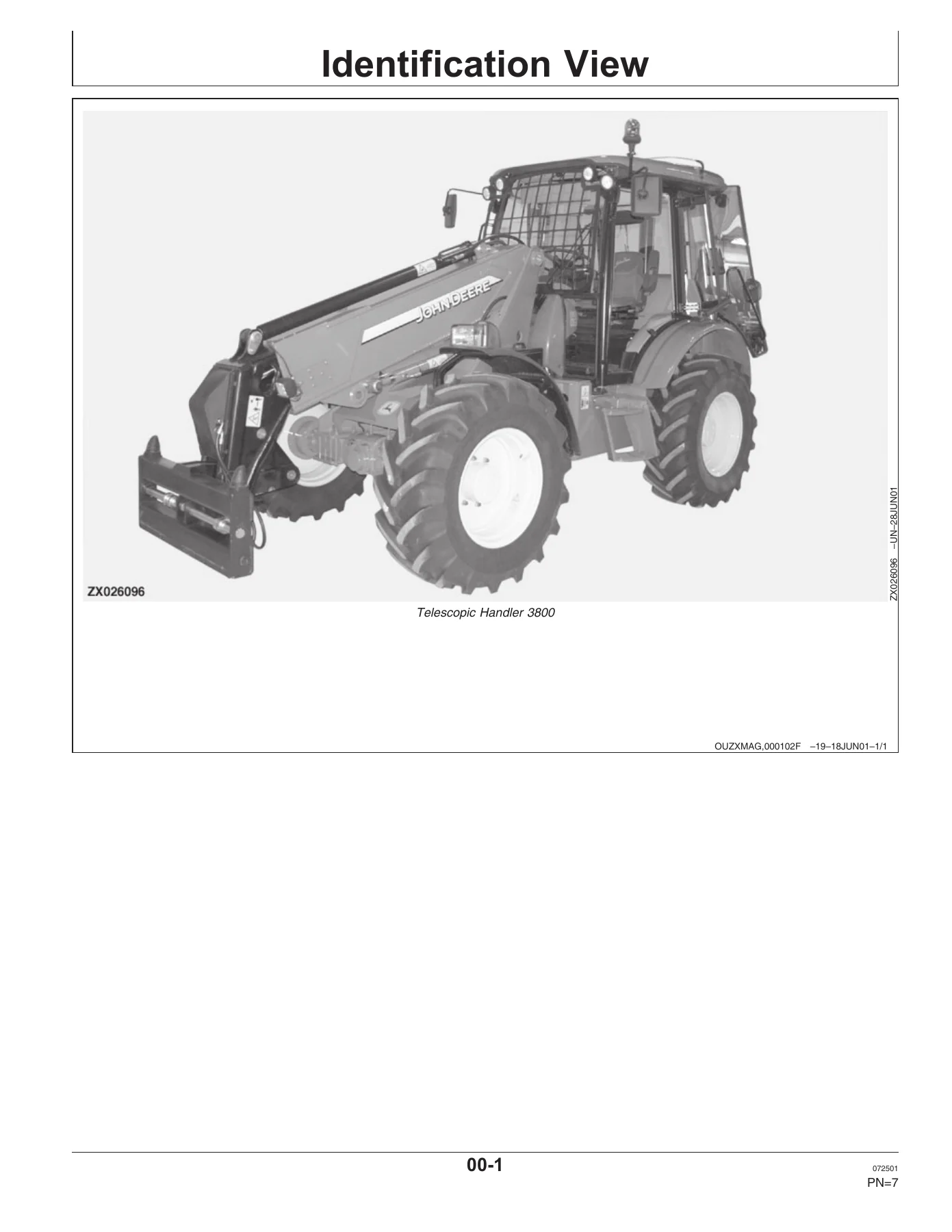
The identification view shows the complete 3800 with cab, telescopic boom, and John Deere carrier. Type plates and serial locations are listed for the handler, product identification number, front and rear axles, engine, transmission, and torque converter. The declaration of conformity names model 3800 and cites 98/37/EEC, 89/336/EEC, and EN1459.
The engine listed in specifications is type 4045HZQ50: 4 cylinders, 106.5 mm (4.19 in.) bore, 127 mm (5 in.) stroke, 4.5 L (276 cu.in.) displacement, 80.9 kW (110 hp) ECE-R24 at rated speed with fan, 454 Nm (334 lb-ft) maximum torque at 1400 rpm, rated speed 2200 rpm.
Safety, Cab, and Controls
Opening chapters walk through the safety-alert symbol, DANGER / WARNING / CAUTION wording, and pictorial decals for raised boom, lift cylinder lock, fan, exhaust heat, wheel nuts, hydraulic accumulator, and crush zones at the pivot. Operating rules cover people under a raised boom, runaway starts, overhead power lines, digging near buried services, round-bale handling, public-road driving, ROPS, high-pressure fluid, batteries, and tire mounting.
Controls and instruments are mapped on the armrest, roof console, and corner post: multi-function lever, indicator lights, coolant and fuel gauges, speedometer / hour meter, forward stability indicator (load monitor), start switch, Synchro-Shuttle gear lever, PowerShift gear switch, FNR lever, and lighting. Cab equipment includes ROPS, FOPS, seat-belt use, deluxe and super-deluxe air-suspension seats, parking brake, steering-wheel tilt, wipers, heater, optional air conditioning, and trailer socket.
Operating the Handler and Boom
Engine starting covers the battery main switch, slave-battery and booster-battery methods, the electrical starting aid, and the ban on ether when that aid is used. Driving chapters explain public-road lighting, reverse travel alarm, transport on a flatbed, towing limits of 8 km/h (5 mph) after drive shafts are removed, and parking with chock blocks.
Boom work is treated as a stability problem, not just a lever sequence. The manual states lift limits, how to test the forward stability indicator, overload examples, the boom lift-cylinder safety channel, approach / pick / place steps, unpalletized loads, pile work, digging, and round-bale pickup on level ground and on a slope. Travel is to be done with the boom fully retracted and low. Attachments include pallet forks on the John Deere carrier, auxiliary hydraulics front and rear, hose unions, mechanical rear hitch, and the optional semi-automatic wagon hitch.
Service Intervals, Fluids, and Capacities
Lubrication is scheduled from daily / 10 hours through 50, 100, 250, 500, 750, 1000 / 1 year, 2000 / 2 years, and 3000 / 3 years. Daily work includes engine, hydraulic, and transmission oil levels, coolant, lights, and John Deere carrier pivots. Fifty-hour service greases fittings and checks axle oil and the parking brake. Five-hundred-hour work changes engine oil and crankcase filter, fuel filter, transmission and hydraulic filters, and greases boom-extension wear pads.
Capacities printed in the book: fuel tank 180 liters (48 U.S. gal); cooling system 19 liters (5 U.S. gal); crankcase with filter 12.5 liters (3.3 U.S. gal); PowerShift transmission 12.5 liters (3.3 U.S. gal); Synchro-Shuttle transmission 18.5 liters (4.9 U.S. gal); hydraulic system 106 liters (28 U.S. gal); axle differential 15 liters (4 U.S. gal); final drive 0.8 liters (0.21 U.S. gal). Preferred oils after break-in are John Deere PLUS-50 or TORQ-GARD SUPREME for the engine and HY-GARD / Low Viscosity HY-GARD for transmission and hydraulics. Diesel should meet EN 590 or ASTM D975.
Chapters Covered
- Identification View
- Safety — recognize safety information, protect people and animals, prevent runaway, power lines, digging, round bales, public roads, ROPS, high-pressure fluids, batteries, tires
- Safety Decals — operator’s manual, maintenance, raised boom, lift cylinder, fan, exhaust, wheel nuts, accumulator, pivoting area
- Controls and Instruments — armrest, roof console, multi-function lever, gauges, load monitor, gear levers, mirrors
- Lighting System and Signals — standard and optional lights, hazard and turn signals, work and boom lights, reverse alarm, seven-terminal trailer socket
- Operator’s Platform and Cab — ROPS / FOPS, doors, seats, parking brake, wipers, heater, optional A/C
- Break-In Period — first 4 and 8 hours, first 100 hours, after 100 hours
- Prestarting Checks — daily oil, coolant, tires, fuel, lubrication, cab checks
- Operating the Engine — starting rules, battery switch, slave and booster batteries, cold-weather aid, warm-up, stopping, stalling
- Driving and Transporting — public roads, reverse alarm, transport, parking, chock block
- Operating the Machine — fuel use, Synchro-Shuttle and PowerShift shifting, hydraulic foot brakes, transmission declutch
- Operating the Boom — lift limits, load monitor and test, overload examples, safety channel, picking and placing loads, bales, digging
- Operating Attachments — pallet forks, John Deere carrier, auxiliary hydraulics, hitches, tipping a trailer
- Fuel, Lubricants, Coolant and Capacities
- Lubrication and Periodic Service — intervals, hood, fuses, battery, alternator notes
- Service at 10 / 50 / 250 / 500 / 750 / 1000 / 2000 / 3000 hours and as required
- Troubleshooting — hydraulic system, engine, electrical system
- Storage — long-period storage and return to service
- Specifications — engine, transmissions, hydraulics, electrics, dimensions, lift chart, tire pressures, declaration of conformity
- Serial Numbers — type plates and component serial locations
IMAGES PREVIEW
Taken together, those sections give an operator the sequence for a cold start, a loaded travel move, a pallet or bale lift that stays inside the printed capacity, and a service day that matches the hour meter. Hydraulic troubleshooting, engine smoke and knock charts, and fuse / relay identification sit at the back for first-line diagnosis before a dealer visit.
Printed Ratings That Matter on the Job
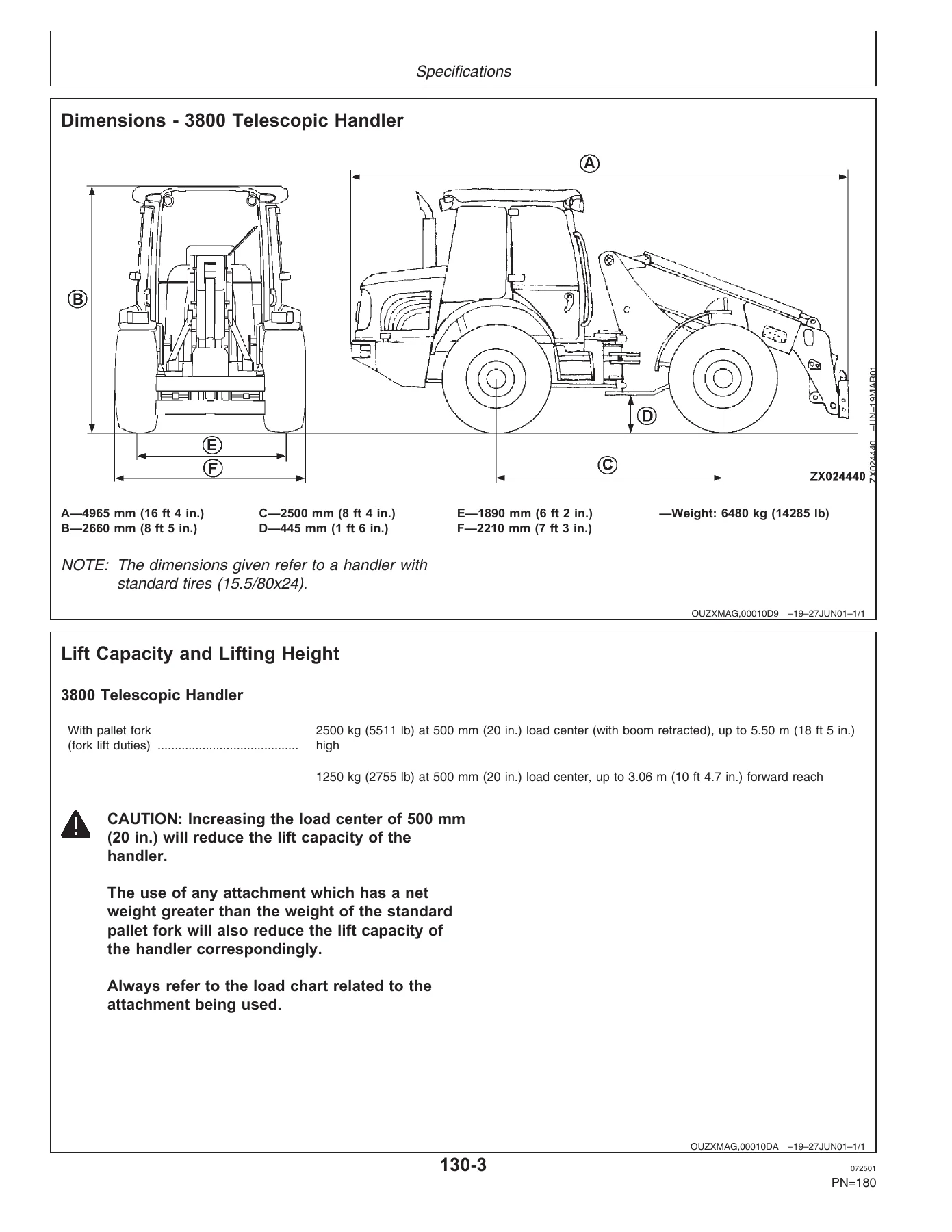
With standard 15.5/80-24 tires the handbook lists overall length 4965 mm (16 ft 4 in.), height 2660 mm (8 ft 5 in.), wheelbase 2500 mm (8 ft 4 in.), and weight 6480 kg (14285 lb). Fork-lift duty is given as 2500 kg (5511 lb) at 500 mm (20 in.) load center with the boom retracted, up to 5.50 m (18 ft 5 in.) high, and 1250 kg (2755 lb) at the same load center out to 3.06 m (10 ft 4.7 in.) forward reach. Hydraulics are open-center with load-sensing control, gear pump 99 l/min (21.8 U.S. gal/min), system pressure 22500 kPa (225 bar; 3263 psi). Electrical system is 12 V, 154 Ah battery, 14 V 95 A alternator, 12 V 3.0 kW starter. Maximum travel speed is 40 km/h (24.8 mph) on either transmission. Cab sound level is 73 dB(A) closed and 76 dB(A) open.
Use the John Deere 3800 Telescopic Handler Operator’s Manual OMZ93152 F1 on the Machine
Keep this copy with the handler so prestart checks, boom lock-out, load-monitor tests, fluid grades, filter intervals, and parking steps match the printed procedure instead of memory. Correct capacities and tire pressures protect stability and driveline life; the lift figures and load-monitor test reduce the chance of an overload on the 3800 boom. After payment you receive the PDF immediately — no shipping wait — and you can open it on a phone, tablet, or shop computer and print the pages you need in the cab or on the bench.
Reviews
There are no reviews yet.