
Land Rover Range Rover Velar 2020 Engine Controls Diagnosis & Testing Manual – Ingenium I4 2.0L Petrol
Original price was: $39.95.$23.95Current price is: $23.95.
Workshop diagnosis and testing manual for the 2020 Range Rover Velar (LY) Electronic Engine Controls, section 303-14B, covering the Ingenium I4 2.0L Petrol engine. Includes full symptom chart, Powertrain Control Module DTC index P0611-02 to U2300-64, component descriptions, test procedures and torque specifications. 452-page English PDF.
Description
Land Rover Range Rover Velar 2020 Engine Controls Diagnosis & Testing Manual – Ingenium I4 2.0L Petrol
The Land Rover Range Rover Velar 2020 Engine Controls Diagnosis & Testing Manual is the workshop reference for section 303-14B Electronic Engine Controls on the Ingenium I4 2.0L Petrol engine fitted to the Range Rover Velar (LY). It gathers the principles of operation, component-by-component descriptions, a symptom-driven diagnostic chart, the full Powertrain Control Module DTC index from P0611-02 to U2300-64, dedicated test procedures and the torque and capacity specifications needed to put an engine management fault right the first time. If you are diagnosing a Velar that will not crank, will not start, misfires, stalls, hesitates, loses power or logs a fault code, this manual is the reference you want open on the bench.
File Details
- Manual type: Diagnosis and Testing workshop manual
- Brand: Land Rover
- Model: Range Rover Velar (LY)
- Model year: 2020.0
- Section: 303-14B Electronic Engine Controls – Ingenium I4 2.0L Petrol
- Language: English
- File format: PDF
- Page count: 452 pages
- Latest publication date shown: 28-FEB-2024
- Document references: G1998393, G2116765 and associated procedure references
Chapters and Systems Covered
- Principles of Operation
- Inspection and Verification – visual inspection, system integrity checks, symptom verification, campaign checks
- Symptom Chart – engine does not crank; engine cranks but does not start; engine cranks and fires but will not start; engine difficult to start (cold engine); engine difficult to start (warm / hot engine); engine difficult to start after hot soak; engine cranks too slowly; engine cranks too fast; engine stalls soon after start; engine stalls on overrun; engine stalls at steady speed; engine stalls with speed control enabled; engine stalls when manoeuvring; engine hesitates / poor acceleration; engine backfires; engine surges; engine detonates / knocks; no throttle response; speed control inhibited / disabled; throttle response poor; malfunction indicator lamp illuminated; poor running; engine hunting; hesitation; lack of power; induction noise; engine misfire
- DTC Index – Powertrain Control Module, P0611-02 to U2300-64, with description, possible causes and prioritized checks
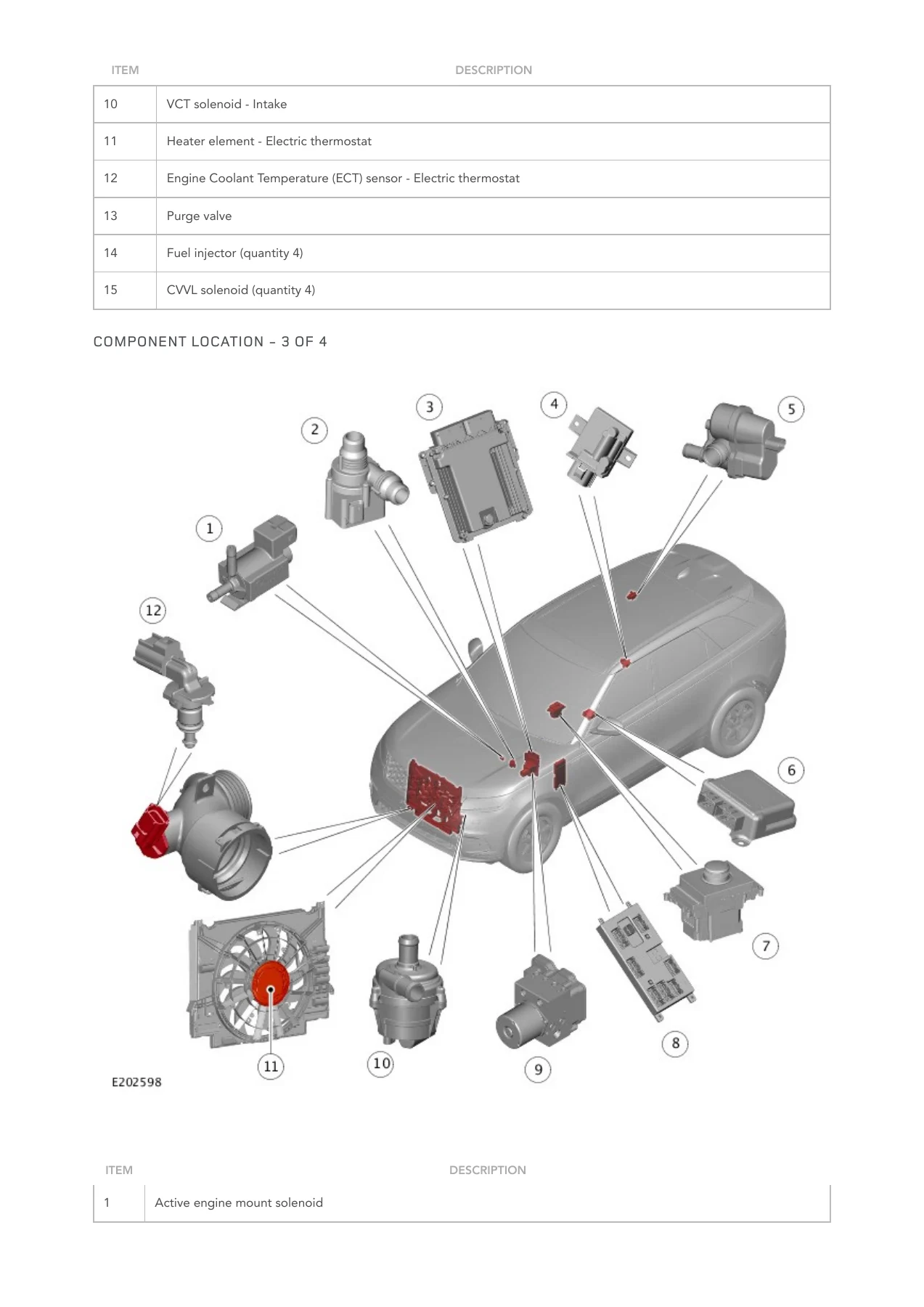
- Component Location – four illustrated views across the engine bay, vehicle and driveline
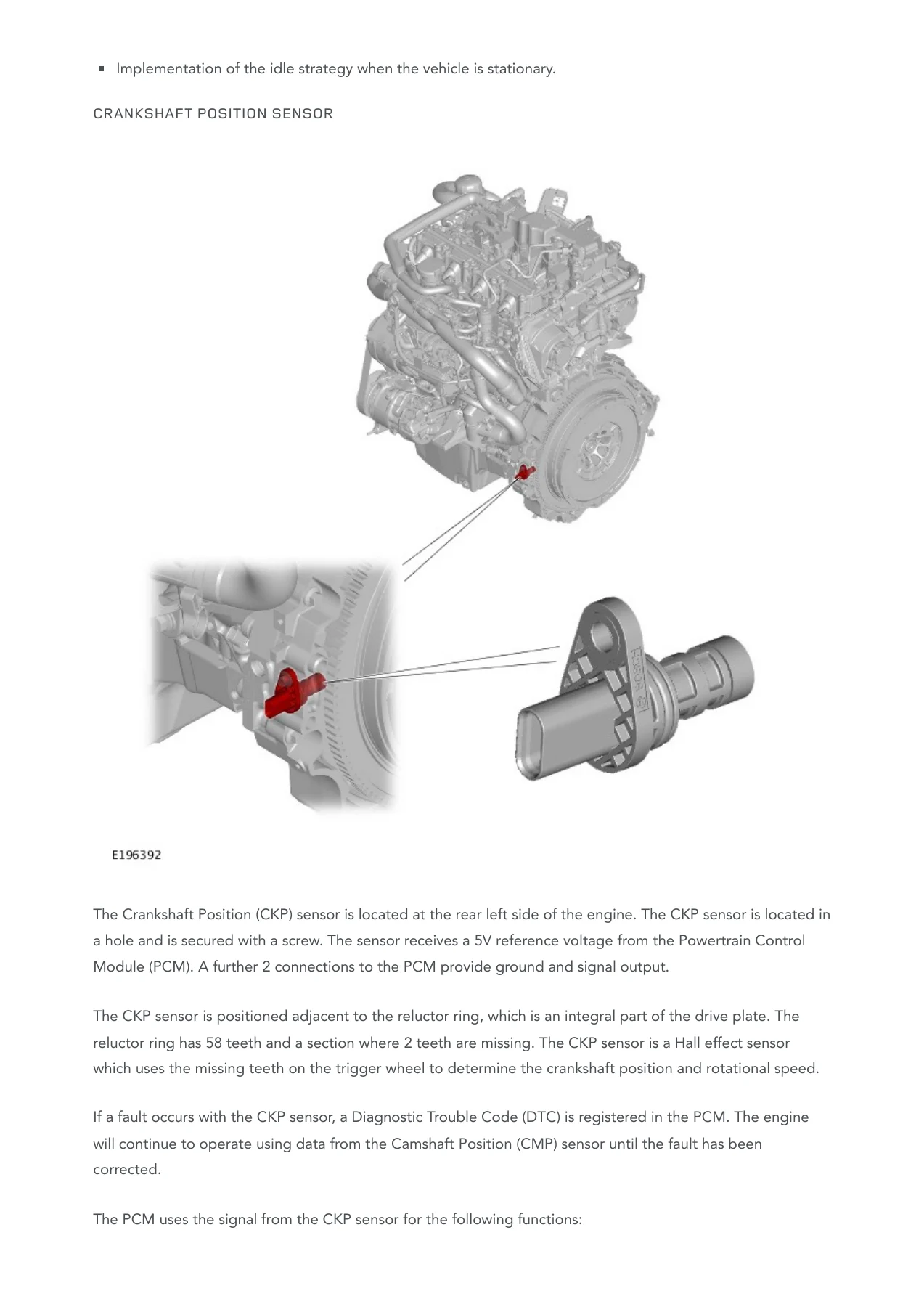
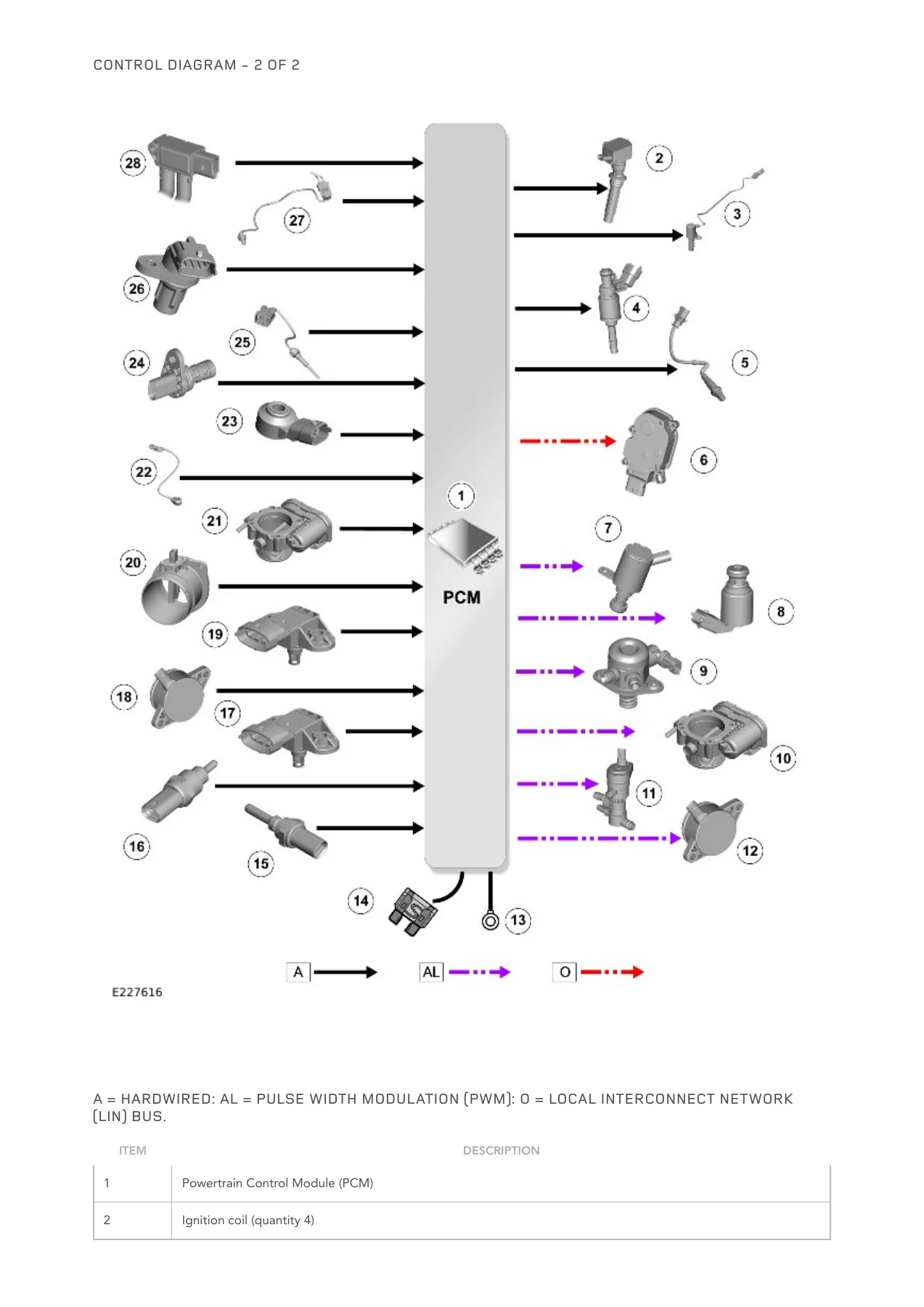
- Description and Operation – Powertrain Control Module (PCM), crankshaft position sensor, camshaft position sensors (quantity 2), mass air flow and temperature sensor, manifold absolute pressure and temperature sensor, cylinder head temperature sensor, cylinder block temperature sensor, front and rear knock sensors, electric throttle, variable camshaft timing solenoids (intake and exhaust), oil pressure and temperature sensor, oil pump control solenoid, piston cooling oil jets solenoid, high pressure fuel pump, fuel rail pressure and temperature sensor, ignition coils (quantity 4), fuel injectors (quantity 4), purge valve, fuel pump driver module, low pressure fuel system fuel pressure sensor, diagnostic module tank leakage pump, heated oxygen sensors (pre, mid and post catalyst), exhaust back-pressure sensor, continuous variable valve lift assembly, CVVL assembly oil temperature sensor, variable coolant pump, electric thermostat, electric cooling fan, radiator outlet engine coolant temperature sensor, charge air coolant pump, auxiliary coolant pump, turbocharger wastegate actuator, compressor recirculation valve, active engine mount solenoid, active grille air shutter, ambient air temperature sensor, accelerator pedal position sensor, brake pedal switch, transmission control module, transmission control switch, ABS control module, restraints control module, body control module / gateway module
- Operation – PCM adaptions, gasoline particulate filter, diagnostic data and freeze frame information
- Cylinder Compression Test – dry and wet test procedures with recorded values per cylinder
- Starter Motor Testing – bench test procedure with expected pinion and rotation results
- Continuous Variable Valve Lift – removal and installation with special tools
- Turbocharger – diagnosis and testing, turbine bypass actuator lubrication, removal and installation
- Intake Air Resonator – removal and installation
- Cooling System Draining and Vacuum Filling
- Engine Cover – removal and installation
- Jacking and Lifting – vehicle recovery methods
- Specifications – torque specifications, capacities, general engine specification
Read together, those chapters turn a raw fault code or a driver complaint into a structured diagnostic path: which sensor feeds which signal to the PCM, how the PCM drives each actuator, what the symptom chart flags as the likely cause, and which pinpoint checks to run before any part is replaced. It is the difference between guessing at a component and following the manufacturer’s test sequence.
What This Manual Lets You Diagnose and Repair
This Range Rover Velar 2020 engine controls diagnosis and testing manual supports the full range of electronic engine control work on the Ingenium I4 2.0L Petrol. Starting with the symptom chart, you can chase a no-crank condition through battery and charging checks, smart key recognition, starter relay and starter motor circuits, transmission control switch position and CAN bus authorisation from the telematics control module. Cranking but not starting is separated from cranking, firing and then cutting out, so you can narrow fuel, ignition, evaporative emissions and crankcase ventilation checks correctly instead of replacing parts on suspicion.
The DTC index is the other half of the picture. Every code from P0611-02 through U2300-64 lists the electrical or mechanical cause, the circuit reference where one applies, the monitor description, the vehicle conditions that set the code, and the prioritized checks to perform. Fuel injector control faults, starter relay faults, PCM torque calculation codes, fuel pump control codes, throttle actuator codes, camshaft position actuator codes, oxygen sensor codes, fuel pressure regulator codes, ignition coil primary codes, turbocharger wastegate codes, continuous variable valve lift codes, communication bus codes and configuration codes are all covered with the same level of detail. That means a misfire on a Velar is not just diagnosed as a misfire: it is traced back through the ignition system, fuel injectors, air induction, camshaft and crankshaft position sensors, wiring integrity, cylinder compression and the CVVL solenoids before a repair is signed off.
Component descriptions give you the reference material to understand what each sensor and actuator is doing, where it sits on the engine, and how the PCM uses its signal. The crankshaft position sensor and the two camshaft position sensors, the mass air flow and temperature sensor, the manifold absolute pressure and temperature sensor, the cylinder head and cylinder block temperature sensors, the two knock sensors, the electric throttle with its two-track throttle position sensor, the variable camshaft timing solenoids, the oil pressure and temperature sensor, the oil pump control solenoid, the piston cooling oil jets solenoid, the high pressure fuel pump and fuel metering valve, the fuel rail pressure and temperature sensor, the four ignition coils and four fuel injectors, the purge valve, the fuel pump driver module, the low pressure fuel pressure sensor, the diagnostic module tank leakage pump, the pre, mid and post catalyst oxygen sensors, the exhaust back-pressure sensor, the continuous variable valve lift assembly and its oil temperature sensor, the variable coolant pump, the electric thermostat, the electric cooling fan, the radiator outlet engine coolant temperature sensor, the charge air coolant pump, the auxiliary coolant pump, the turbocharger wastegate actuator, the compressor recirculation valve, the active engine mount solenoid, the active grille air shutter, the ambient air temperature sensor, the accelerator pedal position sensor, the brake pedal switch, the transmission control module and switch, the ABS control module, the restraints control module and the body control module / gateway module are each covered in their own right, with the wiring interface and the PCM strategy that governs them.
Why Correct Procedures and Specifications Matter on a Velar
A Range Rover Velar runs a tightly integrated engine management system. The PCM cross-checks the crankshaft and camshaft signals, monitors fuel rail pressure against a map, controls variable camshaft timing and continuous variable valve lift, regulates a variable coolant pump and an electric thermostat, and talks to the transmission, ABS, restraints and gateway modules over FlexRay and CAN buses. A fault in one place can present as a symptom somewhere else entirely, and a repair made without the correct data can trigger new codes on top of the original concern. The pressure and cleanliness warnings for the high pressure fuel system, the diagnostic note that control modules cannot be substituted from a donor vehicle, and the sequence-based procedures for the CVVL and turbocharger all exist for a reason. Following them protects the vehicle, the components and your time.
IMAGES PREVIEW
Instant PDF Delivery, Ready When You Are
The Land Rover Range Rover Velar 2020 Engine Controls Diagnosis & Testing Manual – Ingenium I4 2.0L Petrol is delivered instantly as a PDF download after checkout. No shipping, no waiting for a parcel, no restrictions on which device you read it on. Open it on a laptop in the workshop, a tablet on the lift, or a phone beside the vehicle, and print whichever pages you need for the job in front of you. Whether you are an independent workshop taking on a Velar for the first time or an owner who wants to understand what the fault codes really mean, this manual puts the manufacturer’s diagnostic information at your fingertips the moment you need it.
Reviews
There are no reviews yet.